


Over 70% of intraday traders in India lose money.

Rajesh Sharma
Senior Forex Analyst ·  India
India
☕ 13 min read
What you'll learn:
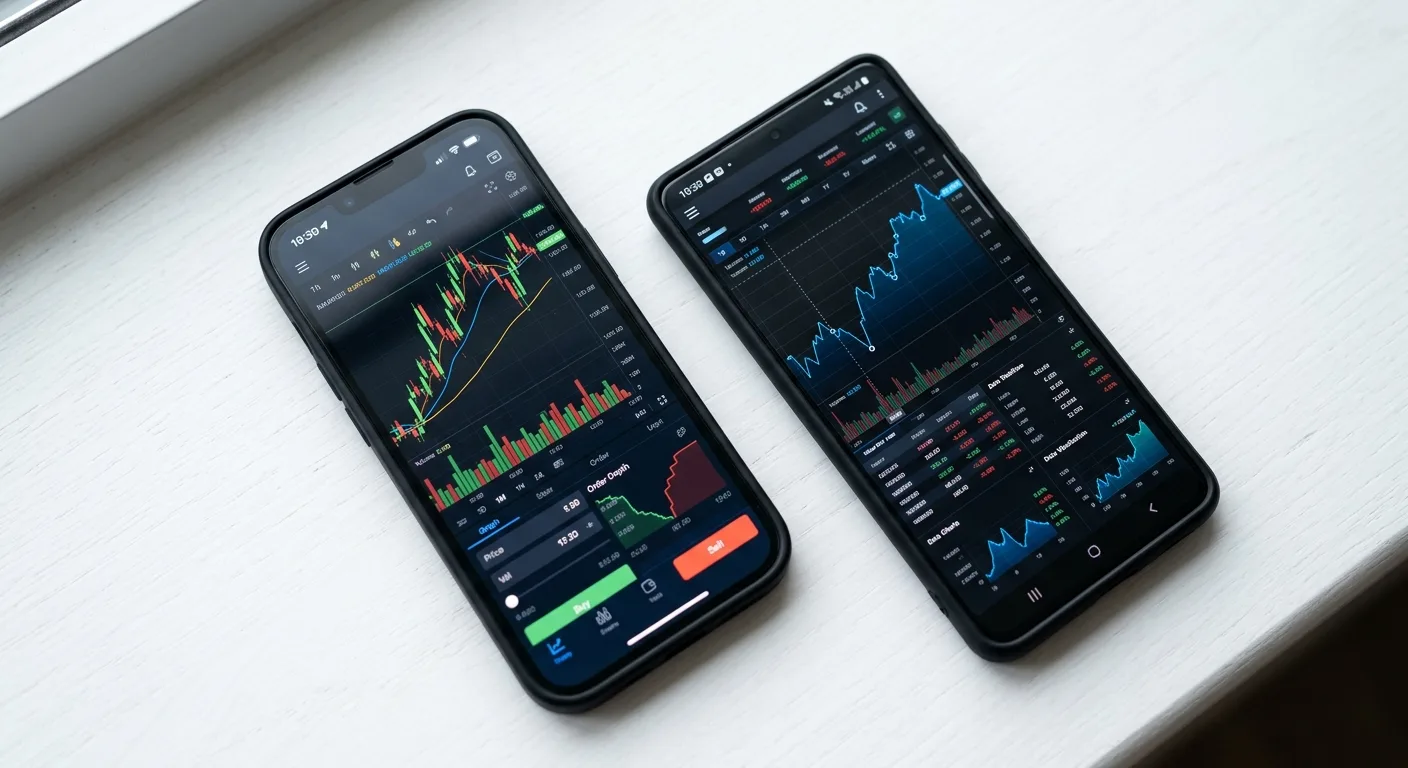
Over 70% of intraday traders in India lose money. SEBI's own study from 2024 confirmed it. The brutal truth is, most people are using indicators wrong. They clutter their charts, chase signals, and get wiped out by costs before 3:30 PM. I was one of them for a long time. This isn't about finding a magic formula. It's about learning which technical indicators for intraday trading can give you an edge in the Nifty or Bank Nifty, and more importantly, how to use them within India's specific rules. Let's talk about what I've found actually works, after 12 years and plenty of blown-up accounts.
Before we look at a single chart, you need to understand the battlefield. Intraday trading in India isn't a free-for-all. It's a tightly regulated sprint from 9:15 AM to 3:30 PM, with SEBI watching every move.
The biggest killer isn't a bad trade. It's the death by a thousand cuts from costs. Let's break down a ₹1 lakh intraday trade on a stock. You pay brokerage (say, ₹20 flat), STT (0.025% on sell value = ₹25), SEBI fee (₹0.20), exchange charge (about ₹3), GST on fees (another ₹4-5), and stamp duty (₹3 on buy). That's around ₹55-60 gone before you even make a rupee in profit. On a ₹1 lakh trade, you need a 0.06% move just to break even. Do that a few times a day, and your profits evaporate.
Then there's the 20% peak margin rule. For a ₹50,000 position, you need ₹10,000 blocked. It limits your use to 5x, which SEBI did for a good reason: to protect us from ourselves. The old 10x or 20x use was a one-way ticket to a margin call.
And remember, you can't use today's intraday profits to trade again tomorrow. SEBI's 2026 rule says you wait two days. Your capital is finite. This changes everything about how you manage risk and position size. You can't just "average down" recklessly. I learned this the hard way in 2022, turning a ₹5,000 loss on a Bank Nifty trade into a ₹22,000 disaster because I kept adding, thinking the market owed me a reversal. It didn't. I blew my daily loss limit and sat out for a week.

Warning: Your trading platform will likely auto-square off your positions around 3:20 PM. If you're not out by then, they'll force-close you, often at terrible prices. Never rely on holding till the last minute.
“Over 70% of intraday traders in India lose money. The brutal truth is, most people are using indicators wrong.”
Forget the 20-indicator screenshots you see online. More indicators mean more confusion and conflicting signals. For intraday, you need speed and clarity. I use a three-layer approach: one for trend, one for momentum, and one for dynamic support/resistance.
The Trend Anchor: Exponential Moving Averages (EMAs)
The simple moving average is too slow for intraday. The EMA reacts faster. I keep two on my chart: the 20-period EMA and the 50-period EMA. On a 5-minute or 15-minute chart, these are my north star.
The rule is simple: Price above both EMAs? The short-term trend is up. Look for buy opportunities on pullbacks. Price below both? Trend is down. Look for sell opportunities on rallies. When the price is chopping between them, it's a range-bound market. Step away. Some of my worst trades happened when I tried to force a trend trade in a choppy Nifty session.
The 20-EMA often acts as dynamic support in an uptrend and resistance in a downtrend. A clean bounce off it with volume can be a high-probability entry.
The Momentum Gauge: Relative Strength Index (RSI)
The classic RSI indicator is misunderstood. People see it go above 70 and immediately short, or below 30 and buy. That's a great way to get run over in a strong trend.
My use is different. I look for failure swings and divergence. A failure swing is when RSI makes a new high (above 70) but then fails to reach that high on the next price peak. That's a potential reversal signal. Divergence is even stronger: price makes a higher high, but RSI makes a lower high. That's hidden selling pressure.
I also use the 50 level as a bias line. RSI above 50 suggests bullish momentum under the hood, even if the price is dipping. Below 50 suggests bearish momentum.
The Volatility & Reaction Framework: Bollinger Bands
Bollinger Bands are a volatility channel. The middle line is a 20-period SMA, with two standard deviation bands above and below. In intraday, they tell me two things.
First, when the bands squeeze tight, it means volatility is low. A big move is coming, but I don't know the direction. I wait for the breakout. Second, the bands themselves are not rigid buy/sell signals. In a strong trend, price can ride the upper or lower band for ages. I use touches of the band as potential exhaustion points, but only if confirmed by the RSI or a candle pattern.

Pro Tip: Don't use all three on the same chart pane. Put your EMAs on the main chart, RSI in a sub-window below, and Bollinger Bands on a separate chart for the same instrument. This prevents visual clutter and lets you analyze each signal independently.

💡 Winston's Tip
The 20-period EMA isn't just a line. It's a crowd psychology gauge. In an uptrend, a retest of it represents a collective 'second chance' to buy. Watch the order flow when price touches it.

“Your edge comes from your risk management and discipline, not from a secret indicator.”
Indicators alone are just pretty lines. You need a rule-based setup to turn them into trades. Here are two I use weekly, with real numbers from my journal.
Setup 1: The EMA Pullback (My Bread and Butter)
This is for trending Nifty or stock sessions.
- Trend Confirm: Price must be above the 20 and 50 EMA on the 15-minute chart. Both EMAs should be sloping up.
- Wait for Pullback: Price retraces and touches or comes very close to the 20-period EMA.
- Momentum Check: On the 5-minute chart, the RSI must be above 50. Even better if it dipped to 45-50 and is turning back up.
- Entry: Buy on a bullish candle close above the low of the pullback. Place stop loss just below the recent swing low on the 5-minute chart.
- Exit: Take partial profit at 1:1 risk-reward. Trail the rest with a moving stop, or exit if the 5-minute RSI crosses below 50 again.
Example from last week: I took this on HDFC Bank. 15-min trend was up. It pulled back to ₹1,680 (right at the 20-EMA). 5-min RSI was at 48 and curling up. I entered at ₹1,682. Stop at ₹1,677 (₹5 risk). Took half off at ₹1,687. The rest ran to ₹1,695 before the RSI tipped over. Total gain: ~₹8 on the second lot. Not huge, but clean.
Setup 2: The Bollinger Band Squeeze Breakout
This is for range-bound markets expecting a volatility spike.
- Identify the Squeeze: On a 10-minute chart, the Bollinger Bands are visibly pinched together (width is near its lowest for the day).
- Wait for the Break: Do not anticipate. Wait for a candle to close outside the band.
- Volume & Momentum Confirm: The breakout candle should have higher-than-average volume. The RSI should be moving strongly in the breakout direction (above 60 for a long break, below 40 for a short).
- Entry: Enter on a retest of the middle Bollinger Band (the 20-SMA) after the breakout. Your stop goes on the other side of the band.
- Exit: Aim for a move to the opposite band, or use a trailing stop.
This one requires patience. I missed a great one on Reliance recently because I jumped in before the candle closed. It fake broke, reversed, and took out my stop. Lesson re-learned: wait for the close.
These setups work because they combine trend, momentum, and structure. They force discipline. For more aggressive styles, you can adapt these principles for scalping on lower timeframes.
💡 Winston's Tip
RSI divergence is more reliable on the 15-minute chart than the 5-minute. The lower timeframe gets too many false divergences. Always zoom out one notch to confirm.
“Your edge comes from your risk management and discipline, not from a secret indicator.”
Not all indicators are created equal for the Indian intraday grind. Some are too slow, some are redundant, and some will actively mislead you.
The Lagging Brigade:
- Standard MACD: The classic MACD indicator is fantastic for swing trading trends over days. But for intraday? It's painfully slow. By the time the MACD line crosses the signal line, the move is often half over. I've been whipsawed too many times. There are faster versions (like the MACD histogram), but even then, I find RSI gives me a quicker read on momentum.
- Slow Stochastic: Same story. It's smoothed and laggy. In a fast market, it will keep you in overbought/oversold territory for too long.
The Redundant Crowd: Do you really need both RSI and Stochastic? They both measure momentum. Pick one and learn it deeply. I see traders with RSI, Stochastic, Williams %R, and CCI all on the same screen. They're all saying roughly the same thing with different math. When they conflict, you're paralyzed.
The "Magic Bullet" Traps: Avoid any indicator that claims to predict tops and bottoms with 100% accuracy, especially those sold as expensive "systems." If it worked, everyone would use it and it would stop working. The market is a dynamic puzzle. I wasted over ₹50,000 in my early years on various "guaranteed" signal software. The only thing guaranteed was my losses.
Stick to the classics that have stood the test of time across global markets. Their value isn't in prediction, but in providing a structured framework to assess probability. Your edge comes from your risk management and discipline, not from a secret indicator.
“Price can lie. Volume doesn't. A breakout on low volume is a fakeout waiting to happen.”
This is the single most important lesson I can give you about technical indicators for intraday trading. Price can lie. Volume doesn't.
A breakout on low volume is a fakeout. A pullback on declining volume is likely just a pause in the trend. A spike in volume at a key level tells you where the big money is acting.
I don't use complex volume indicators like OBV for intraday. I just look at the volume bars on my candlestick chart. Here's my checklist:
- Breakout Confirm: Is the volume on the breakout candle higher than the last 5-10 candles? If not, be suspicious.
- Trend Health: In an uptrend, up candles should generally have higher volume than down candles. The opposite for downtrends.
- Exhaustion Signal: A very long-range candle (a big move) on absolutely massive volume can signal a climax move. It might be the end of that leg. I often look to take profits here.
I got caught in a false breakdown in Tata Motors last month. Price broke below a key ₹950 support. My indicators said short. But I glanced at the volume. It was pathetic, the lowest of the morning. I hesitated. Sure enough, 10 minutes later, it spiked back up on huge volume, trapping all the shorts. That one glance saved me a 1.5% loss. Always, always check the volume.

Example: You see Nifty break above 22,500. Your EMA is aligned, RSI is strong at 65. But the volume bar is tiny, half the size of the last hour's average. This is a warning. Consider a smaller position, a tighter stop, or just skip the trade. Wait for volume confirmation.

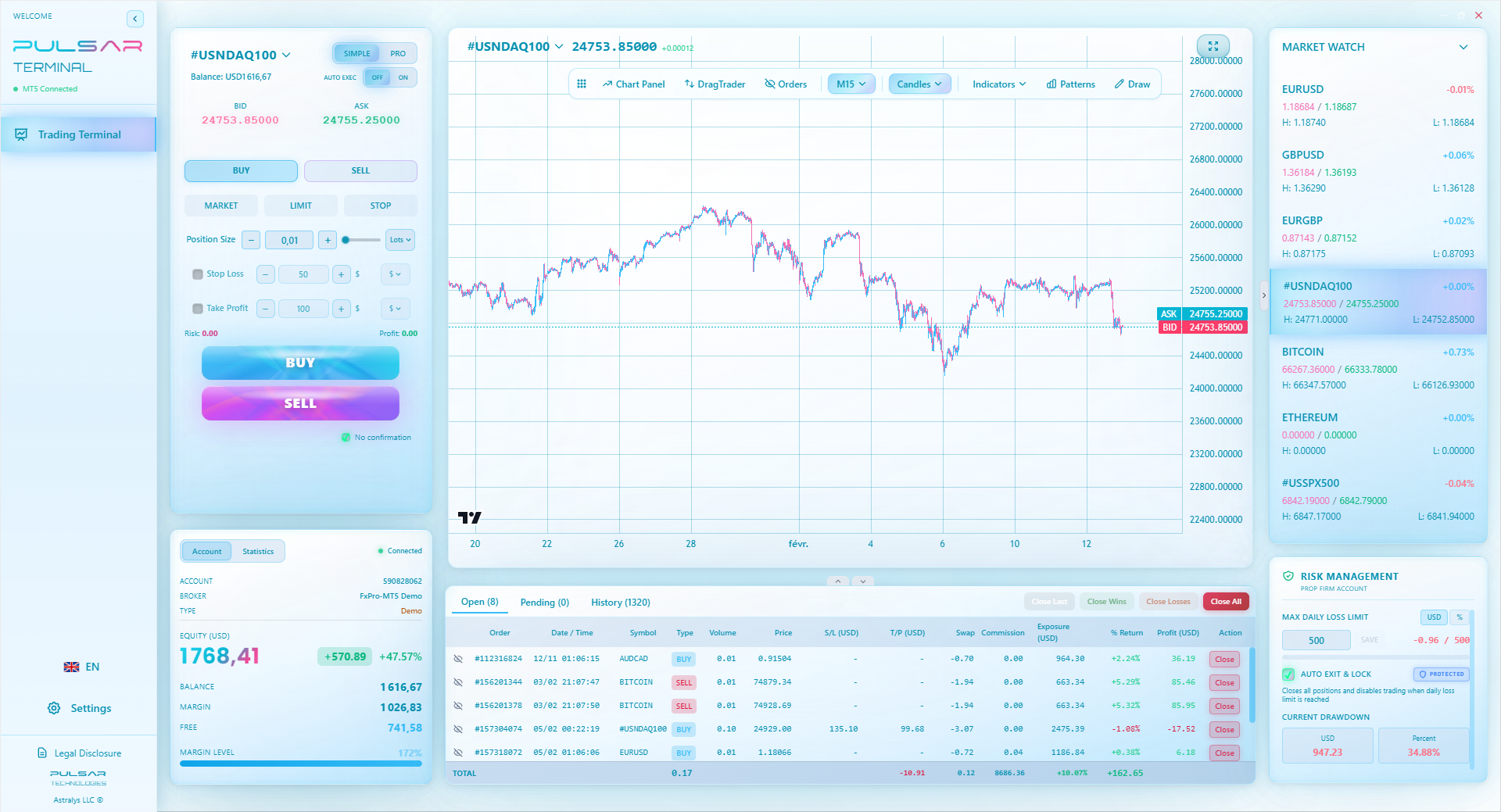
Managing multiple profit targets and a breakeven stop manually is stressful and error-prone; Pulsar Terminal automates this directly on your MT5 platform, executing your plan precisely so you can focus on the next setup.
Pulsar Terminal
The all-in-one MT5 companion: drag-and-drop orders, multi-TP/SL, trailing stop, grid trading, Volume Profile, and prop firm protection. Used by 1,000+ traders daily.
“Price can lie. Volume doesn't. A breakout on low volume is a fakeout waiting to happen.”
Let's walk through a hypothetical morning, 9:15 AM to 11:30 AM, trading the Nifty 50 index.
9:15 - 9:45 AM: The Opening Range I do nothing but watch. The first 30 minutes are chaotic. I'm marking the high and low of this range on my chart. I have my 20 & 50 EMA, RSI, and volume visible. I'm not looking for trades. I'm assessing: Is price above or below the EMAs? Is the RSI biased above/below 50? Is volume picking up?
9:45 AM: First Setup Price holds above the EMAs. The opening range high is 22,520. At 9:42, a 5-minute candle breaks above 22,520. I check volume: it's the highest of the morning. Good. RSI on the 5-minute chart jumps to 58. This is a potential breakout.
I don't chase. I wait for a pullback. At 9:50, price pulls back to 22,515 (near the breakout level). Volume is low on the pullback. RSI holds above 50. This is my entry signal. I go long at 22,517.
Risk Management: My stop loss goes at 22,505 (just below the opening range low). That's a 12-point risk. My account risk for this trade is 0.5%, so I use a position size calculator to determine how many lots I can trade. I set two targets: TP1 at 22,537 (20 points), TP2 at 22,560.
10:15 AM: Management Price hits TP1. I close half my position, booking a profit. I move my stop loss on the remaining half to my entry price (22,517). Now, the trade is risk-free.
11:00 AM: Exit Price rallies further but then the 5-minute RSI shows divergence: price makes a new high near 22,555, but RSI makes a lower high. This is a warning. I exit my remaining position at 22,552. Session done.
Total: First half made 20 points, second half made 35 points. Average gain: 27.5 points minus costs. I'm done for the day. This is the discipline. You don't need 10 trades. You need 1-2 good ones. The rest of the day is for analysis and planning for tomorrow.
💡 Winston's Tip
Your first trade of the day is often your best. Your mind is fresh, unbiased by P&L. After a loss or big win, your judgment is impaired. Know when to shut down the terminal.
“The goal isn't perfection. It's consistent execution of a simple plan.”
Let me save you some money and heartache by sharing my most expensive mistakes.
1. Over-optimization: I spent months backtesting the "perfect" EMA combination for Nifty. 13-EMA crossover with the 48-EMA gave 95% win rate in my test! In live markets, it failed miserably. Why? I curve-fitted the indicator to past data. The market changed. Keep your settings standard (like 20 & 50). They work because everyone sees them, creating self-fulfilling reactions.
2. Ignoring the Higher Timeframe: I used to only look at the 5-minute chart. I'd be happily short, only to realize the 1-hour chart was in a raging bull trend. I was fighting the tide. Now, I always check the 30-minute or 1-hour trend before my intraday session. It defines my bias.
3. Revenge Trading After a Stop Hit: This is the account killer. My stop gets taken out, the market reverses, and I'm furious. I jump back in twice the size to "make it back." Nine times out of ten, I lose even more. My rule now: If I get stopped out on a clear signal, I'm done for that instrument for at least an hour. Go for a walk.
4. Not Accounting for All Costs: In my early days, I'd see a 0.4% move, take profit, and think I made money. Then my weekly statement showed a loss. The brokerage, STT, and GST ate me alive. Now, I use a simple rule: My minimum profit target must be at least 0.15% above my entry just to cover average costs. This often means I need a clearer, stronger signal to pull the trigger.
The goal isn't perfection. It's consistent execution of a simple plan. The indicators are just tools in that plan. Your psychology and risk rules are the foundation.
FAQ
Q1What is the best time frame for intraday trading in India?
There's no single "best" frame, but a multi-timeframe approach works best. Use the 30-minute or 1-hour chart to establish the broader intraday trend. Then use the 5-minute or 10-minute chart for your precise entry and exit signals. The 15-minute chart is a good middle ground for confirming setups. Avoid the 1-minute chart unless you're an experienced scalper, as the noise is extreme.
Q2Can I use these indicators for Bank Nifty and stock futures?
Absolutely. The principles are the same. However, Bank Nifty is more volatile than Nifty, so you may need to widen your stop losses slightly. For stock futures, always check the liquidity. Applying a volume-based strategy to a low-volume stock future is pointless. The indicators work best on highly liquid instruments like Nifty, Bank Nifty, and large-cap stocks.
Q3How many indicators should I have on my screen?
As few as possible. I recommend a maximum of three core indicators: one trend (like EMA), one momentum (like RSI), and one volatility/structure tool (like Bollinger Bands). Having more leads to analysis paralysis. Master a small set. You can learn more about combining them in our guide on swing trading principles, which also apply to intraday structure.
Q4What broker platform is best for charting and indicators?
Most Indian discount brokers have decent charting. Zerodha Kite and Upstox Pro are very popular for their clean interface and built-in studies. For more advanced features, some traders use paid platforms like TradingView and link them to their broker. The key is speed and reliability during market hours. Check reviews for platforms like Zerodha Kite (often cited for its efficiency) to see if it fits your style.
Q5Is intraday trading profitable after all the taxes and charges?
It can be, but the hurdle is high. The SEBI study showing 70% losers factors in all costs. To be in the profitable minority, you need a clear edge (your strategy), strict discipline (your risk management), and you must keep your trading frequency in check. Overtrading guarantees your profits will be lost to brokerage and STT. Focus on quality, not quantity.
Q6How do I practice without losing money?
Use a paper trading (virtual trading) account. Almost every major broker offers one. Trade with virtual money for at least 2-3 months. Track your trades in a journal as if it were real money. Only go live when you can consistently execute your plan in the simulator, including adhering to stop losses and profit targets. This practice is useful.
Prof. Winston's Lesson
Key Takeaways:
- ✓Use only 2-3 core indicators: EMA for trend, RSI for momentum, Volume for confirmation.
- ✓Your minimum target must cover costs: aim for moves >0.15%.
- ✓Always check the 30-min chart trend before taking a 5-min signal.
- ✓If stopped out, walk away for an hour. No revenge trades.
How useful was this article?
Click a star to rate
Weekly Trading Insights
Free weekly analysis & strategies. No spam.
About the Author
Rajesh Sharma
Senior Forex Analyst
Trading Indian and South Asian markets for over 10 years. Started with NSE currency derivatives before moving to international forex. Specializes in USD/INR and emerging market pairs.
Comments
Risk Disclaimer
Trading financial instruments carries significant risk and may not be suitable for all investors. Past performance does not guarantee future results. This content is for educational purposes only and should not be considered investment advice. Always conduct your own research before trading.
You Might Also Like

Cara Trading Forex Sukses: 7 Prinsip dari Trader Profesional
Cara trading forex sukses dengan 7 prinsip trader pro: manajemen modal, disiplin, journal trading, backtest. Data nyata, bukan janji profit palsu.
Jam Trading Forex Terbaik untuk Trader Indonesia: Panduan Lengkap dengan Tabel Waktu
Panduan jam trading forex untuk trader Indonesia. Tabel 4 sesi dunia, jam emas 20:00-00:00, sesi mana yang harus dihindari. Data akurat + tips dari trader berpengalaman.
Top 5 Sàn Forex Uy Tín Nhất 2026: Review Jujur dari Trader Indonesia
Top 5 sàn forex uy tín 2026 untuk trader Indonesia. Review jujur: spread, deposit, withdraw, dukungan lokal. Exness, XM, IC Markets & lebih.
Get Pulsar Terminal
All these calculators are built into Pulsar Terminal with real-time data from your MT5 account. One-click position sizing, automatic risk management, and instant calculations.
Get Pulsar Terminal