


I was staring at my screen on March 15th, 2026, watching USD/ZAR tick up to 18.92.

David van der Merwe
Emerging Markets Trader ·  South Africa
☕ 12 min read
What you'll learn:
- 1What Makes a Pair 'Trend' Right Now? (It's Not What You Think)
- 2The Top Trending Majors & Crosses for 2026
- 3ZAR Exotic Pairs: The Real Local Opportunity (and Danger)
- 4How to Spot the Next Trending Pair (Your Daily Routine)
- 5Why Your Broker & Costs Matter More in South Africa
- 6A Simple Strategy to Trade Any Trending Pair
- 7Common Mistakes to Avoid (I've Made Them All)
I was staring at my screen on March 15th, 2026, watching USD/ZAR tick up to 18.92. The SARB had just held rates, and the market was digesting it. My phone buzzed with messages from three different trading groups - everyone was asking the same thing: 'What pairs are moving today?' That moment captures what we're talking about. Trending forex pairs today isn't about some theoretical list; it's about what's actually getting volume, where the opportunities are right now, and how you trade them from South Africa without getting burned by spreads or regulations.
When we say 'trending forex pairs today,' most beginners think about which chart has the prettiest upward slope. That's only half the story. A truly trending pair for a South African trader needs three things: liquidity you can actually access, a spread that doesn't eat your profit, and a catalyst that makes sense in our timezone.
I learned this the hard way in 2023. I spotted a beautiful setup on GBP/NOK (British Pound vs Norwegian Krone). The trend was crystal clear on the daily chart. I entered, and the move eventually played out... but the spread was 17 pips. To even reach breakeven, the market had to move 17 pips in my favor before I saw a cent. The trade was 'right' but the instrument was wrong. The liquidity was too thin for my broker.
For us, trending means tradable. The EUR/USD might only move 50 pips on a busy day, but with a 0.8 pip spread on a good XM review account, you're in the game immediately. A USD/ZAR move can be 200 pips, but if your broker's spread is 80 pips wide (yes, some are that bad), you're fighting an uphill battle from the start.

Example: Let's say you have R10,000 and use 30:1 use (the FSCA max). On USD/ZAR with a 50-pip spread, you need the pair to move 50 pips just to cover costs. That's a huge initial hurdle. On EUR/USD with a 1-pip spread, you're working with a much smaller deficit. Always run your potential trade through a position size calculator with the real spread included.
The real trending pairs are where the market's story (fundamentals) meets accessible price action (technicals) and reasonable trading costs. Right now, that's a specific mix of majors and certain ZAR crosses.
These are the workhorses. They might not always make the flashiest headlines, but they provide the most reliable, liquid trends for building a strategy.
EUR/USD: The Constant Benchmark It's boring until it's not. This pair makes up about a quarter of all global forex volume. For us in SA, trading it during the London/New York overlap (3 PM - 5 PM our time) is golden. The spreads are tight, and the moves are clean. I've built entire months of profit just focusing on a simple swing trading approach on the EUR/USD 4-hour chart. In January, I caught a 120-pip short from 1.0950 down to 1.0830. It wasn't explosive, but with proper size, it paid the bills.
USD/JPY: The Interest Rate Play This has been the story pair. With the Bank of Japan hesitating and the Fed holding firm, the interest rate differential has kept this pair in a persistent uptrend. It's a classic carry trade, but also a technical trader's dream. The trend respects moving averages beautifully. Just watch out for intervention chatter from Japanese officials - it can cause violent, short-term reversals.
GBP/USD: The Volatility Specialist 'Cable' is for when you've had your coffee. It reacts sharply to UK inflation data and Bank of England speeches. The trends can be powerful but whippy. I don't recommend it for your first trade of the day. If you're looking at GBP/USD, you need a wider stop and a stomach for some back-and-forth.
AUD/USD & NZD/USD: Our Commodity Cousins These are particularly relevant for South Africans because our economy is also commodity-driven. When iron ore or copper prices move, AUD/USD reacts. When global dairy prices shift, NZD/USD moves. They often give you a cleaner read on global risk sentiment than the S&P 500. I use the AUD/USD as a 'risk gauge' before entering any ZAR trade.

Warning: Don't chase exotic crosses like EUR/TRY or USD/MXN just because they're moving 1000 pips a day. The spreads are monstrous, and the liquidity for South African brokers can be terrible. Stick to the liquid majors for your core trading.

💡 Winston's Tip
A trend is your friend, but only until it ends. The final 20% of a trend often causes 50% of the drawdown. Know when to walk away.
“The real trending pairs are where the market's story meets accessible price action and reasonable trading costs.”
This is where South African traders can have an edge. You live the news that moves these pairs. You feel the load-shedding, you hear the political debates. That local knowledge is valuable.
USD/ZAR: The Main Event This is the most traded ZAR pair by far. The trends are driven by a brutal tug-of-war: US interest rates and dollar strength vs. South African political risk, commodity exports (platinum, gold), and our own interest rate policy. A trending USD/ZAR market is often a 'risk-off' environment for the globe. When investors panic, they sell emerging market currencies like the Rand.
Here's a real trade from last month: We had US CPI data come in hot, and SARB was seen as nearing the end of its hiking cycle. The setup was there for a stronger dollar and weaker Rand. I went short USD/ZAR (betting on a higher number) at 18.45. My stop was at 18.30, target at 18.80. It hit my target in four days. The key was the fundamental narrative aligning with a breakout on the chart.
EUR/ZAR & GBP/ZAR: The European Plays These pairs let you trade the Rand against other major economies. They're fantastic when you have a strong view on Europe or the UK relative to SA. For example, if the EU economy is struggling but SA is stable, EUR/ZAR could trend down. The spreads are wider than USD/ZAR, so your time frame needs to be longer.
The Brutal Truth About Trading ZAR Pairs
- Spreads Vary Wildly: I've seen USD/ZAR spreads from 25 pips to 80 pips on different platforms. You must use a broker with competitive pricing on these exotics. Check our Exness review or IC Markets review for their ZAR spread data - it's crucial.
- Swap Rates Matter: Sometimes called 'carry,' these are the fees or credits for holding a position overnight. With SA's high interest rates, you can sometimes GET PAID to hold a short USD/ZAR position overnight. This can add up over time. Check your broker's swap calculator.
- Liquidity Dries Up Fast: After 5 PM SA time and on weekends, liquidity evaporates. Never leave a tight stop on a ZAR pair over a major international holiday or a Sunday night. The gap risk is real.

Pro Tip: When trading USD/ZAR, keep an eye on the XAU/USD guide (gold price). A falling gold price often pressures the Rand, as it's a major export. It's not a perfect correlation, but it's a useful context clue.
You don't need a crystal ball. You need a checklist. Here's what I do every morning before 8 AM:
- The Economic Calendar Scan: I'm not looking for every event. I'm looking for the big red ones: Central Bank interest rate decisions (Fed, ECB, SARB, BoE), inflation data (CPI), and employment reports (like US NFP). I circle any major event happening in the next 24-48 hours.
- The 'Pair to Watch': If the US Fed is speaking at 8 PM our time, USD pairs (USD/ZAR, EUR/USD, USD/JPY) are on watch. If the SARB is releasing minutes, all ZAR pairs are on watch. I don't trade the news directly (too risky), but I watch for the breakout that happens after the news is digested.
- The Technical Screen: I have a watchlist of 8 pairs: The 4 majors above, USD/ZAR, EUR/ZAR, GBP/ZAR, and AUD/USD. I quickly look at the 4-hour and daily charts for each. I'm asking one question: "Is price above or below the key moving average (like the 50 or 200 EMA), and is it staying there?" I'm not analyzing deeply yet, just sorting.
- The Liquidity Check: I note the current spread on each pair on my platform. If USD/ZAR is showing a 60-pip spread, it's off the table for the day unless I'm planning a multi-day swing trade. I focus on the pairs with the cleanest, cheapest access.
This 15-minute routine tells me which 2-3 pairs are the most likely to provide a clean trending opportunity that day. Most days, it's just one or two.
💡 Winston's Tip
The spread isn't a fee, it's the market's first opinion against your trade. If you can't overcome it consistently, your edge is an illusion.
“Trading a trending pair with the wrong broker is like trying to surf with an anchor tied to your leg.”
Trading a trending pair with the wrong broker is like trying to surf with an anchor tied to your leg. The FSCA's 30:1 use cap is a good thing - it protects you. But other cost factors are in your control.
The Spread Trap: This is the biggest profit killer for new traders. Let's compare (using typical rates from early 2026):
| Pair | 'Cheap' Broker Spread | 'Expensive' Broker Spread | Cost per Standard Lot (R) |
|---|---|---|---|
| EUR/USD | 0.8 pips | 1.6 pips | R120 vs. R240 |
| USD/ZAR | 25 pips | 60 pips | R2,500 vs. R6,000 |
See that? On USD/ZAR, the expensive broker charges you R3,500 more just to enter the trade. You need the market to move 35 extra pips in your favor just to catch up. It's unsustainable.
Local vs. International Brokers:
- Local (e.g., Khwezi Trade): Pros: ZAR account, fast EFTs, local support. Cons: Sometimes higher spreads, smaller product range.
- International FSCA-Regulated (e.g., Pepperstone review, IG): Pros: Often tighter spreads on majors, great technology. Cons: Withdrawals might take a day longer, support might be overseas.
My advice? Start with a demo account from a few. Test their spreads on USD/ZAR at 9 AM, 2 PM, and 6 PM. Test their withdrawal process with a small amount. Your broker is your business partner - choose wisely.
Taxes (SARS): This isn't a cost from your broker, but it's a cost from your profits. SARS views active trading as income. Keep a detailed log of every trade. Use a spreadsheet or a dedicated journal. When you win, set aside 30-40% of the profit immediately. Trust me, an audit is much less stressful when you're prepared.
Let's get practical. Here's a method I've used for years. It works on EUR/USD, USD/JPY, or USD/ZAR. It's not fancy, but it's effective.
The 'Trend Pullback' Setup:
- Identify the Trend: Use the Daily chart. Is price mostly making higher highs and higher lows (uptrend) or lower highs and lower lows (downtrend)? If it's choppy sideways, move on. We only want clear trends.
- Find the Pullback: Switch to the 4-hour or 1-hour chart. In an uptrend, wait for price to pull back DOWN towards a key support level. This could be a moving average (like the 50-period EMA) or a previous resistance-turned-support area. In a downtrend, wait for a pullback UP.
- Look for a Reversal Signal: This is where your price action skills come in. At that support area, do you see a bullish candlestick pattern (like a hammer or engulfing bar)? Does the RSI indicator show it's coming out of oversold territory (above 30)? That's your cue.
- Enter and Manage: Enter long (in an uptrend) after the bullish signal confirms. Place your stop loss below the recent swing low of the pullback. Your take profit target should be at least 1.5 times the distance of your stop loss.
Example from my journal (USD/JPY, April 2026):
- Daily trend: Clearly up.
- Pullback on H4: Price dipped to the 50 EMA at 152.80.
- Signal: A bullish pin bar formed right on the EMA, with RSI bouncing from 35.
- Entry: 152.95. Stop: 152.50 (45 pip risk). Target: 153.70 (75 pip reward).
- Result: Target hit in 2 days. Risk/Reward: 1:1.67.
The beauty of this strategy is it forces you to trade in the direction of the main trend (the smart money) and buy at a discount (during the pullback). It keeps you out of choppy markets. For managing multiple targets or moving your stop to breakeven, having the right tools makes life easier.
💡 Winston's Tip
Your best trade on a trending pair is often the one you don't take - the one where you wait for the pullback everyone else is panicking about.
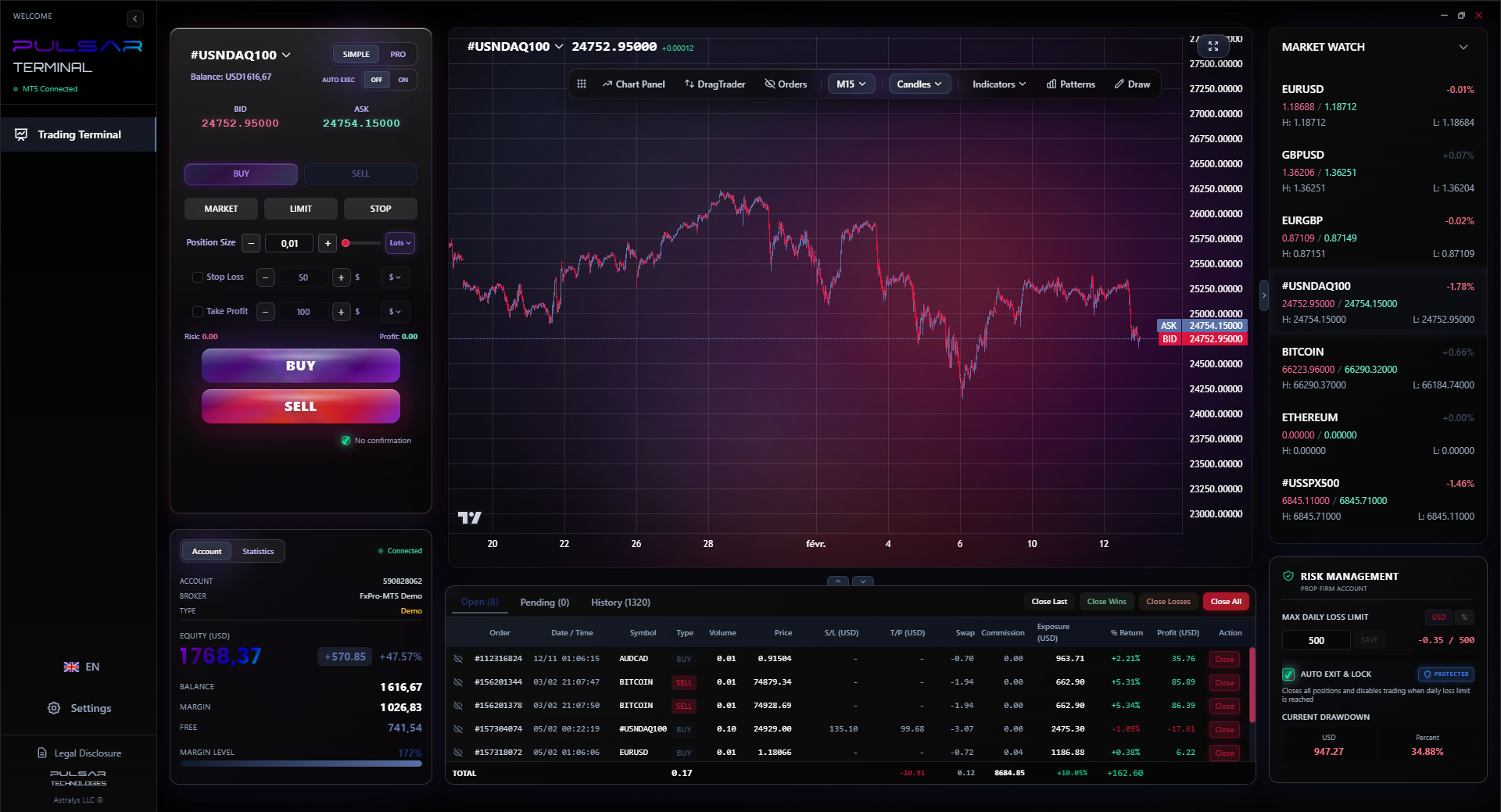
Managing a clean 'Trend Pullback' trade requires precise order placement and stop management, which tools like Pulsar Terminal streamline directly on your MT5 charts.
Pulsar Terminal
The all-in-one MT5 companion: drag-and-drop orders, multi-TP/SL, trailing stop, grid trading, Volume Profile, and prop firm protection. Used by 1,000+ traders daily.
“Your best trends have a story behind them. No catalyst means a fragile trend that can reverse on a whim.”
Let me save you some money and frustration.
Mistake 1: Chasing the 'Hot' Pair. Just because GBP/NZD is up 200 pips this week doesn't mean it's a good idea to jump in now. You're probably buying at the top. Always ask, 'Has the trend been going for a long time? Am I late to the party?'
Mistake 2: Ignoring the Spread on Entry. You would never buy bread for R50 if the shop next door sells it for R20. Yet traders enter USD/ZAR without checking if their spread is 25 or 60 pips. It's the same thing. Know your costs.
Mistake 3: Overleveraging on ZAR Pairs. The FSCA's 30:1 limit is there for a reason. ZAR pairs are volatile. Using max use on a large USD/ZAR position is a surefire way to get a margin call. I once lost 40% of an account in one afternoon doing this. It was a brutal, but necessary, lesson.
Mistake 4: Trading Without a Catalyst. If there's no economic reason (a data release, a central bank speech, a shift in commodity prices) for a pair to trend, the trend is fragile. It can reverse on a whim. Your best trends have a story behind them.
Mistake 5: Not Adapting Your Timeframe. A trending pair on the weekly chart might be range-bound on the 5-minute chart. If you're a scalping strategy trader, you need to find the intraday trend within the larger trend. Don't use a daily chart trend to justify a 5-minute chart trade unless they align.
FAQ
Q1What is the most traded forex pair in South Africa?
Globally, it's EUR/USD, and that's true for SA traders too due to its liquidity. But locally, the most actively traded pair involving the Rand is USD/ZAR. It's the primary gauge for the Rand's strength and is heavily influenced by both US and South African economic news.
Q2Is 30:1 use enough for forex trading?
Absolutely, and it's safer. The FSCA imposed this limit to protect retail traders. With good risk management (like risking 1-2% of your account per trade), 30:1 is more than sufficient to generate meaningful returns. Higher use just increases the speed of potential losses. I've built a career using far less than the maximum allowed.
Q3How do I avoid high spreads on USD/ZAR?
First, choose a broker known for competitive spreads on exotic pairs - compare our broker reviews. Second, avoid trading during low-liquidity periods: late Friday afternoons, weekends, and major SA or US public holidays. The spread often widens dramatically. Third, consider using limit orders instead of market orders to control your entry price more precisely.
Q4What time of day is best for trading trending pairs in SA?
The best overlap for liquidity is when both London and New York are open, which is roughly 3:00 PM to 5:00 PM South African Standard Time (SAST). This is when you'll find the tightest spreads on major pairs like EUR/USD and GBP/USD. For USD/ZAR, activity is also high during the Johannesburg market hours (9 AM - 5 PM).
Q5Do I pay tax on forex trading profits in South Africa?
Yes. SARS considers profits from active trading as ordinary income, not capital gains. You must declare it on your annual tax return (ITR12) and will be taxed at your marginal income tax rate. It's crucial to keep detailed, accurate records of all your trades, deposits, and withdrawals.
Q6Can I trade forex with just R500?
Technically, yes. Some brokers like Khwezi Trade or XM allow very small minimum deposits. However, practically, it's extremely difficult. With R500 and a 30:1 use, your buying power is R15,000. But a single 50-pip move against you on a micro lot could wipe out a large chunk. I recommend starting with at least R5,000-R10,000 in a demo account to prove your strategy, then funding a live account with a minimum of R2,000-R5,000 to manage risk properly.
Q7What's a good indicator to confirm a trend?
I keep it simple. The 50-period and 200-period Exponential Moving Averages (EMAs) on the daily chart are my go-to. If price is above both and the 50 EMA is above the 200 EMA, that's a strong uptrend. The MACD indicator is also excellent for spotting both trend direction and momentum. Remember, indicators confirm what price is already telling you.
Prof. Winston's Lesson
Key Takeaways:
- ✓Prioritize liquidity & low spreads over sheer pip movement.
- ✓Use the 4-hour chart to find pullbacks within a clear daily trend.
- ✓Always know your exact spread cost before entering any ZAR trade.
- ✓The FSCA's 30:1 use is a protective tool, not a limitation.
How useful was this article?
Click a star to rate
Weekly Trading Insights
Free weekly analysis & strategies. No spam.
About the Author
David van der Merwe
Emerging Markets Trader
Johannesburg-based trader with 11 years in emerging market currencies. Specializes in ZAR pairs, FSCA-regulated trading, and South African market analysis.
Comments
Risk Disclaimer
Trading financial instruments carries significant risk and may not be suitable for all investors. Past performance does not guarantee future results. This content is for educational purposes only and should not be considered investment advice. Always conduct your own research before trading.
You Might Also Like

Cara Trading Forex Sukses: 7 Prinsip dari Trader Profesional
Cara trading forex sukses dengan 7 prinsip trader pro: manajemen modal, disiplin, journal trading, backtest. Data nyata, bukan janji profit palsu.
Jam Trading Forex Terbaik untuk Trader Indonesia: Panduan Lengkap dengan Tabel Waktu
Panduan jam trading forex untuk trader Indonesia. Tabel 4 sesi dunia, jam emas 20:00-00:00, sesi mana yang harus dihindari. Data akurat + tips dari trader berpengalaman.
Top 5 Sàn Forex Uy Tín Nhất 2026: Review Jujur dari Trader Indonesia
Top 5 sàn forex uy tín 2026 untuk trader Indonesia. Review jujur: spread, deposit, withdraw, dukungan lokal. Exness, XM, IC Markets & lebih.
Get Pulsar Terminal
All these calculators are built into Pulsar Terminal with real-time data from your MT5 account. One-click position sizing, automatic risk management, and instant calculations.
Get Pulsar Terminal