


Most new traders I meet think 'deviation' is just a fancy word for volatility.

David van der Merwe
Emerging Markets Trader ·  South Africa
☕ 12 min read
What you'll learn:
- 1The Two Faces of Deviation: Slippage vs. Statistics
- 2Execution Deviation & Slippage: A South African Reality Check
- 3Standard Deviation: Your Gauge for Rand Volatility
- 4The Real Costs & Risks in the South African Context
- 5How to Set It Up: MT4/MT5 for South African Traders
- 6Mistakes I've Made (So You Don't Have To)
- 7Pulling It All Together: A Simple ZAR Trading Framework
Most new traders I meet think 'deviation' is just a fancy word for volatility. They slap a standard deviation indicator on their USD/ZAR chart and call it a day. That's only half the story, and it cost me real money early on. The other half - the slippage tolerance setting in your MT4/MT5 platform - is where the rubber meets the road for your orders. Let's clear up the confusion and show you how both concepts work in the South African market, from managing rand volatility to protecting your trades from nasty surprises.
Right off the bat, you need to understand that 'deviation' wears two hats in trading. Confusing them is a rookie mistake I made more than once.
First, there's execution deviation (or slippage tolerance). This is a setting you control in your trading platform, like MetaTrader. It's the maximum number of pips you're willing to let your order price slip before the broker cancels it. Think of it as a safety net. You place a buy limit order for EUR/USD at 1.1000 with a 5-pip deviation. The broker will try to fill it between 1.0995 and 1.1005. If the price gaps past that range, your order gets rejected. It's there to prevent you from buying at a terrible price during a news spike.
Then there's statistical deviation, usually the standard deviation. This is a measure of how wild or calm the market is. It tells you how much prices are bouncing around their average. High standard deviation on USD/ZAR? The rand is all over the shop. Low deviation? It's probably stuck in a tight range, maybe before a big move. This is what most indicators, like Bollinger Bands (which use standard deviation), are showing you.

Warning: Don't mix them up. Setting a 20-pip 'deviation' on your pending order is about controlling slippage. Seeing a 20-pip 'standard deviation' on your chart is about measuring recent volatility. They're related - high volatility often causes slippage - but they're different tools.
“Deviation is the buffer between your perfect plan and the market's messy reality.”
This is where theory meets the often-chaotic reality of our market. Setting your deviation isn't a 'set and forget' thing. You have to match it to the pair you're trading and the conditions.
Why It Matters for ZAR Pairs
Our beloved (and sometimes hated) rand pairs like USD/ZAR and EUR/ZAR are notoriously volatile. The spread can widen dramatically during London open or when local economic data drops. I learned this the hard way. Back in 2022, I had a sell limit order on USD/ZAR at 18.5000 with the default 1-pip deviation. South African CPI data came out hotter than expected. The price spiked down to 18.4800 for a split second - a 20-pip move - before rocketing higher. My order didn't fill because it slipped past my tiny 1-pip buffer. I missed the entire 150-pip move that followed. A painful lesson.
For major pairs like EUR/USD during calm hours, a 2-5 pip deviation is often enough. For USD/ZAR? I wouldn't go below 10 pips on a normal day, and I might push it to 15-20 around major news. The trade-off is clear: a higher deviation means a higher chance your order fills, but also a higher chance it fills at a worse price than you wanted.
How Brokers Handle It
Not all brokers are equal here. An ECN broker like IC Markets or Pepperstone will typically give you more transparent execution. You might get slipped, but you'll see why. Some market maker brokers might use your deviation setting against you, filling you at the worst possible price within your range. Always check your broker's execution policy and read reviews from other South Africans. A good broker for scalping strategy, which needs tight execution, is crucial.

Pro Tip: Test your deviation settings on a demo account during South African market hours (8am-5pm SAST). Watch how your orders behave on USD/ZAR when you simulate news events. It's the best way to find a setting that doesn't get you missed trades or bad fills.

💡 Winston's Tip
Think of execution deviation as insurance. You pay for it (via potential worse fills) to avoid a catastrophe (a rejected order in a fast-moving market). For volatile ZAR pairs, it's insurance worth having.
“A high deviation setting increases your fill rate but decreases your fill quality. It's a constant trade-off.”
Now let's talk about the indicator side of things. Standard deviation is your best friend for quantifying the market's mood swings. It’s the math behind Bollinger Bands. When the bands widen, standard deviation is high - volatility is expanding. When they contract, volatility is low.
For a South African trader, this is useful. Let's say you're looking at Gold (XAU/USD), which many of us trade alongside forex. You check the 20-period standard deviation on the daily chart. If it's been creeping higher while price makes new highs, that's a strong, volatile trend. It tells you to maybe give your trade more room, setting a wider stop-loss. I use this constantly when planning trades on our XAU/USD guide.
Conversely, if USD/ZAR has been trading in a 50-pip range for a week and the standard deviation reading is at a multi-week low, that's a compression. It's like a spring coiling. A breakout is coming. This is a classic swing trading setup. You can place orders above and below the range, knowing the move, when it comes, could be powerful.
Here’s a simple table for reading standard deviation on a currency pair:
| Standard Deviation Reading | Market Implication | Common Action for ZAR Pairs |
|---|---|---|
| Rising | Volatility is increasing. Trend may be strengthening or a reversal may be starting. | Avoid tight stops. Consider trailing stops to capture the move. |
| Falling | Volatility is decreasing. Market is consolidating, often before a breakout. | Prepare for a breakout. Place pending orders at range boundaries. |
| Extremely High | Market is in a period of panic or euphoria. Prices are moving wildly. | Reduce position size dramatically. The risk of a sharp reversal or margin call is high. |
| Extremely Low | Market is asleep. Range-bound, low-interest trading. | Be patient. Wait for the volatility to return before entering new trades. |
The key is to not use it in isolation. Pair it with other tools like the RSI indicator or MACD indicator for confirmation.
“A high deviation setting increases your fill rate but decreases your fill quality. It's a constant trade-off.”
Let's get practical about how this affects your bottom line in rands. Deviation isn't free.
Execution Deviation Costs: When you set a high deviation and get slipped, that's an immediate, real loss. If you bought USD/ZAR at 18.5100 instead of 18.5000 because of a 10-pip deviation, you're down 10 pips (about R67 per standard lot) the second your trade opens. On a major pair like EUR/USD guide, that's a smaller dollar amount, but it adds up. This is why understanding the typical spread definition and spread behavior of your pair is non-negotiable.
Broker Differences: This is critical. A broker like XM or Exness might have a different model for handling deviation than IC Markets. Some explicitly state they'll fill you at the first available price within your deviation range. Others might fill you at the worst price in that range. You must read the fine print. I made the switch to a broker with clearer execution policies (like the ones reviewed in our IC Markets review) and my slippage costs dropped noticeably.
The Swap Rate Twist: Here's a local angle we often forget. If you're trading a ZAR pair and get slipped into a position, you're now holding that position. If you hold it overnight, you pay or receive the swap rate. A bad fill can force you into a trade you didn't fully want, locking you into those daily costs. For a carry trade on USD/ZAR (which often has a negative swap for USD buyers), a bad fill can eat into your profits from day one.
Always factor in these hidden costs. They're why a simple win rate doesn't tell the whole story. Your profitability is your entry price minus your exit price, minus spread, minus commission, minus any slippage from deviation. It all counts.
💡 Winston's Tip
When the standard deviation indicator is at a 3-month low on the daily chart, get ready. The market is storing energy. Have your breakout orders primed, but keep your position size small until the move confirms.
“Low standard deviation doesn't mean low risk; it means compressed risk, which often explodes.”
Alright, let's get our hands dirty. Here’s exactly where to find and set these parameters on the platforms we all use.
Setting Execution Deviation (Slippage Tolerance):
- In MT4 or MT5, press F9 to open the 'New Order' window.
- Choose your instrument (e.g., USDZAR).
- Instead of 'Market Execution', select 'Pending Order' (like Buy Limit, Sell Stop).
- You'll now see a field called 'Deviation'. It's measured in points (for 5-digit pricing, 1 pip = 10 points). So, a 5-pip deviation = 50 points.
- Type in your value. For USD/ZAR, I rarely go below 100 points (10 pips).
Adding a Standard Deviation Indicator:
- Go to the 'Insert' menu at the top, then 'Indicators', then 'Trend'.
- Find 'Standard Deviation'.
- A settings box pops up. The main setting is the 'Period' (e.g., 20). This calculates how far prices deviate from the average over the last 20 candles.
- Click OK. It will appear in a separate window below your chart, showing a line that rises and falls with volatility.
A Personal Configuration: I have two charts for USD/ZAR. On my main trading chart, I have Bollinger Bands (period 20, deviation 2) which visually show me 2 standard deviations from the average. On a smaller sub-chart below, I have the raw Standard Deviation indicator (period 20). When the raw indicator line starts to rise from a low level, and the Bollinger Bands start to expand, I start paying very close attention. It's a signal that the quiet period is ending.
Remember, these settings aren't magic. They need to be tuned to your trading style and the pair's character. A scalper will use a much shorter period (like 10) than a position trader (who might use 50).
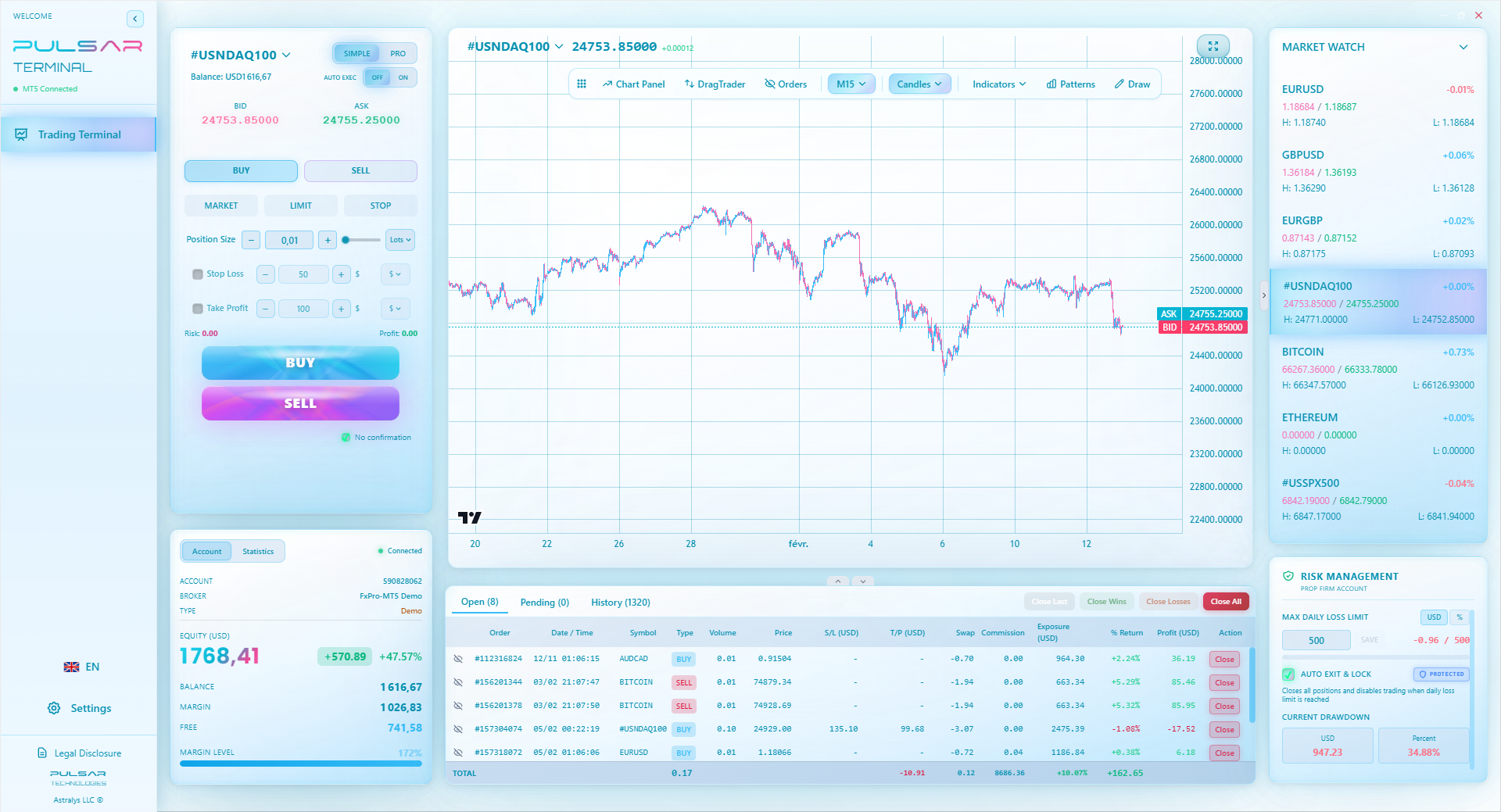
Manually adjusting stop-losses and managing multiple orders based on volatility is time-consuming, but Pulsar Terminal automates trailing stops and partial closures directly on your MT5 charts.
Pulsar Terminal
The all-in-one MT5 companion: drag-and-drop orders, multi-TP/SL, trailing stop, grid trading, Volume Profile, and prop firm protection. Used by 1,000+ traders daily.
“Low standard deviation doesn't mean low risk; it means compressed risk, which often explodes.”
I've blown up a small account and had many frustrating trades because I got deviation wrong. Here's my hall of shame.
Mistake 1: Ignoring Deviation on Pending Orders. I used the default setting (often 0 or 1 pip) for years. In a fast market, my orders just vanished - rejected because the price blew straight past my tiny buffer. I thought the broker was at fault. They weren't. I had set my orders up to fail. The fix was simple: increase the deviation to a realistic level for the pair's volatility.
Mistake 2: Confusing Low Volatility with Safety. Just because the standard deviation is low doesn't mean the market is 'safe'. It means it's tight. I used to pile into range-bound markets with huge position sizes, thinking the risk was minimal. Then the breakout would happen, stop-hunt, and take me out before the real move even started. Low deviation requires smaller positions, not bigger ones. Always use a position size calculator.
Mistake 3: Not Adjusting for News. This was a costly one. I had a nice short on GBP/ZAR with a 15-pip deviation on my stop-loss order. UK inflation data came out massively higher. The pair gapped up 80 pips on the open. My stop-loss, with its 15-pip deviation, was utterly useless. It got filled 80 pips worse than I expected. The lesson? Before major scheduled news, either close the trade, move to a much wider deviation (which is risky), or accept that you might need to manually manage the risk. There's no perfect solution, but being aware is half the battle.
Mistake 4: Chasing in High Deviation Markets. When standard deviation is screaming high, it's tempting to jump in because 'the trend is strong'. That's how you buy the very top or sell the very bottom. High deviation often precedes a pullback or reversal. Now, I wait for the volatility to settle slightly (the deviation line to start curling down) before looking for a new entry in the trend direction.
💡 Winston's Tip
Never set your execution deviation lower than the current average spread of the currency pair. If USD/ZAR's spread is 12 pips, a 5-pip deviation is practically guaranteeing your order will be rejected.
“Your broker's execution policy matters more than your deviation setting if they fill you at the worst price in the range.”
So how do you actually use this in a weekly trading routine? Here's a basic framework I follow.
Step 1: The Weekly Volatility Scan. Every Monday, I look at the 20-period standard deviation on the daily chart for my watchlist: USD/ZAR, EUR/ZAR, GBP/ZAR, and XAU/USD. I note which ones are at 3-month highs (explosive), 3-month lows (coiling), or somewhere in between. This sets my mindset. Is this a week for trend following or breakout hunting?
Step 2: Setting Order Deviations. Before I place any pending order, I ask: "What's the typical 5-minute candle range for this pair right now?" I'll look at the ATR indicator or just eyeball recent candles. I set my execution deviation to be at least 1.5 times that range. If USD/ZAR is making 8-pip candles, my deviation is at least 12 pips (120 points). This information is part of why I value tools from brokers like Pepperstone review or Exness review, who provide clear data on execution.
Step 3: Dynamic Stop-Loss Placement. My stop-loss isn't a random number. If the daily standard deviation is 150 pips, placing a 20-pip stop on a daily chart trade is suicide. I might place my stop 1.5 times the current daily ATR (which is similar to standard deviation) away from my entry. This gives the trade room to breathe.
Step 4: The Exit Check. If I'm in a profitable trade and I see the standard deviation start to spike to an extreme high on the 4-hour or 1-hour chart, it's a warning. It doesn't mean I exit immediately, but I might move my stop to breakeven or start trailing it more aggressively. It's a signal that the move is getting exhausted and a correction is likely.
This framework turns deviation from a confusing term into a practical tool for market assessment, order placement, and risk management. It's not a crystal ball, but it stacks the odds a little more in your favor.
FAQ
Q1What is a good deviation setting for USD/ZAR in MT4?
There's no single 'good' setting, as it depends on market conditions. For normal trading hours, a setting between 10 and 20 pips (100-200 points on a 5-digit quote) is a reasonable starting point. During major news or market opens, you may need to increase it to 30 pips or more to have a chance of your order filling, but accept that the fill price could be worse.
Q2Is standard deviation the same as volatility?
, yes. In trading, standard deviation is the primary statistical measure used to quantify volatility. A high standard deviation means high volatility (prices are spread out from the average). A low standard deviation means low volatility (prices are clustered tightly). It's what indicators like Bollinger Bands are built on.
Q3Can deviation settings prevent all slippage?
No. Deviation settings can only control slippage on pending orders (like limits and stops) by defining a price range for execution. For market orders, you will always experience whatever slippage occurs between the click and the execution. Deviation settings help manage, not eliminate, the risk.
Q4Do all forex brokers in South Africa offer deviation settings?
Most brokers offering the MetaTrader platforms (MT4/MT5) will have the deviation setting for pending orders. However, how they interpret and execute within that deviation range can vary. Always check your broker's execution policy. FSCA-regulated brokers like those in our XM review are required to be transparent about their execution methods.
Q5How does the ZAR's volatility affect my deviation strategy?
Significantly. The South African Rand is one of the most volatile major emerging market currencies. This means you must use wider execution deviation settings on ZAR pairs compared to, say, EUR/USD, to account for larger sudden moves. Similarly, standard deviation readings on ZAR charts will generally be higher, requiring wider stop-losses and profit targets.
Q6What's the difference between 'Deviation' and 'Max Deviation' in MT4?
In the context of order placement, they are the same thing - the maximum allowed slippage for a pending order. Some platforms or expert advisors might label it 'Max Deviation'. It always refers to the slippage tolerance setting.
Q7Can I use standard deviation to find overbought or oversold conditions?
Not directly. Standard deviation measures dispersion, not price level. A price can be at a high with low deviation (a steady uptrend) or with high deviation (a parabolic blow-off top). To gauge overbought/sold, use an oscillator like RSI or Stochastic alongside standard deviation. High deviation + extreme RSI can signal a potential reversal.
Prof. Winston's Lesson
Key Takeaways:
- ✓Use 10-20 pip deviation on ZAR pairs, 2-5 on majors.
- ✓High standard deviation warns of potential trend exhaustion.
- ✓Match your stop-loss distance to current volatility levels.
- ✓Test deviation settings on demo during SA market hours.
How useful was this article?
Click a star to rate
Weekly Trading Insights
Free weekly analysis & strategies. No spam.
About the Author
David van der Merwe
Emerging Markets Trader
Johannesburg-based trader with 11 years in emerging market currencies. Specializes in ZAR pairs, FSCA-regulated trading, and South African market analysis.
Comments
Risk Disclaimer
Trading financial instruments carries significant risk and may not be suitable for all investors. Past performance does not guarantee future results. This content is for educational purposes only and should not be considered investment advice. Always conduct your own research before trading.
You Might Also Like

Cara Trading Forex Sukses: 7 Prinsip dari Trader Profesional
Cara trading forex sukses dengan 7 prinsip trader pro: manajemen modal, disiplin, journal trading, backtest. Data nyata, bukan janji profit palsu.
Jam Trading Forex Terbaik untuk Trader Indonesia: Panduan Lengkap dengan Tabel Waktu
Panduan jam trading forex untuk trader Indonesia. Tabel 4 sesi dunia, jam emas 20:00-00:00, sesi mana yang harus dihindari. Data akurat + tips dari trader berpengalaman.
Top 5 Sàn Forex Uy Tín Nhất 2026: Review Jujur dari Trader Indonesia
Top 5 sàn forex uy tín 2026 untuk trader Indonesia. Review jujur: spread, deposit, withdraw, dukungan lokal. Exness, XM, IC Markets & lebih.
Get Pulsar Terminal
All these calculators are built into Pulsar Terminal with real-time data from your MT5 account. One-click position sizing, automatic risk management, and instant calculations.
Get Pulsar Terminal