


I was staring at my screen on March 7th, 2023, watching the UK100 CFD price hover around 7745.

David van der Merwe
Emerging Markets Trader ·  South Africa
☕ 11 min read
What you'll learn:
- 1UK100 Basics: It's Not a Share, It's a CFD Basket
- 2Trading from South Africa: FSCA Rules You Can't Ignore
- 3The Real Costs of Trading UK100 from ZA
- 4Choosing a Broker & Platforms in South Africa
- 5Trading Strategy & Managing UK100 Volatility
- 6Common Pitfalls for South African Traders
- 7Getting Started: Your First UK100 Trade
I was staring at my screen on March 7th, 2023, watching the UK100 CFD price hover around 7745. The Bank of England was about to speak, and my stomach was in knots. I had a small long position, convinced the index would bounce. It didn't. It dropped 87 points in 20 minutes, and I learned a harsh, expensive lesson about trading a foreign index from my desk in Johannesburg. That's what this guide is about: understanding exactly what the UK100 is in the forex and CFD world, and how you, as a South African trader, can approach it without getting cleaned out.
Let's get this straight first. When you trade 'UK100' with your forex broker, you are almost certainly not buying the actual FTSE 100 Index. You can't. What you're trading is a Contract for Difference (CFD) based on its price. Think of it as a bet on the direction of the basket.
The UK100 represents the 100 largest companies listed on the London Stock Exchange, weighted by market cap. Heavyweights like AstraZeneca, HSBC, and Shell dominate its movement. So, when you go long on UK100, you're betting that Britain's biggest blue-chip companies, as a group, will go up.
Why does this matter for us? Because trading it as a CFD changes everything. You're using use, you're dealing with spreads and overnight fees, and you're exposed to the broker's pricing, not directly to the LSE. It's a derivative, pure and simple. Understanding this distinction is the first step to not blowing up your account. I made the mistake early on of treating it like I was investing in the index. I held positions for weeks, racking up swap fees that ate into my profits before price even moved. Don't be me.

Warning: The UK100 CFD's price is derived from the underlying FTSE 100 Index futures. While they track closely, they are not identical. Your broker's spread, liquidity, and quote feed create the price you see. During volatile news (like a BoE announcement), this gap can widen painfully.

💡 Winston's Tip
The UK100 often fakes a direction at the London open. Wait 60-90 minutes for the real institutional flow to show itself. Patience here saves capital.
Trading the UK100 from South Africa comes with a specific set of rules, courtesy of our regulator, the Financial Sector Conduct Authority (FSCA). Ignoring these is a great way to get into trouble or lose more than you planned.
The 30:1 use Cap
This is the big one. Since 2021, the FSCA has capped use for retail traders at 30:1. For the UK100, that means you need at least 3.33% of the position's value in your account as margin. On a R100,000 notional position, you need R3,333.33. This is a good thing. It stops you from taking insane risks with 500:1 use, where a 0.2% move against you triggers a margin call. I've seen too many new traders chase offshore brokers offering 500:1, get a few lucky wins, and then get obliterated in a single session.
Broker Licensing & Your Money
Always, and I mean always, check if your broker is FSCA licensed. This isn't just bureaucratic box-ticking. An FSCA license means the broker must segregate client funds. Your money is held in a separate account from the broker's operating funds. If the broker goes under (it happens), your capital should be protected. Using an unregulated offshore entity is like handing your cash to a stranger and hoping they'll be nice. I stick with FSCA-regulated brokers like Pepperstone or IC Markets for this reason.
The Rand Allowance Loophole
You can't directly speculate against the ZAR with a local broker. But here's the practical workaround: you use your annual R1 million Single Discretionary Allowance (or your R10 million Foreign Investment Allowance) to fund an international trading account in USD, EUR, or GBP. This is perfectly legal. You then trade the UK100 in that account, avoiding any ZAR speculation rules. It adds a currency conversion step, but it's the cleanest way to operate.
“Trading the UK100 as a CFD changes everything. You're using use, you're dealing with spreads and overnight fees, and you're exposed to the broker's pricing, not directly to the LSE.”
Forget the 'commission-free' marketing. Trading the UK100 costs money, and if you don't account for it, you're trading blind. Here’s the breakdown with real numbers from the South African perspective.
The Spread: This is the difference between the buy and sell price. It's your immediate cost of entry. For UK100 CFDs, expect spreads between 1.0 and 1.9 points during normal London hours. At 2:00 AM SAST when liquidity is thin, it can blow out to 3 or 4 points. A 1.5-point spread on a standard 1-contract (roughly £10 per point) position costs you £15 (about R350) the moment you click 'buy'.
Overnight Financing (Swap): This is where I got burned. If you hold a UK100 position past the broker's rollover time (usually 10 PM London time, midnight SAST), you pay or receive a fee. This fee is based on the interbank lending rates. For a long UK100 position, you're typically paying a fee, as you're borrowing money to buy the index. On a £10-per-point position, this can be anywhere from -£2 to -£5 per night. Over a week, that's R800-R2000 gone before the market moves. It makes long-term swing trading strategies very expensive.
Currency Conversion: If your international account is in USD but the UK100 is priced in GBP (it usually is), your broker converts your P&L. They often add a 1-1.5% markup to the interbank rate. On a £1000 profit, that's another £15 vanished.

Example: You buy 1 contract of UK100 at 7900. Spread is 1.2 points (£12). You hold for 3 nights at -£3.80/night (£11.40). You sell at 7920 for a 20-point gain (£200). Your gross profit is £200. Minus spread (£12) and swaps (£11.40) = £176.60. Convert to USD at a 1.2% fee, and your real net is closer to £174.50. The costs ate over 12% of your gross profit.
Your broker and platform are your tools. You wouldn't build a house with a spoon, so don't trade with junk software.
Broker Checklist for ZA Traders:
- FSCA License: Non-negotiable. Verify the FSP number on the FSCA website.
- ZAR Deposits/Withdrawals: Does the broker accept EFT from your FNB or Standard Bank account? Local payment processing saves you days and forex fees. Brokers like XM and Exness have solid local bank integration.
- UK100 Spreads & Commission: Compare. Some have tight spreads but charge a commission. Others have wider spreads but no commission. Do the math for your typical trade size. A broker offering 1.0 point spread with a $5 commission might be cheaper for larger positions than one with a 1.8 point spread and no commission.
- Minimum Deposit: This is where South Africans have great options. You can start with as little as $5 (under R100) with some brokers. It’s a fantastic way to test the platform and your strategy with real, but minimal, risk.
Platforms: MT4/MT5 is King, But Not the Only Kingdom. MetaTrader 4 and 5 are ubiquitous for a reason. They're stable, support automated trading (EAs), and have thousands of custom indicators. Every broker supports them. However, many brokers now have excellent proprietary web platforms that are more intuitive for beginners. Try both. Use the broker's platform for analysis and MT5 for execution if you prefer.
I use MT5 for the UK100 because I like its depth of market feature and the ability to easily set multiple take-profit levels, which is crucial for managing a volatile index.
💡 Winston's Tip
Your biggest enemy trading the FTSE from SA isn't the market - it's the overnight swap fee. If you're not day trading, you must factor that constant bleed into your profit target. A 50-point target might only be 35 points after costs.
“The FSCA's 30:1 use limit isn't a restriction; it's a life jacket. Ignore it at your peril.”
The UK100 isn't the S&P 500. It can be a sluggish beast, then suddenly roar to life. You need a strategy that respects its personality.
What Moves the UK100?
- GBP/USD (Cable): A weaker Pound often lifts the UK100, as the overseas earnings of its giant multinationals (like Unilever, Diageo) are worth more in GBP. It's an inverse relationship you must watch.
- Bank of England Policy: Interest rate decisions are huge. The index hates surprise hikes.
- Commodity Prices: Heavy weighting in miners (Rio Tinto, Glencore) and oil (BP, Shell) means it's sensitive to global commodity swings.
- US Market Sentiment: It often follows the S&P 500's lead, especially at the US open (3:30 PM SAST).
A Practical Approach for SA Traders
Given our timezone (SAST is 1-2 hours ahead of the UK), the most active and predictable sessions are the London open (10:00 SAST) and the overlap with the US open (15:30 SAST). Trying to trade it at 2 AM is a recipe for getting stopped out by wild spreads.
I've had most success with a simple breakout strategy around these times. I wait for the first hour after the London open to establish a range (say 7850-7870). I then place buy stop orders just above 7870 and sell stop orders just below 7850, with tight stops. The position size calculator is my best friend here, ensuring my risk is never more than 1% of my account on that initial false breakout.
Volatility Management: The UK100's Average True Range (ATR) is your friend. If the 14-day ATR is 80 points, setting a 15-point stop-loss is naive. Your stop needs to be placed beyond the market's normal daily noise. I use at least 1.5 x ATR for my stops. This means sometimes my position size has to be smaller to keep my rand risk acceptable. That's discipline.

Pro Tip: Don't just look at the UK100 chart. Keep the EUR/USD guide and XAU/USD guide open. A crashing Euro or spiking Gold can signal risk-off flows that will hit the FTSE. Context is everything.
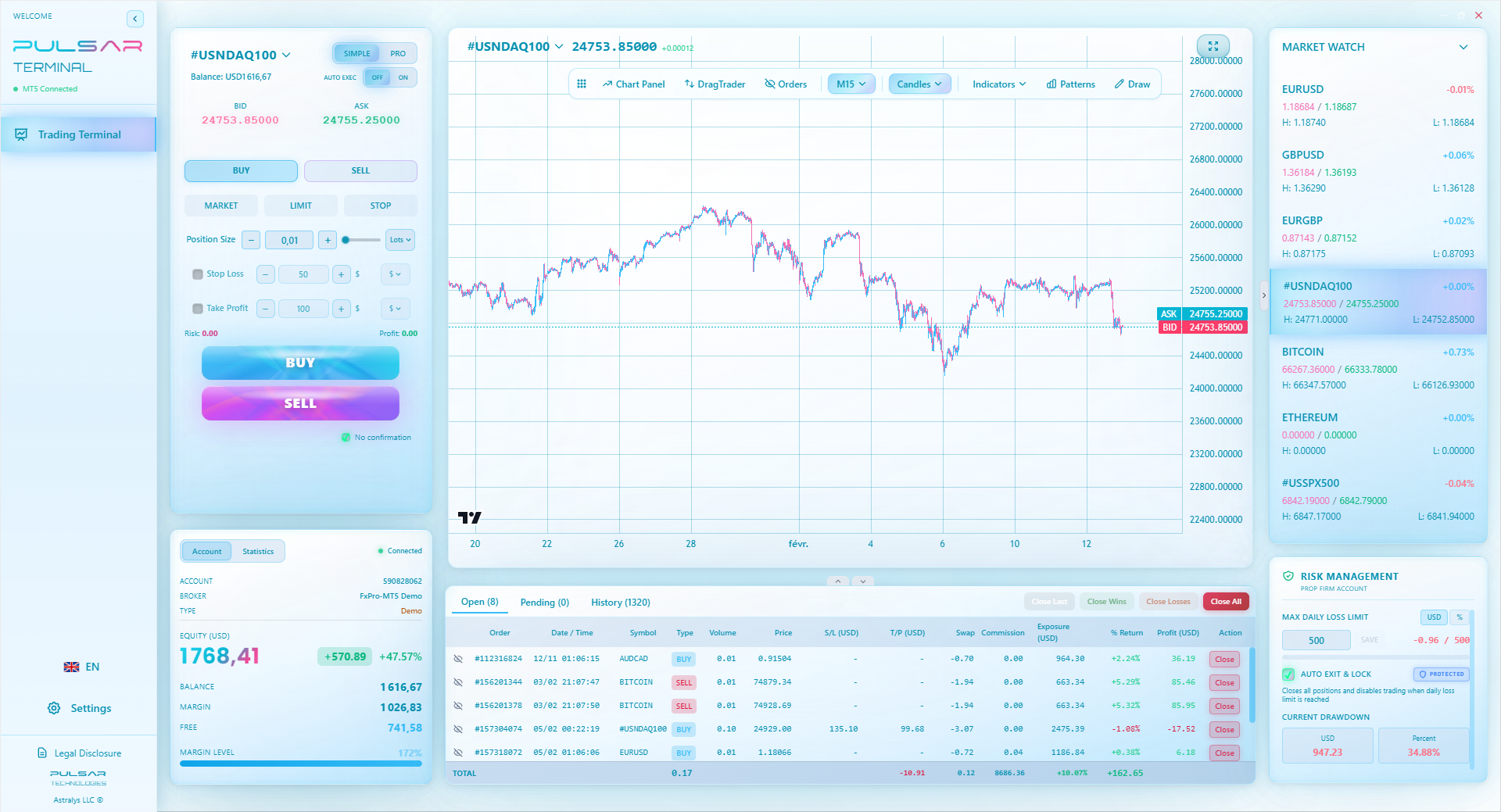
Managing multiple take-profit levels and moving stops to breakeven on a volatile index like the UK100 is manual hassle; Pulsar Terminal automates it all directly within your MT5 platform.
Pulsar Terminal
The all-in-one MT5 companion: drag-and-drop orders, multi-TP/SL, trailing stop, grid trading, Volume Profile, and prop firm protection. Used by 1,000+ traders daily.
Let's talk about the mistakes I've made and seen repeated a thousand times in local trading groups.
1. Chasing Offshore High use: "Bro, this broker offers 500:1!" Yeah, and they're probably not regulated, and that use is a debt trap. The FSCA's 30:1 limit is there to protect you. Use it. The dream of turning R1000 into R50,000 overnight is what bankrupts people.
2. Ignoring Swap Fees for 'Long-Term' Holds: This was my major error. I bought UK100 at 7600, thinking I'd ride a long-term trend. After two weeks of paying £4 a night in swaps, the index needed to move 56 points just for me to break even. It never did. I sold at a loss, with swaps making it worse. For long holds, you need a massive directional move to overcome this constant bleed. It's often better to use shorter timeframes like scalping or day trading the index.
3. Not Accounting for ZAR Volatility: Your account might be in USD, but your brain thinks in Rands. A 50-point win on the UK100 might be a $500 gain. But if the Rand has strengthened 3% against the Dollar that week, your Rands-on-withdrawal profit is significantly less. You're effectively running a micro forex book alongside your index trading. It's a complex layer most beginners completely miss.
4. Trading Without a Catalyst: The UK100 can drift for days. Entering a trade just because a MACD indicator crossed, without an upcoming economic event or a clear technical level break, is a fast track to watching paint dry while swaps eat your capital. Be patient. Wait for the London open, wait for the news.
“A 1.5-point spread on a standard UK100 contract costs you about R350 the moment you click 'buy'. That's your first opponent.”
Alright, let's put this into a step-by-step plan. This is exactly how I'd approach it today, knowing what I know.
Step 1: Open a Demo Account. Pick an FSCA-regulated broker that offers ZAR funding. Don't even think about real money yet. Trade the demo for at least a month, through different market conditions. Experience the spread widening at news time. See the swap fees deducted daily.
Step 2: Define Your Risk. How much of your capital are you willing to lose on one trade? 1% is a standard, sane rule. If you have a R20,000 account, that's R200 risk per trade.
Step 3: Plan the Trade. Let's say it's 9:45 AM SAST. London opens in 15 minutes. You see the UK100 has been consolidating between 7920 and 7940 overnight. You decide to buy a breakout above 7945.
Step 4: Calculate Position Size. Your entry is 7945. You'll set your stop-loss at 7920 (a 25-point risk). You're risking R200. What's the point value? Your broker tells you 1 standard contract = £10 per point.
- 25 points x £10 = £250 risk.
- Convert to ZAR: £250 x R23.50/£ = R5,875. That's way over your R200 risk!
So, you can't trade 1 contract. You need a micro lot. If your broker offers a mini contract at £1 per point:
- 25 points x £1 = £25 risk.
- £25 x R23.50 = R587.50. Still too high.
You need an even smaller size. This is where CFD trading shines. You can often trade a custom size of, say, 0.3 of a mini contract.
- 25 points x (£1 * 0.3) = £7.50 risk.
- £7.50 x R23.50 = R176.25. Perfect. That's within your R200 risk.
Step 5: Execute & Manage. Place the trade with your 25-point stop and a take-profit target at, say, 7985 (a 40-point reward). Risk/Reward is 1:1.6. Now, manage it. If it goes in your favour by 20 points, consider moving your stop to breakeven. Don't just set and forget.
This careful sizing is the difference between surviving to trade another day and being a one-hit wonder. It's boring, but it's how you keep the lights on.
FAQ
Q1Is it legal for South Africans to trade the UK100?
Yes, it is completely legal. You trade it as a CFD through an FSCA-licensed broker or by using your foreign investment allowance to fund an international trading account. The key is using a regulated entity to protect your funds.
Q2What's the minimum deposit to trade UK100 from South Africa?
It can be very low. Some FSCA-regulated brokers like XM have minimum deposits as low as $5 (approx. R90). Others like Pepperstone or IG start around $50-$100 (R900-R1800). You can start small to test the waters.
Q3Why does the UK100 price on my broker's platform differ from the FTSE 100 on the news?
You're looking at two different things. The news shows the actual cash index (FTSE 100). Your broker shows the price of the UK100 CFD, which is typically based on the FTSE Index Futures. There will always be a small difference (the 'spread'), and it can widen significantly during fast markets or outside main trading hours.
Q4What's the best time of day for a South African to trade the UK100?
The most liquid and ideal times are during the London trading session (10:00 SAST to 18:30 SAST) and especially the London-US overlap (15:30 SAST to 18:30 SAST). Avoid the Asian session (overnight SAST) when spreads are wide and moves can be erratic.
Q5How does the strength/weakness of the South African Rand affect my UK100 trading?
It affects your final profit or loss in Rands. If you have a USD trading account, a stronger ZAR (e.g., moving from R19/$ to R18/$) will reduce the Rand value of your USD profits when you withdraw. It adds an extra layer of currency risk to your trading results.
Q6Can I use my R1 million discretionary allowance to fund a UK100 trading account?
Yes, absolutely. This is a common and legal method. You use this allowance to transfer funds overseas to an international broker of your choice. Once the funds are in a foreign currency account (USD, GBP, EUR), you can trade the UK100 and other international instruments freely.
Prof. Winston's Lesson
Key Takeaways:
- ✓UK100 in forex is a CFD, not the actual index.
- ✓FSCA 30:1 use is mandatory for ZA retail traders.
- ✓Overnight swap fees can destroy long-term holds.
- ✓Trade London & US overlap (3:30-6:30 PM SAST).
- ✓Size positions based on points risk, not guesswork.
How useful was this article?
Click a star to rate
Weekly Trading Insights
Free weekly analysis & strategies. No spam.
About the Author
David van der Merwe
Emerging Markets Trader
Johannesburg-based trader with 11 years in emerging market currencies. Specializes in ZAR pairs, FSCA-regulated trading, and South African market analysis.
Comments
Risk Disclaimer
Trading financial instruments carries significant risk and may not be suitable for all investors. Past performance does not guarantee future results. This content is for educational purposes only and should not be considered investment advice. Always conduct your own research before trading.
You Might Also Like

Cara Trading Forex Sukses: 7 Prinsip dari Trader Profesional
Cara trading forex sukses dengan 7 prinsip trader pro: manajemen modal, disiplin, journal trading, backtest. Data nyata, bukan janji profit palsu.
Jam Trading Forex Terbaik untuk Trader Indonesia: Panduan Lengkap dengan Tabel Waktu
Panduan jam trading forex untuk trader Indonesia. Tabel 4 sesi dunia, jam emas 20:00-00:00, sesi mana yang harus dihindari. Data akurat + tips dari trader berpengalaman.
Top 5 Sàn Forex Uy Tín Nhất 2026: Review Jujur dari Trader Indonesia
Top 5 sàn forex uy tín 2026 untuk trader Indonesia. Review jujur: spread, deposit, withdraw, dukungan lokal. Exness, XM, IC Markets & lebih.
Get Pulsar Terminal
All these calculators are built into Pulsar Terminal with real-time data from your MT5 account. One-click position sizing, automatic risk management, and instant calculations.
Get Pulsar Terminal