


I lost NGN 120,000 in a single afternoon back in 2018.

Olumide Adeyemi
West African Trading Pioneer ·  Nigeria
☕ 11 min read
What you'll learn:
- 1Forex Basics: The Nigerian Angle
- 2The New Rules: Nigeria's Regulatory Shift in 2025
- 3The Real Costs of Trading with Naira
- 4How Forex Actually Works: Orders, use, and Margin
- 5Developing a Strategy That Fits the Nigerian Mindset
- 6Your First Steps as a Nigerian Trader
- 7Pitfalls to Avoid: Lessons from My Losses
I lost NGN 120,000 in a single afternoon back in 2018. I thought I understood what's forex. I'd bought USD/NGN, convinced the Naira couldn't fall further. Then the CBN made an announcement, and my screen turned a deep, sickening red. That loss, more than any win, taught me what this market truly is: a vast, unforgiving ocean of global sentiment, policy, and pure psychology. It's not a side hustle; it's a serious financial undertaking. Let me walk you through what forex trading really means for us here in Nigeria, from the new SEC rules to the hard numbers on your screen.
At its core, forex is just the exchange of one currency for another. You see it when you go to a Bureau de Change (BDC) on Allen Avenue. The difference with online trading is the scale, speed, and purpose. We're not changing money for a trip; we're speculating on the price movements between currency pairs, hoping to buy low and sell high (or sell high and buy low).
The most important pair for any Nigerian trader to understand is USD/NGN. It's not just a chart; it's a direct reflection of our economic reality. When I started, it was around NGN 360 to $1. Watching it climb past NGN 700, then NGN 1,000, and hit NGN 1,700 was a brutal, real-time economics lesson. Trading other pairs like EUR/USD or GBP/JPY is about global macro trends, but USD/NGN is personal. It's where local knowledge can actually give you an edge, if you know how to read the CBN's moves.

Warning: Don't confuse trading with a get-rich-quick scheme. The banks made $1.7 billion in FX gains in 2023 because they have massive capital and insider access to the interbank market. You and I are playing a different, much harder game on the retail side. Respect the market's power.
Understanding the pip definition is your first technical step. A pip is usually the smallest price move a currency pair can make. For USD/NGN, a move from 1500.00 to 1500.50 is a 50-pip move. That volatility is why the potential - and the risk - is so high.
“Forex trading isn't a side hustle; it's a serious financial undertaking that reflects global sentiment and local policy.”
This is the biggest change every Nigerian trader must understand. For years, our space was the wild west. The SEC basically said, "Trade at your own risk." That changed on April 14, 2025, with the Investments and Securities Act (ISA) 2025.
What the ISA 2025 Means for You
Now, it's illegal for any online forex trading platform to operate here without formal registration with the SEC. This is huge. It means the authorities are finally paying attention. For you, it adds a layer of safety - or at least, it should. Going forward, you must check if your broker is on the path to SEC registration. If they're not even trying, that's a major red flag.
The CBN's role is different. They manage the big picture: monetary policy, interbank rates, and overall FX market stability. Their revised guidelines from late 2024 unified the exchange rate windows (the "willing buyer, willing seller" model) and forced more transparency. This CBN policy directly feeds the volatility on your USD/NGN chart.
Broker Realities: International vs. Local
Most of us still use international brokers like Exness, IC Markets, or XM. They're regulated offshore (CySEC, FSCA, ASIC). The new ISA doesn't instantly block them, but it creates a future where local regulation might become mandatory. My advice? Stick with reputable international brokers who have a long track record and clear compliance. The cheap, unknown platforms offering 1:5000 use are the ones that will likely get squeezed out.
Here’s a quick look at the landscape:
| Aspect | Old Reality (Pre-2025) | New Direction (Post-ISA 2025) |
|---|---|---|
| Legal Status | Operated in a grey area; "buyer beware." | Platforms must register with SEC; illegal to operate unregistered. |
| Trader Protection | Minimal; relied on broker's international license. | Should increase as SEC establishes oversight frameworks. |
| Key Action | Choose broker based on international reputation. | Start checking for SEC registration status alongside international licenses. |

💡 Winston's Tip
The ISA 2025 is your friend, not your enemy. A regulated environment weeds out the scammers. Always verify a broker's registration status before depositing.
“My NGN 120,000 loss taught me more than any win: the market doesn't care about your confidence, only your stop-loss.”
Let's talk numbers, because this is where dreams get a reality check. Your profit isn't just your winning trade minus your losing trade. It's what's left after all the silent fees take their cut.
First, the spread. This is the difference between the buy (ask) and sell (bid) price. It's the broker's immediate fee. On EUR/USD with a good broker, you might see 0.6 pips. On a volatile exotic pair, it can be 20 pips or more. I once entered a trade on USD/ZAR where the spread was 25 pips. I was "in profit" on my screen instantly, but I was actually 25 pips underwater from the start. I needed the market to move just for me to break even. Always know the typical spread definition for your chosen pair.
Second, taxes. The FIRS wants 10% of your net capital gains. If you make NGN 1,000,000 in a year, set aside NGN 100,000. You must file a return within 90 days after December 31st. I learned this the hard way after a good year; an accountant friend had to help me sort the paperwork. Keep detailed records of every trade.

Example: Let's say you deposit $100 (about NGN 170,000). You trade EUR/USD with a 1-pip spread on a standard lot (100,000 units). Each pip is worth $10. Just opening and immediately closing that trade costs you $10 (1 pip spread) or NGN 17,000. That's 10% of your capital gone on fees before the market even moves. This is why a position size calculator is non-negotiable.
Third, payment fees. Funding your account via bank transfer or card often has a fee, and the exchange rate your bank uses is rarely the interbank rate. You lose another 1-3% there. Some brokers offer local payment channels, which can help.
Finally, the hidden cost: opportunity cost. The time, stress, and mental energy you pour into this. It's not free.
“My NGN 120,000 loss taught me more than any win: the market doesn't care about your confidence, only your stop-loss.”
You understand the what. Now, the how. This is the engine room.
You're always trading in a pair. Buying EUR/USD means you're buying Euros and selling US Dollars. You profit if the Euro strengthens against the Dollar. Selling GBP/NGN means you're betting the Naira will strengthen against the Pound. It's a relative game.
use is a double-edged sword that's particularly sharp in Nigeria. Because our capital can be limited, the temptation of 1:500 or even 1:2000 use is huge. Here's my painful lesson: In 2019, I used 1:500 use on a $200 account. A 20-pip move against me triggered a margin call and wiped out the entire account in minutes. use amplifies gains, but it amplifies losses faster. It's not free money; it's rented risk.
Margin is the collateral you put up to open that leveraged position. If your trade goes south, your broker uses your margin to cover the loss. If losses eat too far into it, you get that margin call.
Order types are your tools. A market order gets you in now. A limit order lets you set a price to buy below the market or sell above it. A stop-loss order is your lifeline - it automatically closes a losing trade at a predetermined level. Never, ever trade without one. I don't care how confident you are. My NGN 120,000 loss happened because I was "watching it closely" and didn't have a hard stop. By the time I reacted, it was too late.

Pro Tip: Start with a demo account and practice placing different orders. Get used to setting stop-loss and take-profit levels before you even think about live money. Treat it like a flight simulator. Would you fly a real plane without hours in the sim?
💡 Winston's Tip
Your first profitable withdrawal? Put 10% straight into a separate tax account. Do not touch it. The FIRS has a long memory.
“High use is not a tool for making money; it's a tool for losing it very, very quickly.”
Copying a strategy from a trader in London or New York often fails here. Our market access, internet stability, and psychological context are different.
Scalping (entering and exiting trades within minutes) is popular because it promises quick returns. But with Nigerian internet? A single glitch during a scalping strategy can be disastrous. I tried it early on. The stress of staring at 1-minute charts, combined with network lag, was unsustainable. The spreads also eat heavily into tiny profit targets.
Swing trading (holding trades for days or weeks) aligned better with my life. It lets you analyze the higher-timeframe trends driven by CBN policy or oil prices. You can set your trades and check them a few times a day without being glued to the screen. This approach, focusing on swing trading the daily charts, saved my mental health and became more profitable.
Indicators are guides, not gods. The RSI indicator can show overbought or oversold conditions. The MACD indicator can hint at momentum shifts. But in a market driven by central bank announcements (like the CBN's rate hikes totaling 875 basis points in 2024), a fundamental news event will smash through any technical indicator signal. Your strategy must blend chart reading with an awareness of the local and global economic calendar.
The most successful Nigerian traders I know have a hybrid approach. They use technicals on major pairs like EUR/USD or XAU/USD (gold), but they trade USD/NGN almost entirely based on fundamental analysis of CBN statements, oil prices, and inflation data.
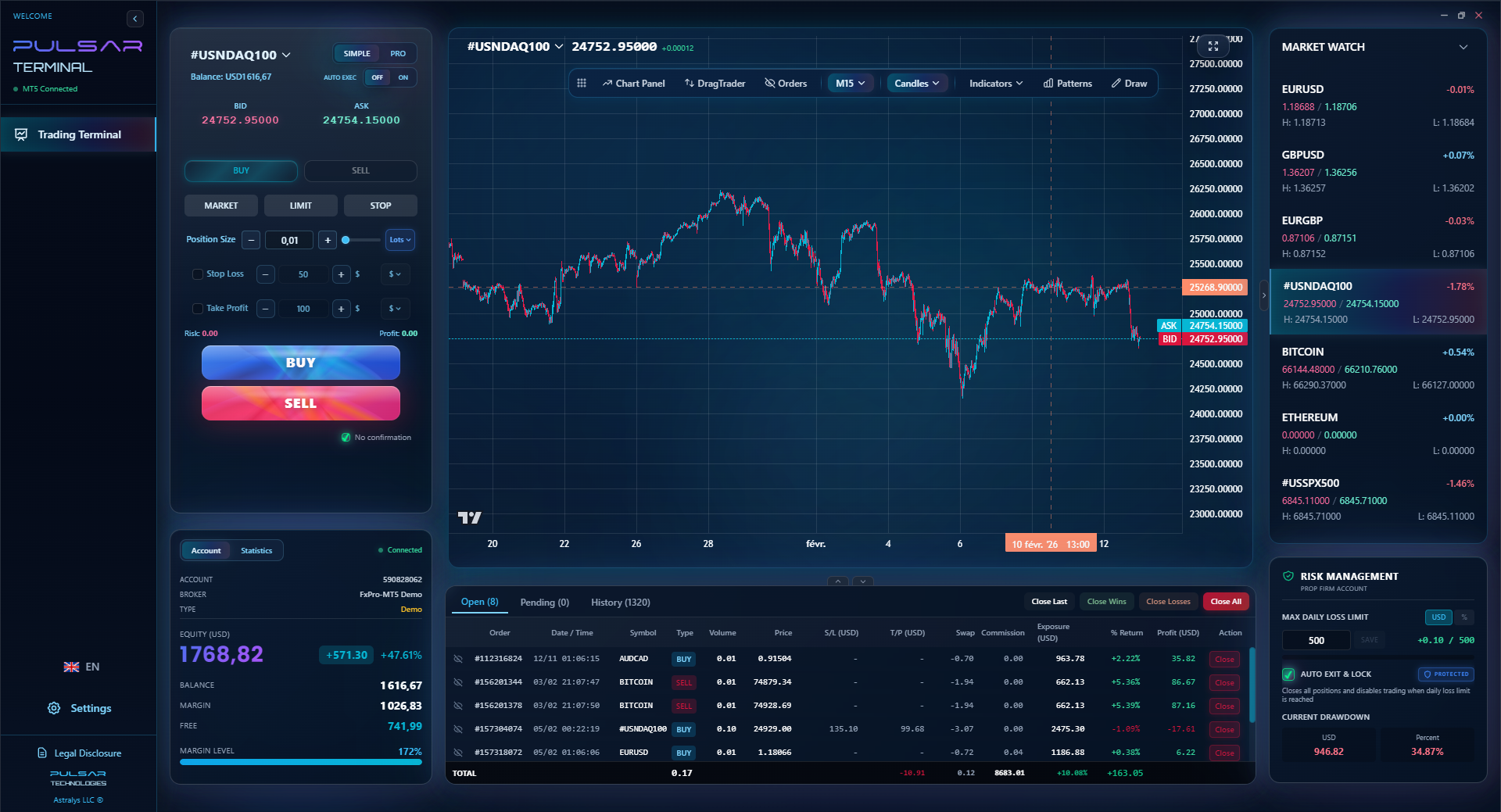
Managing multiple trades and setting precise stop-losses is critical, and tools like Pulsar Terminal automate this directly on your MT5 platform, letting you focus on analysis instead of order mechanics.
Pulsar Terminal
The all-in-one MT5 companion: drag-and-drop orders, multi-TP/SL, trailing stop, grid trading, Volume Profile, and prop firm protection. Used by 1,000+ traders daily.
“High use is not a tool for making money; it's a tool for losing it very, very quickly.”
Ready to begin? Do it in this order. Skipping steps is how you fund the market with your savings.
- Education First, Money Last. Spend at least 2-3 months learning. Understand everything in this guide. Read the new ISA 2025 yourself. Follow financial news, not just forex gurus on Twitter.
- Choose a Broker Carefully. Look for:
- Strong International Regulation: ASIC, FCA, FSCA are good signs.
- Local Payment Options: Can you fund with Naira via bank transfer or local e-wallets?
- Reasonable Minimum Deposit: Start small. Brokers like Exness or XM allow very small deposits, which is perfect for learning.
- MT4/MT5 Platform: This is the industry standard. Get familiar with it.
- Open a Demo Account. Trade on it for a minimum of 3 months. Your goal isn't to make fake millions. Your goal is to develop a consistent process and experience a losing streak without real money on the line. Can you stick to your rules when you're down?
- Start a Trading Journal. Write down every trade: the reason for entry, your emotion, the outcome. Review it weekly. This is your single most important tool for improvement.
- Go Live with Micro Lots. When you finally deposit, start with the smallest possible trade size. Your mission for the first 6 months is to preserve capital, not to explode it. Use your position size calculator religiously. Risk no more than 1-2% of your account on any single trade.
- Plan for Taxes. Open a separate savings account. Every time you make a profitable withdrawal, put 10% of the net gain into it for the FIRS. Do it immediately. Future you will be grateful.
💡 Winston's Tip
The most important indicator on your USD/NGN chart is the CBN's monetary policy committee calendar. Mark it in red.
“In Nigeria, trading USD/NGN is personal. It's where local knowledge meets brutal economic reality.”
Let me save you some money and heartache by sharing where I stumbled.
Chasing the Naira: When USD/NGN is rocketing, the fear of missing out (FOMO) is intense. You see it at 1500 and think, "It has to go to 2000!" You jump in late. Then the CBN intervenes, or there's a sudden dollar inflow, and it snaps back 300 pips. You're caught. Trade the trend, but wait for a pullback. Don't buy at the very top because of panic.
Over-leveraging: I've covered this, but it bears repeating. That 1:1000 use is a trap for new traders. It's designed to blow up your account quickly. Start with 1:10 or 1:20 max, even if your broker offers more.
Trading Without a Stop-Loss: This is suicide. Your stop-loss is your admission that you could be wrong. If you can't admit you're wrong, you shouldn't be trading.
Ignoring Fundamentals for Technicals: You might see a perfect bullish pattern on GBP/NGN. But if the Bank of England is about to cut rates and oil prices (which boost Naira reserves) are rising, that pattern is likely to fail. Always know what week it is on the economic calendar.
Emotional Trading After a Loss: You lose NGN 50,000. The anger and desire to "get it back now" are overwhelming. So you double your next position size, ignore your strategy, and trade recklessly. This is how a single bad loss turns into a catastrophic week. After a loss, walk away. Close the platform. Come back tomorrow.
The market doesn't care about your rent, your plans, or your ego. It just is. Your job is to build a system that interacts with it rationally, not emotionally.
FAQ
Q1Is forex trading legal in Nigeria?
Yes, it is legal for individuals. The landscape changed significantly with the Investments and Securities Act (ISA) 2025. It is now illegal for online forex trading platforms to operate without registering with the Securities and Exchange Commission (SEC). As a trader, you should ensure your chosen broker is compliant with this new law.
Q2How much money do I need to start forex trading in Nigeria?
Technically, you can start with a very small amount. Some brokers like Exness or FBS allow you to open an account with $0 or $1. However, I strongly advise against this. To trade responsibly with proper risk management (risking 1-2% per trade), a more realistic starting capital is at least $100-$200 (NGN 170,000 - NGN 340,000). Always start with a demo account first, regardless.
Q3How are my forex trading profits taxed?
Profits from forex trading are subject to Capital Gains Tax in Nigeria. The current rate is 10%. You are required to file a tax return with the Federal Inland Revenue Service (FIRS) and pay this tax on your net annual gains. Keep detailed records of all your trades, deposits, and withdrawals.
Q4What is the best forex trading platform for Nigerians?
MetaTrader 4 (MT4) and MetaTrader 5 (MT5) are by far the most widely used and supported platforms among international brokers that accept Nigerian clients. They are stable, have countless analytical tools, and are familiar to most traders. Most reputable brokers like IC Markets, Pepperstone, and XM offer these platforms.
Q5Can I trade the Nigerian Naira (NGN) online?
Yes, but primarily through the USD/NGN currency pair. This pair is offered by many international brokers. Trading it requires a deep understanding of local Nigerian economic policy, Central Bank of Nigeria (CBN) announcements, and oil price dynamics, as these are the main drivers of its price.
Q6Why do most Nigerian traders use international brokers instead of local ones?
Historically, because the local online retail forex market was not specifically regulated, leading to a lack of established, trustworthy local platforms. International brokers offer stronger regulatory protection (under bodies like CySEC or ASIC), advanced technology, and global market access. The new ISA 2025 may encourage more local platform development in the future.
Q7What is a safe use level for a beginner?
I recommend beginners use no more than 1:10 use. It might seem low, but it forces you to focus on good trade selection and position sizing. High use (like 1:500) allows you to control large positions with little capital, which magnifies losses and can wipe your account out from a very small market move against you.
Prof. Winston's Lesson
Key Takeaways:
- ✓The ISA 2025 mandates SEC registration for platforms, changing the legal landscape.
- ✓Capital Gains Tax is 10% on net profits; file returns within 90 days of year-end.
- ✓Start with use no higher than 1:10 to survive your learning phase.
- ✓A stop-loss order is non-negotiable, your single most important risk tool.
- ✓Market turnover grew 56.4% to $8.6bn in 2025, showing increased activity.
How useful was this article?
Click a star to rate
Weekly Trading Insights
Free weekly analysis & strategies. No spam.
About the Author
Olumide Adeyemi
West African Trading Pioneer
One of Nigeria's most active forex trading educators. 8 years of experience trading from Lagos. Specializes in low-capital strategies and prop firm challenges for African traders.
Comments
Risk Disclaimer
Trading financial instruments carries significant risk and may not be suitable for all investors. Past performance does not guarantee future results. This content is for educational purposes only and should not be considered investment advice. Always conduct your own research before trading.
You Might Also Like

Cara Trading Forex Sukses: 7 Prinsip dari Trader Profesional
Cara trading forex sukses dengan 7 prinsip trader pro: manajemen modal, disiplin, journal trading, backtest. Data nyata, bukan janji profit palsu.
Jam Trading Forex Terbaik untuk Trader Indonesia: Panduan Lengkap dengan Tabel Waktu
Panduan jam trading forex untuk trader Indonesia. Tabel 4 sesi dunia, jam emas 20:00-00:00, sesi mana yang harus dihindari. Data akurat + tips dari trader berpengalaman.
Top 5 Sàn Forex Uy Tín Nhất 2026: Review Jujur dari Trader Indonesia
Top 5 sàn forex uy tín 2026 untuk trader Indonesia. Review jujur: spread, deposit, withdraw, dukungan lokal. Exness, XM, IC Markets & lebih.
Get Pulsar Terminal
All these calculators are built into Pulsar Terminal with real-time data from your MT5 account. One-click position sizing, automatic risk management, and instant calculations.
Get Pulsar Terminal