


Most traders think asking 'when will forex market open' is about finding a time on a clock.

Olumide Adeyemi
West African Trading Pioneer ·  Nigeria
☕ 9 min read
What you'll learn:
- 1The '24/5' Myth and Why It's Dangerous
- 2Forex Market Sessions (in Nigerian Time)
- 3The Only Three Times That Actually Matter
- 4A Personal Story: My $1,200 Sunday Night Mistake
- 5How to Never Miss the Real Open (Tools & Tricks)
- 6Matching Your Strategy to the Right Session
- 7The Weekend Gap & The Prop Firm Trap

Most traders think asking 'when will forex market open' is about finding a time on a clock. They're wrong. That's the first step to blowing your account. The real opening isn't a single moment, it's a rolling wave of opportunity and danger that depends entirely on what you're trading and how you trade. I'll show you why the official 'open' is irrelevant, and the only three times that actually matter for your P&L.
You've heard it a million times: the forex market is open 24 hours a day, five days a week. Technically, that's true. But telling a new trader that is like telling a driver that a road is always open, without mentioning the hurricane, the gridlock, and the empty stretches in between. It's misleading.
The market doesn't trade with consistent energy. It sleeps, it wakes up, it has lunch, and it parties. Trading during the 'open' but dead hours is a surefire way to get chopped up by spreads or see no movement at all. I learned this the hard way early on. I'd sit at my screen at 10 PM Lagos time, ready to trade GBP/USD, wondering why my perfect setup on the RSI indicator was just sitting there, doing nothing. The spread was 3 pips wide on a normally 1-pip pair. I was trading in a ghost town.

Warning: Thinking the market is equally 'open' at all times is a fast track to frustration. Low liquidity means wider spreads, which instantly puts your trade in the red. Your broker isn't cheating you; there's simply no one on the other side of the trade.
The practical truth? The market is only truly 'open for business' when at least two of the major financial centers (London, New York, Tokyo, Sydney) are actively trading. For us in Nigeria, that means we need to plan our lives around when London and New York are awake.
Forget GMT. Let's talk WAT (West Africa Time). This is your daily rhythm. The sessions roll from one to the next, with overlaps creating the real fireworks.
Sydney Session (Opens ~10:00 PM WAT) This is the quiet opener. It's more of a warm-up. Pairs like AUD/USD and NZD/USD might see some action, but for most majors, it's slow. Not the best time for a scalping strategy unless you're specifically trading the Aussie.
Tokyo Session (Opens ~12:00 AM WAT) Now we get some action. The Asian session brings focus to JPY pairs (USD/JPY, EUR/JPY). It can be range-bound, but you get clear moves. If you're a night owl in Lagos, this is your first real window.
London Session (Opens ~8:00 AM WAT) This is the main event. The London open is when volume floods the market. This is the answer to 'when will forex market open' for 80% of traders. Spreads tighten, volatility picks up, and major trends often begin here. I make most of my money between 8 AM and 12 PM WAT. If you have a day job, waking up early to catch the London open can be a game plan.
New York Session (Opens ~1:00 PM WAT) London is still open, so from 1 PM to 4 PM WAT, you have the London-New York overlap. This is the most volatile, highest-volume period of the day. Big economic data (like US NFP) drops here. It's where you can make a lot of money very quickly, or lose it just as fast. It's not for the faint-hearted.

Example: On a typical Wednesday, EUR/USD might move 30 pips during the Asian session. During the London-New York overlap, it can easily move 70-100 pips in the same amount of time. That's the difference between a session being 'open' and being alive.

💡 Winston's Tip
The market's 'open' is a feeling, not a time. You feel it when spreads tighten and candles start pushing with purpose. If you don't feel it, walk away.

“The real opening isn't a single moment, it's a rolling wave of opportunity and danger.”
You don't need to memorize every session change. You need to know the three specific moments when the market's character fundamentally shifts. These are the real 'opens'.
1. The London Open (8:00 AM WAT)
This is the single most important open of the day. Liquidity providers, hedge funds, and major banks in Europe hit their desks. Order books fill up. The first hour after 8 AM WAT often sets the tone for the day. I've seen countless breakouts fail or succeed based on the momentum established here. If you only trade one 'open,' make it this one.
2. The New York Open (1:00 PM WAT)
This is when American liquidity enters. But the key isn't the New York open alone, it's the one-hour window from 1:00 PM to 2:00 PM WAT. This is peak liquidity. It's when the day's trend often accelerates or reverses. If you're holding a swing trading position from London, this is when you should be glued to the screen to manage it.
3. The Sydney/Tokyo Handover (12:00 AM - 1:00 AM WAT)
This is for the dedicated night trader or the insomniac. The transition from the quiet Sydney session to the more active Tokyo session can create sneaky volatility, especially in Asian pairs. It's a niche time, but if you're trading USD/JPY, you need to be aware of it.

Pro Tip: Don't place trades right at the open (e.g., 8:00:01 AM). Wait 15-30 minutes. Let the initial flood of orders settle and see which direction the market chooses. The first few minutes can be chaotic and whippy.
Let me be vulnerable. Early in my career, I didn't respect the market's weekly open. The forex market opens for the week on Sunday at 10:00 PM WAT (with the Sydney session). I saw a nice setup forming on EUR/USD late Sunday evening. The charts looked good, the news was calm. I entered a 2-lot position, thinking I was getting a head start on the week.
What I forgot was that Sunday liquidity is thin. Really thin. My entry was fine, but then a piece of unexpected news hit the wires - something minor that would normally cause a 10-pip blip. In this illiquid environment, it caused a 50-pip spike against me. My stop-loss was hit, but the spread had widened to 5 pips. I was filled at a terrible price.
Loss: $1,200 in under an hour. All because I traded the 'open' when the market was functionally still closed. The lesson was brutal: The first few hours of the Sunday/Monday open are a minefield. Wait until London gets in on Monday morning before you take any serious positions. Now, I use a tool to help me visualize session times and avoid these traps, which reminds me of the importance of context on your charts.
💡 Winston's Tip
Your most important trade management tool is a clock set to London and New York time. Everything else is background noise.
“I make most of my money between 8 AM and 12 PM WAT. If you have a day job, waking up early to catch the London open can be a game plan.”
You don't have to keep a mental clock. Use technology.
- Session Indicator on Your Chart: This is non-negotiable. Most platforms have indicators that shade the London, New York, and Asian sessions right on your chart. Seeing is believing. When the London shade appears, you know volatility is coming.
- Economic Calendar: The 'open' is about more than time, it's about events. The economic calendar on The Trading Mentor is your bible. A high-impact news event at 1:30 PM WAT (US data) defines the New York session open. Schedule your trading around it.
- Simple Phone Alarms: This is my low-tech solution. I have alarms set for:
- 7:45 AM WAT: 'London in 15'
- 12:45 PM WAT: 'NY in 15' It's a simple nudge to get focused.
- Watch the Spread: Your broker's spread is a direct liquidity meter. If the EUR/USD spread is normally 0.8 but is currently 2.5, the market isn't 'open' for your style of trading. Step away.
The goal is to make this automatic. You shouldn't be asking 'when will forex market open' every day. You should have a routine that aligns with the market's rhythm.
This is where knowledge turns into profit. Different strategies work at different 'opens.'
| Your Strategy | Best Session (WAT) | Why |
|---|---|---|
| Scalping | London-New York Overlap (1-4 PM) | Maximum liquidity, tightest spreads, quick moves. Ideal for taking 5-10 pips repeatedly. |
| Breakout Trading | First hour of London (8-9 AM) | New volatility breaks ranges established in Asia. |
| News Trading | 5 mins before/after major US data (Often 1:30 PM WAT) | You're trading the volatility spike itself. Requires a specific news trading strategy. |
| Swing Trading | Any time, but place orders during London hours. | You're catching a multi-day trend. Enter during high liquidity (London) for better fills, then manage over days. |
I used to try and scalp during the Tokyo session. It was like pulling teeth. I'd grind for 3 hours to make 15 pips. Once I shifted my scalping to the London-New York overlap, I could often make that in two trades. It's about efficiency. Don't fight the market's natural energy flow.
Also, consider your pair. Trading GBP/USD? Your world revolves around London and New York. Trading AUD/JPY? The Tokyo and Sydney opens are critically important. Check out our specific guide on the EUR/USD for a deep dive on timing that major pair.
💡 Winston's Tip
The first rule of prop firm survival: Your Friday trade close time is 3:30 PM WAT. No exceptions. Let the weekend warriors blow up.
“Loss: $1,200 in under an hour. All because I traded the 'open' when the market was functionally still closed.”
Here's a critical nuance for funded traders and everyone else. The market closes on Friday around 10 PM WAT (NY close) and reopens Sunday at 10 PM WAT. Price can, and does, 'gap' open at a different level based on weekend news.
For a prop firm trader, this is a massive risk. Most prop firms (like FTMO, MyForexFunds) have a daily loss limit. If you hold a position over the weekend and it gaps against you on Sunday open, that loss is calculated immediately. You could blow your daily loss - and your challenge - before you even log in.
Warning: If you're in a prop firm challenge, going into the weekend with an open position is borderline reckless. The Sunday open is the most unpredictable of the week. Always close your positions before Friday's New York close. The peace of mind is worth it.
This is where trade management tools become essential. Having a platform that can help you visualize risk and set hard rules to avoid weekend holds is a career-saver. It automates the discipline you need to survive.

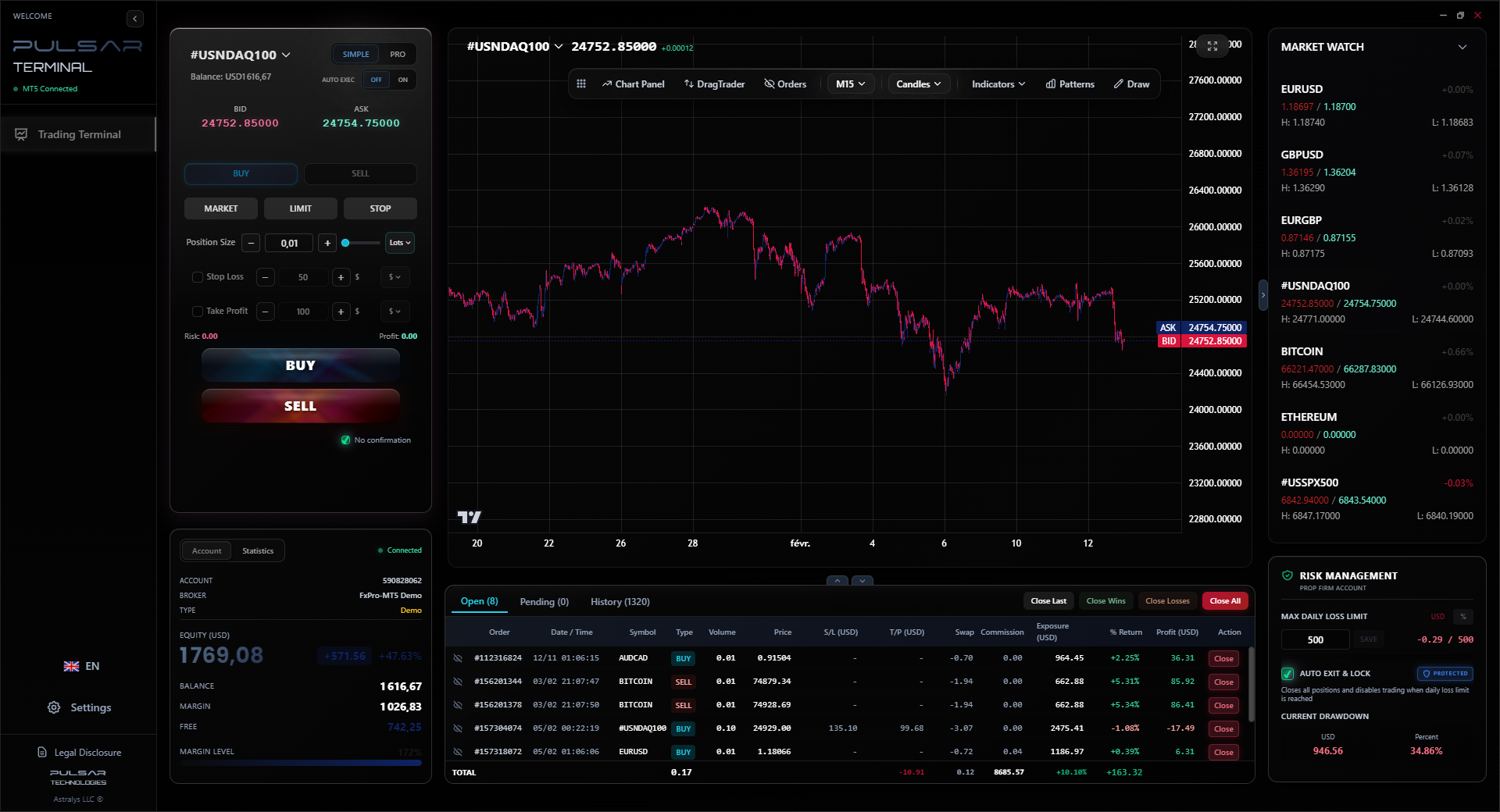
Managing trades across volatile session opens requires precision; Pulsar Terminal's drag-and-drop orders and multi-TP/SL tools let you adjust your plan in seconds directly on your MT5 chart.
Pulsar Terminal
The all-in-one MT5 companion: drag-and-drop orders, multi-TP/SL, trailing stop, grid trading, Volume Profile, and prop firm protection. Used by 1,000+ traders daily.
FAQ
Q1What time does forex market open on Monday in Nigeria?
The forex market's weekly trading begins with the Sydney session opening at 10:00 PM West Africa Time (WAT) on Sunday evening. However, liquidity is very thin. For practical trading, wait for the major London session open at 8:00 AM WAT on Monday morning.
Q2Is the forex market open on Saturday and Sunday in Nigeria?
No. The spot forex market is closed to retail trading from roughly Friday 10:00 PM WAT (New York close) until Sunday 10:00 PM WAT (Sydney open). Some brokers offer limited weekend trading on futures or specific instruments, but liquidity is extremely low and it's not recommended.
Q3What is the best time to trade forex in Nigeria?
The best time is during the overlap of the London and New York sessions, from 1:00 PM to 4:00 PM WAT. This period has the highest volume and volatility, offering the best opportunities for most strategies. The first two hours of the London session (8:00 AM - 10:00 AM WAT) are also excellent.
Q4Can I trade forex at night in Nigeria?
Yes, but your options are limited. The Tokyo session runs from about 12:00 AM to 8:00 AM WAT. This is suitable for trading JPY pairs (like USD/JPY) or if you have a specific strategy for Asian market hours. Expect lower volatility than the London/New York sessions.
Q5Why did my stop-loss get a bad fill on a Sunday?
This is likely due to a 'gap' and low liquidity. When the market opens Sunday at 10 PM WAT, price can jump from Friday's close. If the jump is past your stop-loss price, your order is filled at the next available price, which can be much worse. This is a key reason to avoid holding trades over the weekend.
Q6Does the forex market close for holidays in Nigeria?
The forex market doesn't close for Nigerian holidays. It closes for holidays in the major financial centers (UK, US, Japan, Australia). For example, if it's a bank holiday in London, the London session will be very quiet even though the market is technically 'open.' Always check an economic calendar for holiday schedules.
Prof. Winston's Lesson
Key Takeaways:
- ✓The London Open (8 AM WAT) is the true market engine start.
- ✓Sunday/Monday open is a liquidity trap. Wait for London.
- ✓Match your strategy to the session: Scalping needs the 1-4 PM WAT overlap.
- ✓Never hold a prop firm trade over the weekend. Ever.
How useful was this article?
Click a star to rate
Weekly Trading Insights
Free weekly analysis & strategies. No spam.
About the Author
Olumide Adeyemi
West African Trading Pioneer
One of Nigeria's most active forex trading educators. 8 years of experience trading from Lagos. Specializes in low-capital strategies and prop firm challenges for African traders.
Comments
Risk Disclaimer
Trading financial instruments carries significant risk and may not be suitable for all investors. Past performance does not guarantee future results. This content is for educational purposes only and should not be considered investment advice. Always conduct your own research before trading.
You Might Also Like

Cara Trading Forex Sukses: 7 Prinsip dari Trader Profesional
Cara trading forex sukses dengan 7 prinsip trader pro: manajemen modal, disiplin, journal trading, backtest. Data nyata, bukan janji profit palsu.
Jam Trading Forex Terbaik untuk Trader Indonesia: Panduan Lengkap dengan Tabel Waktu
Panduan jam trading forex untuk trader Indonesia. Tabel 4 sesi dunia, jam emas 20:00-00:00, sesi mana yang harus dihindari. Data akurat + tips dari trader berpengalaman.
Top 5 Sàn Forex Uy Tín Nhất 2026: Review Jujur dari Trader Indonesia
Top 5 sàn forex uy tín 2026 untuk trader Indonesia. Review jujur: spread, deposit, withdraw, dukungan lokal. Exness, XM, IC Markets & lebih.
Get Pulsar Terminal
All these calculators are built into Pulsar Terminal with real-time data from your MT5 account. One-click position sizing, automatic risk management, and instant calculations.
Get Pulsar Terminal