


You're probably scrolling through Instagram, seeing flashy cars and screens full of green trades, thinking the secret is in some N500,000 'masterclass'.

Olumide Adeyemi
Пионер трейдинга в Западной Африке ·  Nigeria
☕ 10 мин чтения
Что вы узнаете:
- 1The Academy Myth: Why You're Chasing Ghosts
- 2The Real Curriculum: What You Actually Need to Learn
- 3Free Resources vs. Paid Courses: Where to Put Your Money
- 4The Nigerian Context: Unique Challenges You Must Account For
- 5Building Your Own 'Academy': A 90-Day Plan
- 6Massive Red Flags: How to Spot a Scam 'Academy'
- 7Invest in Tools, Not Gurus
You're probably scrolling through Instagram, seeing flashy cars and screens full of green trades, thinking the secret is in some N500,000 'masterclass'. Let me stop you right there. The best forex academy isn't a course or a guru. It's the brutal, expensive school of your own blown-up accounts and the disciplined process you build from the ashes. I've lost more money searching for a 'system' than I care to admit. This guide isn't about where to sign up, it's about what you actually need to learn to survive.
Everywhere you look in Nigeria, there's a new 'forex god' selling a course. They promise a secret indicator, a guaranteed strategy, instant funding. It's a trap. I paid N300,000 for one of these programs back in 2017. The 'secret' was a basic moving average crossover you can find for free on YouTube. The real lesson, the one that cost me that money, was that no one sells a golden goose. If their strategy printed money consistently, they'd be using it, not selling it for the price of a laptop.
The search for the best forex academy is often a form of procrastination. It feels like progress - you're 'learning' - but it's just delaying the real work: putting your own skin in the game and developing judgment. You're waiting for permission to start, for someone to hand you the keys. They never come.

Warning: Any 'academy' that focuses more on lifestyle (cars, watches, vacations) than on drawdown statistics, risk-reward ratios, and journaling is selling a dream, not an education. Their profit is your registration fee, not your trading success.
True education is iterative and personal. What works for a scalper in Lagos with a fast Exness review ECN account won't work for a swing trader in Port Harcourt dealing with power outages. The core principles are universal, but the application isn't. You can't buy a one-size-fits-all solution.
“The search for the best forex academy is often a form of procrastination.”
Forget the fancy titles. Your education needs to cover three brutal subjects, in this order: Risk Management, Trading Psychology, and only then, Market Analysis.
1. Risk Management: Your Survival Manual
This is non-negotiable. Before you even think about an entry signal, you need to know exactly how much you can lose. I define this as a percentage of my account per trade and per day. My rule is 1% max per trade, 3% max per day. If I hit that 3% daily loss, I'm done. Computer off. This single rule has saved me from ruin more times than any indicator.
You must understand position sizing cold. Not knowing how to calculate your lot size based on your stop-loss is like driving blindfolded. Use a position size calculator every single time, no exceptions. You also need to understand the mechanics of a margin call and how use amplifies both gains and losses.
2. Trading Psychology: Taming Your Biggest Enemy
Your brain is wired to lose money in the markets. It seeks confirmation, fears missing out (FOMO), and hates taking losses. The best forex academy in the world can't fix this for you. You have to build the muscle.
I keep a physical journal. Every trade gets logged: entry, exit, pip definition gain/loss, but more importantly, my emotional state. 'Felt rushed because EUR/USD was moving.' 'Held loser too long hoping for a rebound.' This is where you learn about yourself. The market is a mirror.
3. Market Analysis: The Final Piece
Now you can talk about strategy. This breaks down into:
- Price Action: Learning to read candlestick patterns and support/resistance. This is foundational.
- Technical Indicators: Tools, not oracles. I use the RSI indicator for overbought/oversold zones and the MACD indicator for trend momentum. But they are secondary to price.
- Fundamentals: For a Nigerian trader, this means knowing when major US economic data (Non-Farm Payrolls, CPI) drops, as it causes volatility. It also means understanding how oil prices (like XAU/USD for gold) can affect the Naira and related pairs. Check our XAU/USD guide for a commodity deep dive.

Example: Let's say you have a N200,000 account. Your 1% risk is N2,000. You're looking to buy USD/NGN (if available via CFDs) and your stop-loss is 50 pips away. If the pip value for a standard lot is roughly N1,000 (this varies), you can only risk 2 micro lots (0.02) to stay within your N2,000 risk. Math first, trade second.

💡 Совет Уинстона
The market doesn't care about your tuition fee. A N500,000 course won't make the charts respect you. Only your discipline will.
“Your brain is wired to lose money in the markets.”
Your first N100,000 should not go to a course. It should be capital you are prepared to lose while learning. Here's how to allocate your resources, both time and money.
Free Resources (Your Foundation):
- Broker Education: Reputable brokers like IC Markets review and Pepperstone review have extensive free libraries on basics, webinars, and market analysis.
- YouTube (Carefully): Search for specific concepts: 'how to draw support and resistance', 'understanding candlestick patterns'. Avoid the 'get rich quick' channels. Look for educators who discuss losses openly.
- Forums & Communities: Find serious trading discords or forums where people post trade reviews and losses, not just wins.
When to Consider Paying: The only time I recommend paying is for very structured, mentorship-style learning that focuses on the process, not signals. Even then, be skeptical. Look for:
- Transparency: The mentor shows their full trade history, including losses.
- Process-Oriented: They teach how they think, not just what they see.
- Risk-First Approach: The first module should be on capital preservation.
I once paid for a mentorship that was just weekly Q&A calls. The value wasn't in a magic strategy, it was in hearing an experienced trader talk through their uncertainty in real time. That was worth it. A PDF of '10 winning patterns' is not.

Pro Tip: Before paying for any course, ask the seller for a verified, multi-year track record (like a Myfxbook link). If they can't or won't provide one, walk away. Their business is selling hope, not results.
“Your brain is wired to lose money in the markets.”
Trading from Nigeria isn't the same as trading from London or New York. Your 'best forex academy' must include these local realities in the syllabus.
Internet & Power Stability: Your strategy must account for disconnections. This immediately makes ultra-short-term scalping strategy extremely risky. I learned this the hard way during a key news event. My trade was in profit, the internet dropped, and by the time I reconnected, I was stopped out at a loss. Now, I prefer higher time frame swing trading where a 30-minute disconnection isn't a catastrophe.
Broker Choice & Withdrawals: Not all international brokers are friendly to Nigerian clients. You need a broker with reliable deposit and withdrawal methods (like bank transfer or local e-wallets) and a good local reputation. Do your due diligence with reviews like our XM review to see what other Nigerian traders experience. Always test the withdrawal process with a small amount first.
Regulatory Reality: The SEC Nigeria regulates local forex brokers, but many Nigerians use internationally regulated brokers for access to global markets. Understand where your broker is regulated and what that means for your fund protection. Your capital is likely not covered by Nigerian investor protection schemes if you're with an offshore broker.
The Naira Factor: Volatility in USD/NGN can impact your psychology if you're trading other pairs. Seeing your deposit currency devalue can create a sense of urgency to 'make up for it' in the forex market, leading to reckless trades. Separate your trading capital mentally from your local currency concerns.
💡 Совет Уинстона
Your first profitable trade is a danger. It convinces you you're smart. Your first big loss is the real teacher. Listen to it.
“Before you even think about an entry signal, you need to know exactly how much you can lose.”
This is your action plan. Consider this the syllabus for the only academy that matters: yours.
Weeks 1-4: The Demo Foundation
- Goal: Learn your platform. Place 100 trades on a demo account.
- Action: Don't try to make money. Try to test everything. Trigger a margin call on purpose. Test stop-loss and take-profit orders. Understand the spread definition and how it changes during news events.
- Focus: Pure mechanics. No emotion because it's fake money. That's the point.
Weeks 5-8: Live Micro Account & Journaling
- Goal: Introduce real money and real emotion.
- Action: Fund a live account with the smallest possible amount (e.g., $50 or N20,000). Trade micro lots (0.01). Your goal is not profit. Your goal is to execute 50 trades following a strict written plan for each one. The plan must include entry reason, stop-loss, take-profit, and position size.
- Focus: Journal every trade. Did you follow your plan? How did you feel? This phase is about building the habit of discipline with money that is real but not life-changing.
Weeks 9-12: Review & Refine
- Goal: Analyze your performance data.
- Action: Review your journal. Calculate your win rate, your average win size, and your average loss size. Is your risk-reward ratio at least 1:1.5? Most beginners find they let losses run and cut wins short, resulting in a terrible ratio.
- Focus: Refine your plan based on data, not emotion. Maybe you're better at trend-following than reversal trades. Your journal will tell you.
This 90-day cycle is more valuable than any 4-week intensive course. It's real, it's personal, and it's focused on process.
“Before you even think about an entry signal, you need to know exactly how much you can lose.”
In Nigeria's vibrant but sometimes wild trading space, you need a scam detector. Here are the neon signs.
- Guaranteed Profits or High Win Rates: Anyone guaranteeing more than a 70% win rate is lying. Full stop. The market is probabilistic, not certain. I've had months with 40% win rates that were profitable because my risk-reward was 1:3, and months with 60% win rates that were losers.
- Upfront Payment for 'Signals': Signal sellers are a plague. You learn nothing, and you're dependent on someone who has zero accountability. If their signal loses your money, what's your recourse? Nothing.
- Pressure to Deposit More Money: A real educator teaches you to manage what you have. A scammer always has a reason you need a 'larger capital base' to implement their 'advanced strategy.' They just want a bigger chunk of your money.
- Vague or No Verifiable Track Record: As mentioned, ask for the Myfxbook. Excuses like 'it's private' or 'the platform doesn't work' are nonsense. A real trader can provide some form of verified performance history.
- Focus on Luxury Goods: This is the biggest one in our social media age. The car, the rented penthouse, the stack of cash - it's all theater. It's marketing to appeal to your desire, not evidence of trading skill. I know traders making consistent returns who drive a 2008 Camry because they compound their gains, not spend them.
If you see two of these, run. Your greatest asset as a trader is your capital. Protecting it from predators is your first job.
💡 Совет Уинстона
If you can't explain your edge in one simple sentence, you don't have one. Complexity is often used to hide a lack of understanding.
“A real educator teaches you to manage what you have. A scammer always has a reason you need a 'larger capital base'.”
Shift your spending mindset. Instead of sending N150,000 to a guru, invest in tools that improve your process and objectivity.
A Reliable Laptop & Internet: This is your primary tool. A good router and a stable ISP are more critical than a new indicator.
A Trading Journal Software: While a notebook works, dedicated software can help you analyze your stats more easily over time.
A Quality Charting Platform: MetaTrader 5 is standard, but its native tools can be clunky. This is where a companion app that enhances your efficiency becomes a force multiplier.
Think about it: a guru gives you a fish (maybe). A good tool helps you build a better fishing rod and teaches you to maintain it yourself. The right tool removes emotional friction from your trading. For example, setting a complex trade with multiple take-profit levels manually while the market is moving is stressful and error-prone. Automation and better order management take that psychological burden off your shoulders, letting you focus on analysis and sticking to your plan.
The goal is to systemize your process so your human weaknesses - fear, greed, hesitation - have less room to interfere. That's a better investment than any secret strategy.
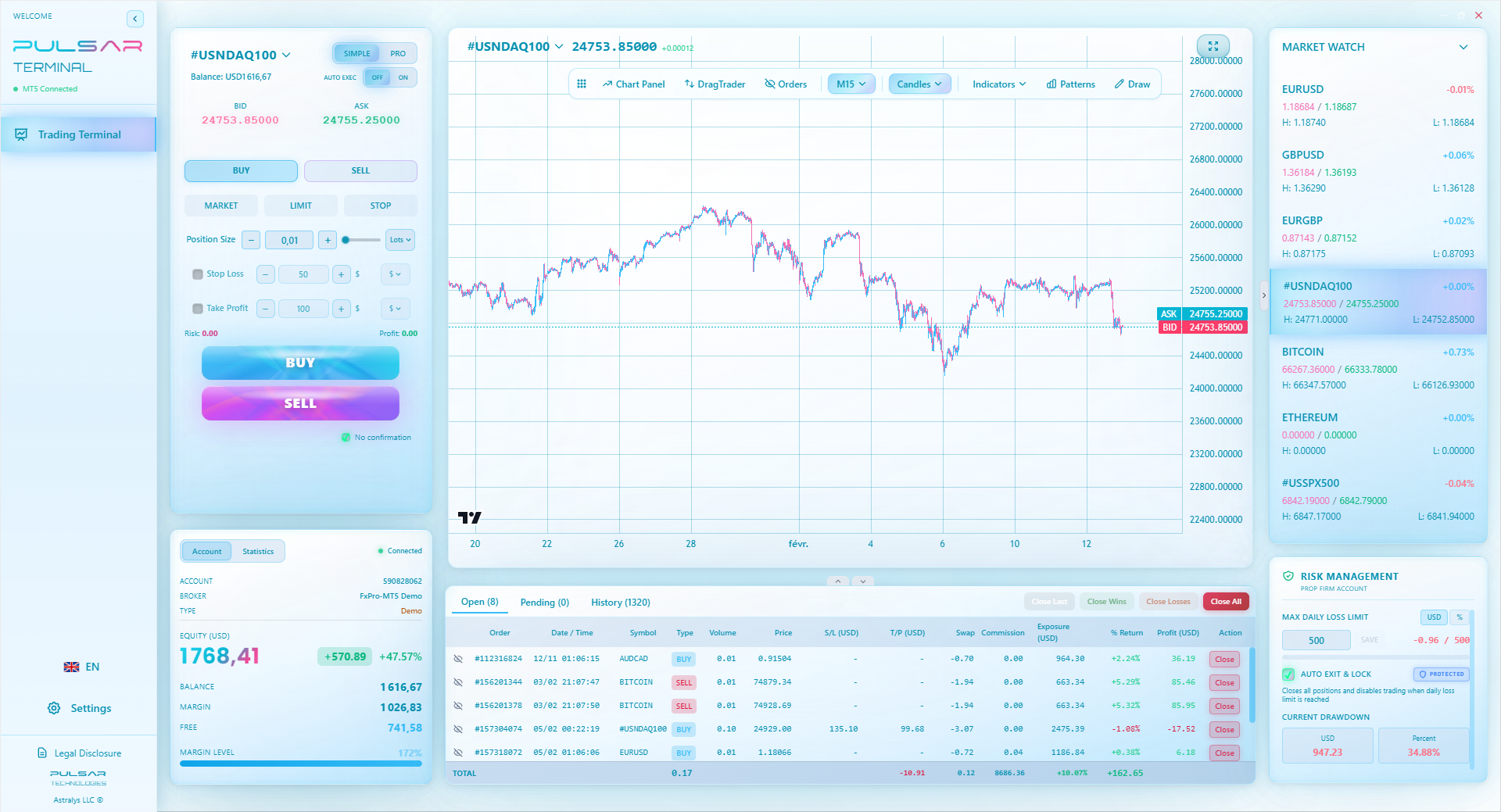
Managing complex trades and your emotions is easier when your platform handles the mechanics, letting you focus on your plan—tools like Pulsar Terminal automate advanced order types directly on MT5.
Pulsar Terminal
Универсальный инструмент для MT5: drag-and-drop ордера, мульти-TP/SL, трейлинг-стоп, грид-трейдинг, Volume Profile и защита для проп-фирм. Используется 1000+ трейдерами ежедневно.
FAQ
Q1What is the best forex academy in Nigeria?
Honestly, there's no single 'best' academy. The most effective education is self-directed and focuses on risk management, psychology, and consistent practice on a demo then micro account. Be deeply skeptical of any institution that makes grand promises.
Q2How much does a good forex trading course cost in Nigeria?
A legitimate, process-focused mentorship might cost between N100,000 to N500,000. However, you can build a world-class foundation for free using broker resources and YouTube. Only consider paying once you know the basics and are seeking to refine a specific, proven process. Never pay for 'guaranteed' signals.
Q3Can I learn forex trading by myself in Nigeria?
Absolutely, and I recommend you start that way. Use free educational content from major international brokers, practice extensively on a demo account for at least a month, and then trade micro lots with real money to learn psychology. Self-learning forces you to develop your own judgment, which is the core skill of trading.
Q4What should I look for in a forex mentor?
Look for transparency (verified track record), a focus on risk management first, and a teaching style that explains the 'why' behind decisions. They should talk openly about their losses and psychological struggles. Avoid anyone who just shows wins, luxury items, or uses high-pressure sales tactics.
Q5Is forex trading profitable in Nigeria given the internet challenges?
It can be, but you must adapt your strategy. High-frequency scalping is very risky due to connectivity issues. Many successful Nigerian traders use higher time frame strategies (like 4-hour or daily charts) for swing trading, where a temporary disconnection is less likely to ruin a trade. Reliable internet and a power backup are part of your necessary trading capital.
Q6How long does it take to become a consistently profitable trader?
Assume a minimum of 1 to 2 years of dedicated study and practice. It's not about learning a strategy; it's about rewiring your brain's instinctive responses to money and uncertainty. Most people give up or blow up their accounts before this period is over. Consistency comes from experience, not just knowledge.
Урок проф. Уинстона
Ключевые выводы:
- ✓Risk 1% per trade, 3% per day max.
- ✓Demo trade for mechanics, micro account for psychology.
- ✓Journal every trade: entry, exit, and emotion.
- ✓Win rate is less important than risk-reward ratio.
- ✓Avoid any 'educator' who showcases luxury over logs.
Насколько полезна эта статья?
Нажмите на звезду
Еженедельные торговые инсайты
Бесплатный еженедельный анализ и стратегии. Без спама.
Об авторе
Olumide Adeyemi
Пионер трейдинга в Западной Африке
Один из самых активных преподавателей форекс-трейдинга в Нигерии. 8 лет торгового опыта из Лагоса. Специализируется на стратегиях с малым капиталом и челленджах проп-фирм для африканских трейдеров.
Комментарии
Предупреждение о рисках
Торговля финансовыми инструментами сопряжена со значительным риском и может не подходить всем инвесторам. Прошлые результаты не гарантируют будущих доходов. Данный контент носит исключительно образовательный характер и не является инвестиционной рекомендацией. Всегда проводите собственное исследование перед торговлей.
Вам также может понравиться

Cara Trading Forex Sukses: 7 Prinsip dari Trader Profesional
Cara trading forex sukses dengan 7 prinsip trader pro: manajemen modal, disiplin, journal trading, backtest. Data nyata, bukan janji profit palsu.
Jam Trading Forex Terbaik untuk Trader Indonesia: Panduan Lengkap dengan Tabel Waktu
Panduan jam trading forex untuk trader Indonesia. Tabel 4 sesi dunia, jam emas 20:00-00:00, sesi mana yang harus dihindari. Data akurat + tips dari trader berpengalaman.
Top 5 Sàn Forex Uy Tín Nhất 2026: Review Jujur dari Trader Indonesia
Top 5 sàn forex uy tín 2026 untuk trader Indonesia. Review jujur: spread, deposit, withdraw, dukungan lokal. Exness, XM, IC Markets & lebih.
Скачать Pulsar Terminal
Все эти калькуляторы встроены в Pulsar Terminal с данными в реальном времени с вашего счёта MT5.
Скачать Pulsar Terminal