


You want to know who the best forex brokers in the world are, right? Let me stop you right there.

Olumide Adeyemi
Пионер трейдинга в Западной Африке ·  Nigeria
☕ 11 мин чтения
Что вы узнаете:
- 1Why 'Global' Broker Rankings Are Mostly Useless
- 2Your 3 Non-Negotiable Filters (Before You Look at Spreads)
- 3Breaking Down the Top Contenders for Nigeria
- 4The use Trap: Why 1:1000 Will Bankrupt You
- 5Taxes & Legal Reality: What Nobody Tells You
- 6My Broker Journey: Two Costly Mistakes
- 7The Final Step: How to Choose Yours
You want to know who the best forex brokers in the world are, right? Let me stop you right there. The real question isn't about a global ranking. It's about which of those top brokers actually works for you, sitting in Lagos, Port Harcourt, or Abuja. The 'best' broker for a trader in London with pounds is useless if it won't accept your Naira deposit or gets your account frozen. I've traded from Nigeria for over a decade, and I've seen more accounts blown by poor broker choice than by bad market calls. Let's cut through the hype and talk about what actually matters for your money.
Every year, some website publishes a list of the 'top 10 best forex brokers in the world.' They use fancy algorithms and weightings for regulation, spreads, and platforms. It looks scientific. It's mostly nonsense for you.
Why? Because they assume a level playing field. They don't account for the single biggest factor for a Nigerian trader: accessibility. A broker regulated by the UK's FCA might be 'Tier-1,' but if they've closed their doors to Nigerian clients due to regulatory pressure (which happens), they're worth exactly zero to you. Your first filter isn't spreads; it's 'Will they open my account and let me fund it?'
I learned this the hard way early on. I spent days researching a highly-rated European broker, only to get my application rejected because of my residency. Wasted time. The second lesson was funding. I funded an account with a broker that had great reviews, only to discover their only withdrawal method was an international wire that cost me $45 in bank charges and took two weeks. My first 'profit' was completely eaten by fees. That's when I realized the real cost of trading isn't just the spread; it's the total cost of getting your money in and out.
So, we're not looking for a mythical 'world's best' broker. We're looking for the best available broker that meets a Nigerian trader's non-negotiable needs: acceptance, affordable funding/withdrawal, and then competitive trading conditions.

💡 Совет Уинстона
A broker is a utility, not a strategy. Your edge comes from your analysis and discipline, not their flashy platform. Choose the one that's most reliable, not the most exciting.
“The 'best' broker for a trader in London is useless if it won't accept your Naira deposit.”
Before you even glance at a pip or use number, run every broker through these three checks. Fail any one, and you move on.
1. Do They Accept Nigerian Clients?
This seems obvious, but you'd be surprised. Many top-tier brokers under strict EU or UK regulation have geoblocked Nigeria or certain African countries. Always check the broker's official website for their country list. Don't rely on affiliate review sites; they're often outdated.
2. What Are the REAL Deposit & Withdrawal Options?
This is where the rubber meets the road. Can you deposit in Naira? What methods do they offer?
- Local Bank Transfer (NGN): The gold standard. You send Naira to a local intermediary (like a payment processor or a Nigerian bank account), and it's converted and credited to your trading account. Fees are usually low or zero from the broker's side.
- Cryptocurrency (USDT, BTC): Increasingly popular. Fast, often low-fee, and bypasses traditional banking hurdles. The volatility of the crypto itself is a separate risk, but for moving value, it's efficient.
- International Wire (USD): The old way. Expensive, slow, and you'll have to deal with your bank's FX sourcing questions. I avoid this unless it's the only option.
- E-wallets (Skrill, Neteller, PayPal): Convenient, but check if the broker supports them for Nigerian users. Sometimes there are restrictions.

Warning: If a broker only offers international wire transfers, think twice. The hidden costs and delays will chip away at your capital before you even place a trade.
3. What's Their Regulatory Stance?
Since Nigeria's SEC doesn't specifically regulate online forex brokers, you're relying on the broker's international regulation. This is your safety net. Look for brokers licensed by at least one reputable authority: ASIC (Australia), CySEC (Cyprus), FSCA (South Africa), or the FSA (Seychelles). This means they have to adhere to certain capital requirements and client fund segregation rules. It's not perfect, but it's far better than an unregulated offshore shell company.
A broker like Exness, for example, is popular here precisely because it ticks these boxes: accepts Nigerians, offers local deposits, and holds multiple international licenses.
“Using 1:1000 use is a one-way ticket to a margin call for 99.9% of traders.”
Based on the filters above, here are brokers that consistently come up as viable for Nigerian traders. This isn't a ranking, but a comparison of key specs. Remember, the 'best' depends on your style. A scalping needs raw spreads. A beginner might value a low minimum deposit.
| Broker | Key Regulation | Min. Deposit (Approx.) | Key Feature for Nigerians | Best For... |
|---|---|---|---|---|
| Exness | CySEC, FSCA | ~$10 (often less) | Naira deposits, local support, very high use available. | Traders who want flexibility in funding and high use. |
| XM | CySEC, ASIC | $5 | Very low minimum deposit, $30 no-deposit bonus (check eligibility). | Beginners wanting to start very small. |
| IC Markets | ASIC | $200 | some of the tightest raw spreads in the industry. | Serious scalpers and high-volume traders who need the best possible execution. |
| HFM | FSCA | NGN 4,000+ | Offers Naira-denominated accounts explicitly. | Traders who want to think purely in Naira for account size. |
| FBS | CySEC | $1 | Extremely low barrier to entry, high use. | Absolute beginners testing the waters with tiny capital. |
Let me give you a real example. In 2023, I was testing a high-frequency strategy on EUR/USD. I used an IC Markets Raw Spread account. The spread was consistently 0.0 pips with a $3.50 commission per lot. For 100 trades a day, that cost was predictable. I tried the same strategy on a different 'commission-free' broker. The spread averaged 1.2 pips. That's a $12 cost per lot round turn. My strategy was profitable on IC, but a net loser on the other platform because the hidden cost was higher. Always calculate the total cost.

Pro Tip: Don't get hypnotized by 'zero spread' claims. Often, it's '0.0 pips + commission.' Do the math: (Spread in pips * Pip Value) + Commission = Your real cost. Sometimes a 0.8 pip fixed spread with no commission is cheaper.
“Using 1:1000 use is a one-way ticket to a margin call for 99.9% of traders.”
This is the section where I sound like your angry risk manager. Because I need to.
Brokers advertise insane use like 1:1000, 1:2000, even 1:3000 to attract clients. It's marketing candy. For 99.9% of traders, using anything close to that is a one-way ticket to a margin call. Let's talk numbers.
With 1:1000 use, a $100 account can control a $100,000 position. A move of just 10 pips against you on a standard lot would be a $100 loss. Your entire account. Gone in a blink. The market moves 10 pips in seconds.
Here's my personal rule, forged from burning $2,000 in my second year of trading: Never use more than 1:10 use on your entire account equity. If you have a $1,000 account, don't open positions with a total notional value exceeding $10,000. For most retail traders, even 1:10 is aggressive.
Why do brokers offer it then? Because they know most traders don't understand position sizing. They see big use, think they can get rich with $50, and then lose it quickly. The broker makes money on the spread whether you win or lose. Your high use is their customer acquisition cost.
Use a position size calculator religiously. Decide your risk per trade (e.g., 1% of your account), your stop-loss distance, and let the calculator tell you the correct lot size. The broker's maximum use is irrelevant. Your own risk-defined use is everything.

Example: You have a NGN 300,000 account (~$200). You decide to risk 1% (NGN 3,000 / ~$2). Your stop loss on a USD/NGN trade is 50 pips. A pip on a micro lot (0.01) might be ~NGN 10. To risk NGN 3,000, you can only trade 0.06 lots. That's using effective use of maybe 1:3. Not 1:1000.
💡 Совет Уинстона
Test withdrawal before you deposit big. The true test of a broker isn't how easy it is to give them money, but how easy it is to get it back.
“Your profit is taxable income. The FIRS expects you to pay Capital Gains Tax. Set aside 10%.”
Let's be clear about the law. Forex trading is legal in Nigeria. The Central Bank of Nigeria (CBN) regulates the FX market, but online retail trading with international brokers operates in a bit of a gray area - it's not explicitly illegal, but it's not specifically regulated by the SEC for retail like stocks are.
This is the critical part: Your profit is taxable income. The Federal Inland Revenue Service (FIRS) expects you to pay Capital Gains Tax on your trading profits. The standard rate is 10%.
I know, I know. You're thinking, 'My broker is offshore, how will they know?' That's a short-term gamble. If you succeed and start withdrawing significant amounts to your Nigerian bank account, the bank may ask questions about the source of funds. Consistent large inflows from overseas can raise flags.
The professional approach is to keep careful records. Track every deposit, withdrawal, and your net profit/loss for the year. Consult with a Nigerian accountant who understands trading. Set aside a portion of your profits for tax. Treating this as a real business is what separates a gambler from a trader.
The market is maturing. The CBN's recent reforms, like unifying exchange rates and launching an electronic FX trading system, are steps towards a more formal market. Being on the right side of the tax law now will save you massive headaches later.
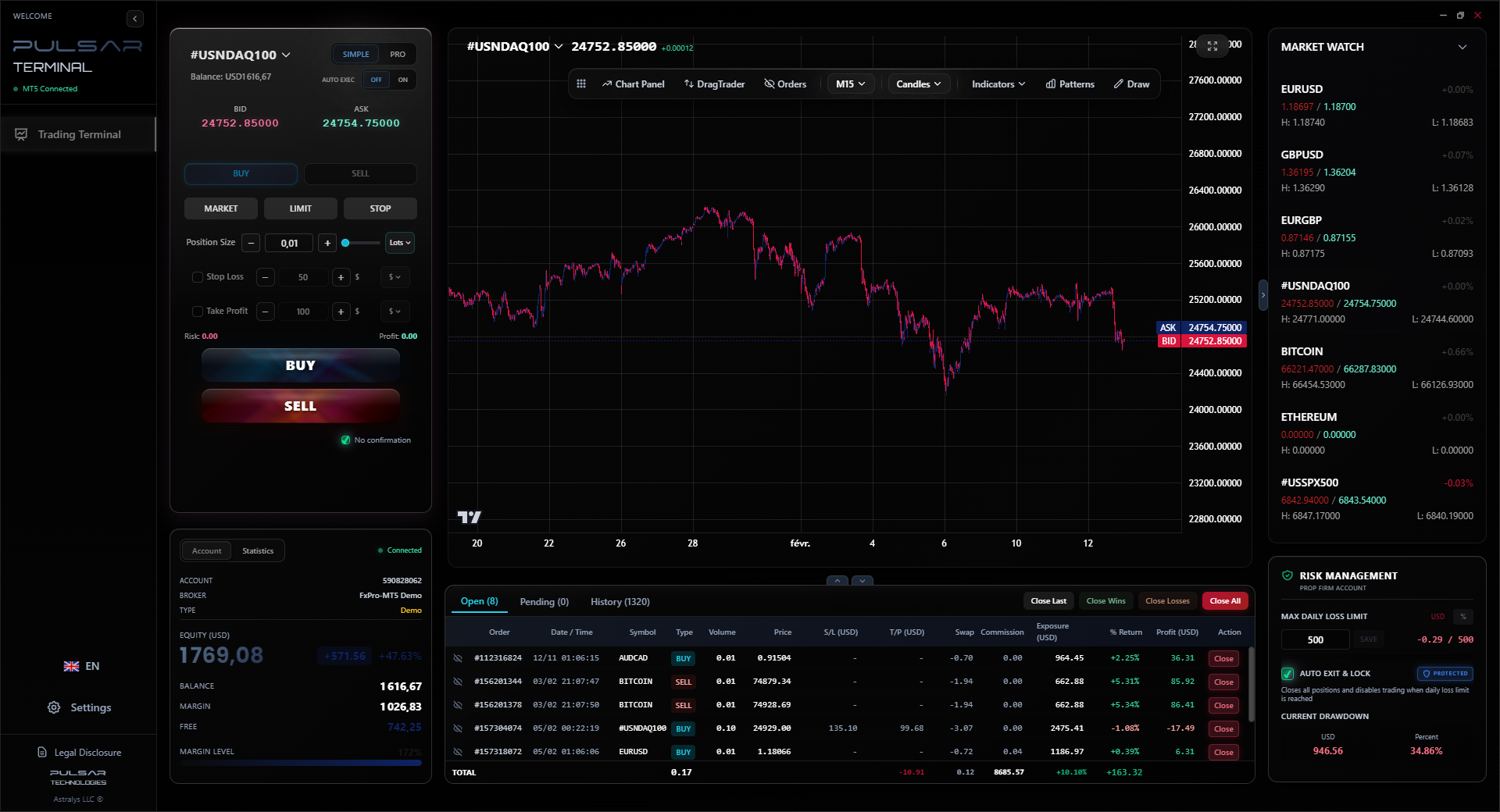
Managing your risk and trade exits manually across multiple positions is where mistakes happen; a tool like Pulsar Terminal automates trailing stops and multi-target exits directly on your MT5 chart.
Pulsar Terminal
Универсальный инструмент для MT5: drag-and-drop ордера, мульти-TP/SL, трейлинг-стоп, грид-трейдинг, Volume Profile и защита для проп-фирм. Используется 1000+ трейдерами ежедневно.
“Your profit is taxable income. The FIRS expects you to pay Capital Gains Tax. Set aside 10%.”
Let me be vulnerable so you don't have to be.
Mistake 1: Chasing the 'Holy Grail' Platform. Around 2015, I was deep into complex MACD and RSI divergences on the 15-minute chart. I read about a broker with a proprietary platform that had 'advanced pattern recognition.' I switched, ignoring their slightly wider spreads. The platform was flashy but slow. My scalping edge, which depended on quick execution, vanished. I lost about NGN 150,000 in two months trying to adapt to a glitchy platform. The lesson? Your strategy must fit the broker's practical offering. For most of us, reliable MT4/MT5 execution is better than a fancy, unstable platform.
Mistake 2: Ignoring Withdrawal Times. In 2020, I had a great quarter with a broker. I requested a $2,000 withdrawal. Their policy said '3-5 business days.' It took 18 days. Why? 'Compliance checks.' My money was stuck. During that time, I saw a beautiful setup on XAU/USD but couldn't access my capital to trade it. That missed opportunity cost me more than any fee. Now, I always test a small withdrawal first before committing serious capital to a new broker. How fast and smooth is it? That's part of their service.
These experiences shaped my current shortlist. I need a broker that's boringly reliable, with fast local deposits/withdrawals, tight enough spreads for my swing trading style, and solid MT5 integration. For me, that's been a mix of IC Markets for raw costs and Pepperstone for reliability, but your needs may differ.
“There is no single 'best forex broker in the world.' There's only the best broker for you, right now, in Nigeria.”
You have the data. You know the traps. Here's your action plan:
- Define Your Profile: Are you a beginner with NGN 50,000? A seasoned trader with $5,000? Your capital dictates your priorities. Small accounts need low minimums. Large accounts need the best execution.
- Apply the 3 Filters: Go to 2-3 broker websites from our comparison list. Confirm they accept Nigeria. Examine their deposit/withdrawal page for Naira or crypto options. Note their primary regulator.
- Open a Demo Account: This is non-negotiable. Open a demo with your top 2 choices. Test everything.
- Test order execution speed (place and close a market order).
- Check the spreads during your usual trading hours (London open, NY open).
- Try depositing and withdrawing simulated funds in the demo client area if possible.
- Make a Small Live Test: Fund your chosen broker with the minimum amount you're willing to lose. Trade small for a month. Then, request a small withdrawal. If the entire process - funding, trading, withdrawing - is smooth, you have a winner.
There is no single 'best forex broker in the world.' There's only the best broker for you, right now, in Nigeria. It's the one that gives you reliable access to the markets, doesn't eat your money with hidden fees, and stays out of your way so you can focus on your trading. Stop searching for a mythical champion and start vetting for a reliable partner. Your equity depends on it.
💡 Совет Уинстона
Your effective use is defined by your stop-loss and position size, not the broker's offer. A 1:1000 offer with a 50-pip stop is the same risk as 1:100 with a 5-pip stop. Control your risk, not the use.
FAQ
Q1Is forex trading legal in Nigeria?
Yes, forex trading is legal for individuals in Nigeria. The Central Bank of Nigeria (CBN) regulates the foreign exchange market. However, trading with online international brokers operates in a space not specifically regulated by the Nigerian SEC for retail traders, so your protection comes from the broker's international licenses.
Q2Do I pay tax on my forex trading profits in Nigeria?
Yes. The Federal Inland Revenue Service (FIRS) requires you to pay Capital Gains Tax on your net trading profits. The standard rate is 10%. You are responsible for declaring this income and paying the tax.
Q3What is the best way to fund my forex account from Nigeria?
The most efficient ways are through local Naira bank transfers (to a broker's local payment partner) or via cryptocurrency (like USDT). These methods are usually faster and cheaper than international wire transfers, which involve high bank fees and FX sourcing hurdles.
Q4Should I use a broker with 1:1000 use?
Almost certainly not. High use is a major risk amplifier. For most traders, using use above 1:20 on their entire account is extremely dangerous. Focus on proper position sizing based on your account risk (e.g., 1% per trade), not the maximum use advertised.
Q5What is more important, low spreads or good regulation?
Good regulation is a non-negotiable foundation. It provides a basic level of security for your funds. Once you have a shortlist of properly regulated brokers that accept Nigerians, then you compare spreads and trading costs. A broker with cheap spreads but no regulation is a dangerous gamble.
Q6Can I use MetaTrader 5 (MT5) in Nigeria?
Absolutely. MT4 and MT5 are the most popular trading platforms worldwide and are fully available to Nigerian traders through most international brokers. Many brokers like Exness, IC Markets, and XM offer both platforms.
Q7How much money do I need to start forex trading in Nigeria?
While some brokers allow you to start with as little as $1 (NGN ~1,500), a more realistic and responsible starting point for proper risk management is between NGN 150,000 to NGN 300,000 (approx. $100-$200). This allows for meaningful position sizing without being wiped out by a single small loss.
Урок проф. Уинстона
Ключевые выводы:
- ✓Filter brokers by Nigerian access & Naira deposits first.
- ✓Real cost = (Spread Cost) + Commission + Funding Fees.
- ✓Never let broker-defined use dictate your position size.
- ✓Always demo trade and test a small withdrawal first.
Насколько полезна эта статья?
Нажмите на звезду
Еженедельные торговые инсайты
Бесплатный еженедельный анализ и стратегии. Без спама.
Об авторе
Olumide Adeyemi
Пионер трейдинга в Западной Африке
Один из самых активных преподавателей форекс-трейдинга в Нигерии. 8 лет торгового опыта из Лагоса. Специализируется на стратегиях с малым капиталом и челленджах проп-фирм для африканских трейдеров.
Комментарии
Предупреждение о рисках
Торговля финансовыми инструментами сопряжена со значительным риском и может не подходить всем инвесторам. Прошлые результаты не гарантируют будущих доходов. Данный контент носит исключительно образовательный характер и не является инвестиционной рекомендацией. Всегда проводите собственное исследование перед торговлей.
Вам также может понравиться

Cara Trading Forex Sukses: 7 Prinsip dari Trader Profesional
Cara trading forex sukses dengan 7 prinsip trader pro: manajemen modal, disiplin, journal trading, backtest. Data nyata, bukan janji profit palsu.
Jam Trading Forex Terbaik untuk Trader Indonesia: Panduan Lengkap dengan Tabel Waktu
Panduan jam trading forex untuk trader Indonesia. Tabel 4 sesi dunia, jam emas 20:00-00:00, sesi mana yang harus dihindari. Data akurat + tips dari trader berpengalaman.
Top 5 Sàn Forex Uy Tín Nhất 2026: Review Jujur dari Trader Indonesia
Top 5 sàn forex uy tín 2026 untuk trader Indonesia. Review jujur: spread, deposit, withdraw, dukungan lokal. Exness, XM, IC Markets & lebih.
Скачать Pulsar Terminal
Все эти калькуляторы встроены в Pulsar Terminal с данными в реальном времени с вашего счёта MT5.
Скачать Pulsar Terminal