


Here's a hard truth: over 70% of retail forex traders lose money.

David van der Merwe
Трейдер развивающихся рынков ·  South Africa
☕ 13 мин чтения
Что вы узнаете:
- 1The #1 Non-Negotiable: A Regulation-First Mindset
- 2Their Real Edge: Mastering Costs & Execution
- 3Strategy: Discipline Over Genius
- 4Broker Choices: What the Pros Actually Look For
- 5The Psychology: Mindset of the Survivors
- 6The Traps the Best Traders Avoid (And You Should Too)
- 7Your Path Forward: Building Your Own Edge
Here's a hard truth: over 70% of retail forex traders lose money. Yet, South Africa has an estimated 500,000 traders, with over 190,000 active daily. The best forex traders in South Africa aren't just lucky. They operate within a specific, regulated framework, use particular tools, and follow mental models that separate them from the crowd. This isn't about finding a guru. It's about understanding the practical, repeatable habits of those who consistently win.
Before we talk about charts or strategies, we need to talk about safety. The single biggest difference between a hopeful beginner and a seasoned pro in South Africa is their approach to regulation. The pros treat it as their first line of defense.
The Financial Sector Conduct Authority (FSCA) is the main watchdog here. Since 2021, they've capped use for retail traders at 30:1. That might feel restrictive if you're chasing crazy returns, but the best traders see it differently. They see it as a guardrail that prevents them from blowing up their account in one bad trade. I learned this the hard way early on, using an unregulated offshore broker offering 500:1. A volatile move in GBP/JPY wiped out 60% of my capital before I could blink. That loss stung, but it taught me that high use is a trap, not a tool.
A regulated FSCA broker isn't just about rules. It means your funds are segregated (kept separate from the broker's operating money), you have a formal complaints process, and the broker is audited. Always, and I mean always, verify the FSP number on the FSCA's public register. If a "guru" on Telegram is pushing a broker you can't verify, run. The FSCA fined someone over R1 million in 2024 for exactly that.

Warning: Trading with an unregulated entity means you have zero protection if they disappear with your money. Your deposit is a gift.
This mindset extends to your choice of platform. The best forex traders in South Africa overwhelmingly use platforms like MetaTrader 4, MT5, or cTrader through reputable brokers. These platforms are the industry standard for a reason - they're stable, widely supported, and where the real liquidity is. You can read our deep dive on why platforms matter in our XM review and IC Markets review.

💡 Совет Уинстона
A trader once told me, 'The market's job is to take your money. Your job is to not give it to them.' Start every day with that defensive mindset.
“The best forex traders in South Africa aren't just lucky. They operate within a specific, regulated framework.”
Beginners look at the chart. Professionals look at the receipt. Your trading costs are a silent tax on your performance, and the best traders are obsessed with minimizing them.
Let's break down what they're looking at, with real numbers from the South African market:
Spreads & Commissions: The Two-Pronged Attack You'll generally find two account types: commission-free with wider spreads, or raw spread accounts with a per-lot commission. There's no "best," only "best for your style."
- The Scalper's Choice: If you're a high-frequency trader taking 5-10 trades a day, a raw spread account is usually cheaper. Think Tickmill's Raw account with spreads as low as 0.11 pips on EUR/USD, plus a $4 commission per lot. Your total cost on a 1-lot trade might be 0.11 pips + $4. For a scalper, that predictable cost is everything. Our scalping strategy guide explains why this matters.
- The Swing Trader's Choice: If you hold trades for days or weeks and trade less frequently, a commission-free account with a slightly wider spread might be simpler. XM offers spreads from 0.8 pips with no commission. On a 1-lot swing trade, that's a one-time cost of 0.8 pips, which becomes negligible on a 100-pip move.
I personally use a hybrid approach. For my quick, technical plays on majors like EUR/USD, I use a raw spread account. For longer-term, fundamental bets on something like XAU/USD (gold), I might use a commission-free account to avoid the per-lot fee on a larger position I plan to hold. You can learn more about trading gold in our XAU/USD guide.
The Hidden Killers: Overnight Fees & Currency Conversion This is where amateurs get slaughtered. Holding a position overnight incurs a swap fee. It can be positive or negative depending on the interest rate differential. I once held a long AUD/JPY position for three weeks, aiming for a 150-pip move. I made 120 pips, but the negative swap fees ate 35 of those pips. I netted 85. I didn't factor in the cost of time.
If your account is in ZAR but you're trading USD pairs, a conversion fee applies on profits and losses. Some local brokers like Khwezi Trade offer ZAR-denominated accounts to eliminate this. It's a small thing, but small things add up to a big edge over a year.

Example: Trade 1 lot EUR/USD, make 10 pips profit. That's $100. With a 1.2% conversion fee to ZAR, you lose R22 (at ZAR 18.50/$). Do that 100 times a year, that's R2,200 gone.
“Beginners look at the chart. Professionals look at the receipt.”
You won't find the best forex traders in South Africa chasing "secret indicators" or 100% win-rate signal services. They have a written plan and the emotional discipline to follow it, especially when it's boring.
Their Toolbox is Simple, Not Magical
They use a handful of proven tools deeply:
- Price Action & Support/Resistance: This is the foundation. Where did the price stop before? That's more important than any oscillator.
- Moving Averages: For trend identification and dynamic support/resistance. A simple 50 and 200-period EMA on the 4-hour chart tells a story.
- Momentum Confirmation: Tools like the RSI indicator or MACD indicator aren't used for signals. They're used to ask, "Does the momentum support my price action thesis?"
Risk Management is Their Religion
This is the absolute core. Every single trade has a predetermined stop-loss and take-profit before entry. No exceptions. Ever. Their rule is simple: risk a small, fixed percentage of their capital per trade - usually between 0.5% and 2%. This means their position size changes with their account balance. If you don't know how to calculate this, stop trading and use our position size calculator until it's second nature.
I'll give you a real, vulnerable example. In early 2023, I was convinced the USD/ZAR was going to break lower. I risked 3% of my account (breaking my own 2% rule) on a short position. The pair ripped higher against me. My stop-loss was hit, and I lost R4,500 in minutes. That loss hurt not just financially, but because I broke my system. It took two months of disciplined 1% risk trades just to get back to even. That lesson was more valuable than the money.

Pro Tip: Your trading plan should be so boring you could fall asleep reading it. Entry criteria, exit criteria, risk per trade. The excitement is in the hunt and the execution, not in a chaotic, emotional mess on the chart.
Their strategy alignment is also key. A scalper with a 5-pip target cares about the 1-minute chart spread. A swing trader looking for 200 pips couldn't care less. Know who you are. Our guide on swing trading outlines a completely different mindset to scalping.
“Beginners look at the chart. Professionals look at the receipt.”
The best traders choose a broker like a mechanic chooses a toolbox. It needs to be reliable, have the right tools, and not overcharge for the service. It's a pragmatic business decision.
Here’s a comparison of what matters to a professional, based on common FSCA-regulated options:
| Broker | Why a Pro Might Choose Them | The Catch (Because There Always Is One) |
|---|---|---|
| Tickmill | Ultra-competitive raw spreads. Ideal for high-volume scalpers and algorithmic traders who need low latency. | The $100 minimum deposit is fine, but the commission model requires you to factor costs into every trade. Not the best for tiny accounts. |
| Exness | High use availability (up to 1:2000 on certain instruments for retail traders, though FSCA caps forex at 30:1). Smooth local payment processing. | The high use is a double-edged sword. It can magnify losses just as fast as profits. Requires extreme discipline. Check our Exness review for details. |
| IG | Established, Tier-1 regulated giant. Excellent research and educational tools. Strong for longer-term traders and those who trade beyond just forex. | Higher minimum deposit (£250). Spreads can be wider than dedicated ECN brokers on standard accounts. |
| AvaTrade | User-friendly, great for beginners transitioning to serious trading. Wide range of platforms including MT4, MT5, and their own AvaTradeGO. | Spreads are not the absolute tightest in the market. More geared towards the all-round experience than the ultra-low-cost niche. |
| Khwezi Trade | Local South African broker. ZAR accounts eliminate conversion fees. Direct local support and understanding of SA market hours. | May not have the same global brand recognition or asset range as the international giants. |
The pros also prioritize execution speed and reliability over flashy bonuses. A deposit bonus often comes with impossible withdrawal conditions. They'd rather have a stable platform that doesn't freeze during news events. They also look for brokers that offer their preferred platform - be it MT5 for hedging and advanced order types, or cTrader for its clean interface.
Payment methods matter for cash flow. The best traders use efficient, low-cost methods. EFTs directly into a ZAR account are common. They avoid methods with high deposit or withdrawal fees, as that's just another leak in the system. Pepperstone, for instance, is known for good service in this area, which we cover in our Pepperstone review.
💡 Совет Уинстона
Your trading journal is your most important tool. If you're not willing to write down why you lost, you're not willing to learn. Review it every Sunday without fail.
“Your trading plan should be so boring you could fall asleep reading it.”
This is the final, unglamorous frontier. The best forex traders in South Africa have trained their psychology to handle randomness and loss.
They don't seek excitement from trading. If you're getting an adrenaline rush from an open position, your risk is too high. Trading is a probability game. They know that even a great setup with a 60% win rate will have losing streaks. I had a run of 7 consecutive losses once on a strategy that typically wins 55% of the time. It felt like the world was broken. But the math wasn't. I stuck to my 1% risk, and the next 10 trades were mostly winners. If I had doubled down after loss #3 trying to "get back to even," I would have been finished.
They also practice detachment from individual trade outcomes. A trade isn't "good" because it won, or "bad" because it lost. A trade is good if it followed the plan. Period. They review their trades based on process, not profit and loss.
Finally, they have a life outside of trading. This is critical. Your mental capital is a finite resource. Staring at charts for 14 hours a day drains it, leading to fatigue-induced mistakes. They exercise, have hobbies, and spend time with family. This creates the mental resilience needed to not panic when a trade goes 20 pips against you before (sometimes) coming back to hit your target.
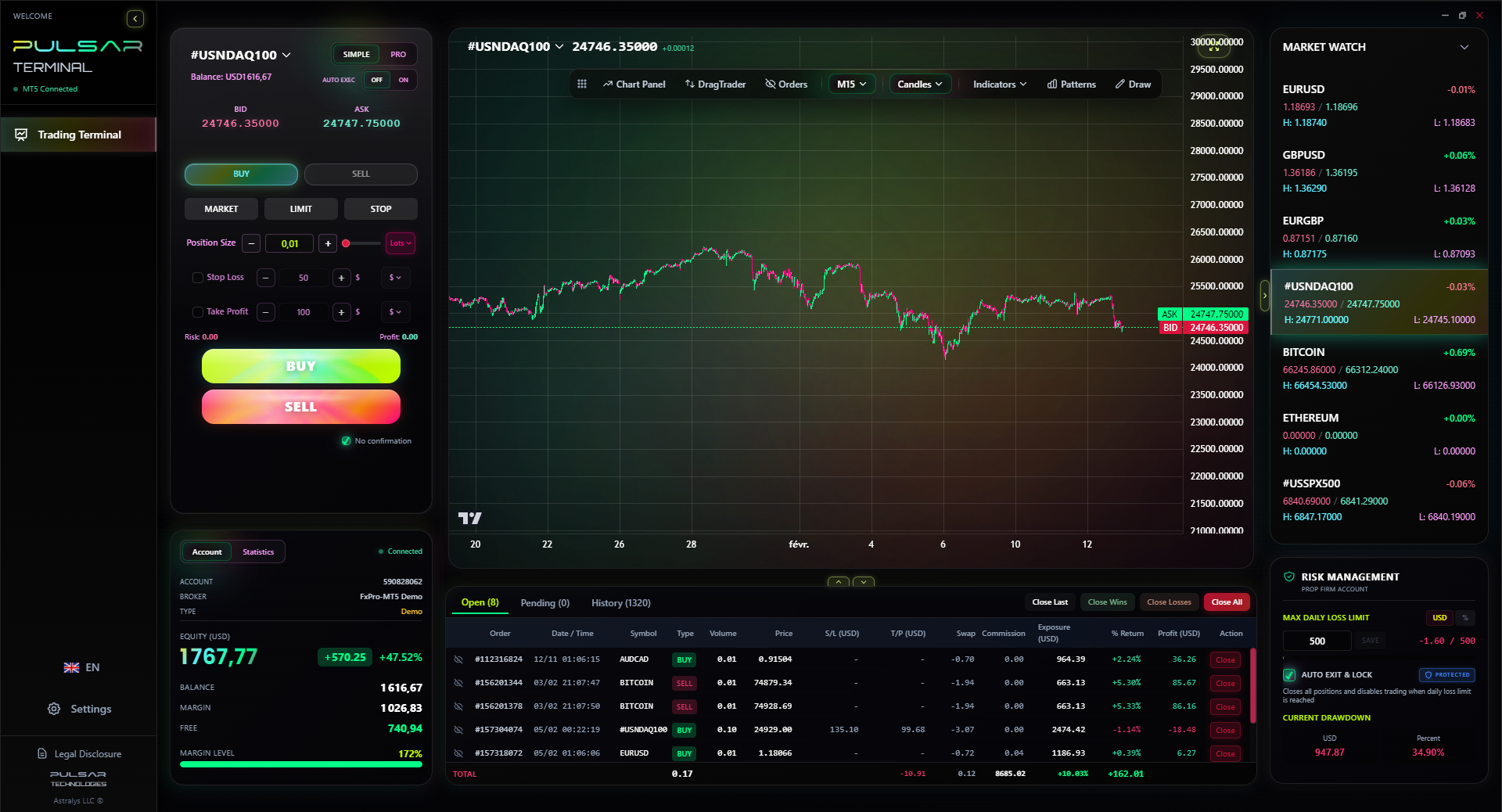
Managing this psychology is easier with the right tools. Manually moving stop-losses to breakeven or setting trailing stops can be emotionally charged. Automating these tasks removes your hesitation and fear from the equation.
Managing the psychology of trailing stops and breakeven orders is easier when you automate them, removing emotional hesitation from your trading process.
Pulsar Terminal
Универсальный инструмент для MT5: drag-and-drop ордера, мульти-TP/SL, трейлинг-стоп, грид-трейдинг, Volume Profile и защита для проп-фирм. Используется 1000+ трейдерами ежедневно.
“Your trading plan should be so boring you could fall asleep reading it.”
Let's talk about the shiny objects that distract newcomers and drain accounts. The best traders see these for what they are.
1. The "Holy Grail" System Trap: No system works forever in all market conditions. The pros have a core strategy but adapt to market volatility (ranging vs. trending). They don't jump from one YouTube strategy to the next every month.
2. The Over-use Trap: Even with the FSCA's 30:1 cap, you can still over-use by using too large a position size. Just because you can trade 3 lots doesn't mean you should. They use use to efficiently use capital, not to amplify bets. A margin call is a sign of catastrophic risk management failure, not bad luck.
3. The Revenge Trading Trap: After a loss, the urge to immediately trade to win the money back is powerful. The best traders do the opposite. They step away. They might even shut down the platform for the day. Trading angry or scared is a guaranteed way to lose more.
4. The Analysis Paralysis Trap: Having 20 indicators on your chart isn't analysis, it's confusion. It creates conflicting signals. Pros keep it simple. They know that a cluttered chart often leads to missed opportunities because you're too busy interpreting noise.
5. Ignoring the Fundamentals (Especially in SA): While many pros are technically focused, the best have a calendar alert for SARB interest rate decisions, local CPI data, and major political events. A perfect technical setup on USD/ZAR can be vaporized by a surprise MPC announcement. They don't predict the news, but they manage their risk around it.
💡 Совет Уинстона
The difference between a professional and an amateur is how they behave after three consecutive losses. The amateur doubles down. The professional reduces size and re-checks the market conditions.
“If you're getting an adrenaline rush from an open position, your risk is too high.”
So, how do you start building the habits of the best forex traders in South Africa? It's a marathon, not a sprint.
Phase 1: The Foundation (Months 1-3)
- Education, Not Gambling: Learn what a pip and spread really are. Understand how use works. Paper trade on a demo account religiously.
- Choose Your Broker Wisely: Pick one FSCA-regulated broker from the list above that fits your intended style. Open a demo and a tiny live account (the minimum). Get used to the platform.
- Write a One-Page Trading Plan: It should include: Your trading style (scalp/swing), your preferred market hours, your 2-3 key indicators, your maximum risk per trade (start with 0.5%), and your weekly loss limit.
Phase 2: The Grind (Months 4-12)
- Trade Small, Live: Move to a live account with real money, but trade the smallest possible size. The goal is to feel the psychological pressure of real gain/loss, not to make money.
- Journal Every Trade: Not just "bought EUR/USD, won 10 pips." Write: "Entered on retest of 4H support, with RSI bullish divergence. Risked 0.75%. Stopped out for a 1% loss. Reason: Price broke through support on stronger USD data. Lesson: Check economic calendar before entering on key levels."
- Review Weekly: Look for patterns in your journal. Are your losses bigger than your wins? Are you breaking your rules? This is where growth happens.
Phase 3: The Refinement (Year 1+)
- Optimize Costs: Now that you have a style, re-evaluate your broker. Are you paying too much in spreads/commissions for your frequency? Could a switch save you money?
- Scale Gradually: Only increase your position size as your account grows, keeping your percentage risk constant. If you started risking R50 per trade on a R10,000 account (0.5%), and your account is now R15,000, you can risk R75 per trade.
- Find Your Community: Not a signal group. A community of serious traders who discuss ideas, psychology, and risk. This provides perspective and accountability.
The journey to becoming one of the best is less about finding magic and more about eliminating stupidity. It's about consistency, risk management, and a deep respect for the market. Start with the foundation. Protect your capital. The rest will follow.
FAQ
Q1Who is the most successful forex trader in South Africa?
There's no publicly crowned "most successful" individual retail trader, and anyone claiming that title online is likely selling something. True trading success is private, consistent, and sustainable. The most successful traders are those who have survived multiple market cycles (like the 2020 COVID crash or the 2022 rate hike frenzy) by managing risk, not those who brag about one big win.
Q2Can you make a living from forex trading in South Africa?
Yes, it's possible, but it's exceptionally difficult and should not be the initial goal. You need a substantial capital base (think R200,000+) to generate meaningful income without taking suicidal risks. Most professionals treat it as a supplemental income for years before even considering going full-time. Your first goal should be consistent profitability on a small account, not replacing your salary.
Q3What is the best forex trading platform in South Africa?
MetaTrader 4 (MT4) and MetaTrader 5 (MT5) are the most widely used and supported by nearly all FSCA-regulated brokers. MT5 is more modern and offers more timeframes and hedging capabilities. cTrader is also excellent, known for its superior execution and clean interface. The "best" is the one your chosen reliable broker offers and that you feel most comfortable using. The platform is a tool; your strategy is the craft.
Q4How much do forex traders earn in South Africa?
Earnings vary wildly. A beginner might lose money. A disciplined part-time trader with a R50,000 account aiming for 5% a month might make R2,500 (before costs). A professional with a R1,000,000 account targeting 2-3% monthly return might earn R20,000-R30,000. These are gross figures. The key is the percentage return on capital, not the rand amount. Chasing high rand amounts with a small account is the fastest path to ruin.
Q5Is forex trading taxable in South Africa?
Yes. Profits from forex trading are generally considered capital gains or income by SARS, depending on your trading frequency and intent (are you an investor or a trader?). It's crucial to keep detailed records of all trades, deposits, and withdrawals. You should consult with a tax professional who understands financial trading to ensure you comply correctly. The best traders factor tax into their overall profit calculations.
Q6What time does forex market open in South Africa?
The forex market is open 24 hours a day from Monday morning (00:00 GMT) to Friday night (22:00 GMT). For South African traders (SAST, GMT+2), the key sessions are: Asian session (opens ~3:00 SAST), European session (opens ~9:00 SAST, most liquid), and US session (opens ~15:00 SAST). The most volatility often occurs during the European and US session overlap (15:00-17:00 SAST).
Q7Are there any successful black forex traders in South Africa?
Absolutely. Success in forex is based on knowledge, discipline, and process, not background. There are many successful traders from all backgrounds in South Africa. The focus should be on learning the craft and developing a strong system, as the market does not discriminate. Look for educators and communities that emphasize solid fundamentals rather than flashy lifestyles.
Урок проф. Уинстона
Ключевые выводы:
- ✓Verify your broker's FSCA FSP number. Every time.
- ✓Never risk more than 2% of your capital on a single trade.
- ✓A 7-trade losing streak is statistically normal for a 55% win-rate system.
- ✓Spend 80% of your time on risk management, 20% on finding entries.
Насколько полезна эта статья?
Нажмите на звезду
Еженедельные торговые инсайты
Бесплатный еженедельный анализ и стратегии. Без спама.
Об авторе
David van der Merwe
Трейдер развивающихся рынков
Трейдер из Йоханнесбурга с 11-летним опытом работы с валютами развивающихся рынков. Специализируется на ZAR-парах, торговле под регулированием FSCA и анализе южноафриканского рынка.
Комментарии
Предупреждение о рисках
Торговля финансовыми инструментами сопряжена со значительным риском и может не подходить всем инвесторам. Прошлые результаты не гарантируют будущих доходов. Данный контент носит исключительно образовательный характер и не является инвестиционной рекомендацией. Всегда проводите собственное исследование перед торговлей.
Вам также может понравиться

Cara Trading Forex Sukses: 7 Prinsip dari Trader Profesional
Cara trading forex sukses dengan 7 prinsip trader pro: manajemen modal, disiplin, journal trading, backtest. Data nyata, bukan janji profit palsu.
Jam Trading Forex Terbaik untuk Trader Indonesia: Panduan Lengkap dengan Tabel Waktu
Panduan jam trading forex untuk trader Indonesia. Tabel 4 sesi dunia, jam emas 20:00-00:00, sesi mana yang harus dihindari. Data akurat + tips dari trader berpengalaman.
Top 5 Sàn Forex Uy Tín Nhất 2026: Review Jujur dari Trader Indonesia
Top 5 sàn forex uy tín 2026 untuk trader Indonesia. Review jujur: spread, deposit, withdraw, dukungan lokal. Exness, XM, IC Markets & lebih.
Скачать Pulsar Terminal
Все эти калькуляторы встроены в Pulsar Terminal с данными в реальном времени с вашего счёта MT5.
Скачать Pulsar Terminal