


Most guides on the best forex trading platform in Singapore are written by people who've never placed a real trade.

Daniel Harrington
Руководитель контента
☕ 11 мин чтения
Что вы узнаете:
- 1What Actually Makes a Platform 'Good' for Singapore?
- 2Top Platforms & Brokers Reviewed (The Real Story)
- 3Non-Negotiable Features You Must Have
- 4The Real Costs (It's Never Just the Spread)
- 5My Personal Setup (And Costly Mistakes)
- 6Your Singapore-Specific Getting Started Checklist
- 7Final Verdict: The Best Forex Trading Platform in Singapore

Most guides on the best forex trading platform in Singapore are written by people who've never placed a real trade. They'll tell you to just pick the one with the lowest spread and call it a day. That's a fantastic way to blow up your account. I've traded from Singapore for over a decade, made six-figure profits, and lost five-figure sums learning the hard way. Let's set the record straight on what actually matters for an SG trader, from MAS regulations to the platforms that won't freeze during US NFP.
Forget the global top 10 lists. Your needs as a trader in Singapore are specific. It's not just about the software, it's about the entire environment: the broker behind it, the local support, and how it handles our unique market access.
First, regulation. The Monetary Authority of Singapore (MAS) is strict, and that's a good thing. A broker licensed by MAS (like a Capital Markets Services license) is legally obligated to keep client funds segregated. This isn't just paperwork, it's your first line of defense if things go south. I learned this the hard way early in my career using an offshore broker that "offered better use." When I tried to withdraw a S$15,000 profit, it took 3 weeks of excuses and threatening to involve MAS before the money arrived. Never again.
Second, latency and servers. You're trading from Southeast Asia. If your broker's main servers are in London or New York, your orders have to travel halfway around the world. For a scalper, that extra 50-100ms is the difference between a win and a loss. Look for brokers with local or regional servers (often in Singapore, Tokyo, or Hong Kong).
Third, funding and withdrawals in SGD. This seems obvious, but you'd be surprised. Some international platforms make you deposit in USD or EUR, forcing you to eat your bank's terrible forex conversion fees twice. A proper SG-focused platform will offer SGD-denominated accounts and local bank transfer options (like FAST transfer). Saving 1-2% on currency conversion might not sound like much, but it adds up fast.

Warning: Just because a broker has a ".sg" website doesn't mean it's MAS-licensed. Some are just marketing fronts for offshore entities. Always verify the license number on the official MAS Financial Institutions Directory.
Let's get specific. I've funded accounts, placed trades, and tested support with these. Here’s the unfiltered take.
MetaTrader 4 / 5 (via a Good Broker)
MT4 and MT5 aren't brokers, they're platforms. The broker you choose to access them with is everything. For Singapore, you want a broker that offers MT4/5 with low-latency local servers.
IC Markets is a common choice for serious traders here. Their raw spread accounts on MT4/5 are legit, often with EUR/USD spreads below 0.1 pips during London/NY overlap. I've used their SG server for scalping and the execution is crisp. Their support isn't 24/7, but they answer emails. My main gripe? Their position size calculator on the platform is basic.
Pepperstone is another strong contender. Their Razor account on MT4 is similar. Where they shine is customer service for APAC; phone support is actually useful. I once had a slippage issue on a GBP news event. Called them, they reviewed the tickets in real-time, and explained it was a genuine liquidity gap, not requotes. Transparency matters.
Exness is popular for its flexible use, but be careful. Their Standard account has wider spreads. I used them briefly for a high-use experiment on XAU/USD. Made S$2,300 in a week, then lost S$1,800 the next when volatility spiked and the spreads widened massively. It's a tool, but you need to understand the cost structure.
cTrader
This is the sleek alternative to MT. Pepperstone and IC Markets also offer it. cTrader's order entry is superior for manual trading - it's just cleaner. Its built-in Volume Profile is a nice touch. However, the environment of custom indicators and Expert Advisors (EAs) is much smaller than MT4/5. If you're a pure discretionary trader, it's fantastic. If you rely on specific EAs, you might be stuck.
Proprietary Platforms
Some brokers like XM have their own platforms. They're often simplified. I find them limiting for advanced analysis. They're okay for beginners who just want to click and trade, but you'll outgrow it fast.
| Platform | Best For | Biggest Drawback for SG Traders |
|---|---|---|
| MT4/5 (via IC/Pepperstone) | EA/Automation, Scalping, Customization | Can feel dated; requires a good VPS for optimal performance. |
| cTrader | Manual & Discretionary Trading, Clean Execution | Smaller community/EA library. |
| Broker Proprietary | Absolute Beginners | Limited tools, often higher hidden costs. |

Pro Tip: Don't get married to one platform. Open demo accounts on MT5 with IC Markets and cTrader with Pepperstone. Trade the same setup on both for a week. Your personal preference is the deciding factor.

💡 Совет Уинстона
Your first platform should feel boring and reliable, not exciting. Excitement in trading comes from your P&L, not the software's animations.

“The spread is a visible cost. Slippage and requotes are invisible killers.”
These are the deal-breakers. If your platform misses one, find another.
- One-Click Trading: The ability to open and close trades directly from the chart with a single click. Dragging an order ticket around while the market moves is for amateurs. In 2022, I missed a perfect breakout entry on EUR/USD because I was fumbling with an order window. That move went for 80 pips. Cost of that lesson: about S$400 in missed profit on my standard lot size.
- Reliable Mobile App: You live in Singapore, you're not always at your desk. The mobile app must allow full trade management - modifying stops, taking partial profits. The MT4/5 mobile apps are surprisingly capable. Test this. Can you move your stop-loss to breakeven easily while on the MRT?
- Advanced Order Types: Beyond just market and limit. You need trailing stops (automatically locking in profit), and stop-limit orders (to avoid terrible slippage on news). If you're into more advanced tactics, the ability to set multiple take-profit levels is gold for scaling out of a position.
- Real, Raw Data: The platform must display real-time spreads, not some averaged, smoothed number. You need to see the true cost of your trade, especially during Asian session when liquidity is thinner. A wide spread can turn a good swing trading idea into a losing one from the start.
- Fast, Clear Deposits/Withdrawals in SGD: This is back-end, but critical. The platform's client portal should show a clear audit trail. I want to see "SGD Deposit - Approved - Funds Available" in under an hour for a FAST transfer. Any vagueness is a red flag.
Brokers and platforms get paid. You need to know exactly how, or you're the product.
The Spread: This is the bid-ask difference. A "raw spread" account (like IC Markets' Raw Spread) gives you the interbank spread plus a small commission (e.g., $3.50 per lot). A "standard" account has no commission but a wider, marked-up spread. Which is cheaper? Do the math. For high-frequency trading, the commission account is almost always cheaper. For longer-term swing trading, the standard might be okay.
Overnight Financing (Swap Rates): Holding a position past 5 pm EST costs or earns you interest. These rates change. If you're holding trades for weeks, this can be a significant cost or a nice little earner. Check the platform's swap rate table. Long EUR/USD might have a different cost than short.
Inactivity Fees: Some brokers charge you if you don't trade for 3-6 months. Read the fine print.
Currency Conversion Fees: If you fund in SGD but trade USD pairs, the platform converts your margin. Some do this at a fair rate, others add a hefty markup. This is a hidden killer for small accounts.

Example: Let's say you trade 10 standard lots of EUR/USD in a month.
- On a Standard Account with a 1.2 pip spread: Cost = 10 lots * 1.2 pips * $10 per pip = $120.
- On a Raw Spread Account with a 0.1 pip spread + $3.5 commission per lot: Cost = (10 lots * 0.1 pips * $10) + (10 lots * $3.5) = $10 + $35 = $45. The raw account saves you $75. That's over S$100 in your pocket.
💡 Совет Уинстона
If you can't explain the broker's entire fee structure on a napkin, you haven't done your homework. Hidden fees are the silent killers of small accounts.

“A great platform gets out of your way and lets you execute your plan without hiccups.”
After 12 years, here's what works for me. I'm a hybrid trader: part technical swing, part news-based.
My Primary Platform: MT5 with IC Markets. I use their raw spread account. I run it on a low-latency VPS (Virtual Private Server) hosted in Singapore. This costs me about S$40 a month, but it means my charts and EAs run 24/7 without my home PC being on, and my connection to the broker is milliseconds fast. It's a business expense.
My Toolkit on MT5: I keep it simple. I use the MACD indicator for momentum confluence, but my main tool is price action and horizontal support/resistance. I have a custom script that alerts me to key daily news events. Most of my analysis is done on TradingView, and I execute on MT5.
The Big Mistake: In my early days, I chased "zero spread" accounts from unregulated brokers. The spread was indeed zero, but the execution was criminal. I'd hit buy, and the order would hang for 2 seconds before filling me at a worse price. I lost S$8,000 in a month to that alone. The spread is a visible cost. Slippage and requotes are invisible killers. A platform with a reputable broker might have a slightly higher visible cost but far better, more honest execution.
Another Lesson: I once tried to automate a complex grid strategy on MT4. The platform handled it, but my own logic was flawed. I didn't have proper daily loss protection built into the EA. The market trended strongly against my grid, and instead of stopping, it kept placing more orders. I lost 15% of my account in a day. The platform was just the tool; my poor risk management was the problem. Now, any automated strategy has a hard daily stop-loss coded in.

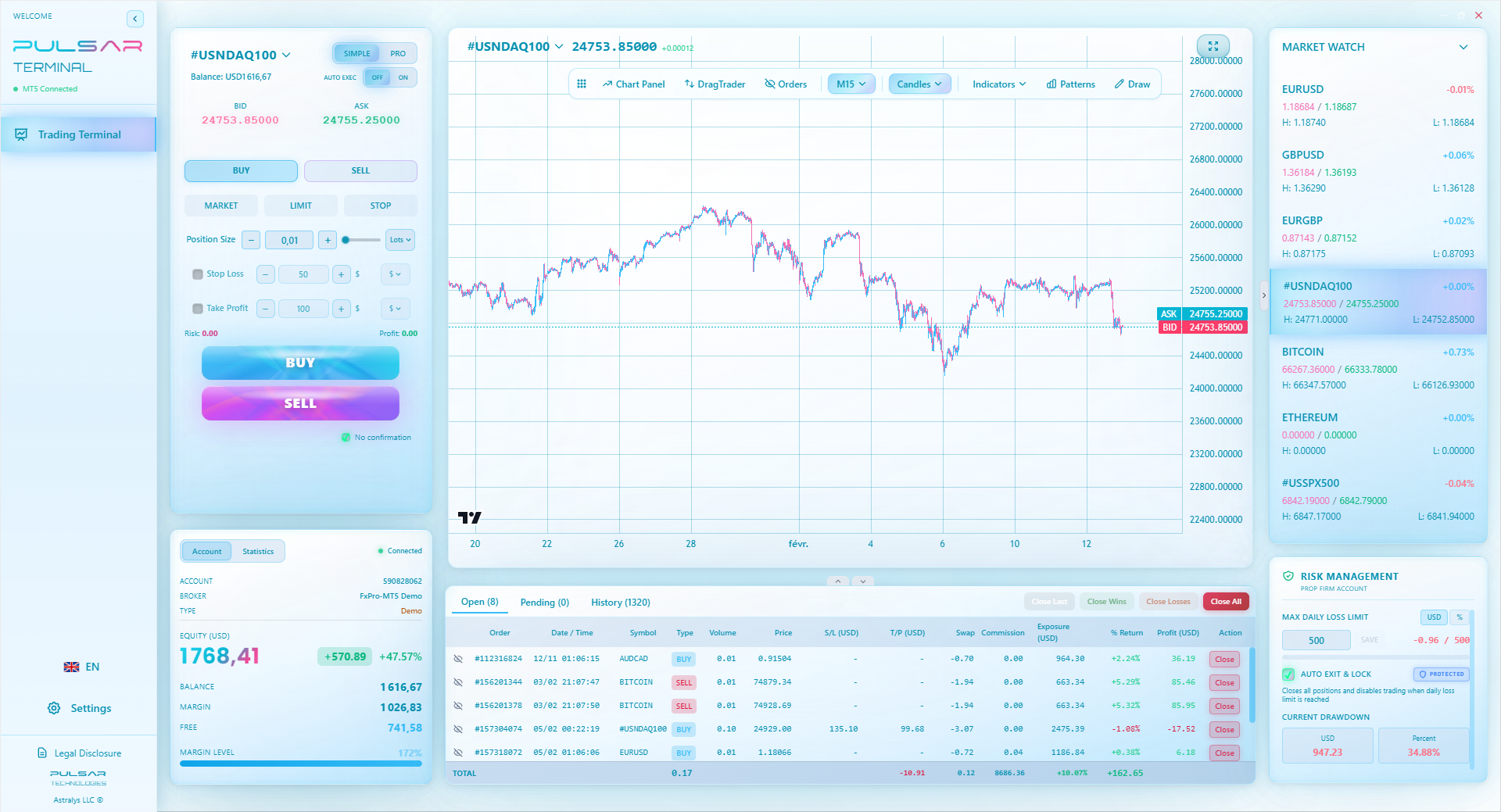
Managing complex strategies and protecting your capital from a single bad day requires tools that go beyond basic MT5, which is where a platform enhancer like Pulsar Terminal comes in.
Pulsar Terminal
Универсальный инструмент для MT5: drag-and-drop ордера, мульти-TP/SL, трейлинг-стоп, грид-трейдинг, Volume Profile и защита для проп-фирм. Используется 1000+ трейдерами ежедневно.
Don't just sign up. Do this in order.
- Regulation Check: Go to the MAS website. Search for your chosen broker's entity name. Confirm they hold a valid Capital Markets Services license for dealing in securities (which includes leveraged forex).
- Open a Demo: Not for a few hours. For at least two weeks. Trade your strategy. Test execution during volatile periods (London open, US data).
- Test the SGD Pipeline: Deposit a small, real amount (e.g., S$200). Do it via FAST transfer. Time how long it takes to show up as tradable. Then, immediately try to withdraw S$150. Does it come back to your local bank account within a business day? This is the ultimate test of a broker's operational integrity.
- Check Mobile & Desktop Sync: Place a trade on your desktop. Can you see it and manage it perfectly on your mobile app? Close it on mobile. Does the desktop update instantly?
- Read the Fee Schedule: Yes, the boring PDF. Know the swap rates, the inactivity fee policy, and the commission structure.
- Contact Support: Ask a technical question before you deposit. "Do you have a local SG server for MT4?" The speed and quality of the answer tell you everything about what it'll be like when you have a real problem with real money on the line.
Following this list would have saved me thousands in my first few years. It forces you to vet the broker as a business, not just be dazzled by the trading platform's colors.
💡 Совет Уинстона
Spend as much time testing withdrawals as you do testing indicators. A platform that makes it hard to get your money out is a prison, not a tool.

“Following a simple checklist would have saved me thousands in my first few years.”
There is no single "best" platform. There's the best platform for you, based on your strategy, experience, and needs.
- For the automation-focused trader who uses EAs and scripts, MetaTrader 5 (via a broker like IC Markets or Pepperstone) is the undisputed king. The environment is unmatched.
- For the manual, discretionary trader who values pristine execution and a clean interface, cTrader (via the same brokers) is a brilliant choice.
- For the complete beginner who needs hand-holding, a broker with a strong local support presence and a simpler proprietary platform might be a gentler start, but plan to graduate to MT or cTrader within 6 months.
My personal recommendation for most serious retail traders in Singapore is to start with MT5 and a reputable, MAS-aware international broker offering local servers. It gives you the most room to grow. The platform is a tool. Your psychology, your risk management, and your edge are what matter. A great platform just gets out of your way and lets you execute your plan without hiccups.
Don't overthink it. Pick one from the reviewed options that fits your style, go through the checklist, fund it, and focus on what really matters: becoming a better trader. The best forex trading platform Singapore has to offer is the one you master inside and out.

FAQ
Q1Is forex trading legal in Singapore?
Yes, forex trading is completely legal in Singapore. However, brokers offering leveraged forex trading to Singapore residents should ideally be licensed by the Monetary Authority of Singapore (MAS) or be a reputable international firm regulated in a top-tier jurisdiction like Australia (ASIC) or the UK (FCA). Trading with unregulated offshore brokers is legal but carries significantly higher risk.
Q2What is the minimum deposit for forex trading in Singapore?
It varies by broker. Some international brokers like XM or Exness allow minimum deposits as low as S$50. More established brokers like IC Markets or Pepperstone typically have minimums around S$200 for standard accounts. My advice? Start with at least S$1,000. A smaller account forces you to use excessive use to make meaningful gains, which is a fast track to losing it all.
Q3Which is better for Singapore traders, MT4 or MT5?
MT5 is the more modern platform with more timeframes, better hedging capabilities, and a built-in economic calendar. For new traders starting today, I recommend MT5. The only reason to use MT4 is if you rely on a specific Expert Advisor (EA) or indicator that hasn't been ported to MT5 yet. Most brokers offer both.
Q4Do I pay taxes on forex trading profits in Singapore?
Generally, no. If you are trading as an individual and it is not your primary source of income (i.e., you're not considered a professional trader by IRAS), your forex trading profits are considered capital gains and are not taxable in Singapore. However, tax laws can change, and your personal situation may vary. Always consult a qualified tax professional in Singapore for definitive advice.
Q5Can I use TradingView to trade with a Singapore broker?
Sometimes, but it's limited. TradingView has direct trading integration with a select number of brokers. Most Singapore traders use TradingView for their charting and analysis (which is excellent), then place the trade manually on their broker's MT4/5 or cTrader platform. It's an extra step, but for many, the superior charting is worth it.
Q6What use is available to retail traders in Singapore?
Brokers regulated by MAS are subject to use caps, typically a maximum of 20:1 for major forex pairs for retail clients. However, if you open an account with an international broker (e.g., their Australian entity), you may have access to higher use (like 500:1). Remember: higher use is a double-edged sword. It amplifies both gains and losses. Most professionals use far less than the maximum available.
Урок проф. Уинстона
Ключевые выводы:
- ✓Always verify MAS licensing before depositing.
- ✓Raw spread + commission accounts often cheaper for active traders.
- ✓Test deposit AND withdrawal with small amount first.
- ✓Use a VPS for 24/7 uptime & lower latency.
Насколько полезна эта статья?
Нажмите на звезду
Еженедельные торговые инсайты
Бесплатный еженедельный анализ и стратегии. Без спама.
Об авторе
Daniel Harrington
Руководитель контента
Руководитель контента The Trading Mentor. Опытный трейдер, увлечённый упрощением сложных торговых концепций. Освещает глобальные темы, стратегии и руководства по платформам.
Комментарии
Предупреждение о рисках
Торговля финансовыми инструментами сопряжена со значительным риском и может не подходить всем инвесторам. Прошлые результаты не гарантируют будущих доходов. Данный контент носит исключительно образовательный характер и не является инвестиционной рекомендацией. Всегда проводите собственное исследование перед торговлей.
Вам также может понравиться

Cara Trading Forex Sukses: 7 Prinsip dari Trader Profesional
Cara trading forex sukses dengan 7 prinsip trader pro: manajemen modal, disiplin, journal trading, backtest. Data nyata, bukan janji profit palsu.
Jam Trading Forex Terbaik untuk Trader Indonesia: Panduan Lengkap dengan Tabel Waktu
Panduan jam trading forex untuk trader Indonesia. Tabel 4 sesi dunia, jam emas 20:00-00:00, sesi mana yang harus dihindari. Data akurat + tips dari trader berpengalaman.
Top 5 Sàn Forex Uy Tín Nhất 2026: Review Jujur dari Trader Indonesia
Top 5 sàn forex uy tín 2026 untuk trader Indonesia. Review jujur: spread, deposit, withdraw, dukungan lokal. Exness, XM, IC Markets & lebih.
Скачать Pulsar Terminal
Все эти калькуляторы встроены в Pulsar Terminal с данными в реальном времени с вашего счёта MT5.
Скачать Pulsar Terminal