


Most articles on the best forex trading platforms in Nigeria are just recycled broker ads.

Olumide Adeyemi
Пионер трейдинга в Западной Африке ·  Nigeria
☕ 10 мин чтения
Что вы узнаете:
- 1The Nigerian Trader's Reality (It's Not What You Think)
- 2Non-Negotiable Platform Features for Naija
- 3Breaking Down the Top Contenders for Nigerian Traders
- 4The Hidden Costs That Kill Nigerian Accounts
- 5How to Test a Platform (The Right Way)
- 6The Prop Firm Angle: A Different Game
- 7My Personal Pick & Final Advice
Most articles on the best forex trading platforms in Nigeria are just recycled broker ads. They'll tell you to look for 'regulation' and 'low spreads' and call it a day. That's how you end up with a fancy platform that freezes during CBN announcements or won't let you withdraw your profit. I've traded from Lagos for over a decade, and I've seen more accounts blown up by poor platform choice than by bad analysis. Let's set the record straight on what actually matters for a Nigerian trader.
Forget what you read on international forums. Trading from Nigeria comes with its own rulebook. The first thing you need to understand is that your primary risk isn't the EUR/USD chart, it's your connection. I've lost count of how many trades I've missed because of 'NEPA' or slow data. A platform that needs a constant, high-speed connection is a liability here.
Then there's funding. Your perfect broker might be regulated by the FCA, but if they don't accept local bank transfers or popular fintechs, you're stuck. I learned this the hard way in 2019. I funded an account with a top-tier EU broker using a card, made a 15% return in two weeks, and then spent over a month trying to get my money back to my GTB account. The fees and delays ate half the profit.
Finally, you have to think about the Naira. Direct Naira accounts can be a double-edged sword. Sure, it's convenient, but you're also exposed to the currency's volatility. Sometimes, the spread on the USD/NGN pair your broker uses for conversion is worse than the spread on your actual trade.

Warning: A platform that offers instant deposits but takes 5+ business days for withdrawals is a major red flag. It often means they're using your money as a float. Test the withdrawal process with a small amount first, always.

💡 Совет Уинстона
Your first platform test: turn off your Wi-Fi for 30 seconds while a demo trade is open. If it doesn't reconnect and show the correct P&L instantly, fail it.
“Your primary risk isn't the EUR/USD chart, it's your internet connection.”
Execution Speed & Reliability
This is king. During major news like US Non-Farm Payrolls or a surprise CBN circular, spreads widen and liquidity drops. A slow platform will give you a 'requote' or worse, a 'no connection' error right when you need to exit. Look for platforms with a proven track record of stability. MetaTrader 4 and 5 (MT4/MT5) are global standards for a reason, they're relatively lightweight and reliable even on slower connections.
Mobile-First Functionality
You will trade from your phone. Maybe on a bus, maybe during a meeting. The mobile app can't be a stripped-down version. You need full charting, one-tap order modification, and reliable notifications. If the app crashes when you try to set a stop-loss, it's useless.
Local Payment Integration
This isn't just a feature, it's a survival tool. The platform's broker must support seamless deposits and withdrawals through channels that work here: direct bank transfer (though sometimes slow), Flutterwave, Paystack, or specific integrations with banks like Zenith or UBA. Instant deposits are common now, but focus on the withdrawal timeline. It should be 24-48 hours max for verified accounts.

Pro Tip: Don't just check deposit methods. Open a demo account and actually simulate a withdrawal request in the client portal. See how many steps it takes and what information they ask for. If it's overly complex, imagine doing it when you really need the money.
“The advertised spread is a lie. Well, not a complete lie, but it's only part of the story.”
Here’s my take on the platforms you hear about most. This is based on my experience and that of a tight-knit group of serious traders here in Lagos and Abuja.
| Platform (via Broker) | Best For | The Nigerian Advantage | The Catch |
|---|---|---|---|
| MetaTrader 4/5 (via Exness) | Scalpers & beginners. | the fastest deposit/withdrawal system for Nigeria I've used. Local agent network can sometimes help. | The very low minimum deposit can encourage terrible position size habits. Their raw spread accounts are competitive. Read our full Exness review for details. |
| MetaTrader 4/5 (via IC Markets) | Serious volume traders & EAs. | True ECN pricing, some of the tightest raw spreads available to retail traders here. Handles high volume smoothly. | The minimum deposit is higher. Withdrawals are reliable but can take a full 24 hours to process. Our IC Markets review covers their raw spreads. |
| MetaTrader 5 (via XM) | Traders who want lots of tools and education. | Offers a direct USD/NGN pair for hedging currency risk. Strong local support and webinar schedule. | Spreads on standard accounts can be wider than competitors. Execution is good, but not the absolute fastest. Check the XM review. |
| cTrader (via Pepperstone) | Traders who hate MT4/5 and want cleaner execution. | Incredibly transparent execution report. Lightning-fast on a good connection. The cTrader app is excellent. | Less common among Nigerian traders, so fewer local guides. Funding options are solid but slightly fewer than MT4 giants. The Pepperstone review details this. |
My personal workhorse for the past 4 years has been MT5 through IC Markets. Why? I trade a swing trading system that relies on precision entry on the 4H chart. In 2023, during the Silicon Valley Bank collapse, the market went haywire. My platform didn't freeze, my stops were honored, and I could manually close positions on my phone when my internet dropped. That reliability is everything. I once tried a fancy proprietary platform from a "local" broker. The charts were beautiful, but it logged me out three times in one day. Never again.
“The advertised spread is a lie. Well, not a complete lie, but it's only part of the story.”
The advertised spread is a lie. Well, not a complete lie, but it's only part of the story. Here’s what actually drains your Naira balance.
1. The Swap/Interest Rate (Overnight Funding): This is the big one everyone ignores. If you hold a trade overnight, you pay or receive interest. For Nigerian traders, holding certain currency pairs (like trying to short USD/NGN equivalents) can have massive negative swap rates. I once held a EUR/TRY short position for a week as a speculative play. The trade was slightly profitable, but the daily swap charges were about $15. By the time I closed it, the swap fees had eaten 80% of my profit. You must check the swap rates on your platform before holding a trade for more than a day.
2. Currency Conversion Fees: You deposit in Naira, but your trading account is in USD, EUR, or GBP. That conversion happens at the broker's rate, which includes a markup. When you withdraw, they convert back, again with a markup. This two-way haircut can easily be 2-3% of your total capital. Some brokers offer true Naira accounts to avoid this, but then you're stuck with their limited instrument list.
3. Inactivity Fees: Life happens. You might need to take a month off. Many platforms will start charging a monthly fee (e.g., $10) if you don't place a trade. This can silently bleed a small account dry.
4. The 'Spread Widening' During Lagos Hours: Liquidity is lower when major European and US sessions are closed. If you're trading exotic pairs or even GBP/USD at 2 AM Lagos time, the spread can be 2-3 times wider than advertised. This makes scalping outside major session overlaps very difficult.

Example: You see a 1.0 pip spread on EUR/USD. You think your cost is small. But add a 0.5 pip commission, a 0.3% currency conversion fee on your deposit, and a widened spread of 1.5 pips at your entry time. Your real cost to enter and exit that trade could be over 3 pips before the market even moves.
💡 Совет Уинстона
The spread shown is for the ideal 1-lot trade. On a 0.01-lot trade, the effective cost in percentage terms is 100 times higher. Small accounts get the worst pricing.
“Use a demo account to find every single point of failure before you fund a live account.”
Downloading a demo and placing a few trades is pointless. You need to stress-test it like your livelihood depends on it, because one day, it might.
Phase 1: The Connectivity Test. Use the demo for a week. Trade from your home Wi-Fi, your mobile data (switch between MTN and Airtel), and even a public hotspot. Does the platform reconnect quickly after a drop? Do pending orders still trigger? I once had a platform that, after a reconnect, would show my old, closed positions as still open. Terrifying.
Phase 2: The News Stress Test. Wait for a high-impact news event (you can find calendars online). One minute before the release, have a buy and a sell limit order placed 10 pips away from the current price on a major pair like EUR/USD. See what happens when the news hits. Do you get filled? Do you get a requote? Does the platform lag? This simulates the worst-case scenario.
Phase 3: The Withdrawal Simulation. As mentioned, go through the full KYC (verification) process on the demo broker's website. Then, simulate a withdrawal request. Understand the exact steps, required documents (utility bill, bank statement), and promised timeline.
Your goal isn't to make fake profit on the demo. Your goal is to find every single point of failure before you fund a live account. Most traders use a demo to confirm their bias that they're geniuses. Use it to confirm the platform isn't garbage.
“Use a demo account to find every single point of failure before you fund a live account.”
Many Nigerian traders are now going through prop firm challenges (like FTMO, The5%ers) to access larger capital. This changes the platform equation completely.
Prop firms almost always make you use their designated platform (often a specific MT4/MT5 server). You have zero choice. So, your focus shifts from choosing the platform to mastering its rules within the prop firm's system.
The critical feature here is daily loss protection. Most firms have a rule where if you hit a daily loss limit (e.g., 5% of the account), they stop you out for the day. On a normal platform, you'd just set a hard stop. But on a prop firm's system, you need to be hyper-aware of your running daily P&L. This is where a tool like a companion app becomes essential. It can monitor your P&L in real-time and warn you or even automatically hedge if you're approaching that limit.
Managing a prop account also means you'll be placing multiple trades with partial take-profits to hit profit targets. Manually calculating and moving stops for 5 different trades is a headache. You need a platform or add-on that lets you set a multi-level exit strategy from the start. Frankly, the native MT4/5 interface is terrible for this. Passing a challenge requires strict, automated discipline that the base software doesn't provide.
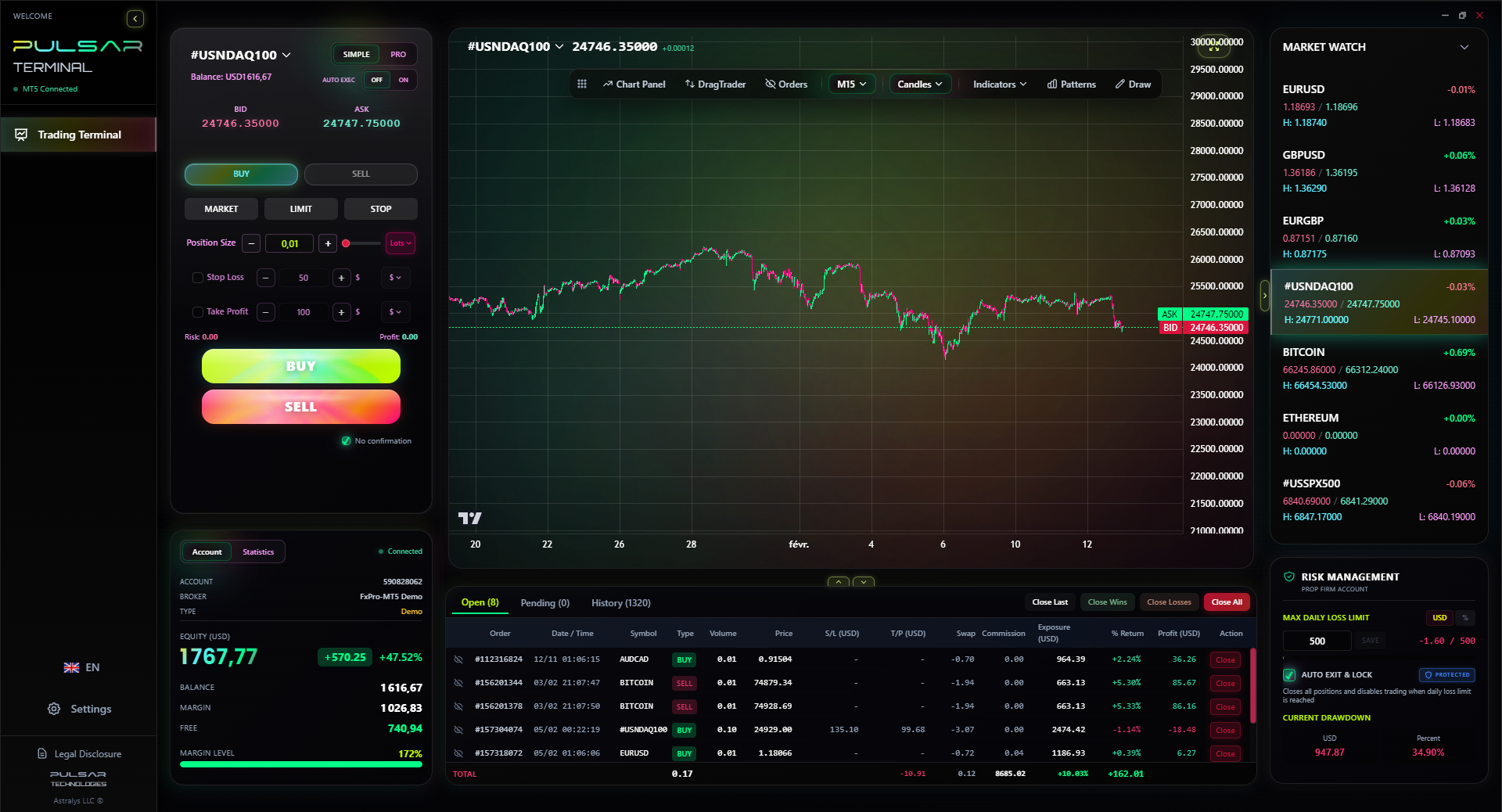
Managing the complex exit strategies and daily loss limits required by prop firms is nearly impossible on vanilla MT5, which is why tools like Pulsar Terminal that automate multi-TP/SL and loss protection are non-negotiable for serious challenges.
Pulsar Terminal
Универсальный инструмент для MT5: drag-and-drop ордера, мульти-TP/SL, трейлинг-стоп, грид-трейдинг, Volume Profile и защита для проп-фирм. Используется 1000+ трейдерами ежедневно.
“Find the platform that solves the Nigerian problems first. The trading problems come after.”
After all these years and thousands of trades, my setup is boring and reliable: IC Markets' Raw Spread account on MetaTrader 5. It's not the flashiest. It doesn't have the most instruments. But it executes, it holds up under pressure, and the money gets back to my Nigerian account reliably. For the raw spreads on majors and the stability, it's worth the slightly higher entry point.
For a complete beginner in Nigeria, I'd point them towards Exness on MT4. The barrier to entry is low, the funding is instant, and they can learn what a pip and spread are without losing a fortune. The moment they start getting serious about volume or automated trading, they should graduate.
Remember, the best forex trading platforms in Nigeria aren't about who has the prettiest charts. They're about who provides a stable, fast connection from Lagos, who gets your money in and out without drama, and who doesn't vanish when you hit a margin call. Everything else - indicators, drawing tools, news feeds - is secondary. Find the platform that solves the Nigerian problems first. The trading problems come after.
One last thing: no matter which platform you choose, your first deposit should be money you are 100% prepared to lose. Use it to learn the real cost of trading, not just the simulated one. That's the only way you'll learn what you truly need.
💡 Совет Уинстона
If a platform's marketing focuses on 'signals' or 'sure profits,' run. A serious platform's marketing focuses on execution speed, uptime statistics, and transparent pricing.
FAQ
Q1Is Forex trading legal in Nigeria?
Yes, forex trading is legal for individuals in Nigeria. The Central Bank of Nigeria (CBN) regulates the official foreign exchange market, but individuals are free to trade on the international spot forex market through licensed offshore brokers. You are responsible for any tax implications on your profits.
Q2Which is better for Nigerian traders, MT4 or MT5?
For most Nigerian traders starting out, MT4 is simpler and has more locally available educational resources. MT5 is more powerful, allows more pending order types, and is better for trading stocks or indices if your broker offers them. For pure forex, MT4 is often sufficient. Choose based on your broker's best offering - sometimes their MT5 servers have tighter spreads.
Q3Can I use a platform like Binance for forex trading?
No, Binance is a cryptocurrency exchange. While it offers crypto/fiat pairs (like USDT/NGN), it is not a forex trading platform for major currency pairs like EUR/USD or GBP/JPY. The use, instruments, and market structure are completely different.
Q4How much money do I need to start?
Technically, some platforms let you start with as little as $10 (about ₦15,000). Practically, this is a terrible idea. Transaction costs (spreads) will eat a tiny account. A more realistic minimum to properly learn position sizing and risk management is $200-$500 (₦300k-₦750k). Never trade with money you need for rent or bills.
Q5Why do my trades keep getting 'requoted' on my platform?
A requote happens when the price you clicked on is no longer available by the time your order reaches the broker's server. It's often due to a slow internet connection, high market volatility, or trading on a platform/broker with poor execution speed. This is why testing platform speed during news events is critical.
Q6Should I choose a broker with a local Nigerian office?
It can be helpful for customer service and feeling secure, but it's not a guarantee of safety. The most important factor is the broker's primary international regulation (like ASIC, CySEC, FCA). A local office is a convenience, not a substitute for proper financial regulation.
Урок проф. Уинстона
Ключевые выводы:
- ✓Test platform stability on mobile data, not just perfect Wi-Fi.
- ✓Always simulate a withdrawal before your first deposit.
- ✓Calculate total cost: spread + commission + swap + conversion fees.
- ✓Prop firms require tools that automate their strict rule sets.
Насколько полезна эта статья?
Нажмите на звезду
Еженедельные торговые инсайты
Бесплатный еженедельный анализ и стратегии. Без спама.
Об авторе
Olumide Adeyemi
Пионер трейдинга в Западной Африке
Один из самых активных преподавателей форекс-трейдинга в Нигерии. 8 лет торгового опыта из Лагоса. Специализируется на стратегиях с малым капиталом и челленджах проп-фирм для африканских трейдеров.
Комментарии
Предупреждение о рисках
Торговля финансовыми инструментами сопряжена со значительным риском и может не подходить всем инвесторам. Прошлые результаты не гарантируют будущих доходов. Данный контент носит исключительно образовательный характер и не является инвестиционной рекомендацией. Всегда проводите собственное исследование перед торговлей.
Вам также может понравиться

Cara Trading Forex Sukses: 7 Prinsip dari Trader Profesional
Cara trading forex sukses dengan 7 prinsip trader pro: manajemen modal, disiplin, journal trading, backtest. Data nyata, bukan janji profit palsu.
Jam Trading Forex Terbaik untuk Trader Indonesia: Panduan Lengkap dengan Tabel Waktu
Panduan jam trading forex untuk trader Indonesia. Tabel 4 sesi dunia, jam emas 20:00-00:00, sesi mana yang harus dihindari. Data akurat + tips dari trader berpengalaman.
Top 5 Sàn Forex Uy Tín Nhất 2026: Review Jujur dari Trader Indonesia
Top 5 sàn forex uy tín 2026 untuk trader Indonesia. Review jujur: spread, deposit, withdraw, dukungan lokal. Exness, XM, IC Markets & lebih.
Скачать Pulsar Terminal
Все эти калькуляторы встроены в Pulsar Terminal с данными в реальном времени с вашего счёта MT5.
Скачать Pulsar Terminal