


I lost $1,200 in evaluation fees before I found a prop firm that actually worked for my style.

Sarah Collins
Торговый стратег ·  Australia
☕ 11 мин чтения
Что вы узнаете:
- 1What Prop Trading Really Means for Aussies
- 2The Rules of the Game (And How They Can Bite You)
- 3Top Prop Firms Accessible to Australian Traders (2026)
- 4Costs, Profit Splits & The Real Maths
- 5My Blueprint for Actually Passing the Challenge
- 6Taxes, Legality & The ASIC Situation
- 7What If Prop Firms Aren't For You? The Alternatives
- 8Final Verdict & Your First Step
I lost $1,200 in evaluation fees before I found a prop firm that actually worked for my style. That’s the brutal truth about finding the best prop firms forex for Australian traders. You’re not just looking for capital; you’re looking for a partner that won’t set you up to fail with impossible rules or sneaky fees. After trading with over half a dozen firms from Sydney, I’ve learned what separates the genuine opportunities from the expensive lessons. This guide cuts through the hype with local context, real numbers, and the hard lessons I wish someone had told me.
Forget the Instagram ads showing lambos. In Australia, prop trading is a simple deal: you prove you can trade profitably with discipline, and a firm gives you a much larger account to trade with their capital. You keep most of the profits. The key difference here, and why it's legal, is that these firms are trading their own money, not pooling client funds like a managed fund would. That's the ASIC loophole, so to speak.
When I started, I didn't get this. I treated a $50,000 evaluation account like my own personal scalping strategy playground. Big mistake. These firms aren't brokers; they're risk managers. Their entire model is based on finding traders who won't blow up the account. The rules - daily loss limits, minimum trading days - aren't there to annoy you. They're the filter. Understanding this mindset shift, from lone wolf to accountable partner, is the first step to passing any challenge.

Warning: Don't confuse prop firms with ASIC-regulated brokers like Pepperstone or IC Markets. You fund a broker account with your own cash. You pay a fee to attempt to earn a prop firm's capital. The risk profile is completely different.
Every firm has its own bible of rules. Ignore them at your financial peril. Here are the big ones, explained through my own blunders.
Profit Targets & Drawdowns
The standard profit target in a one-phase challenge is often 10%. For a $100,000 account, that's $10,000. Sounds achievable, right? It is, but the trap is the twin drawdown limits. You'll have a maximum daily loss (often 5%) and an overall trailing drawdown (often 10%). The overall drawdown usually trails upwards from your starting balance as you hit profit milestones.
My fail? I hit 8% profit quickly on a $50k FTMO challenge, then got cocky. I took a huge EUR/USD position right before a major news event, violating my own rules. The spike against me hit my daily loss limit in minutes. Account failed. I'd forgotten the golden rule: survival is more important than the target. Use a position size calculator religiously to ensure a single bad trade can't take you out.
Trading Days & Consistency Rules
Many firms require a minimum number of trading days (e.g., 10 days). This is to prevent you from hitting a lucky 10% gain in two days with excessive risk. You have to show consistency. I once tried to game this by taking tiny, meaningless trades just to log a day. It messed with my psychology and led to overtrading on the "real" days. Trade your plan, and the days will take care of themselves.
The One-Phase vs. Two-Phase Model
This is crucial. A two-phase challenge (like FTMO's old model) requires you to hit a profit target twice. A one-phase challenge (now more common) has you hit one target, but often with stricter drawdown rules during the evaluation. I prefer one-phase. It's simpler, faster, and mentally clearer. Firms like The5ers and FundedNext offer solid one-step programs.

💡 Совет Уинстона
Your first prop firm challenge fee is tuition, not an investment. Budget for it to be a total loss. If you pass, it's a bonus. This mindset removes the desperate pressure that causes most failures.
“Passing a prop firm challenge is 30% strategy and 70% psychology and risk management.”
Based on my experience and the community pulse, here are the firms that consistently come up for Aussies. This isn't a sponsored list; it's what works on the ground.
| Firm | Key Feature for Aussies | My Experience / Note |
|---|---|---|
| FundedNext | Offers a Stellar Challenge with no daily drawdown, only overall. Payouts up to 95%. | Their consistency rules are fair. Withdrawals to AUD via crypto were smooth for me. A top contender for the best prop firms forex right now. |
| The5ers | High Growth Plan scales you from $6k to $4m. Very clear, established rules. | I like their progressive scaling. They feel professional, not gimmicky. Good for swing trading styles. |
| FTMO | The original giant. Extremely structured, with a strong track record. | I've passed their challenge. The process is rigorous but fair. Their support is good. Withdrawals are reliable, if a bit slower. |
| Axi Select | Unique free evaluation path. You trade a live, but small, account. | This is a great low-risk way to try the prop model. No upfront fee, but you need to fund a small live account (~$200). Profit splits are competitive. |
| E8 Funding | Very low evaluation fees relative to capital offered. Simple one-step evaluation. | Good value for money on the entry fee. Rules are straightforward, no minimum trading days. A solid budget-friendly option. |

Pro Tip: Don't just pick the firm with the biggest advertised capital. Pick the one whose rules best fit your natural trading style. A scalper needs different rules than a position trader.
Let's talk dollars and cents, because this is where dreams get priced.
Evaluation Fees: These range from $49 for a tiny account to over $1,200 for a $200k+ challenge. My advice? Start small. I blew $599 on a big challenge before I was ready. It's smarter to pass a $50k challenge twice than fail a $200k challenge once. Many firms offer periodic discounts of 30-50%. Wait for a sale.
Profit Splits: The standard is 80% to you, 20% to the firm. Some offer 90/10 or even 100% on the first chunk of profits. But read the fine print. That 100% might only be on the first $10k. Don't get dazzled by the top number; look at the long-term split.
The Real Calculation: Let's say you pass a $100k challenge. You earn 10% profit, or $10,000. At an 80/20 split, you get $8,000. Minus your evaluation fee (say $500), your net is $7,500. That's a 1500% return on your fee. That's the potential. But the risk is 100% loss of that fee.
Other Costs: Remember, the firm's capital covers the trading. But if you're using a raw spread account through their broker, you'll pay commissions per lot. This comes out of the account equity, not your pocket. It just affects your net performance. Always factor in the spread and commission when planning your trades.

Example: On a $100k account with an 80/20 split and a $500 fee. To break even on the fee, you only need to make $500 / 0.8 = $625 in net profit for the firm. That's just 0.625% on the account. The barrier isn't the profit target; it's the drawdown rules getting you first.
💡 Совет Уинстона
Map your strategy's historical max drawdown in percentage terms. If it's ever been above 12%, walk away from standard 10% drawdown challenges. You are statistically doomed before you start.
“Don't pick the firm with the biggest advertised capital. Pick the one whose rules best fit your natural trading style.”
This is the distilled wisdom from my passes and many more fails.
Phase 1: The Grind (First 50% of Target) This is about risk-free accumulation. Your position size should be so small that you can barely feel the wins or losses. Aim for 0.5% to 1% risk per trade max. Use boring, high-probability setups. I used a simple MACD indicator divergence on the 4-hour chart for my first 5%. The goal here is to build a buffer above your starting balance so your trailing drawdown moves up. You want to get that safety net in place.
Phase 2: The Cruise (Second 50% of Target) Once you have a 3-4% buffer, you can breathe a little. Do NOT increase your risk. Keep grinding with the same small size. The psychological pressure will mount as you get close. This is where you must ignore the P&L. Focus on executing trades that fit your journal, not trades that "get you over the line." A desperate trade is a losing trade.
The Tool That Saved Me: I can't stress this enough - automate your risk. Whether it's a spreadsheet or a trading tool, you need to know your exact max position size for the day the second you log in. After my daily loss blow-up, I started using a tool that automatically sets hard stop losses based on my daily limit. It removes emotion. Passing a challenge is 30% strategy and 70% psychology and risk management. A tool that enforces your rules is a game-winner.
What NOT to Do: Don't trade during major news if your strategy isn't built for it. Don't try to recover a loss in the same session. Don't change strategies mid-challenge. And for heaven's sake, don't forget about the weekend. A firm's daily loss limit usually resets at 5 PM NY time Friday. A Sunday night gap open can blow through your limit before you can even log in on Monday in Sydney.
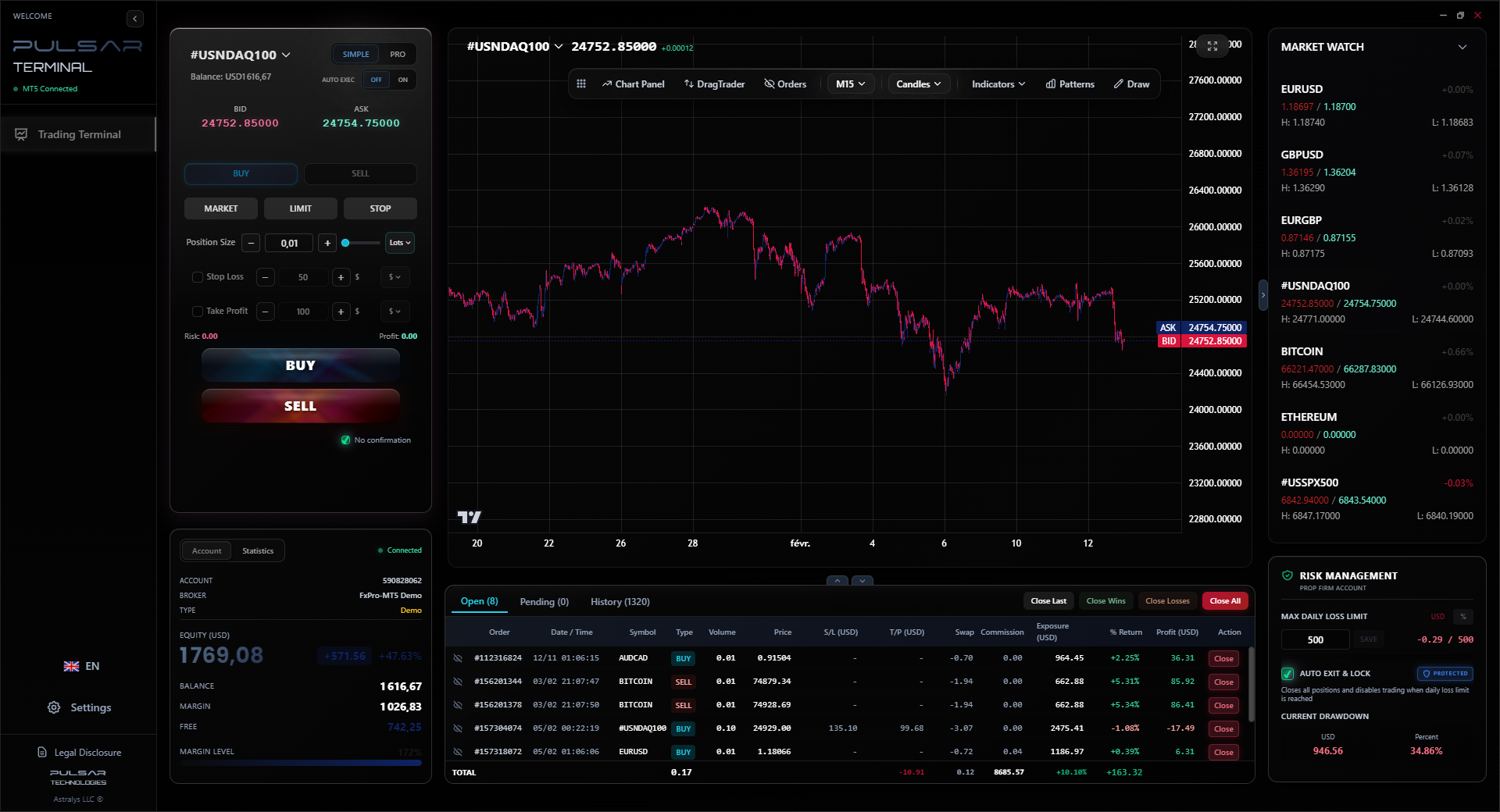
Managing the strict daily loss limits of a prop firm challenge is the hardest part, which is why tools like Pulsar Terminal that can set and lock automatic stop-loss rules based on a percentage of your account are invaluable for taking emotion out of the equation.
Pulsar Terminal
Универсальный инструмент для MT5: drag-and-drop ордера, мульти-TP/SL, трейлинг-стоп, грид-трейдинг, Volume Profile и защита для проп-фирм. Используется 1000+ трейдерами ежедневно.
This is the boring but critical stuff.
Is it Legal? Yes. Prop firms operating correctly are trading their own capital and hiring you as a contractor. They are not providing you with a financial product (like a CFD broker does), so the strict ASIC margin call and use rules don't directly apply to their capital. However, ASIC has said they're watching this space closely in 2024/25. The landscape is stable now, but stay informed.
How Am I Taxed? You're a sole trader. The profit share you receive is Personal Services Income (PSI). You must declare it in your tax return. Keep careful records of all your payouts and evaluation fees (these are tax-deductible as a business expense). I made the mistake of not setting aside tax from my first $15k payout. The ATO bill hurt. Now, I move 30% of every payout straight to a separate savings account. Talk to an accountant who understands trading income.
Withdrawals & AUD: Most international prop firms pay via crypto (USDT) or international wire in USD. You'll need a crypto exchange or your bank to convert to AUD. Factor in conversion fees and potential bank charges for international wires. Some firms with a local presence might offer better options.
“The prop firm world is a shortcut, but not an easy one. It's a filter for discipline.”
The prop path isn't for everyone. The rules chafe some traders. Here are two other ways to scale in Australia.
1. Build Your Own Capital with a Top Broker This is the traditional path. Use a low-cost, reliable ASIC broker like Fusion Markets or XM to grow your own account. The advantages? Total freedom. No profit targets, no daily drawdowns, no one looking over your shoulder. The disadvantage? It's slow, and you're risking your own money. If you have a $10k account and make 20% a year, that's $2k. To make a living, you need a much larger base. This path requires extreme patience and consistent profitability.
2. Join a Trading Firm as an Employee Some actual trading desks or hedge funds in Sydney or Melbourne hire junior traders. You'll get a salary plus a bonus. This is a real finance job with all the pros (stability, mentorship) and cons (office politics, less upside). It's incredibly competitive.
For most retail traders with skill but limited capital, prop firms offer the best middle ground: significant use on your skill without personal bankruptcy risk. It's a trade-off of freedom for opportunity.
💡 Совет Уинстона
When you get funded, withdraw your profit share every single month without fail. It transforms abstract numbers into real wealth and psychologically separates you from the 'firm's money'.
So, what are the best prop firms forex for an Australian in 2026? For most, I'd point to FundedNext or The5ers for their clear rules, good scaling, and trader-friendly features. For a completely risk-free trial of the model, Axi Select is a no-brainer.
Your action plan:
- Audit Your Trading: Pull 6 months of statements. What's your real win rate? Your average risk/reward? Your max drawdown? Be brutally honest. If your personal max drawdown is 25%, you will fail a 10% drawdown challenge.
- Paper Trade the Rules: Before spending a cent, take your strategy and paper trade it under a specific firm's rules for a month. Track every trade against their daily and overall drawdown. This is the most valuable step you can take.
- Start Small: Buy the smallest challenge you can. Your goal for Challenge #1 isn't to get funded; it's to learn how to pass a challenge. The education is worth the fee.
The prop firm world is a shortcut, but not an easy one. It's a filter for discipline, consistency, and emotional control. If you have those, it can be the catalyst that changes your trading career. If you don't, it will be an expensive teacher. Either way, you'll learn the truth about yourself as a trader. I know I did.
FAQ
Q1Do prop firms report my earnings to the ATO?
International prop firms generally do not report to the ATO. However, you are legally required to declare all worldwide income, including profit splits from overseas firms. The responsibility for reporting is 100% on you as a sole trader.
Q2What's the biggest mistake traders make in evaluations?
Oversizing. They treat a $100k prop account like it's their own $10k account and use 10x the position size. They hit a small losing streak and breach the daily drawdown before their strategy has a chance to work. Risk management isn't just important; it's the only thing that matters in the challenge phase.
Q3Can I use EAs or automated trading in prop firm challenges?
Most major firms allow it, but you must check their specific rules. Some prohibit fully automated trading, others allow it but may have restrictions on high-frequency trading (HFT). Always email support to get permission in writing before using any EA in an evaluation.
Q4How long does it take to get funded after passing?
Typically 1-2 weeks. There's a verification period where they check your trading complies with all rules, then they set up your live funded account. Firms like FundedNext promise faster activation, sometimes within 48 hours.
Q5Is the funded account real money?
Yes. Once you pass, you trade a live account with the firm's real capital. Your trades are in the live market. This is different from the evaluation account, which is usually a simulated/simulated live environment.
Q6What happens if I hit the profit target but also breach a rule?
You fail. The rules are absolute. Hitting the profit target does not excuse violating the daily loss limit, minimum trading day rule, or any other condition. You must achieve the target while staying within all constraints.
Q7Are there any prop firms based in Australia?
There are a few smaller, local operations, but the major global players (FTMO, The5ers, FundedNext) are based overseas. They are, however, fully accessible to Australian traders. Axi Select is part of the Axi group, which has a strong Australian presence.
Урок проф. Уинстона
Ключевые выводы:
- ✓Treat your first evaluation fee as a learning cost.
- ✓Your max historical drawdown must be less than the challenge limit.
- ✓Automate your daily loss limit above all else.
- ✓Start with the smallest challenge size available.
Насколько полезна эта статья?
Нажмите на звезду
Еженедельные торговые инсайты
Бесплатный еженедельный анализ и стратегии. Без спама.
Об авторе
Sarah Collins
Торговый стратег
Лондонский торговый стратег с 12-летним опытом на финансовых рынках. Бывший аналитик в брокерской компании Сити. Специализируется на GBP-парах, европейских рынках и FCA-регулированной торговле.
Комментарии
Предупреждение о рисках
Торговля финансовыми инструментами сопряжена со значительным риском и может не подходить всем инвесторам. Прошлые результаты не гарантируют будущих доходов. Данный контент носит исключительно образовательный характер и не является инвестиционной рекомендацией. Всегда проводите собственное исследование перед торговлей.
Вам также может понравиться

Cara Trading Forex Sukses: 7 Prinsip dari Trader Profesional
Cara trading forex sukses dengan 7 prinsip trader pro: manajemen modal, disiplin, journal trading, backtest. Data nyata, bukan janji profit palsu.
Jam Trading Forex Terbaik untuk Trader Indonesia: Panduan Lengkap dengan Tabel Waktu
Panduan jam trading forex untuk trader Indonesia. Tabel 4 sesi dunia, jam emas 20:00-00:00, sesi mana yang harus dihindari. Data akurat + tips dari trader berpengalaman.
Top 5 Sàn Forex Uy Tín Nhất 2026: Review Jujur dari Trader Indonesia
Top 5 sàn forex uy tín 2026 untuk trader Indonesia. Review jujur: spread, deposit, withdraw, dukungan lokal. Exness, XM, IC Markets & lebih.
Скачать Pulsar Terminal
Все эти калькуляторы встроены в Pulsar Terminal с данными в реальном времени с вашего счёта MT5.
Скачать Pulsar Terminal