


I lost $1,200 in under an hour because I didn't understand correlation.

Olumide Adeyemi
Пионер трейдинга в Западной Африке ·  Nigeria
☕ 10 мин чтения
Что вы узнаете:
- 1What is Correlation and Why It Matters More Than Your Strategy
- 2The Major Correlations You Must Know (With Real Numbers)
- 3How to Check Current Correlations (Don't Guess)
- 4Practical Trading Strategies Using Correlation
- 5The Nigerian Trader Context: Naira, Fees, and Reality
- 6Common Mistakes to Avoid (I've Made Them All)
- 7Putting It All Together: A Simple Weekly Routine

I lost $1,200 in under an hour because I didn't understand correlation. I was long EUR/USD, saw it dip, and thought 'Aha, GBP/USD looks cheap!' I piled into that too. What I didn't know was they move together about 80% of the time. A single piece of US data hit the wires, the dollar ripped higher, and I got a margin call on both positions at once. My account was halved. That painful lesson taught me that knowing a correlated forex pairs list isn't just academic, it's survival. Let's make sure you don't repeat my expensive mistake.
Correlation, in simple terms, is how often two currency pairs move in the same direction. We measure it on a scale from -1 to +1. A reading of +1 means they move in lockstep, 100% of the time. A reading of -1 means they move in perfect opposite directions. A reading of 0 means there's no relationship at all, just random noise.
Most traders obsess over their entry signal - the perfect RSI divergence or MACD crossover. I get it, I used to be one of them. But here's the brutal truth: if you're trading two highly correlated pairs in the same direction, you're not executing two separate trades. You're placing one massive, over-leveraged bet and paying two spreads for the privilege. You've effectively doubled your position size without realizing it. This is the single biggest hidden risk in a retail trader's portfolio.

Warning: Trading EUR/USD and GBP/USD in the same direction is not diversification. It's concentration. You're exposed to the same underlying driver: the US dollar's strength or weakness.
Understanding this changes everything. It stops you from accidentally over-leveraging. It helps you spot genuine hedging opportunities. And it can even give you a 'second opinion' on a trade setup. If EUR/USD is breaking out but its correlated cousin AUD/USD is going nowhere, that's a red flag worth paying attention to.
Correlations aren't fixed; they change over time based on economic cycles and market sentiment. However, some relationships are so structurally embedded they persist for years. These are the ones you need burned into your memory.
The Dollar Pairs (The EUR, GBP, AUD, NZD Gang)
These pairs all have the US dollar as the quote currency (the second one). When the dollar gets strong, they all tend to fall. When the dollar weakens, they all tend to rise. They're like a squad.
- EUR/USD and GBP/USD: This is the big one. The correlation typically sits between +0.70 and +0.85. It's high, but not perfect. The key divergence often comes from European vs. UK-specific news.
- EUR/USD and AUD/USD: Surprisingly strong, often in the +0.60 to +0.75 range. Why? Both the Euro and Aussie are considered 'risk' currencies to some degree.
- GBP/USD and AUD/USD: Also positively correlated, usually around +0.60 to +0.70.
The Commodity Bloc (AUD, NZD, CAD)
These currencies are tied to their countries' major exports.
- AUD/USD and NZD/USD: Known as the 'Aussie' and 'Kiwi'. They are extremely tightly correlated, often above +0.85. Trading both is almost always redundant.
- AUD/USD and USD/CAD: Here's where it gets interesting. AUD/USD (AUD up = USD down) and USD/CAD (USD up = CAD down) are typically negatively correlated, around -0.70 to -0.80. A strong commodity rally (like oil and metals) can boost both AUD and CAD, making this relationship messy.
The Safe-Haven Dance (USD, JPY, CHF)
In times of panic, money flows into the Japanese Yen and Swiss Franc. The US dollar can also play this role.
- USD/JPY and EUR/USD: This is a classic negative correlation. When traders are fearful, they sell EUR/USD (a 'risk' pair) and buy JPY (a safe haven), which means selling USD/JPY. The correlation often swings between -0.60 and -0.80.
- EUR/USD and USD/CHF: Historically, these had a near-perfect negative correlation (close to -1). It's loosened a bit since the SNB interventions, but it still often sits around -0.70 to -0.85. Think of them as a seesaw.

Example: If you have a $10,000 account and risk 1% ($100) on a EUR/USD long, then open another long on GBP/USD risking another 1%, your real risk isn't $200. Because they're 80% correlated, your effective exposure is closer to risking 1.8% on the same dollar-down bet. You've nearly doubled your risk target without a second thought.

💡 Совет Уинстона
A correlation above +0.7 or below -0.7 is significant. Treat those pairs as a single position when calculating your total risk.

“Trading EUR/USD and GBP/USD in the same direction is not diversification. It's concentration.”
You can't rely on memory or a static list. Markets evolve. The correlation between EUR/USD and AUD/USD might be +0.8 for six months, then drop to +0.3 during a China-led commodity crash. You need live data.
Most trading platforms have a correlation matrix tool, but they're often buried. Here’s a simpler, free method I use every Monday morning:
- Go to a site like Investing.com or Myfxbook.
- Find their 'Correlation' or 'Forex Correlation' tool.
- Set the timeframe. This is critical. For a swing trader holding positions for days, use a 1-day or 1-week chart setting. For a scalper, you might look at a 1-hour correlation. They can be wildly different.
- Look at the matrix. It's a grid of numbers. Focus on the pairs you actually trade.
My routine: I pull up the 1-week correlation for the 7 major pairs. I screenshot it and stick it on a sticky note next to my screen. If I see EUR/USD and GBP/USD at +0.89, I know I cannot take a long signal on both. I must pick the cleaner chart. This simple habit has saved me from countless overlapping, risky positions.

Pro Tip: A rising positive correlation (e.g., from +0.5 to +0.8) can confirm a strong trend. If all dollar pairs are falling in tight correlation, the dollar trend is powerful. A breaking correlation (e.g., +0.8 down to +0.2) often signals a major shift in market narrative. Pay attention.
So you have your correlated forex pairs list. Now what? Don't just use it to avoid mistakes. Use it to make smarter decisions.
1. Confirmation and Divergence
This is my primary use. Let's say my scalping strategy gives a buy signal on EUR/USD on the 15-minute chart. Before I hit the button, I glance at GBP/USD and AUD/USD. If they're also showing strength or bouncing off a key level, that's strong confirmation. The dollar weakness theme is broad. If EUR/USD is screaming buy but GBP/USD is breaking below support, I pause. That divergence means the move might be isolated and fragile. I'll either pass on the trade or use a much tighter stop.
2. Hedging (The Advanced Move)
This is tricky and not for beginners, but understanding it is key. A true hedge reduces risk. If you are long EUR/USD and you short a highly positively correlated pair like GBP/USD, you're not hedging - you're just creating a messy, spread-eating position that will likely lose on both sides. A better theoretical hedge for a long EUR/USD position would be to go long USD/CHF (given their negative correlation). In practice, hedging with spot forex is inefficient for retail traders due to spreads and swaps. It's a concept to understand, but I rarely recommend executing it.
3. Finding the Strongest Pair in a Trend
In a strong dollar uptrend, all dollar pairs (EUR/USD, GBP/USD, AUD/USD) will be falling. But one will usually be the weakest, leading the pack. Check the correlation matrix and then look at the charts. The pair with the cleanest, most consistent downtrend and the highest correlation to the others is often the best one to trade. You're picking the leader, not a laggard that might reverse prematurely.
💡 Совет Уинстона
If you get a signal on a pair, but its 80% correlated cousin is showing a clear rejection at a key level (like a daily resistance), respect that divergence. It's often smarter money talking.

“Knowing your correlated forex pairs list directly protects your hard-converted Naira.”
Let's get local. You're funding your account with Naira, probably through a broker like Exness or XM that offers local deposits. Your broker might quote you a USD/NGN rate for funding. Every time you trade a correlated pair, you're paying two spreads, two potential swap fees, and dealing with double the psychological stress.
Here’s a real scenario from last year. I was mentoring a trader in Lagos. He had a $5,000 account with a broker. He was long EUR/USD and, seeing a pullback, also went long GBP/USD. His logic was 'averaging down' on the dollar-short idea. He didn't check correlation. When the US CPI data came out hot, both pairs tanked in unison. His combined loss was over $400. The killer? The swap fees (overnight financing) on both positions were negative, slowly bleeding his account while he waited for a rebound that never came.
For us, managing capital is everything. Knowing your correlated forex pairs list directly protects your hard-converted Naira. It stops you from paying multiple fees on what is one idea. Before you open a second position, ask: "Is this a new, independent idea, or am I just doubling down on my first trade in a different font?" If it's the latter, just adjust your position size on the first trade. It's cheaper and cleaner.
Also, remember that liquidity during your trading hours (West Africa Time) can affect correlations. During the Asian session, correlations might be weaker or noisier. The tightest moves often happen during the London and New York overlaps. Plan your correlation checks around your active trading window.

Let me save you the tuition fees.
Mistake 1: Assuming Correlation is Causation. Just because EUR/USD and GBP/USD move together doesn't mean one causes the other to move. They are both reacting to a common factor (USD flows). Don't start trading one as a signal for the other.
Mistake 2: Using a Long-Term Correlation for Short-Term Trading. This is a classic error. The 1-month correlation might be +0.8, but on the 5-minute chart today, the pairs could be moving inversely. Always match your correlation timeframe to your trading timeframe. If you're a day trader, a daily correlation matrix is almost useless to you.
Mistake 3: The 'Hedge' That Isn't. As mentioned, going long EUR/USD and short GBP/USD because they are 'correlated' is not a smart hedge. You'll likely lose on the spread and get whipsawed. If you want to hedge, you need a strongly negative correlation, and even then, it's complex. Most of the time, the best hedge is a smaller position size or a simple stop-loss.
Mistake 4: Ignoring Gold (XAU/USD). It's not a forex pair, but it's crucial. Gold (XAU/USD) has a strong negative correlation with the US dollar. When the dollar is strong, gold often falls, and vice versa. So, if you're long several dollar pairs (betting on dollar weakness), you should expect gold to be rising. If it's not, your dollar-weakness thesis might be flawed. I always keep an eye on the XAU/USD guide for this broader context.
💡 Совет Уинстона
Your broker's swap fees matter. Holding two long positions on positively correlated pairs means paying double the negative swap if you're holding overnight. That's a slow bleed on your account.

“The best hedge for most retail traders is a smaller position size or a simple stop-loss, not a complex correlated pair trade.”
Knowledge is useless without action. Here's the exact 10-minute routine I follow to keep correlation risk in check.
Every Monday Morning:
- Open my correlation matrix website.
- Set the period to '1 Week' (for my swing trading style).
- Write down the three key numbers for my favorite pairs:
- EUR/USD vs. GBP/USD: ______
- EUR/USD vs. USD/JPY: ______
- AUD/USD vs. NZD/USD: ______
- Stick that note on my monitor.
Before Every Trade:
- I have my primary chart (e.g., EUR/USD) with my setup.
- I open a smaller, tiled chart of its most correlated pair (e.g., GBP/USD).
- I ask: "Is this other pair confirming or contradicting my story?"
- If confirming, I proceed. If contradicting, I either reduce my position size by 50% or skip the trade entirely.
Managing Open Trades: If I am already in a trade on EUR/USD and get a signal on GBP/USD, I don't open it as a new trade. Instead, I consider if the new signal is so good that I should close my EUR/USD trade and move to GBP/USD. Or, I acknowledge that I already have exposure to this theme and let it be. This discipline forces me to only add a position when I have a new market view, not just a new chart pattern on the same old view.
This routine turns a complex concept into a simple, actionable filter. It's your first line of defense against portfolio suicide.

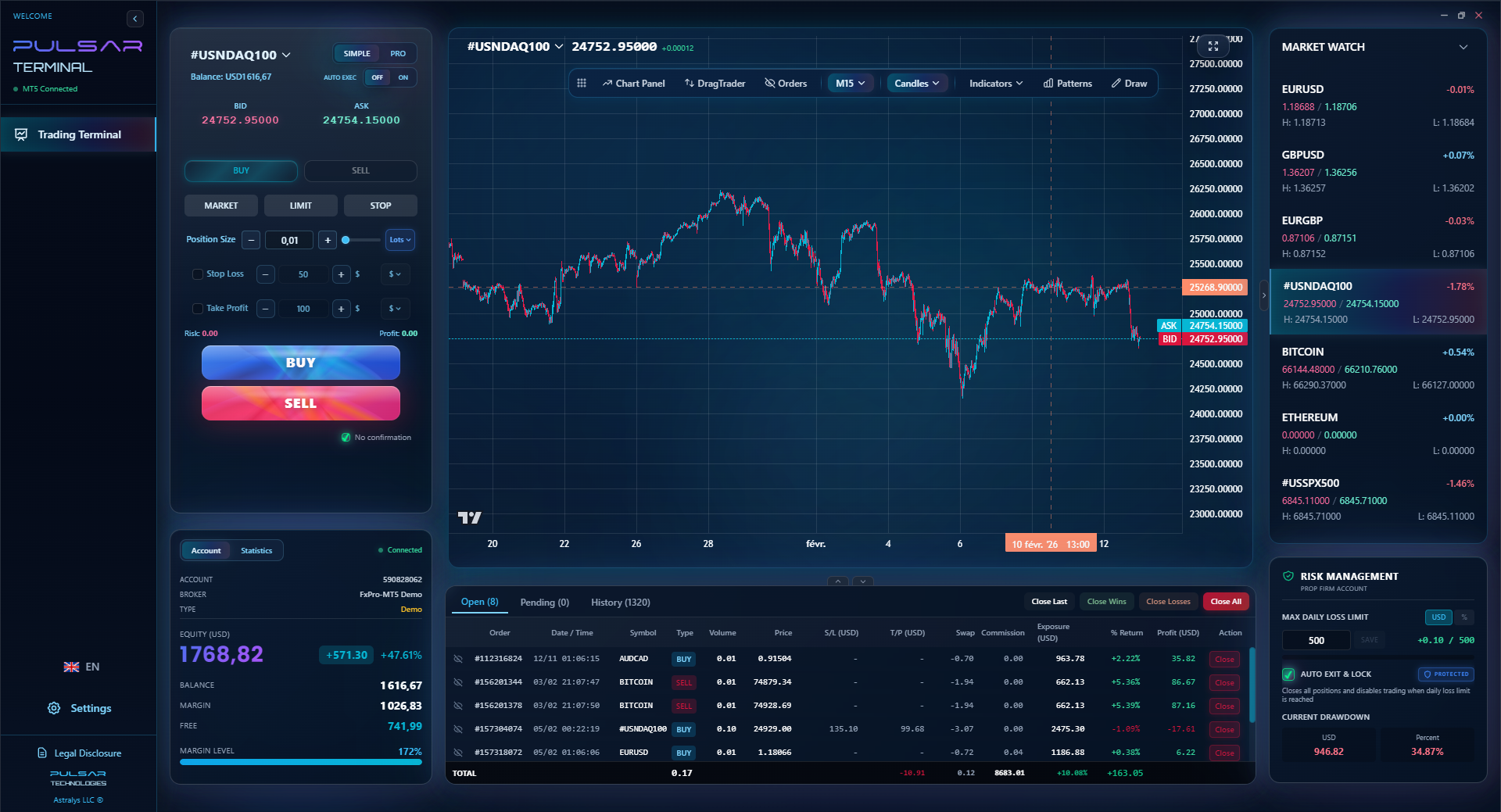
Managing multiple correlated positions manually is a headache; Pulsar Terminal's portfolio view and drag-and-drop order management let you see and adjust your total exposure across all pairs in one click on MT5.
Pulsar Terminal
Универсальный инструмент для MT5: drag-and-drop ордера, мульти-TP/SL, трейлинг-стоп, грид-трейдинг, Volume Profile и защита для проп-фирм. Используется 1000+ трейдерами ежедневно.
FAQ
Q1What is the most strongly correlated forex pair?
AUD/USD and NZD/USD (the Aussie and Kiwi) are typically the most strongly positively correlated, often with a coefficient above +0.85. Trading both in the same direction is almost always redundant and just doubles your costs and risk.
Q2Can correlation be used for hedging?
In theory, yes, but it's difficult in practice for retail traders. To hedge, you need a strong negative correlation (like EUR/USD and USD/CHF). Simply going long one pair and short a positively correlated pair (like EUR/USD and GBP/USD) is not a true hedge; it often creates a messy position that loses on the spread and can whipsaw. For most, using a sensible stop-loss is a more effective risk management tool.
Q3How often do forex correlations change?
They change constantly, but major structural correlations (like EUR/USD & GBP/USD being positive) persist. Significant shifts happen during major economic crises, changes in central bank policy, or sustained commodity booms/busts. You should check a live correlation matrix at least weekly, matching the timeframe (e.g., 1-day, 1-week) to your trading style.
Q4Is there a negative correlation between EUR/USD and USD/JPY?
Yes, typically there is a strong negative correlation, often between -0.60 and -0.80. This is because the JPY is a major safe-haven currency. In 'risk-off' markets, EUR/USD (a risk-sensitive pair) tends to fall while USD/JPY also falls (as traders buy JPY). They often move in opposite directions.
Q5Why should a Nigerian trader care about correlation?
Because it directly protects your capital in Naira terms. Trading two highly correlated pairs doubles your transaction costs (spreads, potential swap fees) on a single market view. In a market move against you, it can trigger a margin call twice as fast. Understanding correlation stops you from accidentally over-leveraging and burning through your hard-deposited funds.
Q6What's a good free tool to check forex correlation?
Websites like Investing.com, Myfxbook, and Mataf.net offer free, user-friendly correlation matrices. You can select your currency pairs and the chart timeframe (1 hour, 1 day, 1 week) to see the current correlation coefficient. This should be part of your weekly market review.
Урок проф. Уинстона
Ключевые выводы:
- ✓Correlation above +0.7 means you're effectively trading one position.
- ✓Always match correlation timeframe to your trade duration.
- ✓AUD/USD & NZD/USD correlation is often above 0.85 (redundant).
- ✓Check correlations weekly; they are not static.
Насколько полезна эта статья?
Нажмите на звезду
Еженедельные торговые инсайты
Бесплатный еженедельный анализ и стратегии. Без спама.
Об авторе
Olumide Adeyemi
Пионер трейдинга в Западной Африке
Один из самых активных преподавателей форекс-трейдинга в Нигерии. 8 лет торгового опыта из Лагоса. Специализируется на стратегиях с малым капиталом и челленджах проп-фирм для африканских трейдеров.
Комментарии
Предупреждение о рисках
Торговля финансовыми инструментами сопряжена со значительным риском и может не подходить всем инвесторам. Прошлые результаты не гарантируют будущих доходов. Данный контент носит исключительно образовательный характер и не является инвестиционной рекомендацией. Всегда проводите собственное исследование перед торговлей.
Вам также может понравиться

Cara Trading Forex Sukses: 7 Prinsip dari Trader Profesional
Cara trading forex sukses dengan 7 prinsip trader pro: manajemen modal, disiplin, journal trading, backtest. Data nyata, bukan janji profit palsu.
Jam Trading Forex Terbaik untuk Trader Indonesia: Panduan Lengkap dengan Tabel Waktu
Panduan jam trading forex untuk trader Indonesia. Tabel 4 sesi dunia, jam emas 20:00-00:00, sesi mana yang harus dihindari. Data akurat + tips dari trader berpengalaman.
Top 5 Sàn Forex Uy Tín Nhất 2026: Review Jujur dari Trader Indonesia
Top 5 sàn forex uy tín 2026 untuk trader Indonesia. Review jujur: spread, deposit, withdraw, dukungan lokal. Exness, XM, IC Markets & lebih.
Скачать Pulsar Terminal
Все эти калькуляторы встроены в Pulsar Terminal с данными в реальном времени с вашего счёта MT5.
Скачать Pulsar Terminal