


Here's a stat that might surprise you: most intraday traders in India lose money trying to chase breakouts.

Rajesh Sharma
Старший форекс-аналитик ·  India
India
☕ 10 мин чтения
Что вы узнаете:
Here's a stat that might surprise you: most intraday traders in India lose money trying to chase breakouts. I was one of them for a long time. Then I started using the Central Pivot Range (CPR), and it completely changed how I saw the market's structure. Forget hunting for some elusive CPR trading strategy PDF. This guide is everything you need, tailored for our market, our timings, and our psychology. It's not a magic bullet, but it's the single most reliable tool I've used to identify where the real battle between buyers and sellers happens each day.
The Central Pivot Range (CPR) is a dead-simple yet powerful indicator that tells you the market's 'fair value' zone for the day. It's calculated from yesterday's price action. Think of it as the market's memory. If today's price is trading above this zone, buyers are in control. If it's below, sellers are dominating. If price is stuck inside it, well, grab a chai because it's going to be a choppy, range-bound day.
The CPR gives you three key levels:
- Pivot Point (P): The central anchor. (Yesterday's High + Low + Close) / 3.
- Top Central Pivot (TC): The first resistance. (Pivot * 2) - Yesterday's Low.
- Bottom Central Pivot (BC): The first support. (Pivot * 2) - Yesterday's High.
The space between the TC and BC is the Central Pivot Range. This 20-30 point zone on Nifty is often where the market decides its next big move. I used to ignore it, focusing on fancy indicators. Big mistake. Now, I won't place a single trade until I've drawn these levels on my chart.

Example: Let's say BANKNIFTY yesterday had a High of 48,500, a Low of 47,800, and it Closed at 48,200.
- Pivot (P) = (48500 + 47800 + 48200) / 3 = 48166.67
- TC = (48166.67 * 2) - 47800 = 48533.34
- BC = (48166.67 * 2) - 48500 = 47833.34 So, today's CPR is between 47833 and 48533. That's a 700-point range where the market might consolidate.

💡 Совет Уинстона
The market's first job is to find value. The CPR is yesterday's value. Today's price action is the auction to discover if that value has changed. Trade the acceptance or rejection of that zone.
You can let your trading platform do it, but doing it manually for a week will burn it into your brain. Here's the formula again, broken down for Indian indices like Nifty 50 or Sensex.
The CPR Formula:
- Pivot (P) = (Previous High + Previous Low + Previous Close) / 3
- TC = (P * 2) - Previous Low
- BC = (P * 2) - Previous High
Using It with Stocks
It works brilliantly on liquid stocks too. I regularly use it on Reliance, TCS, and HDFC Bank. The key is liquidity. Don't bother with a low-volume small-cap; the levels won't hold.
Let me give you a real example from a trade I messed up. On March 15th, I was looking at Tata Motors. The previous day's H=1025, L=1002, C=1018. Pivot came to 1015. TC was 1028. BC was 1005. The stock opened at 1022, right inside the CPR. I got impatient and bought a breakout above 1025, thinking it would rocket. It tagged the TC at 1028, reversed hard, and fell straight to the BC at 1005. I was stopped out for a 2% loss. The CPR told me the whole story - it was a range day - but I didn't listen. The lesson? Price opening inside the CPR often means a bounce between TC and BC. Wait for the edges.

Pro Tip: Most Indian charting platforms (Zerodha Kite, Upstox) have CPR as a built-in indicator. Just search 'Pivot' in the indicators list. But always cross-check the first few times to ensure it's calculating correctly.
“Forget hunting for an elusive CPR trading strategy PDF. The real learning is in applying the levels yourself.”
This is where the rubber meets the road. You've got your levels. Now what?
1. The CPR Breakout / Breakdown
This is the classic. Price consolidates inside the CPR for the first hour or two after market open (9:15 AM - 10:30 AM). Then, it makes a sustained move above the TC (bullish) or below the BC (bearish) with volume. My Action: I enter on a retest of the breached level (TC becomes support, BC becomes resistance). My stop-loss goes just inside the CPR. Target? I often look for the next standard pivot level (R1 or S1) or use a 1:2 risk-reward.
2. The CPR Rejection (My Favorite)
Price opens outside the CPR - say, above the TC in a bullish gap. But instead of running, it gets rejected and falls back inside the CPR. This is a failed breakout and a strong reversal signal. Real Trade: On April 2nd, Nifty opened at 22,400 (above the TC of 22,380). It immediately fell back below the TC. I shorted at 22,375 with a stop at 22,390. The price dropped to the Pivot at 22,340 for a quick 35-point profit. This setup has a high win rate for me because it catches emotional, false moves.
3. Trading the CPR Range
Price opens inside and just oscillates between TC and BC all day. This is common on expiry days or before major news. Here, I become a seller near TC and a buyer near BC. It's simple, but it requires patience. Use a tight stop-loss just outside the level. This is a perfect scenario for a basic scalping strategy.
Combining CPR with a momentum indicator like the RSI indicator can filter these setups further. For example, only take a CPR breakout if RSI is above 50 and rising.
I've blown up a few trades learning this. Here's my hall of shame.
Mistake 1: Trading the First Touch Blindly. Just because price hits the TC doesn't mean it will reverse. Early in my journey, I'd short every first touch. Sometimes, it's just a slight pause before a massive breakout. Now, I wait for confirmation - a bearish candlestick pattern (like a pin bar or engulfing) or a divergence on the MACD indicator.
Mistake 2: Ignoring the Market Open. The first 15 minutes are chaos. The CPR levels need time to 'settle.' Don't place trades based on CPR in the first few candles. Let the market find its feet. I've been whipsawed too many times.
Mistake 3: Using CPR Alone on Low Timeframes. On a 1-minute chart, CPR is just noise. I pair it with a 15-minute or 30-minute chart for direction. The CPR on the higher timeframe defines the major bias, and I use the lower timeframe for entry. For broader trend context, I might check the daily CPR when planning a swing trading idea.
Mistake 4: Forgetting About Costs. In India, every tick counts. If your profit target is 10 points on Nifty but your brokerage, STT, and fees eat up 3 points, your edge is gone. Always use a position size calculator and factor in all costs. That 0.025% STT on intraday sales adds up fast.

Warning: Never add to a losing CPR trade. If you go long at BC and it breaks down, don't average down. The CPR has failed as support. Accept the loss and move on. This one rule has saved me from my biggest losses.
💡 Совет Уинстона
A narrow CPR (TC and BC close together) often precedes a volatile expansion move. A wide CPR suggests a balanced day. Adjust your position size accordingly.
“I won't place a single trade until I've drawn the CPR levels on my chart. It's the market's memory.”
CPR is a fantastic foundation, but it's not a standalone system. Here's what I layer on top.
Volume Profile: This is a game-changer (whoops, I said it). Seeing where high volume nodes align with your CPR levels adds tremendous conviction. If the Pivot point lines up with a high-volume area from the previous day, that level becomes a concrete floor or ceiling.
VWAP (Volume Weighted Average Price): For intraday, I treat VWAP as the dynamic sibling of the static CPR. A classic setup: Price is above the CPR and above VWAP = strong bullish intraday trend. Price below CPR and below VWAP = strong bearish trend. If they conflict (price above CPR but below VWAP), it signals confusion - stay out.
Simple Moving Averages: A 20-period EMA on your 15-minute chart can act as a dynamic filter. I only take long CPR bounces if price is also above the 20 EMA. It keeps you on the right side of the intraday momentum.
The News Catalyst: CPR is technical. It doesn't know about RBI announcements or quarterly results. Always check the economic calendar. I got caught in a perfect CPR rejection short once, only for the company to announce a buyback 30 minutes later. The stock ripped through my stop and the TC like they weren't there. Technicals work until fundamentals kick in.
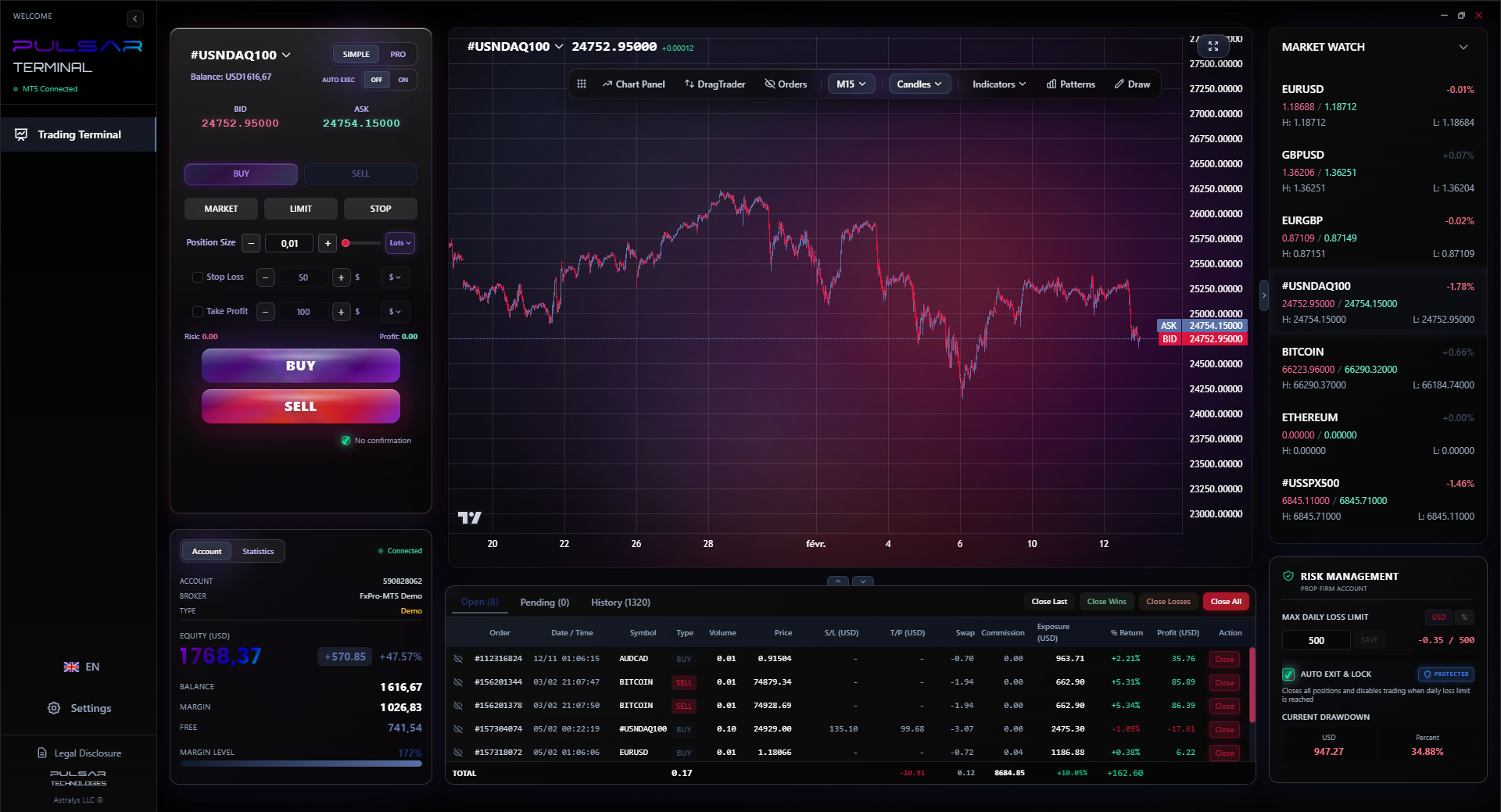
Manually drawing CPR levels every day is a chore; Pulsar Terminal can automate this and other key drawings directly on your MT5 platform, saving you crucial pre-market time.
Pulsar Terminal
Универсальный инструмент для MT5: drag-and-drop ордера, мульти-TP/SL, трейлинг-стоп, грид-трейдинг, Volume Profile и защита для проп-фирм. Используется 1000+ трейдерами ежедневно.
You need a platform that's fast, reliable, and lets you draw these levels easily. Here's the lowdown on the Indian scene.
Zerodha (Kite): My primary platform. It's the market leader for a reason. The charts are clean, CPR is built-in (called 'Pivot Points Standard'), and the execution is rock-solid for intraday. Their flat ₹20 intraday brokerage is a cost-saver. Check our full Zerodha review for more. The only gripe? Their advanced charting (Kite web) is good but not as feature-rich as some dedicated platforms.
Upstox (Pro Web): A very strong competitor to Zerodha. Similar pricing, excellent execution speed. Their charting package is strong and perfect for drawing CPR levels. Great for active intraday traders.
Angel One: Offers advanced charting tools through their platform. They cater well to both new and active traders. Worth a look if you want more research bundled in.
For Advanced Charting (MT5): If you're a charting nerd like me and want to use MT5 with Indian brokers, your options are limited but growing. Some international brokers with local presence offer MT5 for forex and commodities. Platforms like Exness or IC Markets offer MT5, but remember, they are not for trading Indian equities.
Funding & Costs: Almost all Indian brokers now support instant UPI transfers. It's seamless. Remember the cost structure: Brokerage (flat fee with discount brokers), STT, Exchange charges, GST, and Stamp Duty. That STT at 0.025% on the sell side is your biggest fee for intraday. Always calculate your break-even point.
“The CPR told me the whole story - it was a range day - but I didn't listen. That loss was my best teacher.”
Q: Is the CPR trading strategy only for Nifty? A: Not at all. It works best on any liquid instrument - Bank Nifty, liquid stocks like Infosys or ICICI Bank, even on forex pairs like USD/INR futures. The key is high volume so the levels are respected.
Q: What timeframes should I use CPR on? A: For intraday, the daily CPR (calculated from yesterday's data) on a 5-minute or 15-minute chart is the sweet spot. You can also calculate weekly CPR for a broader swing trading perspective.
Q: Why does the CPR on my chart look different from another platform? A: This is crucial. It's usually because of the 'previous close' data used. Some platforms use the official settlement price for futures, while others use the last traded price. For consistency in Indian markets, use the previous day's last candlestick close on the continuous chart. Stick to one data source.
Q: Can I use CPR for positional trading? A: Yes, but differently. Use the weekly CPR levels. A weekly close above the weekly TC can signal a strong bullish week ahead. It's a great filter for longer-term entries.
Q: Do I need to download a CPR trading strategy PDF? A: Honestly, no. Most PDFs are generic and not tailored to Indian market nuances (like market open at 9:15 AM, expiry Thursday volatility). This guide, combined with screen time, is better than any static PDF. The real learning is in applying it yourself.
Q: How do I handle a gap open far beyond the CPR? A: This happens on major news. In this case, the CPR for that day is often irrelevant. The gap area itself becomes the key support/resistance. I wait for the first 30-60 minutes to see if the gap fills or if price consolidates at the new level before trading.
FAQ
Q1What are the exact formulas for calculating CPR?
Pivot (P) = (Yesterday's High + Low + Close) / 3. Top Central (TC) = (P x 2) - Yesterday's Low. Bottom Central (BC) = (P x 2) - Yesterday's High. The range between TC and BC is the CPR zone.
Q2Which Indian trading platforms have the CPR indicator built-in?
Most major platforms like Zerodha Kite, Upstox Pro, Angel One, and Groww have it. Look for 'Pivot Points' or 'Standard Pivot Points' in the indicator list. It's usually based on the classic formula.
Q3Is the CPR strategy good for beginner traders in India?
It's one of the best starting points. It's visual, logical, and teaches you about market structure. Start by just observing how price reacts to the levels for a week without trading. It builds discipline and patience, which is 80% of the battle.
Q4How do I set stop-losses and targets using CPR?
For a long trade at BC, place your stop-loss just below the BC (or below the previous low). For a target, you can aim for the Pivot point first, then the TC. A common method is to use a 1:2 risk-reward ratio. If your stop is 20 points away, aim for a 40-point profit.
Q5Does CPR work on the Bank Nifty?
It works exceptionally well on Bank Nifty due to its high liquidity and volatility. The levels are often respected with precision, especially during the first half of the trading day.
Q6What's the biggest advantage of using CPR over other indicators?
Its objectivity and pre-defined nature. Unlike a moving average that repaints, the CPR levels are fixed at the day's start. Everyone using the same formula sees the same levels, creating collective areas of interest that often act as support/resistance.
Урок проф. Уинстона
Ключевые выводы:
- ✓CPR levels are fixed at market open; no repainting.
- ✓Price above TC = bullish bias; below BC = bearish bias.
- ✓A narrow CPR range often leads to a big directional move.
- ✓Always wait for price confirmation at the level, don't pre-empt.
Насколько полезна эта статья?
Нажмите на звезду
Еженедельные торговые инсайты
Бесплатный еженедельный анализ и стратегии. Без спама.
Об авторе
Rajesh Sharma
Старший форекс-аналитик
Более 10 лет торгует на индийских и южноазиатских рынках. Начинал с валютных деривативов на NSE, затем перешёл на международный форекс. Специализируется на USD/INR и парах развивающихся рынков.
Комментарии
Предупреждение о рисках
Торговля финансовыми инструментами сопряжена со значительным риском и может не подходить всем инвесторам. Прошлые результаты не гарантируют будущих доходов. Данный контент носит исключительно образовательный характер и не является инвестиционной рекомендацией. Всегда проводите собственное исследование перед торговлей.
Вам также может понравиться

Cara Trading Forex Sukses: 7 Prinsip dari Trader Profesional
Cara trading forex sukses dengan 7 prinsip trader pro: manajemen modal, disiplin, journal trading, backtest. Data nyata, bukan janji profit palsu.
Jam Trading Forex Terbaik untuk Trader Indonesia: Panduan Lengkap dengan Tabel Waktu
Panduan jam trading forex untuk trader Indonesia. Tabel 4 sesi dunia, jam emas 20:00-00:00, sesi mana yang harus dihindari. Data akurat + tips dari trader berpengalaman.
Top 5 Sàn Forex Uy Tín Nhất 2026: Review Jujur dari Trader Indonesia
Top 5 sàn forex uy tín 2026 untuk trader Indonesia. Review jujur: spread, deposit, withdraw, dukungan lokal. Exness, XM, IC Markets & lebih.
Скачать Pulsar Terminal
Все эти калькуляторы встроены в Pulsar Terminal с данными в реальном времени с вашего счёта MT5.
Скачать Pulsar Terminal