


I was staring at my screen at 2 AM, watching Bitcoin eat through my stop loss like puff-puff.

Olumide Adeyemi
Пионер трейдинга в Западной Африке ·  Nigeria
☕ 10 мин чтения
Что вы узнаете:

I was staring at my screen at 2 AM, watching Bitcoin eat through my stop loss like puff-puff. ₦1.2 million gone in 12 minutes because some whale in Singapore decided to sell. That same week, I made a calm 3% on a EUR/USD swing trade that felt boring by comparison. The adrenaline of crypto versus the steady grind of forex - it’s not just a choice of markets, it’s a choice of lifestyle. And in Nigeria, where the stakes feel higher and the naira is always under pressure, picking the right fight matters. Let’s strip away the hype and look at what each market really demands from you.
This is the first, most obvious split. Forex markets follow the sun. London opens, then New York, then Tokyo. You get weekends off (mostly). It’s structured, predictable. Crypto? It never sleeps. Not for Christmas, not for Eid, not for anything. That 24/7 access is a double-edged sword. It means you can trade on a Sunday night, but it also means a crash can start while you're at church and wipe you out before you say 'Amen'.
Volatility is where they truly diverge. A 'wild' day on EUR/USD might be a 1% move. In crypto, that's a calm Tuesday. It's not uncommon for major altcoins to swing 10-20% in a day. That volatility is pure opportunity for profit, and pure danger for your account. I learned this the hard way with Solana (SOL). I bought at $95, it ran to $105, I got greedy. While I slept, it dumped to $87. My take-profit was a dream, but my stop-loss was a necessity I'd ignored. The forex market, with its lower volatility, forces more discipline. The moves are slower, giving you time to think. For a new trader, that's a gift.

Warning: Don't confuse crypto's 24/7 market with 24/7 trading. Your brain needs rest. Trading fatigue will make you make stupid, expensive mistakes. Set hours, even for crypto.
Liquidity and Slippage
Forex is the most liquid market on the planet. Trillions of dollars daily. This means when you click 'buy' on a major pair like EUR/USD, you get the price you see. Slippage is minimal. In crypto, outside of Bitcoin and Ethereum, liquidity can be thin. I once tried to exit a decent-sized position in a mid-cap altcoin. The sell order itself pushed the price down 4% before it filled. That's a hidden cost you don't see on the chart. For Nigerians, this is critical because our capital is hard-earned. Losing money to slippage feels like theft. If you're trading smaller crypto pairs, always use limit orders, not market orders.
This structural difference dictates everything: your strategy, your risk management, even your sleep schedule. A scalping strategy in forex relies on tiny, frequent moves. In crypto, those 'tiny moves' are much larger, but so is the risk of a sudden, catastrophic spike against you.
“Crypto's 24/7 market is not an invitation for 24/7 trading. Your brain needs rest more than your account needs action.”
In forex, you're trading national economies. You're betting on interest rate decisions from the CBN or the Fed, on inflation reports, on employment data. There's a fundamental bedrock. When you trade GBP/USD, you can read the Bank of England's minutes and have a clue. Crypto? You're trading narratives, tech hype, and, let's be honest, often pure speculation. The 'fundamentals' might be a developer's tweet or a rumor about a Coinbase listing.
This changes your analysis completely. Technical analysis often works better in crypto because the market is more driven by pure crowd psychology and momentum than by quarterly GDP reports. I've seen perfect head-and-shoulders patterns play out on Bitcoin charts while, fundamentally, nothing had changed. In forex, a key news event can blow your perfect technical setup to pieces in seconds.
The Regulatory Cloud
Here's the Nigerian context. Forex trading operates in a grey area but is generally tolerated through international brokers like Exness or IC Markets. The CBN has issues with crypto. Banks have been told not to help crypto transactions. This adds a layer of friction. Funding your crypto exchange wallet can be a mission involving P2P platforms and their associated risks and premiums. Withdrawing profits? Another hurdle. Forex withdrawals to a Nigerian bank account, while sometimes slow, follow a more established (though still frustrating) path. This isn't just about trading; it's about getting your money in and out. The crypto barrier adds operational risk you must factor in.

💡 Совет Уинстона
If you can't explain your trade setup in one sentence before you enter, you don't understand it. Don't click buy.
“A 2% move in crypto can feel normal. That same move in forex would be a historic, news-making event.”
use is the accelerator. Both markets offer it, but the fuel is different. International forex brokers commonly offer use up to 1:500 or even 1:1000 to Nigerian clients (though regulators elsewhere are tightening this). On a $1,000 account, that's $500,000 in buying power. A 0.2% move against you can wipe you out. That's a margin call waiting to happen.
Crypto use is generally lower on major exchanges (often 1:5 to 1:100), but remember the volatility is 5-10x higher. So, 1:10 use on Bitcoin can feel riskier than 1:100 on EUR/USD. I used 1:5 use on an Ethereum trade, thinking I was being safe. A sudden 8% flash crash liquidated my position before I could even react. The use was low, but the asset's inherent wildness wasn't.

Example:
- Forex: Trade: EUR/USD. Account: ₦500,000. use: 1:100. Position Size: ₦50,000,000. A 0.1% (10 pips) move = ₦50,000 profit or loss (10% of your account).
- Crypto: Trade: Bitcoin. Account: ₦500,000. use: 1:5. Position Size: ₦2,500,000. A 2% move = ₦50,000 profit or loss (Same 10% of your account).
See that? The crypto trade achieved the same account risk with much lower use because the underlying volatility is higher. This is the single most important math you need to understand. Never set your position size based on use alone. Always use a position size calculator based on the volatility of the specific asset you're trading.
“A 2% move in crypto can feel normal. That same move in forex would be a historic, news-making event.”
Let's talk about the silent killers: costs.
Forex Costs: Primarily the spread (difference between buy/sell price). On a major pair with a good broker like Pepperstone, spreads can be as low as 0.0 pips on a raw account (plus a small commission). It's incredibly cheap to get in and out. Overnight financing (swap) fees can be positive or negative depending on your position and the interest rate differential.
Crypto Costs: Trading fees (maker/taker fees) on exchanges, plus often a much wider spread, especially on smaller pairs. Then there's the network fee (gas fee) to move your crypto off an exchange, which can be ridiculous during busy times. I paid $40 in Ethereum gas fees once to move $200 worth of tokens. It felt criminal.
So, Which is More Profitable?
There's no universal answer. Crypto's higher volatility means the potential for higher percentage returns is greater. You could 5x your account in a month (you could also zero it). Forex is about consistent, smaller gains compounded over time. It's a marathon vs. a series of sprints. My most profitable year in forex saw a 47% return. My most profitable month in crypto saw a 120% return, followed by a month where I gave back 70% of it. Which one felt more sustainable? The forex year. The crypto ride was exhilarating but unsustainable for my nerves. For a steady side income, forex's structure is better. For a moonshot gamble, crypto has the mechanics.
💡 Совет Уинстона
Your first profit target should always be to get your risk capital off the table. A trade that pays for itself is a free roll.
“Forex for building wealth. Crypto for asymmetric bets. Use the former to fund the latter.”
Your personality dictates which market you'll survive in.
The Forex Trader's Mindset: You need patience. You're a sniper, waiting for the right setup. It's about discipline, routine, and managing boredom. You'll use strategies like swing trading, holding trades for days or weeks, based on economic cycles. The indicators like MACD and RSI work in established ranges. The emotional rollercoaster is slower, but the dips can still wear you down over time.
The Crypto Trader's Mindset: You're a surfer trying to catch a massive, unpredictable wave. You need to react fast, cut losses instantly, and have the stomach for extreme turbulence. HODLing is a strategy. So is scalping during hype cycles. The emotional swings are violent. The fear of missing out (FOMO) is your biggest enemy. I can't tell you how many times I've bought a coin at the top because I saw it pumping on Twitter, only to watch it crash minutes later.

Pro Tip: Try paper trading both for a month. Not for a day, a full month. Track not just your P&L, but your emotional state. Which market kept you up at night with anxiety? Which one made you feel bored? Your gut will tell you the truth your ego won't.
“Forex for building wealth. Crypto for asymmetric bets. Use the former to fund the latter.”
Theory is fine, but how do you actually do this from Lagos or Port Harcourt?
Forex Brokers: You'll use international brokers that accept Nigerian clients. Your key criteria: reliable deposits/withdrawals in Naira (or USD), good customer support for your time zone, and low spreads on the pairs you care about. XM is popular here for a reason: they've made the funding process relatively painless. You'll typically use the MT4 or MT5 platform.
Crypto Exchanges: You'll likely use a combination of international exchanges (like Binance) and P2P platforms for on/off ramps. Your security is your responsibility. Enable 2FA everywhere. Never leave large sums on an exchange. Use a hardware wallet for long-term holdings. The 'broker' is less important than your own operational security.
The Tool Divide
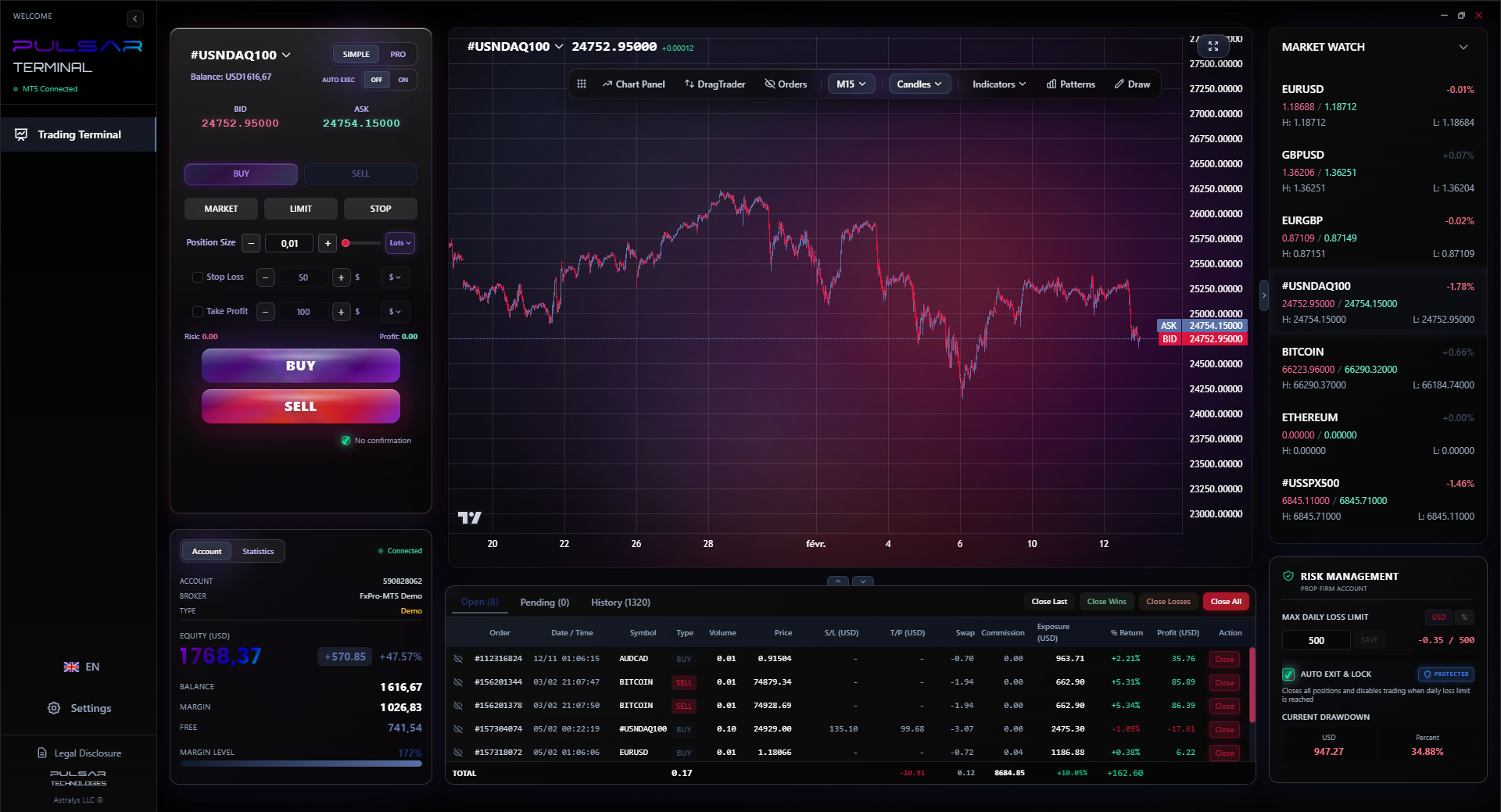
Forex trading is mature. Platforms like MT5 are incredibly powerful for technical analysis. This is where a tool like Pulsar Terminal shines, extending what MT5 can do. Crypto charting platforms (TradingView is the king) are also excellent, but the execution is often on a separate exchange interface. It's a more fragmented experience.
💡 Совет Уинстона
The market doesn't care about your rent, your dreams, or your ego. Trade the price, not your needs.
Managing multiple trades and complex orders across volatile markets is a headache; Pulsar Terminal's drag-and-drop order system and multi-TP/SL tools on MT5 take the guesswork out of execution.
Pulsar Terminal
Универсальный инструмент для MT5: drag-and-drop ордера, мульти-TP/SL, трейлинг-стоп, грид-трейдинг, Volume Profile и защита для проп-фирм. Используется 1000+ трейдерами ежедневно.
“Your rent money is not trading capital. Full stop.”
After 12 years, here's my blunt advice: don't put all your eggs in one basket. Allocate your trading capital.
I use a 70/30 split. 70% of my active trading capital is in forex. It's my 'business' - predictable, analytical, income-focused. I trade instruments like XAU/USD and EUR/USD with clear strategies. The 30% is my 'venture capital' for crypto. It's money I'm emotionally prepared to lose. I use it to speculate on high-potential, high-risk setups. This separation keeps me sane. When my crypto portfolio is down 50%, my forex portfolio is often steady or up, balancing the emotional books.
For a complete beginner in Nigeria, I always say start with forex. Learn discipline, risk management, and how to read charts in a slightly slower-moving market. Lose your beginner mistakes where a 2% stop-loss is a meaningful concept. Once you have a consistently profitable system in forex, then consider allocating a small, speculative portion to crypto. Doing it the other way around - starting in the crypto casino - teaches terrible habits that are hard to unlearn. It makes you addicted to the adrenaline of big swings, and you'll blow up your account trying to recreate that feeling in forex.
The final verdict? Forex for building wealth. Crypto for asymmetric bets. Use the former to fund the latter. And never, ever risk money in either that you can't afford to lose. Your rent money is not trading capital. Full stop.
FAQ
Q1Which is easier to learn for a beginner in Nigeria, forex or crypto?
Forex, without a doubt. The lower volatility gives you time to think and learn from mistakes without being instantly liquidated. The educational resources for forex are also more structured and less polluted by 'get-rich-quick' hype than the crypto space.
Q2Can I trade forex and crypto with the same broker in Nigeria?
Generally, no. Most specialized forex brokers (like IC Markets, Exness) don't offer spot crypto, and major crypto exchanges don't offer forex. You'll need separate accounts. Some multi-asset brokers exist, but they're less common for Nigerian traders and may have limitations.
Q3How much money do I need to start trading forex vs. crypto in Nigeria?
You can start with as little as $50 (about ₦70,000) on some forex brokers with micro lots. For crypto, you can buy fractions of a coin. However, with such small capital, fees and spreads will eat you alive. A more realistic starter amount to properly learn and apply risk management is $500-$1000 (₦700k-₦1.4M). This lets you take sensible position sizes without over-leveraging.
Q4Is crypto trading banned in Nigeria?
It's not banned for individuals, but it's heavily restricted. The Central Bank of Nigeria (CBN) has prohibited banks and financial institutions from processing crypto transactions. This means you must use Peer-to-Peer (P2P) platforms to buy and sell crypto with naira, which carries its own risks like fraud and price premiums.
Q5Which market is more predictable, forex or crypto?
Forex is more predictable in the sense that it reacts to scheduled economic events (interest rates, employment data). Crypto is far less predictable and more driven by social sentiment, tech news, and large holder ('whale') movements. Technical analysis patterns can appear cleaner in crypto due to this pure sentiment-driven action.
Q6Can I make a living trading forex or crypto in Nigeria?
Yes, but it's incredibly difficult and most fail. It requires treating it like a serious profession, not a hobby. You need a proven, disciplined strategy, rigorous risk management, and enough starting capital to withstand drawdowns without panicking. Most successful 'full-time' traders have years of experience and a financial cushion before they make the leap.
Урок проф. Уинстона
Ключевые выводы:
- ✓Match your use to the asset's volatility, not your greed.
- ✓Forex costs are in the spread; crypto costs are in fees + gas + slippage.
- ✓Start with forex to learn discipline; add crypto later for speculation.
- ✓Allocate capital: 70% forex (business), 30% crypto (venture capital).
Насколько полезна эта статья?
Нажмите на звезду
Еженедельные торговые инсайты
Бесплатный еженедельный анализ и стратегии. Без спама.
Об авторе
Olumide Adeyemi
Пионер трейдинга в Западной Африке
Один из самых активных преподавателей форекс-трейдинга в Нигерии. 8 лет торгового опыта из Лагоса. Специализируется на стратегиях с малым капиталом и челленджах проп-фирм для африканских трейдеров.
Комментарии
Предупреждение о рисках
Торговля финансовыми инструментами сопряжена со значительным риском и может не подходить всем инвесторам. Прошлые результаты не гарантируют будущих доходов. Данный контент носит исключительно образовательный характер и не является инвестиционной рекомендацией. Всегда проводите собственное исследование перед торговлей.
Вам также может понравиться

Cara Trading Forex Sukses: 7 Prinsip dari Trader Profesional
Cara trading forex sukses dengan 7 prinsip trader pro: manajemen modal, disiplin, journal trading, backtest. Data nyata, bukan janji profit palsu.
Jam Trading Forex Terbaik untuk Trader Indonesia: Panduan Lengkap dengan Tabel Waktu
Panduan jam trading forex untuk trader Indonesia. Tabel 4 sesi dunia, jam emas 20:00-00:00, sesi mana yang harus dihindari. Data akurat + tips dari trader berpengalaman.
Top 5 Sàn Forex Uy Tín Nhất 2026: Review Jujur dari Trader Indonesia
Top 5 sàn forex uy tín 2026 untuk trader Indonesia. Review jujur: spread, deposit, withdraw, dukungan lokal. Exness, XM, IC Markets & lebih.
Скачать Pulsar Terminal
Все эти калькуляторы встроены в Pulsar Terminal с данными в реальном времени с вашего счёта MT5.
Скачать Pulsar Terminal