


Here's a hard truth: over 90% of prop firm traders fail their challenges.
James Mitchell
Старший аналитик по трейдингу
☕ 9 мин чтения
Что вы узнаете:
- 1What Was Fidelcrest? A Quick Pre-Shutdown Snapshot
- 2The Sudden Collapse: What Actually Happened in March 2024
- 3The Rules, Targets, and Costs (When It Was Running)
- 4The US Regulatory Gray Zone: Where Prop Firms Really Stand
- 5Red Flags & Lessons Learned: How to Vet a Prop Firm Now
- 6US-Friendly Alternatives and Your Path Forward
Here's a hard truth: over 90% of prop firm traders fail their challenges. But what happens when the firm itself fails first? That's the story of Fidelcrest. One day they were a major player with $2 million funding offers, and the next, their website was a blank login page. As a US trader, navigating the prop firm world is tricky enough with its regulatory gray areas. Now you've got to deal with firms vanishing overnight. I'll walk you through exactly what Fidelcrest was, why it collapsed, and how to spot the warning signs next time.
Before it all went quiet in March 2024, Fidelcrest was a Cyprus-based proprietary trading firm that made big promises. They weren't your average broker; you paid a fee to take a trading challenge. Pass it, and you'd get to trade their capital, keeping a big chunk of the profits.
Their main draw was the high profit splits and massive scaling potential. They offered two main paths: the 'Normal' accounts and the high-stakes 'Aggressive' ones. The Aggressive accounts were tempting - a 90% profit split from day one. But the targets were brutal: a 20% profit target in Phase 1 with a matching 20% max drawdown. That's a tightrope walk.
They used popular platforms like MT4 and MT5, which was a plus for familiarity. Their liquidity came through firms like The FX Clearing House (FXCH), and they claimed you could even request to trade with other big names like IC Markets or Pepperstone. On paper, it looked solid. But paper doesn't always hold up, does it?

Warning: The high profit splits (80-90%) were a major selling point, but they often come with proportionally higher risk targets. That 90% split meant facing a 20% drawdown limit. One bad week could blow the whole account.

💡 Совет Уинстона
A firm's scaling plan is a promise. A firm's payout history is a fact. Always invest more weight in the fact.
Let's cut to the chase. On or around March 4, 2024, Fidelcrest effectively ceased operations. No grand announcement, just a slow fade to black. Their official website stopped working properly, redirecting everyone to a broken login portal. Their social media accounts (Facebook, Instagram, you name it) were either wiped clean or went silent.
The only explanation was a brief note citing "unexpected problems in finding a new technology provider." For a firm managing trader evaluations and payouts, that's not a minor hiccup; that's a catastrophic failure. It's like a restaurant closing because it lost its only oven.
Trustpilot and forum reviews quickly filled with traders who couldn't access accounts, were waiting on payouts, or felt completely ghosted. This wasn't a planned sunset. It was a collapse. For any US trader who had paid a challenge fee - which acted as their minimum deposit - this was a nightmare. The money was likely gone, with little recourse.
The Real Lesson for US Traders
This incident highlights the single biggest risk with offshore prop firms: counterparty risk. You're not just betting on your trading skills; you're betting on the company's solvency and operational integrity. When a firm is based in Cyprus and serving US clients in a regulatory gray zone, your use in a dispute is virtually zero. Their shutdown proves that high profit splits and big funding promises are meaningless if the company itself isn't stable.
“Your biggest risk isn't always the market; it's the firm holding the capital.”
To understand what traders were signing up for, let's break down the old Fidelcrest model. It was a two-phase evaluation, just like most prop firms.
The Two-Phase Challenge:
- Phase 1: Hit a profit target without violating drawdown rules.
- Phase 2: Often called the 'Verification' phase, with a lower profit target to prove consistency.
They had two tracks: Normal and Aggressive. Here’s how they stacked up:
| Rule | Normal Account | Aggressive Account |
|---|---|---|
| Phase 1 Profit Target | 10% in 60 days | 20% in 60 days |
| Phase 2 Profit Target | 5% in 60 days | 10% in 60 days |
| Max Drawdown | 10% | 20% |
| Daily Drawdown | 5% | 10% |
| Profit Split | 80% | 90% from Day 1 |
The Costs (Challenge Fees): These weren't deposits, but non-refundable fees to take the test. They were in Euros, so US traders got hit with conversion fees.
- $10K Account: €49 - €69
- $50K Account: €149 - €209
- $250K Account: €549 - €769
- $1M Account: €999
I once paid €549 for a $250K Normal challenge. Made it to Phase 2, then got stopped out by the 5% daily drawdown on a single GBP/USD spike during the London open. Lost the fee, learned a pricey lesson about news events. The fee was refundable only on your first funded payout, which of course required passing both phases first.

Example: A $50K Aggressive account had a 20% ($10,000) profit target and a 20% ($10,000) max loss limit. To hit target, you'd need to make 200 pips on EUR/USD trading 5 standard lots. One wrong 200-pip move against you, and you're out. It's high-pressure swing trading on steroids.
This is the critical part for American traders. Firms like Fidelcrest operate in a loophole. They're not brokers in the eyes of the SEC or CFTC. They sell you an 'evaluation service' for a fee. You're not giving them money to manage; you're paying to take a test. If you pass, they let you trade a simulated account that mirrors their own capital. This structure has, until recently, kept them off the direct radar of US regulators.
But the winds are changing. In early 2024, the SEC adopted new rules that could classify some active proprietary trading firms as "dealers," requiring registration, audits, and meeting net capital requirements. The CFTC is also looking at these firms as potential Commodity Trading Advisors (CTAs).
The bottom line? The era of the unregulated prop firm is ending. By 2026, I expect mandatory licensing in major jurisdictions. This is actually good news for you. It means more transparency, clearer rules about where your fee money goes, and hopefully, protections against another Fidelcrest-style disappearance.
Fidelcrest itself was registered in Cyprus (not known for stringent oversight) and had no US regulatory standing. When they shut down, US traders had no SEC or CFTC complaint to file. You were just a customer of a defunct foreign company. Always, always check where a firm is based and what regulator, if any, oversees them. It's your first line of defense against a margin call from the firm itself going bankrupt.
💡 Совет Уинстона
If you wouldn't deposit $500 with their chosen broker for your own account, why would you trust them with a $100,000 simulated one?
“Promises of scaling to $2M are cheap. A consistent payout history is priceless.”
Fidelcrest's crash course wasn't a total loss if we learn from it. Here’s what I’m looking for now, and what you should too.
1. Transparency on Liquidity & Execution: Who is the actual broker executing the trades? Fidelcreth used FXCH. Is that broker itself reputable and regulated? If a firm is vague about this, be wary. Spreads and slippage can make or break a strategy, especially for scalping.
2. Payout Consistency & Reviews: Don't just look at the shiny Trustpilot reviews from last year. Search for recent, raw feedback on forums. In Fidelcrest's final months, the negative reviews about payout delays were screaming from the rooftops. I missed those signals once. Not again.
3. Sustainable Business Model: A €999 fee for a chance at a $1M account? Do the math. If thousands fail, that's pure profit for the firm. It can create a perverse incentive where they want you to fail. Look for firms that clearly profit from your success (via a fair profit split), not just from your failure fee.
4. Clear, Sensible Rules: Compare their drawdown rules. Is the daily drawdown a hard stop based on the initial balance, or a trailing stop from the equity high? The latter is far more trader-friendly. Fidelcrest's were static, which is much harder to manage.
A personal mistake: I got seduced by the 90% split and ignored the Aggressive account's 10% daily drawdown. On a $100k account, that's $10,000. A single volatile day in the XAU/USD market can wipe that buffer. I learned that expensive lesson so you don't have to. Now, I use a position size calculator religiously, aiming to risk no more than 1% of the drawdown buffer, not the account balance.
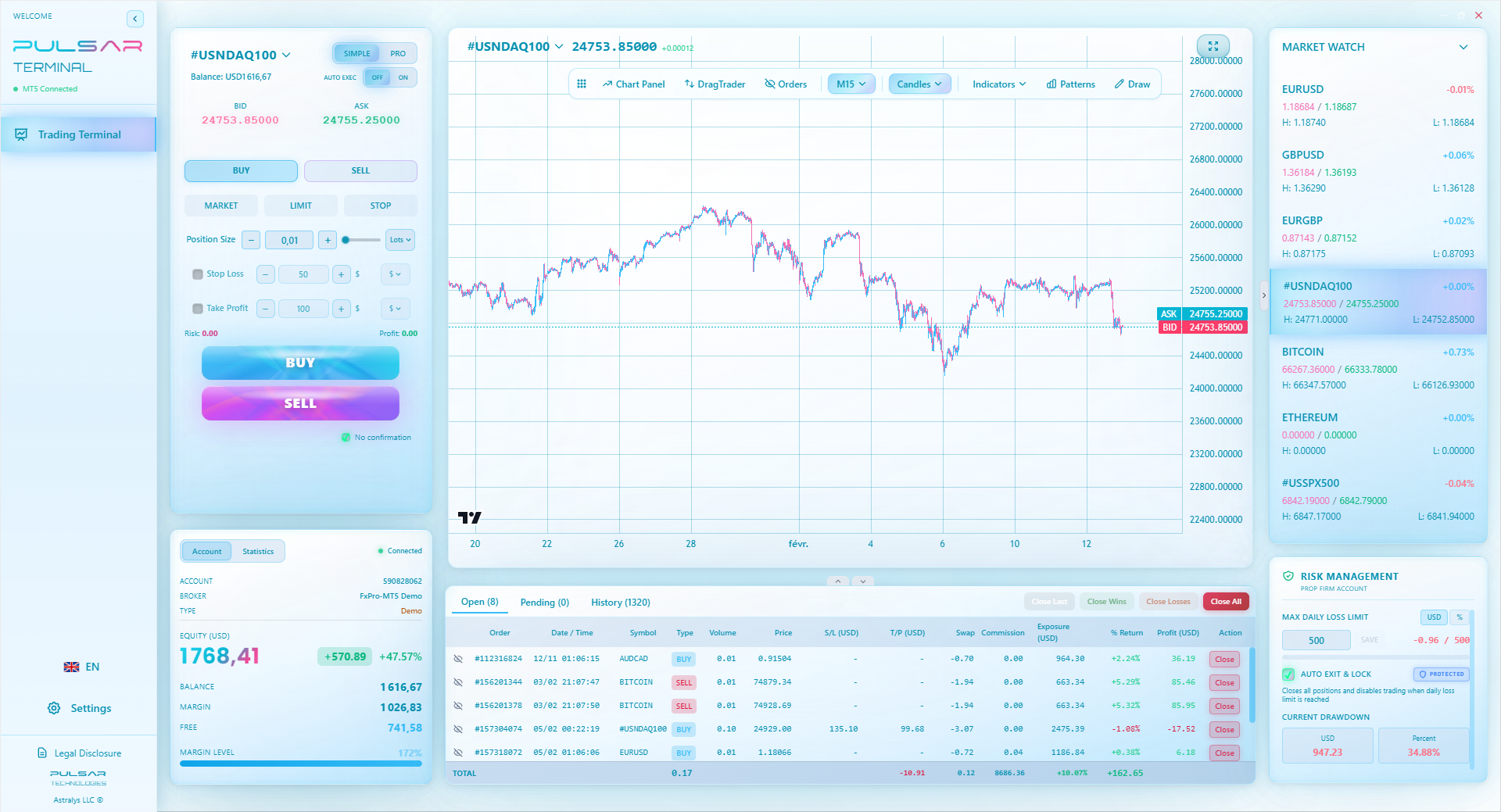
Managing a prop firm challenge's strict daily loss limits is a constant pressure, which is why tools like Pulsar Terminal can automate protective stops and breakeven moves directly on your MT5 charts.
Pulsar Terminal
Универсальный инструмент для MT5: drag-and-drop ордера, мульти-TP/SL, трейлинг-стоп, грид-трейдинг, Volume Profile и защита для проп-фирм. Используется 1000+ трейдерами ежедневно.
With Fidelcrest gone and the regulatory scene shifting, where should a US trader look? First, accept that many offshore firms will explicitly block US and Canadian residents due to regulatory complexity. That's not always a bad thing.
What to Seek in a Firm Now:
- Regulatory Clarity: Firms starting to engage with the coming SEC/CFTC rules are a better long-term bet.
- Realistic Scaling: Fidelcrest promised scaling to $2M. Promises are cheap. Look for firms with a published, transparent scaling plan that traders have actually achieved.
- Technology Reliability: The "tech provider" excuse was Fidelcrest's death knell. Your firm's platform should be strong, with proven uptime. Many reputable firms use MetaTrader 5 or similar stable platforms.
Consider These Approaches:
- Domestic Prop Firms & Day Trading Firms: Some US-based entities operate under different structures (like being a registered CTA). They're fewer, but they exist within the regulatory framework.
- Funded Accounts with Regulated Brokers: Some educational services offer funded account programs through well-known, heavily regulated brokers like those available through Pepperstone or IC Markets. You're still in a challenge, but the broker holding the capital is solid.
- Build Your Own Track Record: This is the old-school path. Trade a small personal account, document everything, and build a verifiable track record. This is what hedge funds and family offices actually look for, not a prop firm certificate.
The core skill - profitable trading - doesn't change. Focus on mastering your strategy, whether that's using the RSI indicator for divergence or the MACD indicator for momentum. The vehicle for your capital will evolve, but your edge is yours forever.
FAQ
Q1Can US traders still join Fidelcrest?
No. As of March 2024, Fidelcrest suspended all operations. Their website is non-functional, and they are not accepting new traders from any country, including the United States.
Q2What happened to traders' money when Fidelcrest shut down?
It's a messy situation. Traders in the evaluation phase likely lost their non-refundable challenge fees. Funded traders waiting for payouts have reported not receiving them. With the company inactive and based in Cyprus, recovering funds is extremely difficult for US traders.
Q3Were Fidelcrest's trading rules fair?
They were standard for the industry but on the tougher side, especially for Aggressive accounts. The 5% and 10% daily drawdowns were static (based on the starting balance), not trailing from equity highs. This made them easier to violate during normal market volatility compared to more forgiving rules.
Q4What is the profit split for prop firms?
A profit split is the percentage of profits you keep from trading the firm's capital. Fidelcrest offered 80% on Normal accounts and 90% on Aggressive accounts, which was among the highest in the market. However, the higher split came with much stricter risk targets.
Q5Are prop firms like Fidelcrest regulated in the USA?
Generally, no. Most operate as unregulated evaluation service providers. However, US regulators (SEC and CFTC) are actively working on new rules that may require them to register by 2026, which would provide more protection for traders.
Q6What's the main lesson from the Fidelcrest shutdown?
Counterparty risk is real. Your biggest risk isn't always the market; it's the firm holding the capital. Always prioritize the firm's long-term stability, transparency, and operational history over flashy offers like high profit splits or massive account sizes.
Урок проф. Уинстона
Ключевые выводы:
- ✓Prop firm failure rates exceed 90% for traders.
- ✓Fidelcrest suspended operations in March 2024.
- ✓US prop firm regulation is tightening for 2026.
- ✓Static daily drawdowns are significantly riskier than trailing ones.
- ✓Always verify the broker behind the prop firm's trades.
Насколько полезна эта статья?
Нажмите на звезду
Еженедельные торговые инсайты
Бесплатный еженедельный анализ и стратегии. Без спама.
Об авторе
James Mitchell
Старший аналитик по трейдингу
Базируется в Нью-Йорке, более 9 лет опыта торговли. Работает с основными USD-парами, проп-фирмами и регулированием в США.
Комментарии
Предупреждение о рисках
Торговля финансовыми инструментами сопряжена со значительным риском и может не подходить всем инвесторам. Прошлые результаты не гарантируют будущих доходов. Данный контент носит исключительно образовательный характер и не является инвестиционной рекомендацией. Всегда проводите собственное исследование перед торговлей.
Вам также может понравиться

Cara Trading Forex Sukses: 7 Prinsip dari Trader Profesional
Cara trading forex sukses dengan 7 prinsip trader pro: manajemen modal, disiplin, journal trading, backtest. Data nyata, bukan janji profit palsu.
Jam Trading Forex Terbaik untuk Trader Indonesia: Panduan Lengkap dengan Tabel Waktu
Panduan jam trading forex untuk trader Indonesia. Tabel 4 sesi dunia, jam emas 20:00-00:00, sesi mana yang harus dihindari. Data akurat + tips dari trader berpengalaman.
Top 5 Sàn Forex Uy Tín Nhất 2026: Review Jujur dari Trader Indonesia
Top 5 sàn forex uy tín 2026 untuk trader Indonesia. Review jujur: spread, deposit, withdraw, dukungan lokal. Exness, XM, IC Markets & lebih.
Скачать Pulsar Terminal
Все эти калькуляторы встроены в Pulsar Terminal с данными в реальном времени с вашего счёта MT5.
Скачать Pulsar Terminal