


If you think using your FNB app to 'buy forex' is the smart, easy way to trade, I need to stop you right there.

David van der Merwe
Трейдер развивающихся рынков ·  South Africa
☕ 9 мин чтения
Что вы узнаете:
- 1What "FNB Buy Forex" Really Means (It's Not What You Think)
- 2The Real Costs: Fees, Spreads, and the Silent Tax
- 3FNB vs. a Real Forex Broker: A Trader's Comparison
- 4When You SHOULD Use FNB Forex (The Legal Stuff)
- 5The Smart Alternative: How to Really Trade Forex from SA
- 6Common Pitfalls and Mistakes to Avoid
- 7Final Verdict for South African Traders
If you think using your FNB app to 'buy forex' is the smart, easy way to trade, I need to stop you right there. I made that exact mistake when I started, and it cost me thousands in hidden fees before I even placed a trade. Most guides just list FNB's services. I'm going to show you the real numbers, the brutal spreads, and why using your bank for active forex trading is one of the most expensive financial decisions you can make. Let's set the record straight.
When you hear "FNB buy forex," you're probably picturing a trading platform like MetaTrader. That's not what this is. FNB is an Authorised Dealer, not a forex broker. Their primary job is to help you move money across borders for life stuff: sending money to family, paying for studies, or buying that overseas holiday.
The services you get are built for that. You can make international payments, open a Global Account to hold foreign currency, or order physical cash. Through their FNB Share Investor platform, they do offer a form of spot forex trading, but it's bolted onto their banking system. It's convenient if you're already banking with them, but convenience has a steep price, as we'll see.
This distinction is crucial. You're not accessing the interbank market. You're buying currency from FNB, the shop. And like any shop, they set the price. Your trade isn't competing with global liquidity; it's a retail transaction with your bank. This fundamental difference explains why the costs are structured the way they are.

Warning: Using FNB for active, short-term trading is like using a luxury hotel's business centre to day trade stocks. It's possible, but the per-minute charges will eat you alive before the market moves in your favor.
“Using FNB for active trading is like bringing a spoon to a gunfight.”
This is where the fantasy meets reality. Let's break down what it actually costs to use FNB for forex, using real numbers from their fee guides.
The Obvious Fees: International Transfers
If you're sending money overseas, FNB charges a fee plus a commission. For amounts over R10,000, it's 0.55% (min R275, max R550). That's just the service fee. Then comes the real killer.
The Hidden Cost: The Exchange Rate Margin
FNB doesn't give you the real market rate (the mid-market rate). They add a margin. This isn't a fee you see on a statement; it's baked into the rate you get. Sources and my own checks show this margin can be 2% to 4.5% on a transaction. Let's do the math with a conservative 2.5%.

Example: You want to send R100,000 abroad when the real USD/ZAR rate is 18.50.
- Real Value: R100,000 / 18.50 = $5,405.41
- FNB's Rate (with 2.5% margin): They might give you ~18.06.
- What you get: R100,000 / 18.06 = $5,537.10
- Your Hidden Loss: $5,405.41 - $5,537.10 = -$131.69 That's a R2,436 loss before the R550 transfer fee even hits. You've lost over 3% before the money leaves the country.
Spreads on FNB Share Investor
If you use their trading platform, you face spreads. While they don't publish them prominently, they are notoriously wide compared to a dedicated broker. I once compared a EUR/USD quote. On my IC Markets review account, the spread was 0.1 pips. On FNB's platform, it was over 2 pips. That's 20 times more expensive per trade. On volatile pairs like USD/ZAR, this difference can be devastating to your strategy.
You might earn some eBucks on fees, but that's a tiny rebate on a massive overcharge. It's like getting a 10% discount on a car that's marked up 50%.

💡 Совет Уинстона
A spread isn't a fee, it's a distance. If your starting line is 50 meters behind everyone else's, you're not in the same race.
“That 2-4% margin isn't a fee you see on a statement; it's a silent tax on every single transaction.”
Let's be clear: FNB is a brilliant bank. But for active forex trading, it's like bringing a spoon to a gunfight. Here’s the side-by-side.
| Feature | FNB (Forex Services) | Specialized Forex Broker (e.g., Pepperstone) |
|---|---|---|
| Primary Role | Authorised Dealer / Bank | Leveraged Trading Broker |
| Pricing Model | High margin on rate + fees | Tight spreads + small commission |
| Typical USD/ZAR Spread | Can be 50+ pips (effectively) | As low as 0.6 pips (Raw account) |
| Platform | Integrated Banking App / Share Investor | MT4, MT5, cTrader, Proprietary platforms |
| use | Minimal or none on transfers | Up to 1:500 (on USD/ZAR for professionals) |
| Order Types | Basic (Market, Limit) | Advanced (Stop-Limit, Trailing Stop, Breakeven) |
| Market Access | You trade against FNB's quote | Access to deep interbank liquidity |
| Best For | International payments, holding forex | Active trading, scalping, swing trading |
My painful lesson: In 2018, I used my bank's platform (similar to FNB's) to short USD/ZAR at 14.20, expecting a drop. The trade went my way, dropping to 13.90. But the spread was so wide that my break-even was miles away. I ended up closing for a tiny profit that didn't even cover the effective spread cost. On a proper broker, that 300-pip move would have been a clean, profitable swing trading win.
The core issue is conflict of interest. With a broker, your profit is their problem. With FNB, your transaction is their profit. Their incentive is to make money on the spread, not to give you the best executable price.
“That 2-4% margin isn't a fee you see on a statement; it's a silent tax on every single transaction.”
I'm not saying never use FNB. For its intended purpose, it's essential and legal. You must understand the SARB allowances.
- Single Discretionary Allowance (SDA): R1 million per year. Use it for travel, gifts, online subscriptions. No tax clearance needed. This is what you'd use to fund an international broker, by the way.
- Foreign Investment Allowance (FIA): R10 million per year. For investing offshore. This requires a Tax Compliance Status (TCS) pin from SARS.
- Proposed Changes (2026): Keep an eye on this. The SARB has draft plans to raise the SDA to R2 million and the travel allowance for minors. This is huge for flexibility.
FNB is perfect here. Need to pay for your kid's uni fees in the UK? Use your SDA through FNB's online portal. Want to fund a USD investment account? Use your FIA, get your SARS pin, and FNB will help the transfer. Their Global Accounts are also great for expats or anyone receiving foreign income who wants to hold it in USD or EUR.

Pro Tip: Always use your SDA first. It's paperwork-free. If you need more, then go through the FIA process with SARS. Never try to circumvent these limits using illegal "bucket shops"; you risk asset forfeiture and prosecution.
💡 Совет Уинстона
Use banks for compliance, brokers for execution. Trying to get one to do the other's job is how you pay for two services and get half of one.
“Convenience in trading is almost always the most expensive option.”
Here's the process I've used for over a decade. It has more steps than clicking "buy" in your banking app, but it saves you a fortune.
- Open an account with a reputable international broker. Choose one with a strong presence here, like IC Markets, Pepperstone, or Exness. Regulated by top-tier authorities (ASIC, FCA, CySEC).
- Use your FNB SDA to fund it. This is the legal part. In your FNB app, initiate an international payment to the broker's client trust account. Use the correct BoP code (likely "portfolio investment"). You'll pay FNB's transfer fee and margin, but only once.
- Trade on the broker's platform (MT5). Now you're in the game. You'll get raw spreads, professional tools, and proper execution. A 1-pip spread on USD/ZAR vs. FNB's effective 50-pip cost means you're saving 49 pips on every lot you trade. That's R490 on a standard lot at today's rates.
- Withdraw profits back to your FNB account. The broker sends USD back to your FNB Global Account. FNB converts it to ZAR (yes, with their margin again, sadly), and it lands in your local account.
Yes, funding and withdrawing have costs. But you incur them once, maybe twice a month. If you're trading actively, the savings on spreads every single day completely dwarf those one-off fees. I once calculated that for a trader doing ten 1-lot trades a week, the spread savings alone would cover the cost of an international transfer in under two weeks.
This method separates your banking (FNB) from your trading (specialist broker). Each entity does what it's best at.
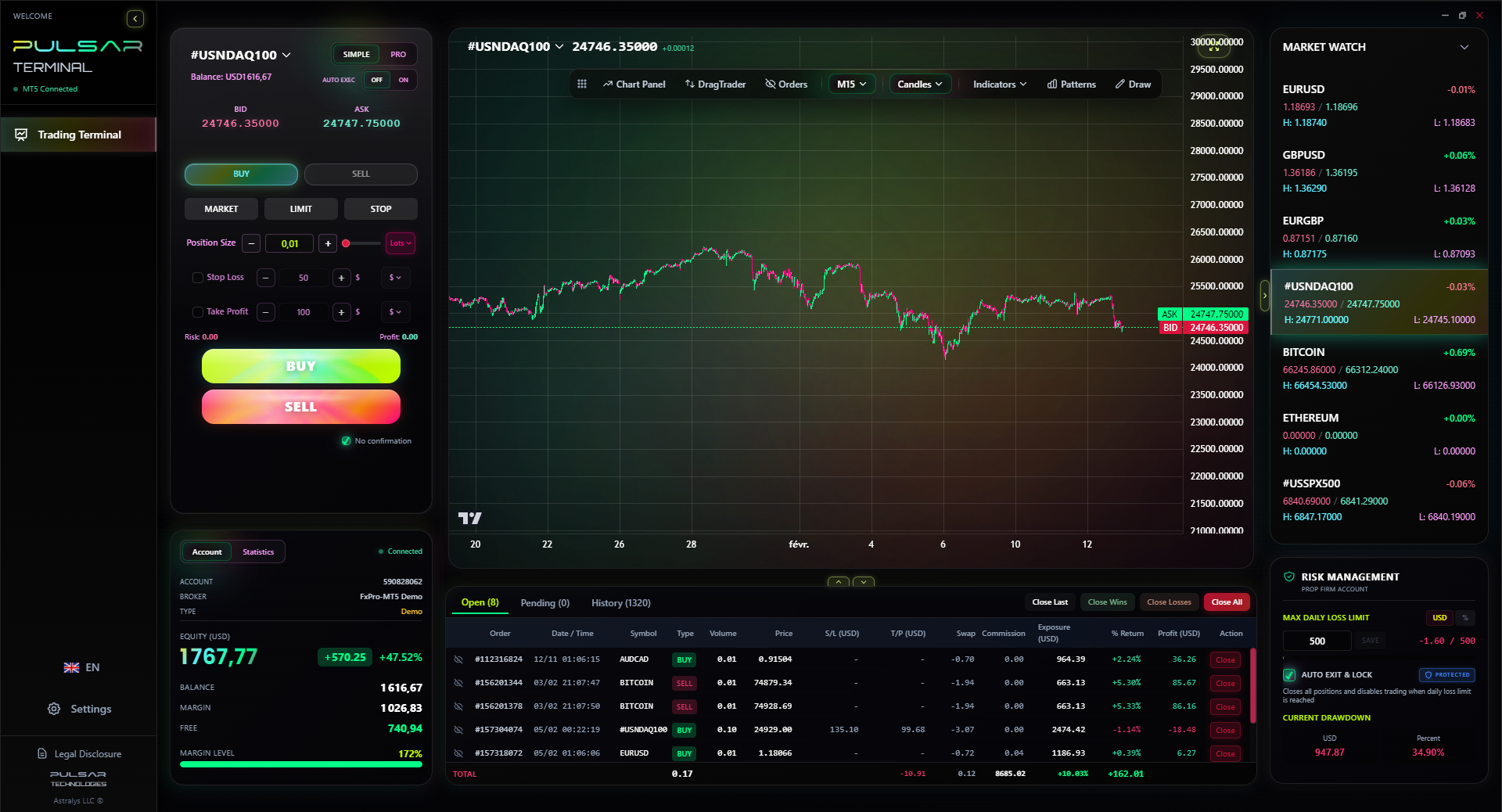
Once you're on a proper MT5 platform with a good broker, managing complex trades with multiple take-profit levels and trailing stops is where a tool like Pulsar Terminal transforms your efficiency.
Pulsar Terminal
Универсальный инструмент для MT5: drag-and-drop ордера, мульти-TP/SL, трейлинг-стоп, грид-трейдинг, Volume Profile и защита для проп-фирм. Используется 1000+ трейдерами ежедневно.
“Convenience in trading is almost always the most expensive option.”
I've seen these destroy accounts.
Pitfall 1: Trading with Emotion Because It's "Easy Money" in the App. Seeing forex next to your balance makes it feel like play money. It's not. You need a plan, a position size calculator, and discipline. The convenience lowers your guard.
Pitfall 2: Ignoring the Total Cost of Ownership. Traders look at the "R0 commission" on Share Investor and think it's cheap. They don't see the massive spread. Always calculate the cost in pips. If the spread is 5 pips, you need the market to move 5 pips in your favor just to break even. On a tight broker, you might need only 0.5 pips.
Pitfall 3: Not Understanding use and Margin Calls. If FNB does offer leveraged trading, their risk management will be brutal. A small move against you could trigger a margin call faster than a broker with more sophisticated risk engines. You must know your pip value and risk per trade.
Pitfall 4: Using FNB for Scalping. This is financial suicide. Scalping relies on tiny, frequent profits. A wide spread turns every potential winning strategy into a guaranteed loser. I tried it early on with a bank platform and had a 40% win rate on trades, yet was down overall because the spreads consumed all my gains.
My biggest mistake was using a bank platform for too long, believing I was just unlucky. The platform wasn't broken; the business model was working perfectly - for them.
💡 Совет Уинстона
Your first profitable trade is the one you don't place on the wrong platform. Choosing the right venue is a trade in itself.
“Separate your banking from your trading. Use FNB as your legal gateway, and a broker as your market tool.”
So, should you use FNB to buy forex?
For living your life: Absolutely. Paying invoices, sending money abroad, holding foreign currency? FNB is award-winning for a reason. Use their Global Accounts, their app, your allowances. It's secure, legal, and integrated.
For building trading capital: Not a chance. The cost structure is designed for occasional, necessary transactions, not for the repeated, high-frequency activity of trading. Those 2-4% margins will systematically bleed your account dry, turning winning strategies into losers.
Think of it this way: You wouldn't buy a case of wine from a restaurant at restaurant prices. You'd go to a wholesaler. FNB is the restaurant - great for a single glass with dinner. A dedicated forex broker is the wholesaler - where you go when you're serious about quantity and price.
Your first step as a serious trader isn't to place a trade. It's to open the right account with the right institution. Use FNB as your SARB-compliant gateway to the world. Then use a professional broker as your tool to navigate the markets. That separation of concerns is the foundation of a sustainable trading career here in South Africa.
FAQ
Q1Is it illegal to use an international broker instead of FNB?
No, it's completely legal. You use your legal South African Reserve Bank allowances (like the R1 million Single Discretionary Allowance) to fund an international broker. The key is that the broker must be properly regulated in its jurisdiction. The illegal act would be using unlicensed 'bucket shops' or trying to move money outside of the SARB's framework.
Q2What is the minimum amount I need to start trading forex properly?
With a reputable international broker, you can often start with $100-$200 (roughly R2,000-R4,000). However, I strongly advise starting with at least $1,000. This allows for proper position size management and withstands normal market volatility without immediately risking a margin call. Starting with too little often leads to over-leveraging.
Q3Can I trade USD/ZAR on platforms like MetaTrader?
Yes, absolutely. Most major international brokers offer USD/ZAR (and often other ZAR pairs like EUR/ZAR and GBP/ZAR) for trading. The spreads are dramatically tighter than what you'll find on a bank platform, often below 1 pip on raw accounts. Check our XAU/USD guide for an example of how to analyze a commodity/currency pair, as the principles for USD/ZAR are similar.
Q4Does FNB offer use for forex trading?
Information on use through FNB Share Investor is not prominently advertised, and if offered, it would be very conservative (e.g., 1:10 or less). Banks are highly risk-averse. For context, professional trading accounts with international brokers can offer up to 1:500 on major forex pairs for eligible clients, giving you far more capital efficiency (and risk).
Q5How do I get my trading profits back into my South African bank account?
You request a withdrawal from your broker back to your nominated bank account, which would be your FNB account. The broker will send the foreign currency (e.g., USD) via SWIFT. FNB will receive it, convert it to ZAR at their buy rate (which includes their margin), and deposit the Rands into your account. You'll need to ensure you have a Global Account or similar set up to receive foreign currency.
Q6Are the proposed SARB changes to allowances (R2m SDA) confirmed?
As of now (early 2026), they are draft proposals published for public comment. They are not yet law. Always check the latest SARB exchange control circulars or consult with FNB's forex desk for the most current limits before making any financial plans based on the new amounts.
Урок проф. Уинстона
Ключевые выводы:
- ✓FNB's effective spread can be 20-50x wider than a professional broker.
- ✓A 2.5% margin on a R100k transfer costs you ~R2,436 before fees.
- ✓Use your R1m Single Discretionary Allowance to fund a real broker.
- ✓Never use a bank platform for scalping or frequent trading.
Насколько полезна эта статья?
Нажмите на звезду
Еженедельные торговые инсайты
Бесплатный еженедельный анализ и стратегии. Без спама.
Об авторе
David van der Merwe
Трейдер развивающихся рынков
Трейдер из Йоханнесбурга с 11-летним опытом работы с валютами развивающихся рынков. Специализируется на ZAR-парах, торговле под регулированием FSCA и анализе южноафриканского рынка.
Комментарии
Предупреждение о рисках
Торговля финансовыми инструментами сопряжена со значительным риском и может не подходить всем инвесторам. Прошлые результаты не гарантируют будущих доходов. Данный контент носит исключительно образовательный характер и не является инвестиционной рекомендацией. Всегда проводите собственное исследование перед торговлей.
Вам также может понравиться

Cara Trading Forex Sukses: 7 Prinsip dari Trader Profesional
Cara trading forex sukses dengan 7 prinsip trader pro: manajemen modal, disiplin, journal trading, backtest. Data nyata, bukan janji profit palsu.
Jam Trading Forex Terbaik untuk Trader Indonesia: Panduan Lengkap dengan Tabel Waktu
Panduan jam trading forex untuk trader Indonesia. Tabel 4 sesi dunia, jam emas 20:00-00:00, sesi mana yang harus dihindari. Data akurat + tips dari trader berpengalaman.
Top 5 Sàn Forex Uy Tín Nhất 2026: Review Jujur dari Trader Indonesia
Top 5 sàn forex uy tín 2026 untuk trader Indonesia. Review jujur: spread, deposit, withdraw, dukungan lokal. Exness, XM, IC Markets & lebih.
Скачать Pulsar Terminal
Все эти калькуляторы встроены в Pulsar Terminal с данными в реальном времени с вашего счёта MT5.
Скачать Pulsar Terminal