


Let's cut through the marketing nonsense right now.

David van der Merwe
Трейдер развивающихся рынков ·  South Africa
☕ 11 мин чтения
Что вы узнаете:
- 1FSCA Regulation: Your First and Last Filter
- 2The Real Costs for a Cape Town Trader
- 3Broker Breakdown: Who Actually Serves Cape Town?
- 4Trading USD/ZAR: Your Home Turf (And Pitfall)
- 5Funding & Withdrawals: Getting Your Rands In and Out
- 6Platforms & Tools: What Works on SA Internet
- 7Your Final Checklist Before You Sign Up
Let's cut through the marketing nonsense right now. Most 'reviews' of forex brokers in Cape Town are written by people who've never placed a real trade here. They don't understand the FSCA's 30:1 use cap, they've never felt the gut-punch volatility of USD/ZAR, and they certainly haven't lost real money to sneaky fees on rand deposits. I've traded from Sea Point for eight years, blown up an account, and built another one back. This guide isn't about finding the 'best' broker. It's about finding a broker that won't get you fined, won't steal your money, and gives you a fighting chance in a market where 89% of retail traders lose. I'll prove that your location in Cape Town changes everything about how you should choose a broker.
If you ignore everything else, hear this: trading with an unregulated broker in South Africa isn't just risky, it's financially suicidal. The Financial Sector Conduct Authority (FSCA) isn't some paper tiger. Since 2021, they've enforced a 30:1 use cap for retail forex traders. Any broker offering you 500:1 is either unregulated or illegally targeting South Africans. I learned this the hard way in 2019. I was with an offshore broker offering 1:1000. Made a killing for two months. Then, a major news event hit, my positions gapped, and my margin call wiped me out before I could even blink. Zero recourse. The FSCA couldn't help because the broker wasn't under their jurisdiction.
What does proper FSCA regulation actually get you?
- Client Fund Segregation: Your money is held in a separate bank account. If the broker goes under (it happens), your capital isn't part of their bankruptcy estate.
- use Limits: Max 30:1 on major forex pairs. This feels restrictive, but it's saved more traders than it's hindered. It forces proper position size calculator use.
- Dispute Resolution: You have a local authority to complain to. This matters when a withdrawal 'gets stuck'.

Warning: Some international brokers are FSCA-regulated but operate their South African clients under a different entity (often in Mauritius or the Seychelles). Check the legal entity name on your contract. If it's not the FSCA-licensed one, you're not protected.
Here's the reality: the 30:1 cap means you need more capital to play the same size. A R10,000 account can't swing for the fences like it could with 100:1. This changes your entire strategy from day one.

💡 Совет Уинстона
Your location is a data point, not an edge. Don't trade the Rand based on a feeling you get from the news. Trade the chart in front of you.
“The 30:1 use cap feels restrictive, but it's saved more traders than it's hindered.”
Brokers advertise 'from 0.0 pips!' but that's for EUR/USD. You're in Cape Town. You're probably looking at USD/ZAR, EUR/ZAR, or GBP/ZAR. The pricing model flips completely on exotic pairs.
Spreads on ZAR Pairs Are a Different Beast
On April 12th last year, I took a long USD/ZAR position at 18.4500. The spread was 45 pips. Not 0.4 pips. Forty-five. That's R450 gone on a standard lot before the trade even moves. On a quiet day, it might be 15-20 pips. On a day with SARB news or load-shedding announcements? It can blow out to 80+. You must factor this into your stop-loss placement immediately. A tight 10-pip stop on USD/ZAR is a guaranteed way to donate to the broker.
The Hidden Tax: Currency Conversion
This is the silent killer nobody talks about. You fund your account in Rands. Your broker converts it to USD at their marked-up rate. Let's say the interbank rate is ZAR 18.50/USD. They'll give you 18.60. That's a 0.54% loss instantly on your entire deposit. When you withdraw, they do it again in reverse. I once deposited R20,000 and lost over R200 before placing a single trade. Some local brokers, like Khwezi Trade, offer ZAR-denominated accounts. This eliminates conversion risk but often comes with wider spreads. You need to do the math.
Commissions and Swaps
If you're a scalping strategy fan, a raw spread + commission account might work on majors. But for holding ZAR pairs overnight, check the swap rates (financing fees). They can be monstrous. Holding a long USD/ZAR position overnight once cost me $28 on a single lot. That adds up fast.
| Cost Type | Typical on EUR/USD | Typical on USD/ZAR | Impact on You |
|---|---|---|---|
| Average Spread | 0.2 - 0.7 pips | 15 - 50 pips | Huge. Defines your minimum profit target. |
| Deposit/Withdrawal Fee | Often $0 | Often R0, but watch the conversion spread | Eats your capital. Use local EFT where possible. |
| Overnight Swap | Small, can be positive or negative | Often very large (carry trade) | Can make or break a swing trading hold. |
“A tight 10-pip stop on USD/ZAR is a guaranteed way to donate to the broker.”
Let's get specific. I've traded with, or had students trade with, most of these. Here's the unfiltered view.
The Local Player: Khwezi Trade Based in Cape Town itself. Big plus: real local support. You can call them. Their ZAR-denominated account is a genuine advantage for beginners. The downside? Their spreads aren't the tightest globally, and their platform choice is limited to MT5. Good for beginners who want simplicity and to avoid forex conversion headaches.
The International Giants (FSCA-Regulated) These are the heavyweights. They have FSCA licenses but often route SA clients through other entities.
- IG: Rock-solid. Their ProRealTime platform is excellent for analysis. Minimum deposit is low ($50). Their ZAR pair spreads are competitive, not the absolute lowest, but execution is reliable. I use them for longer-term analysis.
- Tickmill: Where I keep my main scalping account. Why? Raw ECN pricing. On EUR/USD, I get 0.1 pips + $2 commission. But remember, their USD/ZAR spread is still subject to market liquidity. Their FSCA regulation is clear and direct.
- IC Markets: Similar to Tickmill. Raw spreads, good execution. Their IC Markets review shows consistently good feedback. A $200 minimum deposit filters out the totally unserious.
- Exness: Controversial one. They offer 'unlimited use'... but not to FSCA-regulated clients. For you, it'll be capped at 30:1. They are popular for a reason: low minimum deposit ($10) and tight spreads. Just be very, very sure you're on their FSCA entity. Read our Exness review for the detailed breakdown.
- XM Group: A favorite for algo traders due to their support for Expert Advisors. Minimum deposit is a tiny $5. Good for testing strategies with very little capital. Their XM review highlights their strong educational focus, which is true.

Pro Tip: Don't choose a broker based on their EUR/USD spread alone. Open a demo account. Watch the USD/ZAR pair for a full week during SA market hours (8am - 5pm). See what the spread does at 10am vs. 3pm vs. when US data drops. That's your real cost.
“A tight 10-pip stop on USD/ZAR is a guaranteed way to donate to the broker.”
Trading the Rand feels familiar. You hear the news, you feel the load-shedding, you understand the politics. This is a dangerous illusion of knowledge. Yes, you have context, but the USD/ZAR is a global exotic pair driven by dollar strength, Chinese commodity demand, and global risk sentiment more than by local news.
I made my biggest mistake here. In late 2022, I was convinced the Rand was oversold due to local political drama. I went long ZAR (short USD/ZAR) at 19.80. I ignored the screaming MACD indicator divergence on the weekly chart showing relentless dollar strength. The pair ran to 21.50. I held, adding to the losing position, my 'local knowledge' blinding me. I lost R85,000. My local knowledge was irrelevant against a global macro trend.
What works?
- Treat it as an Exotic: Use wider stops. A 200-pip stop on USD/ZAR is normal, not conservative.
- Watch Gold: ZAR is a commodity currency. A strong gold price often supports the Rand. Use our XAU/USD guide to understand that dynamic.
- Time Your Trades: Liquidity dries up between 5pm SA time and the US open. Spreads widen. Avoid entering then.
The volatility is your edge if you're patient. Big, clean moves happen. But you need the account size to withstand the wider stops. This is why that 30:1 use cap is so critical here - it prevents you from overleveraging on this wild pair.
💡 Совет Уинстона
If the spread on your pair is wider than your planned profit target, your strategy is fundamentally flawed before you even enter. Recalculate.
“Your local knowledge is irrelevant against a global macro trend.”
This is the most practical headache. SARB exchange controls are real. For individuals, you can move up to R1 million offshore annually without special approval (Single Discretionary Allowance). Over that, you need a Tax Compliance Status PIN from SARS. Most brokers don't require this for deposits under R1m, but they will do KYC.
Best Methods for Cape Town Traders:
- Local EFT (Electronic Funds Transfer): The king. If your broker has a South African bank account (many do), you EFT Rand directly. Usually free, clears in a few hours. This is the number one feature to look for.
- Credit/Debit Card: Instant, but your bank might flag it as an international transaction and charge a fee (around 3%). Also, some banks are getting twitchy about forex broker deposits.
- E-wallets (Skrill, Neteller): Fast, but double conversion fees (ZAR>USD>ZAR) murder your money.
The Withdrawal Trap: Brokers love to process withdrawals 'within 24 hours'. But that's to their payment processor. Getting it back to your South African bank account can take 3-5 business days. Plan your cash flow accordingly. Always withdraw to the same method you deposited with. Trying to withdraw to a different bank account will trigger extra compliance checks and delays.
Warning: Never, ever let a friend deposit into your trading account for you. Or try to withdraw to a business account for a personal trade. This triggers immediate AML (Anti-Money Laundering) flags, and your funds can be frozen for weeks while you provide endless documentation.
“Your local knowledge is irrelevant against a global macro trend.”
Load-shedding stage 4? Your trade shouldn't die. Your platform choice matters.
MetaTrader 4/5 is the Standard. Why? Most local VPS (Virtual Private Server) providers are optimized for it. You can rent a VPS in Johannesburg for about R150/month. This keeps your EA's running and charts live when your home Wi-Fi is off. It's non-negotiable for serious trading. Both Pepperstone review and IC Markets offer good MT4/5 integration.
Mobile Trading is a Backup, Not a Strategy. AvaTradeGO, Plus500's app - they're fine for checking positions. Don't try to execute a complex analysis on a 6-inch screen during a power outage. It's a recipe for a panic trade.
The tools you need are the ones that help you manage risk in a volatile, spread-heavy environment. A reliable RSI indicator for overbought/oversold levels on the hourly chart. A clear understanding of what a pip definition really costs on USD/ZAR. And most importantly, a tool that lets you set multiple take-profits and trailing stops easily, because you need to bank partial profits on big ZAR moves.
This is where advanced trading software that integrates with MT5 becomes useful, letting you automate your exit strategy so you're not glued to the screen during a volatile move.
💡 Совет Уинстона
The most important button on your platform isn't 'Buy' or 'Sell'. It's 'Close All'. Know when to use it.
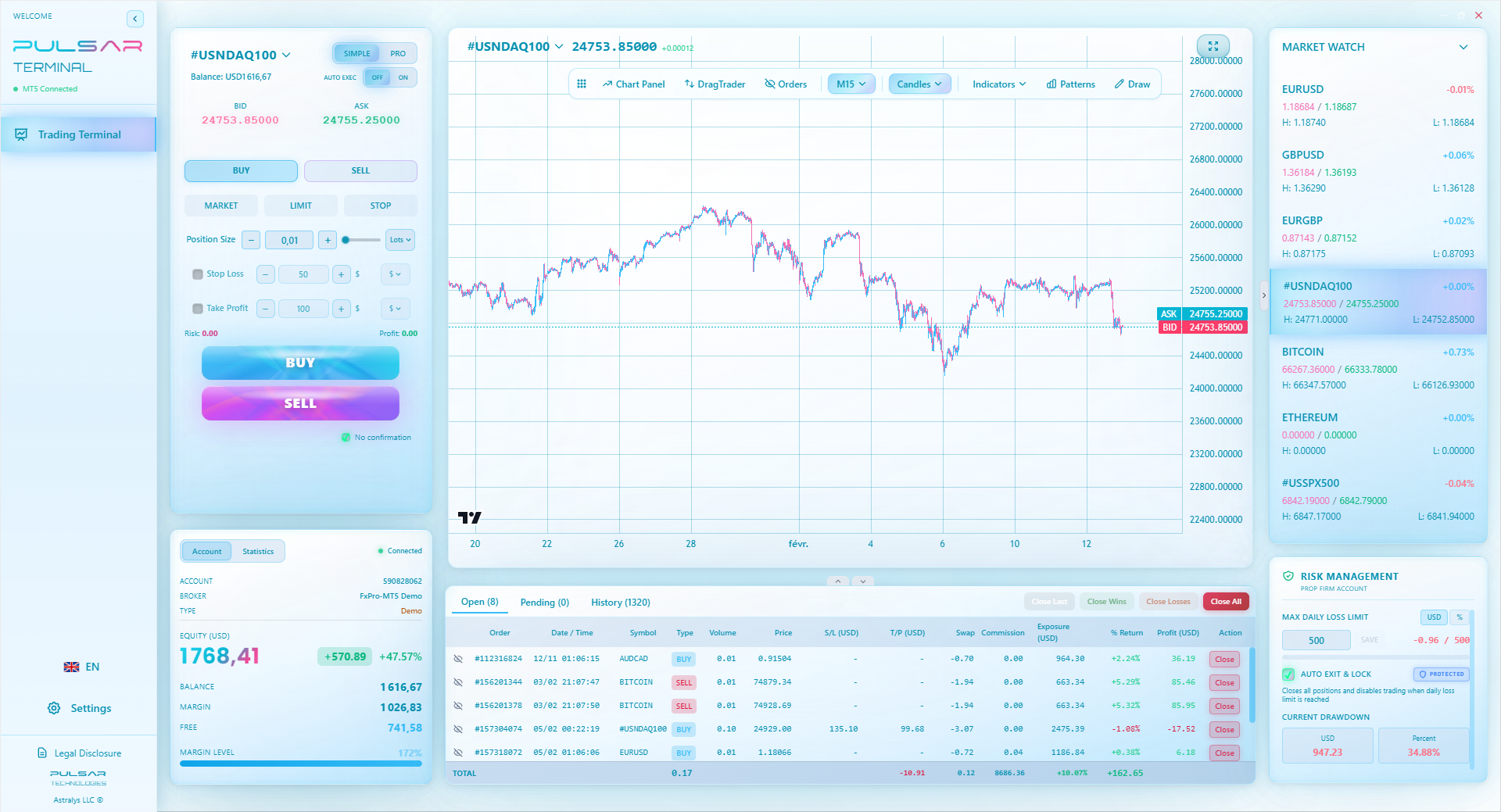
Managing complex exits on volatile pairs like USD/ZAR is critical, and Pulsar Terminal lets you set multi-level take-profits and trailing stops directly on your MT5 charts with one click.
Pulsar Terminal
Универсальный инструмент для MT5: drag-and-drop ордера, мульти-TP/SL, трейлинг-стоп, грид-трейдинг, Volume Profile и защита для проп-фирм. Используется 1000+ трейдерами ежедневно.
“Find the boring, reliable broker that lets you focus on your trading, not on solving problems with them.”
- Verify the FSCA License Number. Go to the FSCA website, type it in. Does the company name match your contract EXACTLY?
- Test the Deposit/Withdrawal. Do they have a local South African bank account for EFT? What are the REAL costs (ask support: 'What is your ZAR to USD conversion spread?').
- Demo the ZAR Pairs. For at least a week. Note the average spread at the time you actually trade.
- Check Platform Stability. Ask if they recommend a local VPS provider. If they don't know what you're talking about, they don't understand the South African trader's reality.
- Read the Margin Call Policy. How do they handle margin call on exotic pairs? Is it a hard stop (close all) or a partial liquidation? This matters when volatility spikes.
- Contact Support. Call them. Email them at 8pm SA time. How fast do they respond? If they're slow when you're giving them money, imagine when you're trying to take it out.
Forex brokers in Cape Town aren't a mystery. They're a practical choice. You need regulation you can trust, costs you can survive, and a platform that works when Eskom doesn't. Ignore the flashy bonuses and the '0 pip' hype. Find the boring, reliable broker that lets you focus on your trading, not on solving problems with them. That's the only edge that matters in the long run.
FAQ
Q1Can I legally use an international broker not regulated by the FSCA?
Technically, yes, there's no law stopping you. But practically, it's a terrible idea. You forfeit all protection under South African law. If they refuse a withdrawal, manipulate spreads, or go bankrupt, the FSCA can't help you. You'd have to pursue legal action in their home country, which is costly and unlikely. The 30:1 use cap also exists to protect you from yourself. Using an offshore broker to get 500:1 is a fast track to blowing up your account.
Q2What is the minimum deposit for forex trading in South Africa?
It varies wildly. Some brokers like XM or Fusion Markets offer accounts from $5-$0. More serious ECN brokers like IC Markets or Tickmill start around $100-$200. Local broker Khwezi Trade's ZAR account starts at R500. My advice: if you can't afford at least a $200 deposit, you probably don't have enough risk capital to trade forex effectively after accounting for spreads and volatility.
Q3Why are the spreads on USD/ZAR so much wider than on EUR/USD?
Liquidity. EUR/USD is the most traded financial instrument on earth. USD/ZAR is an exotic pair. Fewer banks and institutions trade it, so the bid/ask gap is wider. The broker isn't necessarily ripping you off; they're reflecting the actual cost of executing that trade in the interbank market. This wider spread definition is your single biggest trading cost on Rand pairs.
Q4Do I pay tax on my forex trading profits in South Africa?
Yes. The South African Revenue Service (SARS) views forex trading as speculative, and profits are subject to Capital Gains Tax (CGT). It's included in your taxable income. You must keep careful records of all trades, deposits, and withdrawals. I know traders who've made great money only to be crippled by a tax bill they didn't plan for. Consult a tax professional who understands trading.
Q5Is MetaTrader 4 or MetaTrader 5 better for South African traders?
MT5 is technically superior (more timeframes, more order types, better back-testing). However, MT4 is more widely supported, has more custom indicators, and uses less computer resources - a real plus if you're running it on a laptop with a UPS during load-shedding. Most brokers offer both. For pure forex trading, MT4 is often sufficient. If you want to trade local shares or indices as CFDs, MT5 might be needed.
Q6What's the biggest mistake Cape Town traders make when choosing a broker?
Choosing based on a bonus or high use. They get lured by a '100% deposit bonus' from an unregulated entity, not realizing the bonus comes with impossible withdrawal conditions. Or they seek out 500:1 use, which allows them to open a position so large that a normal 50-pip move on USD/ZAR wipes them out. The right choice is boring: a well-regulated broker with clear costs and reliable local EFTs.
Урок проф. Уинстона
Ключевые выводы:
- ✓FSCA regulation is non-negotiable for capital protection.
- ✓USD/ZAR spreads average 15-50 pips, not 0.4.
- ✓Always use a local EFT for deposits to avoid conversion fees.
- ✓Rent a local VPS (R150/month) to survive load-shedding.
- ✓use is capped at 30:1 for your own safety.
Насколько полезна эта статья?
Нажмите на звезду
Еженедельные торговые инсайты
Бесплатный еженедельный анализ и стратегии. Без спама.
Об авторе
David van der Merwe
Трейдер развивающихся рынков
Трейдер из Йоханнесбурга с 11-летним опытом работы с валютами развивающихся рынков. Специализируется на ZAR-парах, торговле под регулированием FSCA и анализе южноафриканского рынка.
Комментарии
Предупреждение о рисках
Торговля финансовыми инструментами сопряжена со значительным риском и может не подходить всем инвесторам. Прошлые результаты не гарантируют будущих доходов. Данный контент носит исключительно образовательный характер и не является инвестиционной рекомендацией. Всегда проводите собственное исследование перед торговлей.
Вам также может понравиться

Cara Trading Forex Sukses: 7 Prinsip dari Trader Profesional
Cara trading forex sukses dengan 7 prinsip trader pro: manajemen modal, disiplin, journal trading, backtest. Data nyata, bukan janji profit palsu.
Jam Trading Forex Terbaik untuk Trader Indonesia: Panduan Lengkap dengan Tabel Waktu
Panduan jam trading forex untuk trader Indonesia. Tabel 4 sesi dunia, jam emas 20:00-00:00, sesi mana yang harus dihindari. Data akurat + tips dari trader berpengalaman.
Top 5 Sàn Forex Uy Tín Nhất 2026: Review Jujur dari Trader Indonesia
Top 5 sàn forex uy tín 2026 untuk trader Indonesia. Review jujur: spread, deposit, withdraw, dukungan lokal. Exness, XM, IC Markets & lebih.
Скачать Pulsar Terminal
Все эти калькуляторы встроены в Pulsar Terminal с данными в реальном времени с вашего счёта MT5.
Скачать Pulsar Terminal