


Most South African traders think a 'buy limit' and a 'buy stop' are just two buttons you click.

David van der Merwe
Трейдер развивающихся рынков ·  South Africa
☕ 12 мин чтения
Что вы узнаете:
- 1What Are Buy Limit and Buy Stop Orders? (It's Not What You Think)
- 2When to Use a Buy Limit Order: Fading the Move
- 3When to Use a Buy Stop Order: Catching the Breakout
- 4How South African Brokers Execute These Orders (The Hidden Cost)
- 5Common Mistakes South African Traders Make (And How to Avoid Them)
- 6Putting It Together: A Simple, Actionable Strategy
- 7Advanced Tips & Tools for the Serious Trader
Most South African traders think a 'buy limit' and a 'buy stop' are just two buttons you click. They're wrong, and that misunderstanding costs them real money. I've seen too many guys on the JSE forums or in trading groups blow accounts because they placed the right idea with the wrong order type. The market doesn't care about your analysis if your entry mechanics are flawed. This isn't about fancy strategies; it's about the basic plumbing of trading. Let's set the record straight on when to use a forex buy limit buy stop, how they work with our FSCA-regulated brokers, and the specific pitfalls that catch local traders.
Let's cut through the jargon. These aren't predictions; they're instructions you give to your broker's platform (like MT4 or MT5) to automate your entry.
A buy limit order is an instruction to buy at or below a specified price. You use it when you believe the price will dip to a certain level of support and then bounce back up. You're saying, "Hey broker, if EUR/USD drops down to 1.0850, please buy it for me there. But don't buy it if it's already above that price."
A buy stop order is an instruction to buy at or above a specified price. You use this when you believe the price will break through a level of resistance and continue climbing. You're saying, "If EUR/USD rallies and hits 1.0950, buy it for me immediately, because that breakout is likely to continue."
The critical thing most beginners miss? These are pending orders. They sit in the market waiting for price to trigger them. They are not market orders, which execute at the current price right now.

Warning: A common, costly mistake is confusing the two. Putting a buy limit above the current price means it will never trigger (it wants a lower price). Putting a buy stop below the current price means it triggers instantly as a market order, often at a worse price than you intended. I've done this myself in a rush, and it's an instant R500 lesson in attention to detail.
In South Africa, every legitimate FSCA-regulated broker, from Exness to Pepperstone, offers these order types. They're a fundamental part of the trading toolkit, not an advanced feature.
“The market doesn't care about your analysis if your entry mechanics are flawed.”
You use a buy limit when you're playing the pullback. It's a counter-trend entry within a larger trend, or an attempt to buy at a perceived bargain price.
Classic Buy Limit Scenarios
- Buying at Support: This is the most common use. You identify a strong support level on the USD/ZAR or GBP/ZAR chart - maybe a previous swing low, a moving average, or a psychological level. You place your buy limit just above or at that level, anticipating a bounce. For example, if USD/ZAR is at 18.20 and trending up, but you see solid support at 18.00, you'd place a buy limit at 18.01.
- Fibonacci Retracement Entries: In a strong uptrend, price often retraces 38.2%, 50%, or 61.8% of the prior move before continuing. Traders will stack buy limit orders at these Fibonacci levels. I used this successfully on a XAU/USD (Gold) trade last year, placing a buy limit at the 50% retracement ($1965) during an overall bullish phase. It triggered, ran to my target, and netted about 85 pips.
- Order Book / Liquidity Grabs: More advanced traders place buy limits below the current market price to target where stop-losses might be clustered (liquidity pools). When price dips to sweep those stops, their buy limit gets filled, and they ride the reversal.
The Risk: It Might Never Bounce
Here's the rub. You place a buy limit at 18.01, and USD/ZAR drops to 18.01, triggers your order, and then just... keeps going to 17.80. Your "bargain" is now a losing trade. The market doesn't owe you a bounce. That's why a stop-loss is non-negotiable. You must define exactly where your idea is wrong. Using a position size calculator here is crucial because you're often entering in a riskier zone (a dip).

Pro Tip: Don't just slap your buy limit on the exact support line. If it's at 18.00, place it at 18.02 or 18.05. Why? Because if price hits 18.00 exactly, it might just tap it and reverse so fast your order doesn't get filled. Giving it a few pips of room increases your fill probability.

💡 Совет Уинстона
A buy limit is a value bet. A buy stop is a momentum bet. Know which game you're playing before you place the order.
“A buy limit is an instruction to buy at or below a price. A buy stop is an instruction to buy at or above a price. Confusing them is an instant R500 lesson.”
The buy stop is for momentum. You're admitting you don't know where the top is, but you want to be in once the market confirms a move higher by breaking a key level.
Classic Buy Stop Scenarios
- Breakout Above Resistance: This is the textbook case. Price has been consolidating between 1.0800 and 1.0850 for days. You place a buy stop at 1.0855 (above the resistance). If price breaks out with volume, your order triggers, and you're riding the new trend. I got caught in a false breakout on EUR/USD doing this, though. Price spiked to 1.0858, triggered my buy stop, then instantly reversed. I was stopped out for a 20-pip loss. It happens.
- Trend Continuation: In a strong uptrend, price makes higher highs and higher lows. You can place a buy stop just above the last minor swing high to get in on the next leg up. This is a core technique in swing trading.
- News Trading (Dangerous): Some traders place buy stops above the current price before a major news event (like SARB interest rate decisions). If the news is bullish and price gaps up, their order catches the move. This is high-risk due to slippage and requires a broker with fast execution, like IC Markets or Pepperstone.
The Risk: The False Breakout
This is the buy stop's nemesis. The market loves to run stops. It will poke above resistance, trigger all the buy stops (and the sell stops of short sellers), and then reverse sharply. Now you're long at the worst possible price. To filter these, look for a close above the resistance level on a 1-hour or 4-hour candle, not just a wick. Also, check volume or use an indicator like the MACD for confluence.
Your stop-loss for a buy stop trade is typically placed below the breakout level or below the recent swing low. The risk per trade can be larger than with a buy limit, because the distance to a logical invalidation point is often greater. Size accordingly.
“A buy limit is an instruction to buy at or below a price. A buy stop is an instruction to buy at or above a price. Confusing them is an instant R500 lesson.”
This is where theory meets the reality of our local market. You click 'buy limit' at 18.01, but you don't always get filled at 18.01. Understanding execution is what separates break-even traders from profitable ones.
FSCA-regulated brokers generally offer two types of execution models, and they affect your fills:
| Execution Type | How It Works with Pending Orders | Best For |
|---|---|---|
| Market Execution | Your buy limit/stop becomes a market order the moment your specified price is touched. You get the next available price, which could be better or worse (slippage). | High-liquidity pairs (EUR/USD, USD/ZAR) during normal hours. |
| Instant Execution | The broker tries to fill you exactly at your specified price. If that price isn't available, you get a 'requote' – a pop-up asking if you'll accept a slightly different price. | Avoiding slippage, but can mean missed trades if you reject requotes. |
Slippage on Buy Stops is Common. During a fast breakout, especially on USD/ZAR around local market opens or news, the price might jump from 18.50 to 18.55 in milliseconds. Your buy stop at 18.51 could get filled at 18.53 or higher. That's an immediate 20-pip disadvantage. I've seen slippage eat up 30% of my planned profit on a single trade.
Spreads Matter. If you place a buy limit at 18.01 and the broker's spread on USD/ZAR is 15 pips, you're actually buying at the Ask price which is 18.01 plus half the spread. Your trade starts in a slight drawdown. This is why comparing brokers on spreads for your favorite pairs is essential. A broker like XM might have tighter spreads on majors than on exotics.

Example: You want to buy USD/ZAR on a dip. Support is at 18.00. You place a Buy Limit at 18.02. The broker's spread is 12 pips (0.0012). When price hits 18.02, your order is triggered at the Ask price of approximately 18.026. Your trade is already 0.6 pips "underwater" on entry. This is normal, but you must account for it in your risk calculation.
Always check your broker's policy on order execution and slippage. It's in the fine print, but it's where the money is made or lost.
💡 Совет Уинстона
Your broker's execution policy is part of your trading edge. If you trade breakouts, you need a broker with low slippage on buy stops. Don't ignore the fine print.
“Slippage on buy stops during a fast breakout can eat up 30% of your planned profit before your trade even starts moving.”
After 12 years and mentoring hundreds of traders, I see the same errors on repeat. Here are the big ones with forex buy limit buy stop orders.
- Placing Orders Too Close to the Market: This is a classic. Price is at 1.0800, you think it'll break up, so you place a buy stop at 1.0805. A tiny, random wiggle triggers your order, and then it reverses. Give your trade idea room to breathe. Place your buy stop above a clear structure, not just a few pips away.
- Forgetting About Spreads and Commissions: As outlined above, you aren't buying at your limit price; you're buying at the Ask. If your profit target is only 20 pips away and the spread is 5, you've given away 25% of your potential profit before you start. This kills scalping strategies.
- Setting and Forgetting (No Management): You place a buy limit and walk away. It triggers, goes into profit, then reverses and hits your stop-loss. You could have moved your stop to breakeven or taken partial profit. This is where trade management tools are gold. (A tool that lets you set multiple take-profit levels and automatically move your stop to breakeven would prevent this).
- Using the Wrong Order in a Range: In a choppy, ranging market, using buy stops above resistance and buy limits below support is a great way to get whipsawed and lose on both sides. In a range, you're better off buying at support with a limit and selling at resistance, not using breakout orders.
- Ignoring Time: Pending orders often have a 'Good Till Cancelled' (GTC) or 'Good For Day' (GFD) option. If you place a GTC buy limit and then forget about it, it could trigger a week later in a completely different market environment. I once left a GTC buy limit on GBP/JPY before a long weekend. It triggered on a Sunday gap, went straight against me, and I woke up to a nasty margin call warning. Manage your orders daily.
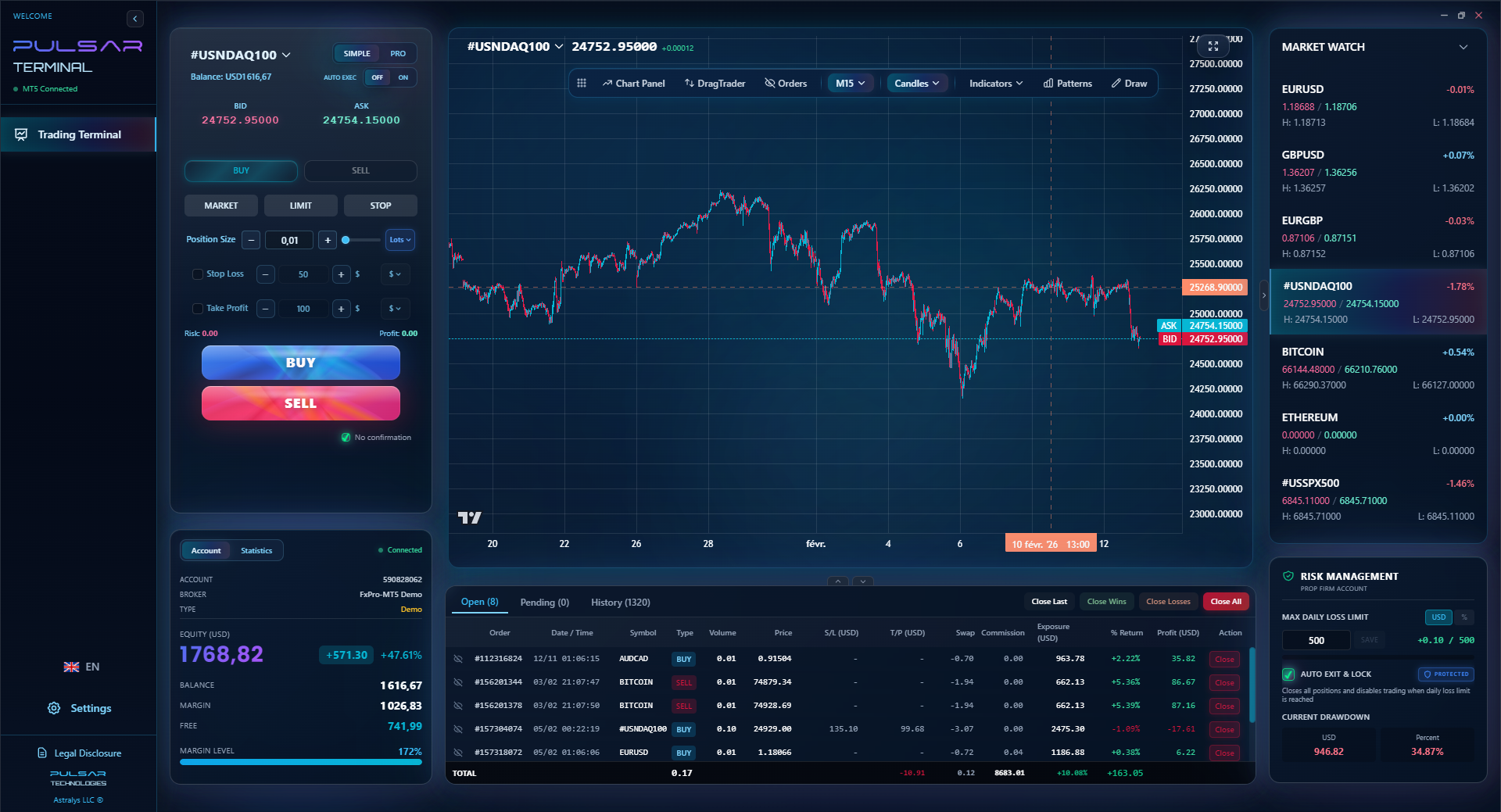
Manually cancelling one pending order when another triggers is a common hassle, but tools like Pulsar Terminal can automate this OCO (One Cancels the Other) logic directly on your MT5 chart.
Pulsar Terminal
Универсальный инструмент для MT5: drag-and-drop ордера, мульти-TP/SL, трейлинг-стоп, грид-трейдинг, Volume Profile и защита для проп-фирм. Используется 1000+ трейдерами ежедневно.
“Slippage on buy stops during a fast breakout can eat up 30% of your planned profit before your trade even starts moving.”
Let's build a concrete example using USD/ZAR, combining a buy limit and a buy stop in a single plan. This is a 'pullback or breakout' strategy for an uptrend.
Scenario: USD/ZAR is in a clear daily uptrend. It's currently pulling back from a high of 18.30. You identify two key levels:
- Support (Buy Limit Zone): 18.00 - 18.05 (previous resistance turned support, aligned with a 50% Fibonacci retracement).
- Breakout Level (Buy Stop Zone): 18.31 (above the recent high of 18.30).
Your Plan:
- Place Buy Limit: Set a buy limit order at 18.04. Stop-loss at 17.94 (100 pips risk). Take-profit at 18.34 (300 pips target). Risk/Reward = 1:3.
- Place Buy Stop: Set a buy stop order at 18.32. Stop-loss at 18.22 (100 pips risk). Take-profit at 18.62 (300 pips target). Risk/Reward = 1:3.
The Logic: You're acknowledging you don't know if the pullback will go deep to 18.04 or if the trend will resume early and break 18.30. You have two entry hypotheses, both with favorable risk/reward.
Critical Management Rule: You must CANCEL one order if the other triggers. If price drops and your buy limit at 18.04 triggers, immediately cancel the buy stop at 18.32. You are now in the trade, and you don't want a second, conflicting entry. This is a manual process on most basic platforms, but it's essential.
This strategy uses both a forex buy limit and a buy stop to cover two high-probability scenarios in a trend. It requires patience and discipline to wait for the trigger and manage the orders. Start by paper trading this setup on your MT4/MT5 platform to get a feel for the order management before risking real Rands.
💡 Совет Уинстона
The most powerful tool isn't the order type, it's the cancel button. Be ruthless in cancelling pending orders when the market context changes.
“In a ranging market, using buy stops and buy limits is a great way to get whipsawed and lose on both sides.”
Once you've mastered the basics, these nuances can improve your edge.
OCO (One Cancels the Other) Orders: Some advanced platforms or tools allow you to link two pending orders as an OCO pair. In our strategy example, you could link the buy limit and buy stop as an OCO. The platform automatically cancels the buy stop if the buy limit fills, and vice-versa. This automates the critical management rule and prevents costly mistakes.
Trailing Stops with Pending Orders: You can't attach a trailing stop to a pending order in MT4/MT5. It only works on open positions. However, once your buy limit or buy stop triggers, you can manually attach a trailing stop, or use a tool that does it automatically. This lets you lock in profits as the trend runs.
Using Volume Profile: Instead of guessing support/resistance, use the Volume Profile indicator to see where the market actually traded the most volume (the Point of Control). These high-volume nodes often act as magnet for price. Placing buy limits below a high-volume node or buy stops above it can be more effective than using arbitrary horizontal lines.
Backtesting Your Order Logic: Don't just guess if your buy limit level is good. Use MT5's strategy tester (even in visual mode) to see how placing buy limits at certain Fibonacci levels or moving averages would have performed over the last year on USD/ZAR. The data might surprise you.
Finally, remember that all this order sophistication means nothing without rock-solid risk management. A perfectly placed buy stop with a 1:3 reward that blows 5% of your account on a false breakout is still a disaster. Keep your position size sane, use your stops, and treat these orders as servants to your overall plan, not the plan itself.
FAQ
Q1Can I use both a buy limit and a buy stop at the same time?
Yes, but you must manage them carefully. They represent two different market hypotheses (a bounce vs. a breakout). The standard practice is to cancel the opposing order once one is triggered. For example, if you have a buy limit below market and a buy stop above market, and the buy limit triggers, you should immediately cancel the buy stop to avoid accidentally entering a second position. Some advanced trading tools offer OCO (One Cancels the Other) functionality to automate this.
Q2What's the difference between a buy stop and a stop-loss order?
A buy stop is a pending order used to OPEN a long position when price rises to a certain level. A stop-loss is an attached order used to CLOSE an existing long position to limit losses if the price FALLS to a certain level. They are opposites in function. Confusing them is a very expensive error.
Q3Why didn't my buy limit order get filled at the exact price I set?
Two main reasons: 1) Spreads: You buy at the Ask price. If your buy limit is set at 18.00 and the spread is 10 pips, the Ask price at that moment is 18.005. Your order triggers when the Ask hits 18.00, but your fill might be slightly higher. 2) Slippage: In fast-moving markets, price can skip past your level. If liquidity is thin, your broker (using market execution) fills you at the next best available price, which could be a pip or two away.
Q4Are buy limit and buy stop orders free with South African brokers?
Placing the orders is typically free. You only pay the trading cost (spread or commission) when the order is triggered and becomes a live trade. Always check your broker's fee schedule, but no reputable FSCA-regulated broker charges a fee just for placing a pending order.
Q5Which is better for beginners: buy limit or buy stop?
There's no universal 'better.' Buy limits often feel psychologically easier because you're 'buying low.' However, catching a falling knife is risky. Buy stops help you trade confirmed momentum but expose you to false breakouts. Beginners should practice both in a demo account. Start by using buy limits to enter at obvious support levels in an uptrend, as it has a clearer invalidation point (the support break).
Q6How does FSCA regulation affect these orders?
The FSCA doesn't regulate the order types themselves, but it ensures brokers provide fair and transparent execution. This means a regulated broker must have systems to execute your buy limit or buy stop as per their stated policy (e.g., dealing with slippage fairly) and cannot deliberately manipulate price to trigger your stops. Trading with an FSCA-licensed broker gives you recourse if there's a dispute about order execution.
Урок проф. Уинстона
Ключевые выводы:
- ✓Buy Limit = Fade the dip. Buy Stop = Chase the breakout.
- ✓Account for the spread: you buy at the Ask, not your limit price.
- ✓Always cancel the opposing pending order after one triggers.
- ✓False breakouts are the #1 killer of buy stop strategies.
- ✓Use a 1:3 risk/reward ratio as a minimum target for these setups.
Насколько полезна эта статья?
Нажмите на звезду
Еженедельные торговые инсайты
Бесплатный еженедельный анализ и стратегии. Без спама.
Об авторе
David van der Merwe
Трейдер развивающихся рынков
Трейдер из Йоханнесбурга с 11-летним опытом работы с валютами развивающихся рынков. Специализируется на ZAR-парах, торговле под регулированием FSCA и анализе южноафриканского рынка.
Комментарии
Предупреждение о рисках
Торговля финансовыми инструментами сопряжена со значительным риском и может не подходить всем инвесторам. Прошлые результаты не гарантируют будущих доходов. Данный контент носит исключительно образовательный характер и не является инвестиционной рекомендацией. Всегда проводите собственное исследование перед торговлей.
Вам также может понравиться

Cara Trading Forex Sukses: 7 Prinsip dari Trader Profesional
Cara trading forex sukses dengan 7 prinsip trader pro: manajemen modal, disiplin, journal trading, backtest. Data nyata, bukan janji profit palsu.
Jam Trading Forex Terbaik untuk Trader Indonesia: Panduan Lengkap dengan Tabel Waktu
Panduan jam trading forex untuk trader Indonesia. Tabel 4 sesi dunia, jam emas 20:00-00:00, sesi mana yang harus dihindari. Data akurat + tips dari trader berpengalaman.
Top 5 Sàn Forex Uy Tín Nhất 2026: Review Jujur dari Trader Indonesia
Top 5 sàn forex uy tín 2026 untuk trader Indonesia. Review jujur: spread, deposit, withdraw, dukungan lokal. Exness, XM, IC Markets & lebih.
Скачать Pulsar Terminal
Все эти калькуляторы встроены в Pulsar Terminal с данными в реальном времени с вашего счёта MT5.
Скачать Pulsar Terminal