


Most people will tell you hedging is a complex, institutional strategy.

David van der Merwe
Трейдер развивающихся рынков ·  South Africa
☕ 12 мин чтения
Что вы узнаете:
- 1What the Hell is Forex Hedging, Really?
- 2A Real Forex Hedging Example: The Direct Hedge
- 3The Smarter Hedge: Using Currency Correlations
- 4The Big Boy Tool: Using Options as a Hedge
- 5How South African Traders Screw Up Hedging
- 6When Should a South African Trader Actually Hedge?
- 7Your 5-Step Hedging Plan for Next Week
- 8Is Hedging Worth It For You?
Most people will tell you hedging is a complex, institutional strategy. I'm here to tell you they're wrong, and that not understanding a basic forex hedging example is why so many local traders get wiped out when the Rand decides to do its usual chaotic dance. It's not about making money; it's about not losing your shirt. I'll show you exactly how it works, with real numbers from my own trades, and explain why a simple hedge can be the difference between a bad month and a margin call.
Forget the textbook definitions. In the trenches, hedging is simply opening a second trade to protect your first one. You're not trying to win on both. You're buying insurance. Think of it like this: you're long USD/ZAR because you think the dollar will strengthen. But then, Eskom announces stage 6 load-shedding and a cabinet reshuffle hits the news. Suddenly, your profitable trade is sinking faster than a Springbok scrum on a bad day. A hedge is your lifeboat.
In South Africa, we need this more than most. Our currency is... let's call it 'spirited'. Political noise, commodity prices, and sheer global risk sentiment can send the Rand reeling 3% in a day. That can obliterate a carefully calculated position. Hedging lets you sleep at night without checking your phone every five minutes. It's a defensive play, pure and simple. The goal is to limit downside, not maximize upside. If you're coming into this looking for a magic profit machine, you've already missed the point.

Warning: Hedging is not free. You're paying the spread on the second trade, and it ties up margin. It's a cost of doing business, like paying for insurance on your car. You hope you never need it, but when you do, you're bloody glad it's there.
This is the simplest form, and the one most brokers allow (though some restrict it on the exact same pair, so check your broker's policy). Let's use a classic USD/ZAR scenario.
The Setup: In early October, I was long USD/ZAR at 18.50. I'd entered believing the Fed would stay hawkish. My position was 1 standard lot (100,000 units). A move to 18.70 would mean a profit of 20,000 ZAR (that's 20 cents per unit, times 100,000).
The Storm Clouds: Then, softer US CPI data dropped, weakening the dollar globally. At the same time, a surprise jump in SA mining output gave the Rand a short-term boost. USD/ZAR started falling: 18.45... 18.40... My paper profit was gone, and I was facing a loss.
The Hedge: Instead of closing and accepting a loss, I opened a SELL order on USD/ZAR at 18.38. Same size: 1 lot.
What This Did: My original trade (long at 18.50) was now losing 12 cents per unit as price fell. My new hedge trade (short at 18.38) was profiting as price fell. The losses and profits began to offset each other. I was effectively 'locked in'. The net effect? I stopped the bleeding. I wasn't gaining, but I wasn't losing more ZAR while I figured out my next move.
The Outcome: The Rand strength faded after a few days as risk-off sentiment returned. USD/ZAR started climbing back up. When it hit 18.42, I closed the hedge (the short trade) for a small profit of 4 cents per unit (4,000 ZAR). This profit offset some of the loss still on my original long trade. I then let the original long trade run, and eventually closed it at 18.65 for a profit. The hedge turned a potential -12,000 ZAR drawdown into a managed -8,000 ZAR drawdown before the recovery.

Example:
- Trade 1 (Long): Buy 1 lot USD/ZAR @ 18.50
- Trade 2 (Hedge): Sell 1 lot USD/ZAR @ 18.38
- Price falls to 18.34: Long trade loses 16,000 ZAR. Short hedge gains 4,000 ZAR. Net Loss = -12,000 ZAR (INSTEAD of -16,000 ZAR).
- Price rises to 18.42: Close hedge. Short trade profit = +4,000 ZAR. Loss on long trade reduced to -8,000 ZAR.
This is the core forex hedging example. It freezes your P&L, giving you time to think. Without it, panic often leads to closing at the worst possible time. For managing these offsetting positions, a good position size calculator is non-negotiable to ensure you don't over-use.

💡 Совет Уинстона
A hedge is a seatbelt, not an airbag. Put it on *before* you crash, not during.
“The goal is to limit downside, not maximize upside. If you're looking for a magic profit machine, you've already missed the point.”
A direct hedge locks your capital. A correlation hedge is more elegant and keeps your margin available. It uses the fact that certain currencies often move together. For a South African trader, this is gold.
The ZAR Proxy Hedge
USD/ZAR is highly correlated with other 'risk-on' emerging market currencies and commodity pairs. When global investors flee risk, they sell AUD, NZD, MXN, and ZAR. They buy USD, JPY, CHF.
Real Example: I was long EUR/ZAR (a common carry trade). I got nervous about a global growth scare that would hit the Rand but also hurt the Euro. A direct hedge on EUR/ZAR would lock everything up.
Instead, I went long USD/CHF. Why? In a panic, everyone buys Swiss Francs (CHF) as a safe haven, selling USD. So USD/CHF tends to fall during risk-off. My EUR/ZAR long would also likely fall (sell ZAR, sell Euro). By being short on USD/CHF (or long CHF), I created a hedge. If my main trade went south, this one would hopefully go north.
It didn't perfectly offset, but it softened the blow by about 60%. That's the key: a correlation hedge reduces risk, doesn't eliminate it. You need to understand these relationships. Tools like a MACD indicator can help confirm the momentum direction of your hedge instrument.
The Commodity Link
ZAR is a commodity currency. Long GBP/ZAR? Worried about a drop in platinum prices hurting the Rand? You could take a small, offsetting position in a metal. This is more advanced but illustrates the principle: hedge the driver of your risk, not just the pair itself.
This is where true precision lies. An option gives you the right, but not the obligation, to buy or sell a currency at a set price before a certain date. For hedging, it's like an insurance policy with a defined premium.
A Simple Forex Hedging Example with Options: Let's say you hold a long 1 lot position in USD/ZAR at 18.00. You're bullish long-term, but worried about short-term volatility around the budget speech.
You buy a put option on USD/ZAR with a strike price of 17.90, expiring in one month. You pay a premium, say 0.5% of the position's value.
Scenario 1: Budget speech is a disaster. USD/ZAR crashes to 17.70. Your main trade is losing 30 cents per unit. However, your put option (the right to sell at 17.90) is now deeply 'in the money'. You can exercise it or sell the option contract for a profit. This profit offsets the loss on your spot trade. Your maximum loss is capped at the difference between your entry (18.00) and the strike (17.90), plus the premium you paid.
Scenario 2: Budget speech is great. USD/ZAR rallies to 18.30. Your main trade profits 30 cents. Your put option expires worthless. You're only out the premium (your 'insurance cost'), but you keep all the profits from the rally.
It's clean. It defines your maximum risk upfront. The downside? Options are less accessible to retail traders in South Africa, often requiring specialized accounts. The pricing (premium) can be steep during high volatility. But for a large, strategic position, it's the professional's choice. If you're running a swing trading book with longer-term holds, exploring options is a logical next step.
“I've made these hedging mistakes so you don't have to. It's a tool, not a strategy.”
I've made these mistakes so you don't have to. Hedging is a tool, not a strategy. Misuse it, and it will bankrupt you.
Mistake 1: Hedging Out of Panic, Not Plan. You're in a losing trade, sweating. You throw on a hedge at the worst possible price, right at the peak of the move. Now you're locked into a loss. You need a rule: hedge at a pre-defined technical level (e.g., a key support break), not when your heart rate hits 120.
Mistake 2: Over-Complicating It. Starting with a complex 3-instrument correlation hedge before you understand a direct hedge is like trying to fly a 747 before you can drive. Get the basic forex hedging example down first. Use one pair.
Mistake 3: Forgetting the Cost. Every hedge costs spreads and margin. If you hedge every tiny fluctuation, you'll grind your account down to zero with transaction costs. Hedge major event risk or technical breaks, not daily noise.
Mistake 4: Turning a Hedge into a Martingale. This is the killer. You're long USD/ZAR, it goes down, you hedge by going short. Then it reverses up. Instead of removing the hedge, you think, 'I'll just add another long to hedge the short!' Now you have two opposing trades and no idea what your actual position is. You're just doubling your bet size and your risk. This is how you get a margin call. Have an exit plan for the hedge before you place it.
Mistake 5: Using a Bad Broker. Some brokers see opposing positions on the same pair as 'taking liquidity' from them and will discourage it with weird rules or poor execution. You need a broker that is truly ECN/STP. I've found brokers like IC Markets and Pepperstone handle this seamlessly, which is critical.
💡 Совет Уинстона
If you can't write down your hedge exit rule in one sentence, you don't have a plan, you have a hope.
Not all the time. Be surgical.
- Major SA Political/Economic Events: Budget speech, SONA, SARB interest rate decisions, Moody's/S&P reviews. The ZAR will gap. If you have an open position, a hedge for the 24 hours around the event is prudent.
- Holding Over Weekends: Geopolitical events happen when our markets are closed. If you're holding a large ZAR position into a weekend with, say, tense US-Iran headlines, a small hedge can save you from a Sunday night gap against you.
- Protecting Profits: You're sitting on a nice +15,000 ZAR profit in a long GBP/ZAR trade. The trend is still up, but it's looking stretched. Instead of closing, place a tight trailing stop AND a small, partial hedge (maybe 30% of your position size) to lock in some of those gains while letting the rest run. This is an advanced tactic, but powerful.
- You're Going to Be Away from Screens. Going on a game drive with no signal for 3 days? Don't just leave a stop and pray. Put on a hedge to neutralize your exposure until you're back at your desk. It's responsible account management.
, hedge against event risk and unavoidable absence. Don't hedge against normal market wobbles. That's what your original stop-loss is for. A tool like an RSI indicator can help you decide if a pullback is just a wobble (oversold RSI) or the start of a larger reversal.
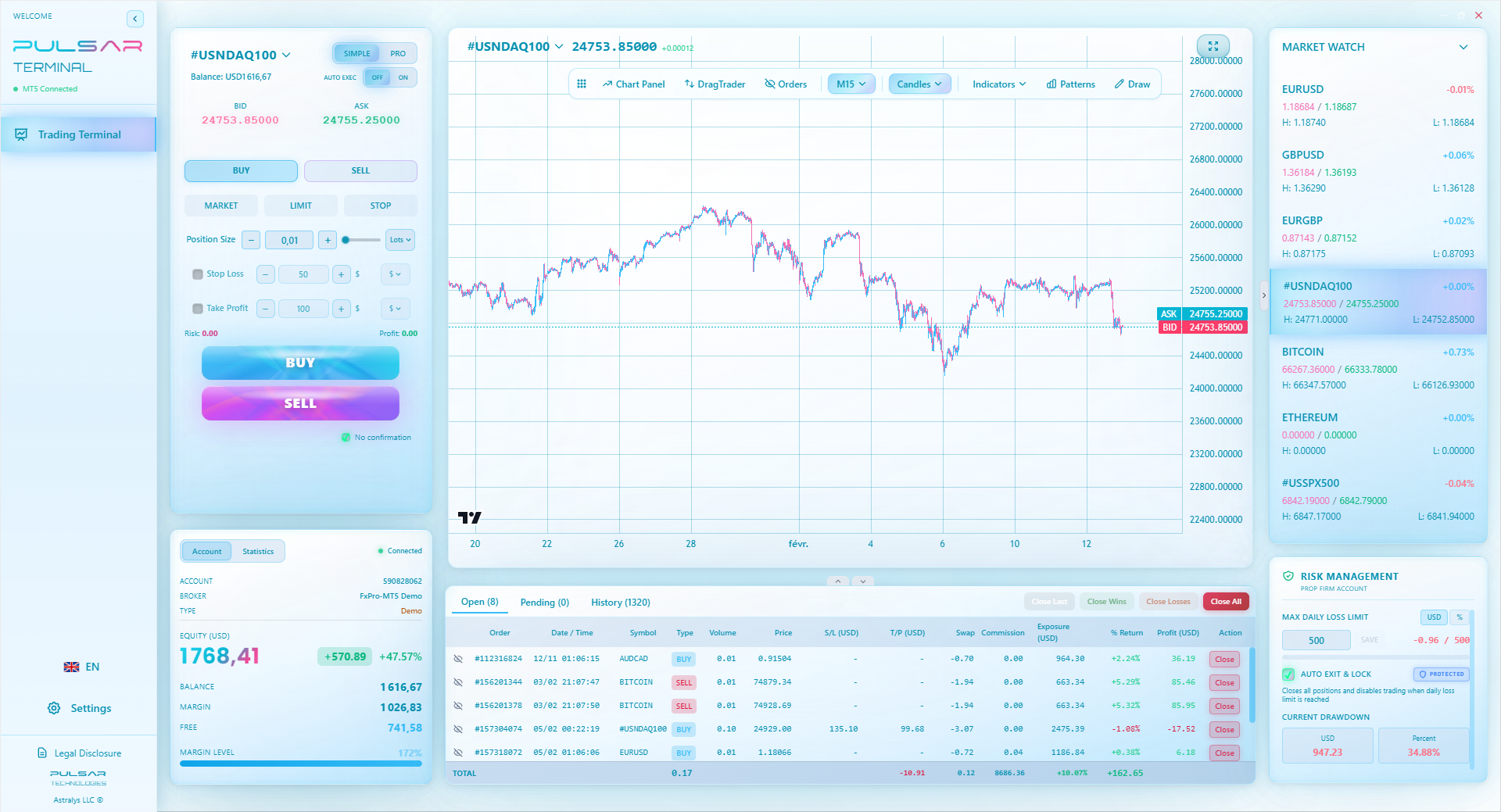
Managing multiple orders for hedging and setting precise exit rules is far easier with a tool like Pulsar Terminal, which lets you drag-and-drop orders and set multi-level take-profits directly on your MT5 chart.
Pulsar Terminal
Универсальный инструмент для MT5: drag-and-drop ордера, мульти-TP/SL, трейлинг-стоп, грид-трейдинг, Volume Profile и защита для проп-фирм. Используется 1000+ трейдерами ежедневно.
“It didn't increase my winning percentage, but it dramatically increased the size of my account over time.”
Let's make this actionable. Here’s exactly what to do.
Step 1: Identify Your Risk. Look at your open positions. Which one keeps you up at night? Which one has the most exposure to a specific, known event? That's your candidate.
Step 2: Choose Your Hedge Type.
- Newbie: Use a Direct Hedge on the same pair.
- Intermediate: Research a correlated pair (e.g., if long USD/ZAR, maybe short AUD/USD).
- Advanced/Professional: Explore options if your broker offers them.
Step 3: Calculate the Size. Your hedge doesn't need to be 100%. A 50% hedge halves your risk. A 25% hedge is a good start. Use your position size calculator to ensure the hedge itself doesn't over-use you.
Step 4: Set Entry & Exit Rules for the HEDGE.
- Entry: 'I will place my hedge if price closes below the 50-day moving average at 18.25.'
- Exit: 'I will remove my hedge when price reclaims 18.30, OR after the SARB announcement passes at 3 PM Thursday.'
Step 5: Execute and Monitor. Place the hedge trade. The moment your exit condition is hit, close the hedge. Do not get emotional. The hedge has done its job. Now you're back to your original, unhedged view.

Pro Tip: Keep a trading journal. Note down: 'Hedged Position X on [Date] because of Event Y. Hedge cost Z ZAR in spreads. Removed on [Date]. Outcome: Reduced drawdown by RXXXX.' This data is priceless for refining your process.
💡 Совет Уинстона
The cost of a hedge is the premium for sanity. Sometimes, that's the best Rands you'll ever spend.
Here's my blunt take. If you're a scalping trader holding positions for minutes, forget hedging. The costs will kill you. Use a tight stop and be fast.
If you're a swing or position trader holding for days to weeks, and you trade volatile pairs like USD/ZAR, GBP/ZAR, or EUR/ZAR, then learning to hedge is not optional. It's a core survival skill. The Rand's volatility isn't a bug; it's a feature of our market. A solid forex hedging example should be in your playbook right next to your entry strategy.
It won't make you a better predictor of the market. But it will make you a better manager of your risk. And in this game, risk management is what separates the tourists from the residents. I started using hedges consistently about 8 years ago. It didn't increase my winning percentage, but it dramatically increased the size of my account over time. Why? Because my worst losses were cut in half, giving my winning trades more capital to work with. That's the real power of the hedge. It's not a shield against being wrong; it's a buffer that lets you live to trade another day, which in South Africa's wild markets, is the whole point.
FAQ
Q1Is forex hedging legal in South Africa?
Yes, absolutely. There's no South African law prohibiting retail forex hedging. The restriction comes from individual broker policies. Some CFD brokers may not allow direct 'locking' of the same pair, but correlation hedging is always possible. Always check your specific broker's terms.
Q2What's the main disadvantage of hedging?
Cost and complexity. You pay the spread on the hedge trade, which eats into profits. It also ties up margin that could be used elsewhere. The biggest risk is mental: it can make you complacent, letting a losing position drift because 'the hedge has it covered,' leading to a tangled mess of trades.
Q3Can I hedge with a small account under R20,000?
You can, but you must be incredibly careful. Hedging uses margin. On a small account, a full 1-lot hedge might use most of your available margin, leaving you vulnerable to margin calls on other positions or if the market gaps. Start with micro lots (1,000 units) to practice the concept without risking your entire capital.
Q4What's better: a hedge or a stop-loss?
They're different tools for different jobs. A stop-loss is for permanent, defined risk on a single trade idea. A hedge is a temporary, flexible risk management tool for uncertain events or to buy time. Use a stop-loss for every trade. Use a hedge selectively for specific high-volatility scenarios.
Q5How do I hedge a long gold (XAU/USD) position as a South African?
Gold (XAU/USD) is priced in USD. If you're worried about a strong US dollar hurting gold prices, you could short a USD pair like USD/ZAR or USD/CHF. Alternatively, if your worry is general risk-off selling, you could go long the US dollar (e.g., long USD/CHF) as a partial offset. Understanding the drivers of your primary trade is key. Check our XAU/USD guide for more on gold's dynamics.
Q6Do prop firms allow hedging?
This is crucial. Most major prop firms (like FTMO, The5%ers) DO allow hedging. In fact, they often see it as a sophisticated risk management technique. However, you must read their specific rules. Some may have rules against 'hedging away' a loss to avoid a stop-out, so use it as a genuine strategic tool, not a rule loophole.
Урок проф. Уинстона
Ключевые выводы:
- ✓Hedge major event risk, not daily noise.
- ✓A 50% hedge halves your risk; start small.
- ✓Always have an exit rule for the hedge itself.
- ✓The spread cost is your insurance premium.
- ✓Use correlation hedges to free up margin.
Насколько полезна эта статья?
Нажмите на звезду
Еженедельные торговые инсайты
Бесплатный еженедельный анализ и стратегии. Без спама.
Об авторе
David van der Merwe
Трейдер развивающихся рынков
Трейдер из Йоханнесбурга с 11-летним опытом работы с валютами развивающихся рынков. Специализируется на ZAR-парах, торговле под регулированием FSCA и анализе южноафриканского рынка.
Комментарии
Предупреждение о рисках
Торговля финансовыми инструментами сопряжена со значительным риском и может не подходить всем инвесторам. Прошлые результаты не гарантируют будущих доходов. Данный контент носит исключительно образовательный характер и не является инвестиционной рекомендацией. Всегда проводите собственное исследование перед торговлей.
Вам также может понравиться

Cara Trading Forex Sukses: 7 Prinsip dari Trader Profesional
Cara trading forex sukses dengan 7 prinsip trader pro: manajemen modal, disiplin, journal trading, backtest. Data nyata, bukan janji profit palsu.
Jam Trading Forex Terbaik untuk Trader Indonesia: Panduan Lengkap dengan Tabel Waktu
Panduan jam trading forex untuk trader Indonesia. Tabel 4 sesi dunia, jam emas 20:00-00:00, sesi mana yang harus dihindari. Data akurat + tips dari trader berpengalaman.
Top 5 Sàn Forex Uy Tín Nhất 2026: Review Jujur dari Trader Indonesia
Top 5 sàn forex uy tín 2026 untuk trader Indonesia. Review jujur: spread, deposit, withdraw, dukungan lokal. Exness, XM, IC Markets & lebih.
Скачать Pulsar Terminal
Все эти калькуляторы встроены в Pulsar Terminal с данными в реальном времени с вашего счёта MT5.
Скачать Pulsar Terminal