


Here's a number that should sober you up: the average monthly income for a 'forex trader' in South Africa, according to Indeed, is R27,306.

David van der Merwe
Трейдер развивающихся рынков ·  South Africa
☕ 10 мин чтения
Что вы узнаете:
- 1The Reality of Forex Salaries: What You'll Actually Earn
- 2Real Forex Job Titles (And What They Actually Do)
- 3How to Actually Get Hired (The 3-Step Process)
- 4The Prop Firm 'Challenge' Path: Legit or a Trap?
- 5Working FOR a Broker (The Other Side of the Desk)
- 6The Dark Side: Scams Masquerading as Forex Jobs
- 7The Long Game: Building Your Own Trading Business
Here's a number that should sober you up: the average monthly income for a 'forex trader' in South Africa, according to Indeed, is R27,306. That's barely above the national average salary. The dream sold on social media of Lamborghinis and private jets? It's a fantasy for 99.9% of people. But real, legitimate forex jobs do exist. They just look nothing like the hype. I've been on both sides of the hiring desk in this industry for over a decade. Let's cut through the nonsense and talk about what a career in forex actually looks like in South Africa today.
Forget the YouTube thumbnails. Your income in forex depends entirely on your job title and who signs your paycheck. Let's break down the real numbers for 2026.
The Employed Trader
If you get a job trading a firm's capital, you're an employee. Your salary might have a small base, but the real money is in the performance cut. A typical structure for a junior prop trader could be a R15,000 base plus 15-20% of net profits. A senior fund manager running a ZAR-focused book could easily clear R100,000+ monthly. The key difference? You're not risking your own money, but your job is on the line every quarter.
I once hired a young analyst who had a killer eye for USD/ZAR correlations. We started him on a R20k base. Within 18 months, his share of the book's profits had him averaging R65k a month. He wasn't a 'guru'; he was a disciplined employee with a niche skill.
The Retail 'Job' (Trading Your Own Capital)
This isn't a job, it's a business. The income ranges are wild. A part-time trader focusing on ZAR pairs might pull in R10,000-R20,000 on a good month. A full-time EUR/USD specialist with a proven system could aim for R30,000-R50,000. The big caveat? Consistency is the holy grail, and most never find it. Your 'salary' is whatever you don't lose.

Example: Let's say you trade a R50,000 account. A realistic, stellar return is 5% a month (R2,500). After living expenses, that's not a salary, it's a side hustle. To make R50k a month, you'd need a R1,000,000 account at that same return. That's the math nobody shows you.
The reported 'average' of R27,306 is misleading. It lumps together employed analysts, rookie prop traders, and retail dreamers. The median is probably much lower.

💡 Совет Уинстона
Your first R100,000 in trading profits is not for a car. It's for buying yourself more time to learn. Reinvest it.
“The dream sold on social media of Lamborghinis and private jets? It's a fantasy for 99.9% of people.”
When we talk about forex jobs, we're not just talking about someone clicking buy and sell. The environment needs other roles. Here are the real positions you can apply for.
| Job Title | Who Hires Them | Real Daily Work | Required Skills |
|---|---|---|---|
| Junior Dealer / Prop Trader | Proprietary Trading Firms, Banks | Executing firm's strategy, managing risk limits, reporting P&L. | Understanding of pips, basic technical analysis, emotional control. |
| FX Analyst / Strategist | Banks, Asset Managers, Brokerages | Writing market reports, building macroeconomic models, presenting to clients. | Deep economic knowledge, stellar writing, understanding of SARB policy. |
| FX Sales Trader | Brokerages (like IG or FOREX.com) | Client relationship management, providing liquidity, executing client orders. | People skills, product knowledge, salesmanship. |
| Compliance Officer (FX Focus) | Any FSCA-licensed broker | Ensuring KYC/AML rules are followed, monitoring trades for market abuse, regulatory reporting. | Law/Compliance degree, attention to detail, knowledge of FAIS Act. |
| Retail Trading Mentor | Established Educational Firms | Creating content, running webinars, providing 1-on-1 coaching on platforms like MT5. | Proven track record, teaching ability, patience. (Not a 'signals seller'). |
The most common path for a newcomer is the Junior Dealer role at a prop firm. You'll use their capital, their tech, and their risk framework. Your job is to follow the process, not be a hero. I've seen more traders blow up trying to impress the boss with one big trade than I care to remember.
“Your 'salary' is whatever you don't lose.”
You won't get a forex job with a slick Instagram profile and a screenshot of a winning trade. Here's what hiring managers like me actually look for.
Step 1: Build a Verifiable Track Record
This is non-negotiable. No one cares about your 500% return in a demo contest. They care about consistent, real-money performance over time. Open a live account with a reputable, FSCA-regulated broker like Pepperstone or IC Markets. Start small - maybe R5000. Trade for a minimum of 6 months. Use a position size calculator religiously. The goal isn't to get rich, it's to generate a broker statement that shows discipline.
Your statement should show:
- Consistent risk per trade (1-2% max).
- A healthy win rate (doesn't have to be high, 40% is fine with good risk/reward).
- No massive, account-blowing drawdowns.
- A clear strategy (e.g., only trading London session breakouts).
Step 2: Get the Right Qualifications
For analyst or sales roles, a degree in Finance, Economics, or Statistics is almost mandatory. For a trading role, it's less about the degree and more about certifications that show initiative. Look at the Certified Financial Technician (CFTe) or even the foundational SAIFM exams. These prove you've studied the craft, not just watched TikTok videos.
Step 3: Network in the Right Places
Join the Financial Markets Association of South Africa (FMASA) if you can. Attend their events. Go to legitimate trading seminars (not the 'get rich quick' ones). LinkedIn is your friend. Connect with analysts at banks, not 'forex gurus.'

Warning: If a 'job offer' requires you to pay for training, buy specific software, or deposit a 'minimum amount' to trade their 'funded account,' walk away. It's a scam. Legitimate prop firms make money from your profits, not your sign-up fee.
I once hired a trader who sent me a 12-month MyFxBook link with a 15% return and a max drawdown of 8%. It was boring. It was beautiful. He showed up to the interview with a printout of his trades and could explain why he took every single one. He got the job over a guy who claimed a 200% return.
“Your 'salary' is whatever you don't lose.”
This is the modern gateway for many aspiring traders. You pay a fee (say, R1500) to take a trading challenge. Pass it, and you get a 'funded account' where you keep a large share of the profits. It's a real alternative to traditional employment, but you need to pick the right firm.
The legitimate ones (there are a few) act as your risk department. They give you capital but enforce strict rules: a daily loss limit (e.g., 5%), a max overall drawdown (e.g., 10%), and often forbid news trading. Your job is to pass their evaluation by hitting a profit target without breaking their rules. It's a test of process, not genius.
The trap firms have impossible rules designed for you to fail. They make their money from the repeated challenge fees, not your trading success.

Pro Tip: If you go this route, treat the challenge like a real job. Use a scalping strategy if that's your edge, but know the rules - many forbid high-frequency trading. The key is managing the daily loss limit. Tools that automate stop-losses and prevent emotional overrides are worth their weight in gold here. Passing requires robotic discipline.
I failed my first two prop challenges years ago. My ego was writing checks my strategy couldn't cash. I blew the daily limit trying to revenge trade after a single loss. The lesson was brutal: in this 'job,' your primary task isn't making money, it's not losing money. The profits come after you've mastered that.
💡 Совет Уинстона
The market doesn't care about your opinion. The quicker you stop trying to be right and start trying to be profitable, the better.
“In this 'job,' your primary task isn't making money, it's not losing money.”
Not everyone can be a profitable trader, and that's okay. The forex industry needs support staff. Working for an FSCA-licensed broker like XM or Exness is a stable, corporate career path.
Roles you can find:
- Client Support: Handling deposits, withdrawals, and platform queries. You'll learn the nitty-gritty of spreads, swaps, and execution.
- Marketing & Affiliate Management: Running campaigns, managing relationships with introducing brokers (IBs).
- IT & Platform Support: Keeping the trading servers (MT4/MT5) running smoothly. This is a highly technical, well-paid role.
- Compliance: The backbone of any regulated broker. You'll ensure every client is verified and every transaction is above board.
The benefit? You get a steady salary, medical aid, and you're immersed in the industry. You'll see how the sausage is made - how liquidity works, why spreads widen during news events, and how most retail clients actually behave (spoiler: they lose). This insider knowledge is useful if you later decide to trade your own account.
I started in client support. Answering 50 calls a day about 'why did my stop loss not work?' taught me more about slippage and market gaps than any textbook ever could.
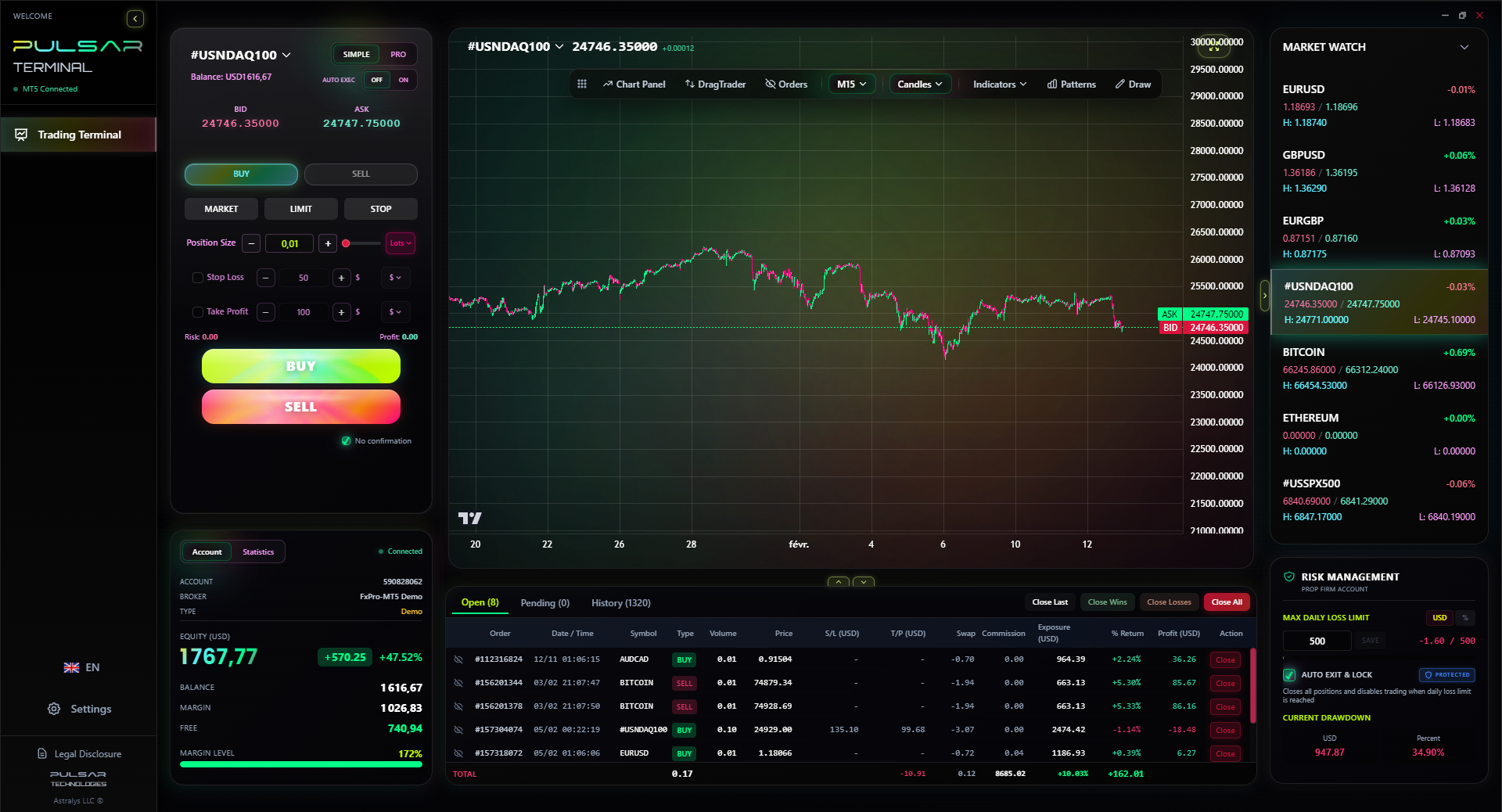
Managing a prop firm challenge's strict daily loss limits is a huge psychological battle, which is why automating your risk rules with a tool like Pulsar Terminal can be the difference between passing and blowing your evaluation.
Pulsar Terminal
Универсальный инструмент для MT5: drag-and-drop ордера, мульти-TP/SL, трейлинг-стоп, грид-трейдинг, Volume Profile и защита для проп-фирм. Используется 1000+ трейдерами ежедневно.
“In this 'job,' your primary task isn't making money, it's not losing money.”
South Africa is unfortunately a hotbed for forex-related scams. You need to spot these a mile away.
1. The 'Signal Seller' Recruitment: You're 'hired' to sell trading signals or manage social media for a guru. You're paid commission on getting people to subscribe. This is often a front for an unregulated bucket shop. You'll be promoting lies, and it's ethically bankrupt.
2. The Pyramid Scheme (MLM Forex): You're recruited to 'build a team.' You earn more from recruiting others who pay for education packs than from any actual trading. The product is the recruitment itself. If the interview focuses more on your network than your trading knowledge, run.
3. The 'Funded Account' Scam: As mentioned, the firm with impossible rules. A real red flag is if they don't use a well-known third-party evaluation platform like MetaTrader. If their 'platform' is proprietary and you can't independently verify prices, it's a scam.
4. The Fake Investment Firm: They promise to pool client funds and trade them. They might even show fake MT4 statements. They're often unlicensed FSPs. Check the FSCA's website for their license number. No number, no go.
Your best defense is skepticism. A real forex job won't promise easy money. It will emphasize risk, discipline, and hard work. If it sounds too good to be true, it's a scam designed to separate you from your money, not give you a career.
“A great analyst with poor risk management is a bankrupt analyst.”
Let's be honest: the most sustainable 'forex job' for most serious individuals is running your own trading business. This isn't a get-rich-quick scheme; it's a multi-year entrepreneurial grind.
Phase 1: Apprenticeship (Years 1-2) Trade your own small capital. Focus on one or two pairs, maybe EUR/USD and USD/ZAR. Your goal is not profit, but survival and education. Document every trade. Learn what a margin call feels like (it should only happen once). Use this time to develop a concrete, written trading plan. A good plan for swing trading ZAR pairs will look completely different from a day trading plan for gold (XAU/USD).
Phase 2: Consistency (Years 2-4) Now, the goal is a small, consistent return. Aim for 2-3% per month with controlled drawdowns. This is where you might incorporate more advanced tools like the MACD indicator or RSI indicator to refine entries, but your plan is king. This performance is what you'd show to a prop firm or an investor.
Phase 3: Scaling (Year 4+) With a multi-year track record of consistent returns, you can now scale. This could mean:
- Applying for larger prop firm capital.
- Attracting private investors (legally, with the proper FSP license).
- Scaling your own capital using prudent position sizing.
The key is to treat it like a business from day one. Separate your trading bank account from your personal one. Pay yourself a modest 'salary' from profits only. Reinvest the rest to grow the business's capital. The traders who last are the ones who manage their psychology and their books with equal care.
💡 Совет Уинстона
Spend as much time analyzing your losing trades as you do celebrating your winners. The lessons are in the losses.
FAQ
Q1What is the best forex trading job for a beginner in South Africa?
Hands down, a Junior Dealer role at a reputable proprietary trading firm. You get to trade with the firm's capital, learn under their risk management system, and get a salary (even if small) while you learn. It's a paid education with much lower personal financial risk.
Q2Do I need a degree to get a forex job?
It depends on the role. For FX Analyst, Sales, or Compliance roles at a bank or broker, a finance-related degree is almost mandatory. For a pure trading role at a prop firm, a proven track record (like a verified 6-12 month statement) and the right attitude often trump a degree. Certifications like CFTe help a lot.
Q3How much do I need to start trading for a living in South Africa?
Realistically, you need enough capital so that a 3-5% monthly return covers your living expenses. If you need R20,000 a month to live, and you're a top-tier trader making 5%, you need a R400,000 trading account. This is why most people start by supplementing their income, not replacing it.
Q4Are forex prop firms in South Africa legitimate?
Some are, many are not. A legitimate prop firm makes its money from your trading profits, not from charging you repeated evaluation fees. Check if they are registered with the FSCA, research their reputation thoroughly, and be wary of any with unrealistic profit targets or restrictive rules designed to make you fail.
Q5What is the most important skill for a forex trader?
Risk management. It's not even close. Knowing how to size a position, where to place a stop loss, and having the discipline to stick to your plan will keep you in the game long enough to develop other skills like analysis. A great analyst with poor risk management is a bankrupt analyst.
Q6Can I work for an international broker from South Africa?
Yes, many international brokers like IC Markets or Pepperstone have remote support, marketing, and IT roles. However, client-facing roles dealing with South African clients will require the broker to be FSCA-licensed, which most major international ones are.
Урок проф. Уинстона
Ключевые выводы:
- ✓Real forex jobs pay R27k-R100k+ monthly, not millions.
- ✓A verifiable 6-month track record beats a fancy degree for trading roles.
- ✓Prop firm challenges test discipline, not genius. Avoid fee-harvesting scams.
- ✓Treat trading as a business: separate accounts, pay yourself a salary from profits.
- ✓Risk management is 80% of the job. Master position sizing first.
Насколько полезна эта статья?
Нажмите на звезду
Еженедельные торговые инсайты
Бесплатный еженедельный анализ и стратегии. Без спама.
Об авторе
David van der Merwe
Трейдер развивающихся рынков
Трейдер из Йоханнесбурга с 11-летним опытом работы с валютами развивающихся рынков. Специализируется на ZAR-парах, торговле под регулированием FSCA и анализе южноафриканского рынка.
Комментарии
Предупреждение о рисках
Торговля финансовыми инструментами сопряжена со значительным риском и может не подходить всем инвесторам. Прошлые результаты не гарантируют будущих доходов. Данный контент носит исключительно образовательный характер и не является инвестиционной рекомендацией. Всегда проводите собственное исследование перед торговлей.
Вам также может понравиться

Cara Trading Forex Sukses: 7 Prinsip dari Trader Profesional
Cara trading forex sukses dengan 7 prinsip trader pro: manajemen modal, disiplin, journal trading, backtest. Data nyata, bukan janji profit palsu.
Jam Trading Forex Terbaik untuk Trader Indonesia: Panduan Lengkap dengan Tabel Waktu
Panduan jam trading forex untuk trader Indonesia. Tabel 4 sesi dunia, jam emas 20:00-00:00, sesi mana yang harus dihindari. Data akurat + tips dari trader berpengalaman.
Top 5 Sàn Forex Uy Tín Nhất 2026: Review Jujur dari Trader Indonesia
Top 5 sàn forex uy tín 2026 untuk trader Indonesia. Review jujur: spread, deposit, withdraw, dukungan lokal. Exness, XM, IC Markets & lebih.
Скачать Pulsar Terminal
Все эти калькуляторы встроены в Pulsar Terminal с данными в реальном времени с вашего счёта MT5.
Скачать Pulsar Terminal