


If you've spent any time in Nigerian trading groups, you've seen it: someone posts a perfect-looking head and shoulders pattern and declares, "USD/NGN is going to crash!" Then...

Olumide Adeyemi
Пионер трейдинга в Западной Африке ·  Nigeria
☕ 12 мин чтения
Что вы узнаете:
- 1What Are Forex Patterns, Really?
- 2Patterns That Actually Work With Nigerian Volatility
- 3How to Trade a Pattern: A Step-by-Step Plan
- 4Common Mistakes Nigerian Traders Make (I Made Them All)
- 5Making Patterns Stronger: Add These Confirmation Tools
- 6The Most Important Part: Managing Your Risk
- 7Choosing a Broker: What Matters for Pattern Trading
If you've spent any time in Nigerian trading groups, you've seen it: someone posts a perfect-looking head and shoulders pattern and declares, "USD/NGN is going to crash!" Then... nothing happens. Or worse, it moves the opposite way. The truth is, most traders use forex patterns wrong. They treat them like magic spells instead of probability tools. I lost money for years making that exact mistake. Let me show you how to read these patterns properly in our market, where volatility can be brutal and spreads matter more than textbook examples.
Let's clear this up first. A forex pattern isn't a prediction. It's a story about crowd psychology playing out on a chart. It shows you when buyers and sellers are exhausted, when one side is gaining control, or when the market is just taking a breather before the next big move.
Think of it like watching a football match. You don't know the exact minute a goal will be scored, but you can see when one team is building pressure, when the defense is getting disorganized, or when a counter-attack is setting up. Patterns are your visual cues for that pressure.
There are two main families: reversal patterns and continuation patterns. Reversal patterns, like the head and shoulders or double top, suggest a trend is running out of steam and might flip. Continuation patterns, like triangles or flags, suggest the market is just pausing before resuming its original direction. The key is context. A triangle pattern in a strong uptrend means something very different from the same triangle in a choppy, sideways market.

Warning: No pattern works 100% of the time. Anyone who tells you otherwise is selling something. Even the best setups fail. Your job isn't to find perfect patterns, it's to find high-probability patterns and manage your risk when you're wrong. I learned this the hard way by blowing up an account chasing a "guaranteed" wedge breakout that never came.

💡 Совет Уинстона
A pattern is just a map of recent fear and greed. The real skill is knowing if that map is still relevant, or if the terrain has changed.
Our market has a personality. The Naira pairs (USD/NGN, GBP/NGN) can be jumpy, influenced by CBN announcements, fuel prices, and local liquidity. Major pairs like EUR/USD are more technical but still feel the ripple effects. You need patterns that can handle this.
Triangles Are Your Best Friend
Symmetrical, ascending, and descending triangles are incredibly reliable here. Why? They represent a consolidation of volatility. As the price squeezes into a tighter and tighter range, it's building energy. The breakout tends to be powerful. I've had my most consistent wins trading these on the 4-hour and daily charts.
For example, back in late 2023, I watched GBP/NGN coil into a tight symmetrical triangle for almost two weeks on the daily chart. The breakout to the upside was sharp and gave me a clean 450-pip move. The key was waiting for the candle to close outside the triangle's boundary before entering, not just touching it.
Flags and Pennants for Trending Markets
When USD/NGN gets a strong directional move (which happens often), it rarely goes straight up or down. It takes little breaks. These pauses often form flags or pennants - small, sloped rectangles or tiny triangles. They are continuation signals. If you miss the initial trend move, a pullback into a flag is a great second-chance entry. My scalping strategy often uses 15-minute flags during high-volatility sessions.
The Head and Shoulders (But Be Careful)
This classic reversal pattern works, but you have to be patient. In a fast market, you'll see a lot of failed head and shoulders where the neckline breaks and then immediately reverses. The trick? Wait for a close below the neckline, and then look for a retest of that neckline (now acting as resistance) for a higher-probability entry. Jumping in on the first break is a sure way to get stopped out.

Pro Tip: Always check the economic calendar before trading a pattern around major Nigerian data releases (like inflation figures or MPC meeting outcomes). A perfect technical pattern will get run over by fundamental news every time. I've been caught holding a beautiful double top right before a surprise CBN rate hike. The pattern broke beautifully... in the wrong direction.
“Your job isn't to find perfect patterns, it's to find high-probability patterns and manage your risk when you're wrong.”
Here's my exact process. It's boring, but it keeps me alive.
- Identify the Major Trend First. Are we on the daily chart in an uptrend, downtrend, or range? I only take continuation patterns (flags, triangles) in the direction of the trend. For reversal patterns, I need to see clear signs of trend exhaustion (like slowing momentum on the MACD indicator).
- Draw the Pattern Correctly. This sounds obvious, but most people force it. A triangle needs at least two swing highs and two swing lows connecting. Don't connect random wicks. Use the candle bodies for cleaner lines.
- Plan Your Entry, Stop Loss, and Take Profit Before the Breakout.
- Entry: I enter on a confirmed candle close outside the pattern boundary. Sometimes, if the breakout is very strong, I'll enter on a retest of that boundary.
- Stop Loss: This is non-negotiable. For a triangle, my stop goes just beyond the opposite side of the pattern. For a head and shoulders, it goes above the right shoulder (for a sell).
- Take Profit: I use a measured move target. For a triangle, I measure the height of the pattern at its widest part and project that distance from the breakout point. I often take 50% off at that target and let the rest run with a trailing stop.
- Check the Volume (if possible). A breakout on increasing volume is more convincing. Not all brokers show great volume data for forex, but it's a nice confirmation if you have it.
- Manage the Trade. Once you're in, don't just watch it. Use a trailing stop or move your stop to breakeven once you're in profit. Let your winners run, but protect your capital.
This is where discipline separates the pros from the hopefuls. I keep a position size calculator open for every single trade. If my stop loss is 70 pips away, I calculate exactly how many lots I can trade so that a loss won't hurt my account. No guessing.
Let's be honest, we all fall into these traps. Recognizing them is half the battle.
Mistake 1: Trading Too Small Timeframes. Trying to find clean patterns on a 1-minute or 5-minute chart with USD/NGN is a nightmare. The spreads are wider relative to the price movement, and market noise will trigger false breakouts constantly. Start with the 1-hour or 4-hour chart for cleaner signals.
Mistake 2: Ignoring the Spread. If you're trading a pattern where your profit target is only 15 pips away, but the spread on that exotic pair is 10 pips, you've already lost before you start. You need a big enough expected move to overcome the transaction cost. This is why I prefer brokers like IC Markets or Pepperstone for their tight spreads on majors when pattern trading.
Mistake 3: No Stop Loss. "This pattern is so perfect, I don't need a stop." Famous last words. I said this in 2019 on a EUR/GBP trade. The pattern failed, I refused to exit, and I watched a 2% account drawdown turn into a 15% disaster. A stop loss is your life jacket.
Mistake 4: Revenge Trading After a Failed Pattern. A pattern fails, you take a loss, and you immediately jump back in trying to make it back. This is how you have a bad day turn into a catastrophic week. When a pattern fails me, I close the charts for the day. Full stop.
Mistake 5: Over-Leveraging the "Sure Thing." You see a textbook pattern and think, "This is it!" and pile on 5x your normal position size. Then a random piece of news hits, and you get a margin call. A good pattern increases probability, not certainty. Never change your risk parameters because a setup looks pretty.
💡 Совет Уинстона
The cleanest patterns often form when the market is bored. The most profitable breakouts happen when the market is scared. Learn to tell the difference.
“A good pattern increases probability, not certainty. Never change your risk parameters because a setup looks pretty.”
A pattern alone is okay. A pattern with confirmation is powerful. Don't use these as more signals to enter, but as filters to avoid bad trades.
1. Support and Resistance: Does the breakout point of your pattern align with a major historical support or resistance level? If a triangle is breaking out right at a key resistance level that's held for months, the breakout has a higher chance of failing. Conversely, a breakout that also breaks a major resistance level is like a double confirmation.
2. Momentum Indicators: I use the RSI indicator and MACD. For a bullish breakout from a pattern, I want to see RSI above 50 and preferably rising. For a bearish breakout, I want RSI below 50. If I see a bearish head and shoulders but the RSI is showing bullish divergence (making higher lows while price makes lower lows), I'll avoid the trade. That divergence saved me from a nasty loss on XAU/USD just last month.
3. Moving Averages: A simple 50-period and 200-period Exponential Moving Average (EMA) on the daily chart tells me the trend. If the price is above both, I'm only looking for bullish patterns or bullish continuation patterns. It keeps me on the right side of the market's momentum.
Think of it like this: the pattern tells you where the market might go. Support/resistance, RSI, and moving averages help you judge how likely it is to get there. Using them together turns a 50/50 guess into a 60/40 or 70/30 edge. And in this game, a small edge, consistently applied, is everything.

Example: Let's say you spot a bullish flag on EUR/USD 4-hour chart. Check: Is the price above the 50 EMA? Yes. Is the RSI above 50 and not in overbought territory (>70)? Yes. Does the flag's resistance line match up with a previous minor resistance level? No, it's clear. That's a triple-confirmed, high-quality trade setup. That's the filter you're looking for.
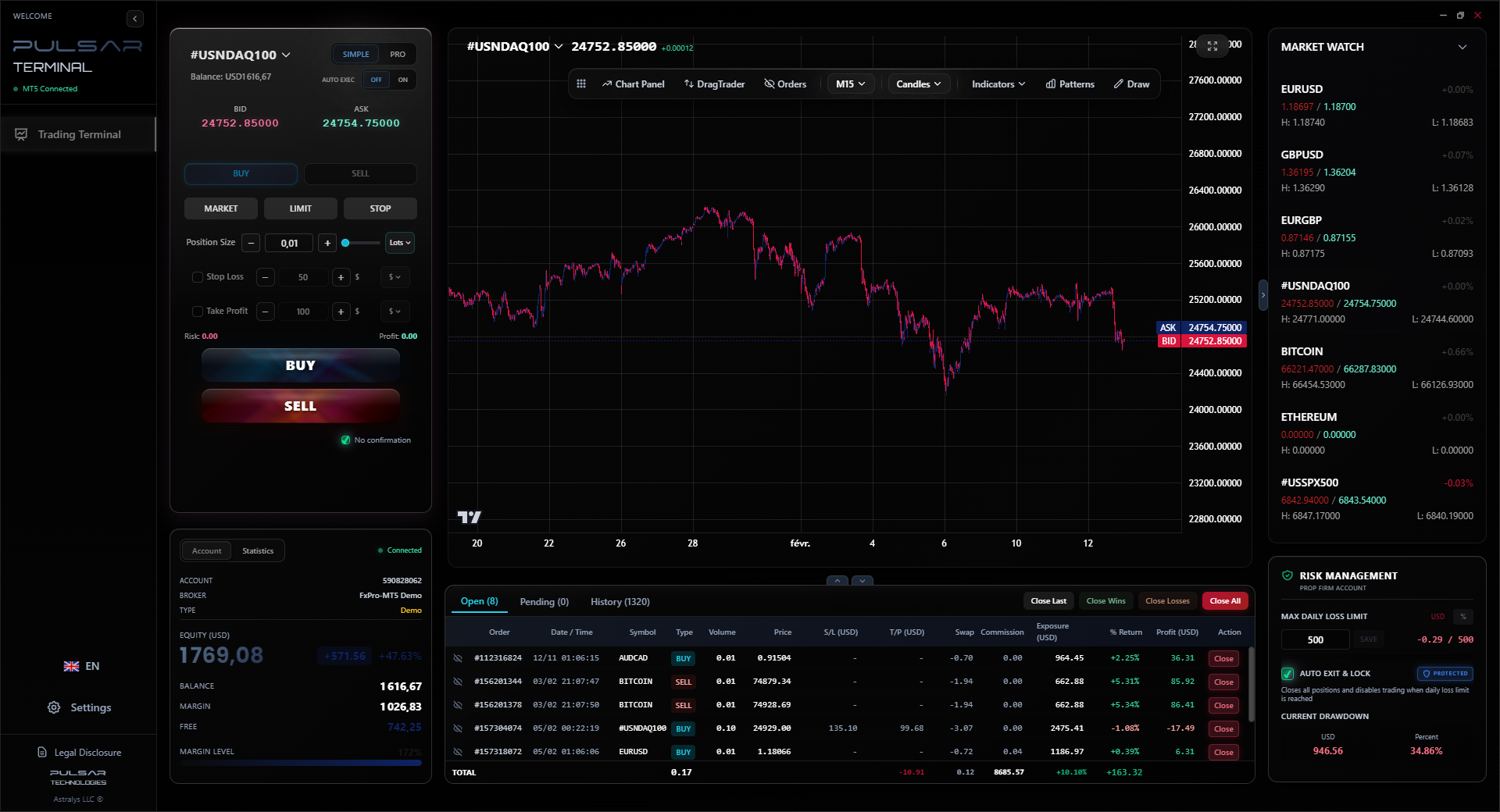
Manually drawing patterns and setting multiple take-profit levels for each trade is time-consuming, but tools like Pulsar Terminal automate this directly on your MT5 charts.
Pulsar Terminal
Универсальный инструмент для MT5: drag-and-drop ордера, мульти-TP/SL, трейлинг-стоп, грид-трейдинг, Volume Profile и защита для проп-фирм. Используется 1000+ трейдерами ежедневно.
You can be wrong about the pattern and still make money if your risk management is solid. Here’s the math that matters.
The Risk-Reward Ratio: Before every pattern trade, you must know this. If your stop loss is 30 pips away, your profit target should be at least 60 pips away for a 1:2 risk-reward ratio. Why? If you're right only 50% of the time on your patterns, you still break even. If you're right more than 50%, you profit. I never take a trade with a potential reward less than 1.5 times my risk. Ever.
Position Sizing: This is critical. Let's say your trading account is 200,000 NGN. Your rule is to never risk more than 1% on a single trade. That's 2,000 NGN.
You find a head and shoulders pattern on GBP/NGN. Your stop loss distance is 80 pips. How much can you trade?
First, you need to know the value of a pip for GBP/NGN. Let's say 1 pip = 50 NGN for a standard lot (this varies, check your broker).
If you risk 2,000 NGN, and your stop is 80 pips away: 2,000 / 80 = 25. So, you can trade a position where each pip is worth 25 NGN. That might be 0.5 of a standard lot, or 5 mini lots. This precise calculation prevents a single bad pattern from damaging your account. I use a position size calculator for this every single time.
Psychology: Holding through a losing pattern trade is hard. Cutting a winning pattern trade short is easy. You have to fight both impulses. Write your plan (entry, stop, target) on a sticky note and stick it to your monitor. Don't touch the trade unless your plan's conditions are met.
💡 Совет Уинстона
If you can't immediately see where to place your stop loss, you haven't found a pattern. You've found a hope.
“You can be wrong about the pattern and still make money if your risk management is solid.”
Not all brokers are created equal when your strategy relies on clear breakouts and precise entries. Here’s what to look for in the Nigerian context:
| Feature | Why It Matters for Patterns | Good Options for Nigerian Traders |
|---|---|---|
| Low & Stable Spreads | A widening spread can turn a winning breakout trade into a loser at the moment of entry. You need consistency. | IC Markets (raw spreads), Exness (tight spreads on majors), XM (good all-round) |
| Fast Execution | When you're entering on a breakout, you want your order filled at the price you see, not with slippage. | Pepperstone, IC Markets (both have excellent execution speeds) |
| Reliable Platform | You need clean charts to draw your patterns accurately. MT4/MT5 is the standard. | Most serious brokers offer MT5, which is superior to MT4 for analysis. |
| Accepts Nigerian Clients | Must-haves: local deposit/withdrawal options (bank transfer, USSD, maybe cards). | XM, Exness, HFM, and OctaFX are very popular here for this reason. |
My personal experience? I started with a broker that had flashy ads but terrible execution. I'd see a breakout, click buy, and get filled 5 pips higher. It killed my strategy's edge. I switched to a broker with a true ECN model and it was like night and day. Do your research. Read our detailed Exness review and others to see how they handle orders.
Remember, the CBN rules make funding international accounts tricky. You'll likely be using a card or transfer. Factor in any potential fees from your bank as part of your trading cost.
FAQ
Q1What is the most reliable forex pattern for beginners in Nigeria?
Start with the symmetrical triangle on the 4-hour chart for major pairs like EUR/USD. It's easy to spot, the rules are clear (trade the breakout), and it occurs frequently. Avoid exotic Naira pairs at first, as the wider spreads make pattern trading more difficult.
Q2How much money do I need to start trading forex patterns in Nigeria?
You can start with a very small amount - some brokers like XM or Exness allow deposits as low as $10. However, to trade properly with sensible risk management, I'd recommend having at least 50,000-100,000 NGN. This allows you to position size correctly without over-leveraging on tiny moves. Remember, it's not about the deposit size, it's about the percentage you risk per trade.
Q3Do I have to pay tax on profits from forex pattern trading?
Yes. According to Nigerian law, profits from forex trading are subject to a 10% capital gains tax. It's your responsibility to declare this income and pay the tax. Keep detailed records of all your trades, wins, and losses.
Q4Why do my pattern trades keep failing?
The three most common reasons are: 1) You're trading on too small a timeframe (like 5-min charts) where noise dominates, 2) You're entering before a confirmed breakout (jumping the gun), or 3) You're ignoring the overall trend. A bullish pattern in a strong daily downtrend has a low probability of success. Always trade with the higher-timeframe trend.
Q5Can I use forex patterns for scalping?
Yes, but it's advanced. You would use smaller patterns like flags or pennants on the 5 or 15-minute chart, but only during the most liquid market sessions (London or New York overlap). Your broker's execution speed and spreads become even more critical. Check out our guide on a scalping strategy for more details.
Q6Is forex pattern trading legal in Nigeria?
Yes, trading forex as an individual is legal. The new Investments and Securities Act (ISA 2025) regulates the platforms offering these services, aiming to protect investors. You can trade with international brokers regulated abroad. The key rule to remember is you cannot use official CBN windows to fund your trading account.
Q7What time frame is best for trading forex patterns?
For swing trading (holding trades for days), the 4-hour and daily charts are best. They filter out market noise and give you more reliable patterns. For day trading, the 1-hour chart is a good balance. I strongly advise against starting with anything below 15 minutes until you have significant experience.
Урок проф. Уинстона
Ключевые выводы:
- ✓Trade triangles and flags in the direction of the daily trend.
- ✓Always wait for a candle close outside the pattern boundary.
- ✓Never risk more than 1-2% of your account on any single pattern.
- ✓A 1:2 risk-reward ratio is your minimum for pattern breakouts.
- ✓Factor in the spread: your target must be 3-5x the spread to be viable.
Насколько полезна эта статья?
Нажмите на звезду
Еженедельные торговые инсайты
Бесплатный еженедельный анализ и стратегии. Без спама.
Об авторе
Olumide Adeyemi
Пионер трейдинга в Западной Африке
Один из самых активных преподавателей форекс-трейдинга в Нигерии. 8 лет торгового опыта из Лагоса. Специализируется на стратегиях с малым капиталом и челленджах проп-фирм для африканских трейдеров.
Комментарии
Предупреждение о рисках
Торговля финансовыми инструментами сопряжена со значительным риском и может не подходить всем инвесторам. Прошлые результаты не гарантируют будущих доходов. Данный контент носит исключительно образовательный характер и не является инвестиционной рекомендацией. Всегда проводите собственное исследование перед торговлей.
Вам также может понравиться

Cara Trading Forex Sukses: 7 Prinsip dari Trader Profesional
Cara trading forex sukses dengan 7 prinsip trader pro: manajemen modal, disiplin, journal trading, backtest. Data nyata, bukan janji profit palsu.
Jam Trading Forex Terbaik untuk Trader Indonesia: Panduan Lengkap dengan Tabel Waktu
Panduan jam trading forex untuk trader Indonesia. Tabel 4 sesi dunia, jam emas 20:00-00:00, sesi mana yang harus dihindari. Data akurat + tips dari trader berpengalaman.
Top 5 Sàn Forex Uy Tín Nhất 2026: Review Jujur dari Trader Indonesia
Top 5 sàn forex uy tín 2026 untuk trader Indonesia. Review jujur: spread, deposit, withdraw, dukungan lokal. Exness, XM, IC Markets & lebih.
Скачать Pulsar Terminal
Все эти калькуляторы встроены в Pulsar Terminal с данными в реальном времени с вашего счёта MT5.
Скачать Pulsar Terminal