


Why on earth would a South African trader care about the forex rate in Pakistan today? It's a fair question.

David van der Merwe
Трейдер развивающихся рынков ·  South Africa
☕ 10 мин чтения
Что вы узнаете:
- 1Understanding the PKR/ZAR Basics: It's Not a Trading Pair
- 2South African Rules for Sending Money to Pakistan
- 3How South African Traders Can Get Exposure to PKR Moves
- 4Broker Reality Check in South Africa
- 5A Practical Trading Strategy for EM Currencies (Like PKR & ZAR)
- 6Common Pitfalls & Costly Mistakes
- 7Final Verdict for South African Traders
Why on earth would a South African trader care about the forex rate in Pakistan today? It's a fair question. Unless you're sending money to family or have business there, PKR probably isn't on your radar. But here's the thing: understanding how to access and think about an exotic currency like the Pakistani Rupee teaches you more about our own market's rules, costs, and hidden opportunities than staring at EUR/USD all day ever will. I've had to navigate this for clients, and it's a masterclass in practical forex.
Let's get the most important fact out of the way first. You cannot walk into your broker's platform and trade ZAR/PKR. It simply doesn't exist as a direct pair on any major FSCA-regulated broker I've used in 12 years. The Pakistani Rupee is a controlled, non-convertible currency for international trading purposes. So when we talk about the forex rate in Pakistan today from a South African perspective, we're almost always talking about a two-step process: ZAR to USD (or another major), then USD to PKR.
The quoted rate you'll see, like 1 ZAR = 16.43 PKR (as of early April 2026), is a derived rate. It's calculated using the ZAR/USD and USD/PKR rates. This matters because you pay the spread twice if you're converting money, which eats into your value. I learned this the hard way years ago trying to help a friend send funds to Lahore. I looked at the derived rate online, did the math, and was shocked when the actual amount received was nearly 5% less. The banks and remittance services had taken their cut on both legs of the journey.

Warning: The 'rate' you see on Google or a generic converter is a mid-market rate. You will never get this rate. Your actual rate will be that number minus a markup (for remittances) or plus the spread (if trading related majors). Always factor in a 2-4% haircut for reality.
This is where the South African Reserve Bank (SARB) becomes your new best friend or your worst bureaucratic nightmare. We have exchange controls. You can't just wire a million Rand to Islamabad because you fancy it.
The Allowances You Actually Need to Know
You have two main channels:
- Single Discretionary Allowance (SDA): R1 million per calendar year. No tax clearance needed. This is for gifts, travel, living costs - perfect for family support. You just need your ID and to fill out the forms at your bank (the Authorised Dealer).
- Foreign Investment Allowance (FIA): R10 million per year. This requires a Tax Compliance Status (TCS) pin from SARS. This is for buying property or making investments in Pakistan.
All of this must go through your bank. Don't try to be clever with crypto to bypass it (yet). The rules are there to protect the Rand, but for you, they mean extra paperwork and planning. I once had to delay a business-related transfer for six weeks waiting for SARS clearance. Not fun, but part of the game.
The Real Cost of Remittance
Using services like Western Union or MoneyGram from SA to Pakistan seems easy, but check the fine print. That '$5 fee' is a trap. They make their real money on the exchange rate markup. I did a test transfer of R10,000 last year.
- Bank Telegraphic Transfer: Fee of R250 + worse exchange rate. Total cost (fees + poor rate): ~R600.
- Western Union (Online): 'Low fee' of $35, but the exchange rate offered was 3.2% worse than the mid-market rate. Total cost: ~R800. You must compare the final amount in PKR that will be received, not the upfront fee. Always ask for the 'all-in' rate.

💡 Совет Уинстона
The rate on the screen is a lie. Your rate is the one on your bank statement after all fees and markups. Always do the math backwards from the final amount received.
“The Pakistani Rupee is not your playground. But the economic forces that move it are the same forces that move our own Rand.”
You're a trader, not just someone sending cash. So how do you speculate on or hedge against PKR movements? You get creative with proxies.
Since you can't trade PKR directly, you trade the things that influence it. Pakistan's economy is heavily tied to a few key factors:
- Oil Prices: Pakistan is a major oil importer. High oil prices = PKR weakness. You could short PKR by going long on crude oil futures or the USD. When I saw oil spike in 2022, a simple long USD/ZAR trade (betting the Rand would also weaken on imported inflation) partially captured the similar dynamic that hammered the PKR.
- IMF Deal Sentiment: Pakistan's currency is often at the mercy of IMF bailout news. Positive news = PKR strength. This is a pure sentiment play on emerging market risk. You can't trade PKR, but you can trade broader EM sentiment via an ETF or by watching USD/MXN or USD/TRY for similar flows.
- The US Dollar Route: Some international brokers (not necessarily FSCA-regulated) might offer USD/PKR as an exotic pair. The spreads are monstrous - think 50-100 pips. It's barely tradeable for a retail trader. The smarter move is to focus on USD/ZAR. If you believe PKR will fall against USD, and you believe ZAR will also fall against USD (a common correlated EM move), then a USD/ZAR long position is your cleanest, cheapest proxy. The liquidity is a thousand times better. Check the EUR/USD guide to understand the major pair dynamics that often drive USD sentiment globally.
Let's talk about the tools you actually have on your desk. Here’s a blunt comparison of some FSCA-regulated brokers relevant to this discussion:
| Broker (FSCA Regulated) | Min. Deposit (ZAR approx.) | Typical EUR/USD Spread | Can you trade PKR? | Best for this situation... |
|---|---|---|---|---|
| XM | ~R90 (USD 5) | From 0.8 pips | No | Testing strategies with tiny capital before committing to larger EM trades. See our full XM review. |
| IC Markets | ~R18,000 (USD 1000)* | From 0.0 pips + commission | No | The serious trader who wants the rawest spread on USD/ZAR to execute proxy trades cheaply. IC Markets review. |
| Khwezi Trade | R500 | From 0.4 pips | No | The local favourite, good support, easier ZAR deposits/withdrawals. |
| Pepperstone | ~R1,800 (USD 100) | From 0.0 pips + commission | No | Excellent execution and platforms (MT4/MT5) for active scalping or swing trading the proxy pairs. Pepperstone review. |
*Some account types have lower minimums.
The key takeaway? None offer PKR pairs. Your battle is fought on the grounds of USD/ZAR, GBP/ZAR, and maybe EUR/ZAR. Your weapon is a tight spread and reliable execution. Choosing a broker because it has a fancy app but charges 2-pip spreads on USD/ZAR is a sure way to lose money before the trade even moves. I made that mistake early on. A 2-pip spread on a standard lot is a R150 hole you start in. Use a position size calculator to understand this cost before every trade.
“A 2-pip spread on a standard lot is a R150 hole you start in. Choose your broker based on execution cost, not flashy ads.”
Forget predicting the exact forex rate in Pakistan today. You can't. Instead, trade the correlation and the technicals of the proxy.
Here's a simple framework I've used:
- Fundamental Trigger: Identify a Pakistan-specific event (e.g., an IMF loan tranche release, a political crisis, a flood affecting crops). News drives exotic currencies.
- Find the Proxy: Determine the most affected major currency. Usually, it's the USD. So the play is USD/PKR, but you can't trade that.
- Trade the Correlated Pair: Look at USD/ZAR. Use technical analysis on the USD/ZAR chart. Is it at a key support/resistance level? Is the RSI indicator showing overbought/oversold conditions? If the Pakistan news is bullish PKR (bearish USD/PKR), and USD/ZAR is also looking technically weak at a resistance level, that's a confluence. Go short USD/ZAR.
A real example from my journal: In Jan 2025, Pakistan secured a crucial IMF review. News positive for PKR. USD/ZAR was trading around 18.50, but had just been rejected at 18.80 (resistance). The daily MACD indicator was showing bearish divergence. I entered a short at 18.48, stop at 18.85. My target wasn't based on Pakistan, but on the next support level for USD/ZAR at 18.00. It took three weeks, but price hit 18.05. I took 430 pips on a 1-lot position. That's about R6,450 profit (minus spread) by using a correlated, liquid pair to express a view on an illiquid one.

Pro Tip: Keep a separate watchlist for 'EM Sentiment'. Include USD/ZAR, USD/TRY, USD/MXN, and Brent Crude. When they all move in unison, it's a macro wave. Trading against that wave on a Pakistan-specific hope is a quick way to get a margin call.
💡 Совет Уинстона
If you can't trade it directly, trade what moves it. Oil up = PKR down. Find the liquid instrument (like Brent Crude) and trade that instead.
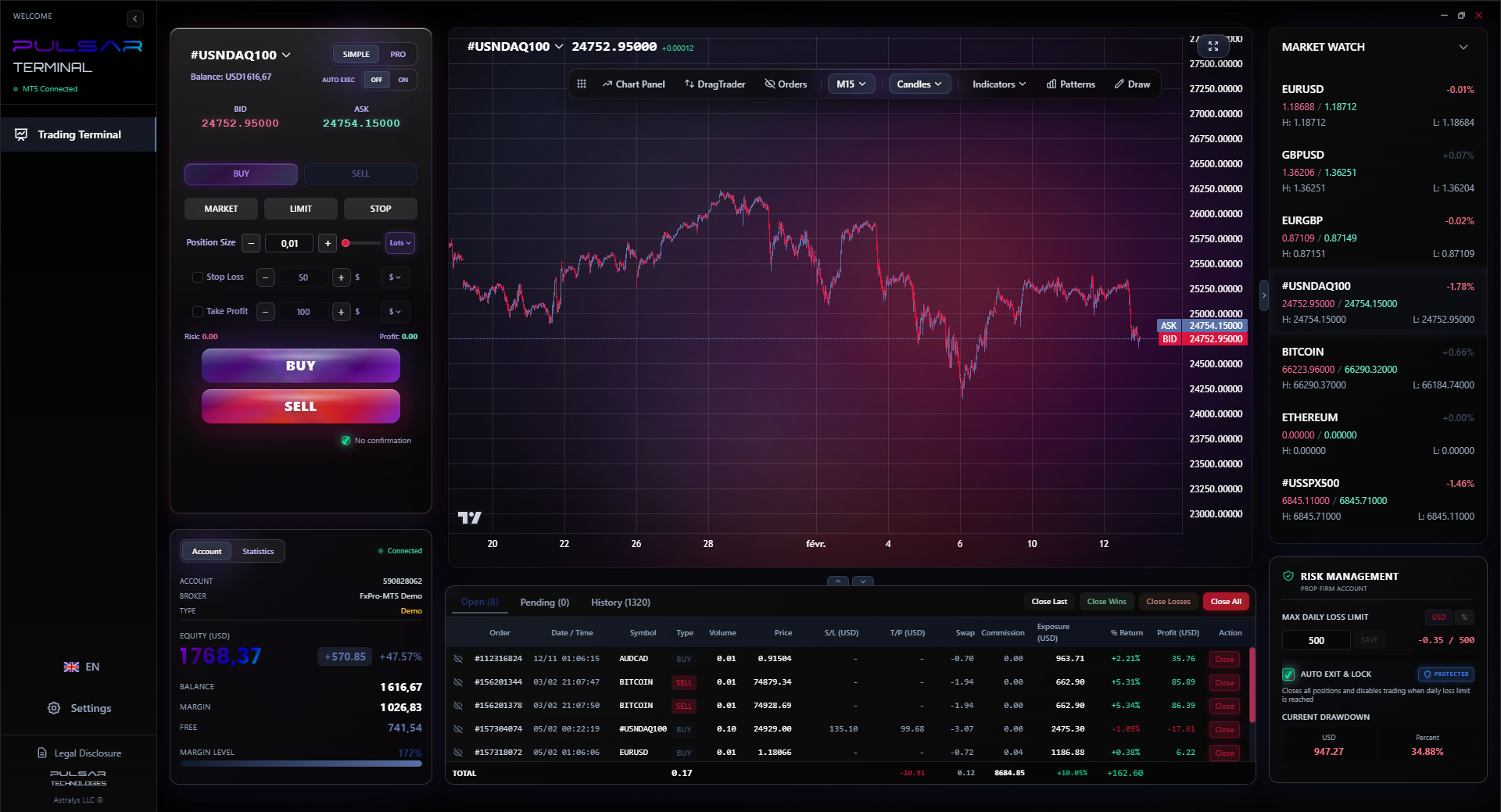
Managing multiple correlated trades across USD/ZAR and crude oil, as part of an EM strategy, is far easier with a tool like Pulsar Terminal that lets you set multi-level take-profits and stop-losses directly on your MT5 charts.
Pulsar Terminal
Универсальный инструмент для MT5: drag-and-drop ордера, мульти-TP/SL, трейлинг-стоп, грид-трейдинг, Volume Profile и защита для проп-фирм. Используется 1000+ трейдерами ежедневно.
I've paid for these lessons so you don't have to.
- Pitfall 1: Chasing the 'Official' Rate. The State Bank of Pakistan's rate and the open market (grey market) rate in Pakistan can differ wildly - sometimes by 10% or more. If you're sending money for someone to collect as cash, they might be quoting you the grey market rate. Your bank will use the official rate. This mismatch causes huge confusion and disappointment.
- Pitfall 2: Ignoring SA Bank Processing Times. A telegraphic transfer to Pakistan from a South African bank can take 3-5 business days. If the rate moves against you during that time, you're screwed. Some banks offer a 'forward contract' to lock in a rate if the amount is large. For smaller amounts, use a remittance service that offers a rate lock at the time of transaction.
- Pitfall 3: Trading Exotics on Shady Platforms. You might find an offshore broker offering USD/PKR. The spread will be criminal, and the platform might be a bucket shop designed to take your money. Stick to your FSCA-regulated broker and trade the liquid proxies. The definition of a pip becomes meaningless when the spread is 100 pips wide.
- Pitfall 4: Not Factoring in Full Cycle Costs. Thinking of buying property in Pakistan? Remember the cost to get the money there (FIA, fees, poor rate) AND the cost to bring profits back (more SARB rules, more fees). Your investment needs to gain enough to clear this double-friction hurdle. I've seen people break even on a property sale only to lose money after the currency round-trip.
“Your edge as a South African trader is in understanding our unique regulatory sandbox, not in accessing obscure pairs.”
So, should you care about the forex rate in Pakistan today? If you have personal or business ties, absolutely. Understand it as a cost of living or doing business.
As a pure trading instrument? Forget it. The Pakistani Rupee is not your playground. But the economic forces that move it - oil, dollar strength, emerging market panic - are the same forces that move our own Rand. By learning to analyze what drives PKR, you become better at predicting pressures on ZAR.
Your edge as a South African trader isn't in accessing obscure pairs. It's in understanding our unique regulatory sandbox (SARB controls), using our strong local brokers with tight spreads on USD/ZAR, and applying disciplined swing trading strategies to capture macro moves that affect all emerging markets, Pakistan included.
Focus on mastering the tools you have. Get proficient with MT5 on a platform like Exness or IC Markets, learn to read the Volume Profile for key levels, and keep one eye on the news coming out of Islamabad and Karachi. It will give you context, not direct signals, and in trading, context is everything.
FAQ
Q1What is the best way to send money from South Africa to Pakistan today?
There's no single 'best' way. For speed (minutes), use a remittance service like Western Union for cash pickup, but compare the final PKR received after all fees and their exchange rate markup. For larger amounts, a bank telegraphic transfer is more secure but slower (3-5 days) and you're exposed to rate movement during processing. Always calculate the total cost, not just the advertised fee.
Q2Can I trade the Pakistani Rupee (PKR) with my South African forex broker?
Almost certainly not. No major FSCA-regulated broker (like IG, Khwezi, IC Markets, XM) offers PKR as a tradable currency pair. It's a non-convertible currency for forex trading. You would need to use an international broker offering exotic pairs, which comes with huge spreads and higher risk.
Q3How does the South African Reserve Bank (SARB) affect sending money to Pakistan?
SARB's exchange controls are the main gatekeeper. You can send up to R1 million per year (Single Discretionary Allowance) without tax clearance for things like gifts. For investments over R1 million up to R10 million, you need a Tax Compliance Status from SARS. All transfers must go through an Authorised Dealer (your bank).
Q4Why is the USD/PKR rate so important for South Africans?
Because the ZAR/PKR rate you see is derived from it. Since you can't trade ZAR/PKR directly, and Pakistan's economy is heavily dollarized, the USD/PKR rate is the primary driver. To guess where ZAR/PKR is going, you often need to analyze USD/PKR and USD/ZAR separately.
Q5What's a common mistake South Africans make when dealing with PKR?
Assuming the rate they see online is the rate they'll get. Banks and remittance services apply a markup. Also, confusing the 'official' exchange rate with the higher 'open market' rate used in Pakistan's grey market, leading to arguments about how much money should have arrived.
Q6As a trader, how can I profit if I think the Pakistani Rupee will strengthen?
You trade a proxy. If PKR strengthens, it often means broad EM strength or USD weakness. Instead of trying to buy PKR, you could sell USD/ZAR (betting the Rand will also strengthen against the dollar). You're trading the correlated sentiment in a liquid, cheap-to-trade market.
Урок проф. Уинстона
Ключевые выводы:
- ✓ZAR/PKR is not a tradable pair on SA brokers.
- ✓SARB controls limit transfers: R1m (SDA) & R10m (FIA).
- ✓Trade PKR via proxies: USD/ZAR & oil prices.
- ✓Remittance 'fees' are dwarfed by exchange rate markups.
- ✓Real rate = screen rate minus 2-4% for costs.
Насколько полезна эта статья?
Нажмите на звезду
Еженедельные торговые инсайты
Бесплатный еженедельный анализ и стратегии. Без спама.
Об авторе
David van der Merwe
Трейдер развивающихся рынков
Трейдер из Йоханнесбурга с 11-летним опытом работы с валютами развивающихся рынков. Специализируется на ZAR-парах, торговле под регулированием FSCA и анализе южноафриканского рынка.
Комментарии
Предупреждение о рисках
Торговля финансовыми инструментами сопряжена со значительным риском и может не подходить всем инвесторам. Прошлые результаты не гарантируют будущих доходов. Данный контент носит исключительно образовательный характер и не является инвестиционной рекомендацией. Всегда проводите собственное исследование перед торговлей.
Вам также может понравиться

Cara Trading Forex Sukses: 7 Prinsip dari Trader Profesional
Cara trading forex sukses dengan 7 prinsip trader pro: manajemen modal, disiplin, journal trading, backtest. Data nyata, bukan janji profit palsu.
Jam Trading Forex Terbaik untuk Trader Indonesia: Panduan Lengkap dengan Tabel Waktu
Panduan jam trading forex untuk trader Indonesia. Tabel 4 sesi dunia, jam emas 20:00-00:00, sesi mana yang harus dihindari. Data akurat + tips dari trader berpengalaman.
Top 5 Sàn Forex Uy Tín Nhất 2026: Review Jujur dari Trader Indonesia
Top 5 sàn forex uy tín 2026 untuk trader Indonesia. Review jujur: spread, deposit, withdraw, dukungan lokal. Exness, XM, IC Markets & lebih.
Скачать Pulsar Terminal
Все эти калькуляторы встроены в Pulsar Terminal с данными в реальном времени с вашего счёта MT5.
Скачать Pulsar Terminal