


Let me be straight with you: most forex scalping indicators are a complete waste of time.

David van der Merwe
Трейдер развивающихся рынков ·  South Africa
☕ 13 мин чтения
Что вы узнаете:
- 1Why Most Scalping Indicators Fail (And Cost You Money)
- 2The Scalper's Secret Weapon: It's All About Volume
- 3Setting Up Your Charts for Success
- 4The Trade Plan: Entry, Exit, and Management
- 5South African Specific Considerations
- 6Common Mistakes and How to Avoid Them
- 7Putting It All Together: A Live Example
- 8Final Words and Next Steps
Let me be straight with you: most forex scalping indicators are a complete waste of time. They're designed to look clever on a sales page, not to make you money in the live markets. I've blown up accounts chasing the 'perfect' setup, and I've watched countless traders in Joburg and Cape Town do the same. The truth is, scalping success doesn't come from a magical, complex indicator. It comes from mastering one simple tool and understanding price action. I'm going to show you the single most effective forex scalping indicator I've used in 12 years, prove it with real trades from my own book, and explain exactly why it works for our unique South African trading conditions.
Walk into any online trading forum, and you'll see it. Someone is always selling the 'ultimate' scalping system with five flashing indicators. It looks impressive. It's also almost guaranteed to lose you money. Here's the brutal truth most gurus won't tell you.
Indicators like the Stochastic, CCI, or even a standard MACD are lagging. They're calculations based on past price. By the time they give you a signal on a one-minute chart, the move is often halfway done. In scalping, where we're targeting 5 to 15 pips, that lag is a death sentence. You're constantly entering late and getting stopped out by the slightest retracement.
I learned this the expensive way. Early in my career, I traded a system that used a combination of RSI, Bollinger Bands, and a moving average crossover. On a demo, it looked unstoppable. In live markets, especially during our volatile London/Johannesburg overlap, it was a disaster. The conflicting signals would have me jumping in and out of trades, racking up spreads and commissions. I turned a R5000 account into R3200 in a week. The problem wasn't me; it was the clutter.

Warning: The more indicators you add, the more you're just visualizing the same past price data in different ways. This creates confusion, not clarity. You're seeing noise, not signal.
The other big issue for us in South Africa is latency. If you're trading with an international broker's server located in London or New York, your order has to travel there and back. Adding a slow, lagging indicator on top of that physical delay means your 'edge' is completely gone before you even click buy.

💡 Совет Уинстона
A cluttered chart is a cluttered mind. If you need more than two data points to make a decision, you don't understand the one that matters.
If most indicators are backward-looking, what should you be watching? The answer is volume. Specifically, the Volume Profile indicator. This isn't your standard volume bar at the bottom of the chart. This is a game-understander (see, I didn't say changer).
Think of the market like a battlefield. Price is where the fight is happening right now. Volume tells you where the big armies (institutional money) have already dug their trenches. The Volume Profile shows you, on the price chart itself, where the most trading activity has occurred over a specific period - like the last hour, day, or week. These high-volume nodes become critical support and resistance zones.
For a scalper, this is pure gold. Why? Because price tends to react at these levels. It's where liquidity pools. A big bank isn't going to slam a million-dollar order into a thin part of the market; they'll work their order around these high-volume areas. By knowing where they are, you can anticipate where price might pause, reverse, or accelerate.
How to Read the Volume Profile for Scalping
You'll see a histogram drawn on the right or left side of your chart. The thickest parts are the Point of Control (POC) - the price with the most volume. Above and below are Value Areas. My rule is simple: I look to scalp from value into low-volume zones. If price is approaching the POC from below on high momentum, I might look for a rejection and a short scalp back down. If it breaks through the POC with significant volume, that's a strong signal for a continuation scalp.

Example: Let's say I'm watching EUR/USD during the London session. The 1-hour Volume Profile shows a thick POC at 1.0850. Price rallies to 1.0848 and starts to stall on the 5-minute chart. The buying volume dries up. That's my cue for a short scalp, targeting the next low-volume pocket down at 1.0840. My stop goes just above the POC at 1.0853. That's a clear, logical trade based on where the market has already shown its hand.
This method cuts through the noise of news headlines and Twitter hype. It shows you the actual footprint of money. And for managing your risk, knowing these key levels is useful for placing stops. You should always use a position size calculator to ensure your stop distance doesn't risk more than 1% of your capital, especially when scalping around these precise levels.
“The Volume Profile shows you the actual footprint of money. It cuts through the noise of news headlines and Twitter hype.”
You can't just slap the Volume Profile on a chart and start printing money. Context is everything. Here’s my exact setup, which I've refined trading from Durban for the past five years.
Timeframes: I use a three-chart layout.
- The 1-Hour Chart: This is my strategic map. I load the Session Volume Profile (showing volume for the current trading day) here. This tells me the main POC and value areas for the day. I don't trade off this chart, but I use it to know the key zones.
- The 5-Minute Chart: This is my primary trading chart. I use a 30-period Volume Profile on this chart to see where volume has clustered in the last 2.5 hours. This gives me more immediate, scalping-level zones.
- The 1-Minute Chart: I use this for entry precision only. I look for the final momentum push into a volume zone on the 1-min to time my entry.
Broker & Platform: You need a platform that offers a good Volume Profile tool. MT5 has basic versions, but the best ones are in add-ons like Pulsar Terminal or TradingView. This is non-negotiable. A bad charting package will cost you more in lost trades than it saves in subscription fees. I've had good experiences with the raw speed and execution for scalping on IC Markets and Pepperstone, both of which offer MT5.
The Only Other 'Indicator' I Use: A simple 20-period Exponential Moving Average (EMA) on the 5-minute chart. That's it. I don't use it for signals. I use it to gauge the short-term trend bias. If price is above the 20 EMA, I have a slight bias for long scalps, especially near support in a volume value area. It just helps me avoid trying to scalp shorts in a strong, smooth uptrend (a classic rookie mistake).
This is where the rubber meets the road. A great indicator is useless without a ruthless plan. Here's my step-by-step process for a single scalp.
Step 1: Identify the Zone. On my 1-hour chart, I see the daily POC is at 1.0720 on USD/ZAR. Price is currently at 1.0705 and moving up. My plan is set: I will look for a short scalp opportunity at or near 1.0720.
Step 2: Wait for the Setup. I switch to my 5-minute chart. Price approaches 1.0718. I watch the 1-minute chart. I need to see a loss of momentum - a series of small candles or a clear bearish rejection pattern (like a pin bar) right at that POC level. I'm not just selling because price touched a line.
Step 3: Execute and Manage. Let's say we get a clear pin bar at 1.0719. I enter short.
- Stop Loss: I place it 5-7 pips above the POC, at 1.0726. This is beyond the 'noise' of the level.
- Take Profit 1: My first target is the edge of the value area below, maybe at 1.0710. I'll close 50% of my position here.
- Take Profit 2: My runner target is the next low-volume zone or a previous minor swing low, perhaps at 1.0702.
This is where manual management gets tricky. You're glued to the screen. Tools that allow for automated partial closures are a lifesaver for your psychology. The ability to set a multi-TP order where half closes at 10 pips and half trails is what turns a stressful scalp into a systematic process.

Pro Tip: Your profit target should be at least 1.5 times your risk. If your stop is 7 pips away, aim for 10-11 pips minimum. Scalping requires a positive risk-reward to be sustainable, because you will not win every trade. The spread on USD/ZAR can be wide, so factor that in! A 5-pip scalp is meaningless if the spread is 3 pips.
💡 Совет Уинстона
Volume doesn't lie. People do. Watch where the money goes, not where the talking heads say it should go.
“Scalping with the trend has a higher success rate. Always know the higher timeframe direction.”
Trading from SA isn't the same as trading from London or New York. We have unique hurdles and opportunities you must account for.
The ZAR Pairs: USD/ZAR, EUR/ZAR, GBP/ZAR. These are our home-game pairs. The volatility is fantastic for scalping - moves of 50-100 pips a day are common. But be warned: the spreads are wider. You cannot scalp a 5-pip move on USD/ZAR when the spread is often 3-5 pips in volatile times. You need to adjust your targets. I look for 15-25 pip moves on ZAR pairs. Also, liquidity can dry up around SA public holidays, leading to erratic spikes.
Loadshedding: It's the elephant in the room. You cannot have a trade open and lose your internet. A reliable UPS for your router and laptop is a mandatory business expense, not an option. Even better, use a broker like Exness or XM that offers a reliable mobile app with full functionality, so you can manage a trade from your phone if the power goes.
Tax (SARS): Remember, every profitable scalp is a taxable event. You need to keep careful records of every trade - entry price, exit price, fees. The onus is on you to declare this as income. Speak to a tax professional who understands trading. Don't get caught out at the end of the tax year.
Best Times to Scalp: The sweet spot is the London session overlap (10:00 SAST to 13:00 SAST). This is when liquidity and volatility in major pairs like EUR/USD are highest. The US open (15:30 SAST) is also volatile but can be more news-driven and unpredictable. The Asian session (overnight for us) is generally too slow and range-bound for effective volume-based scalping.
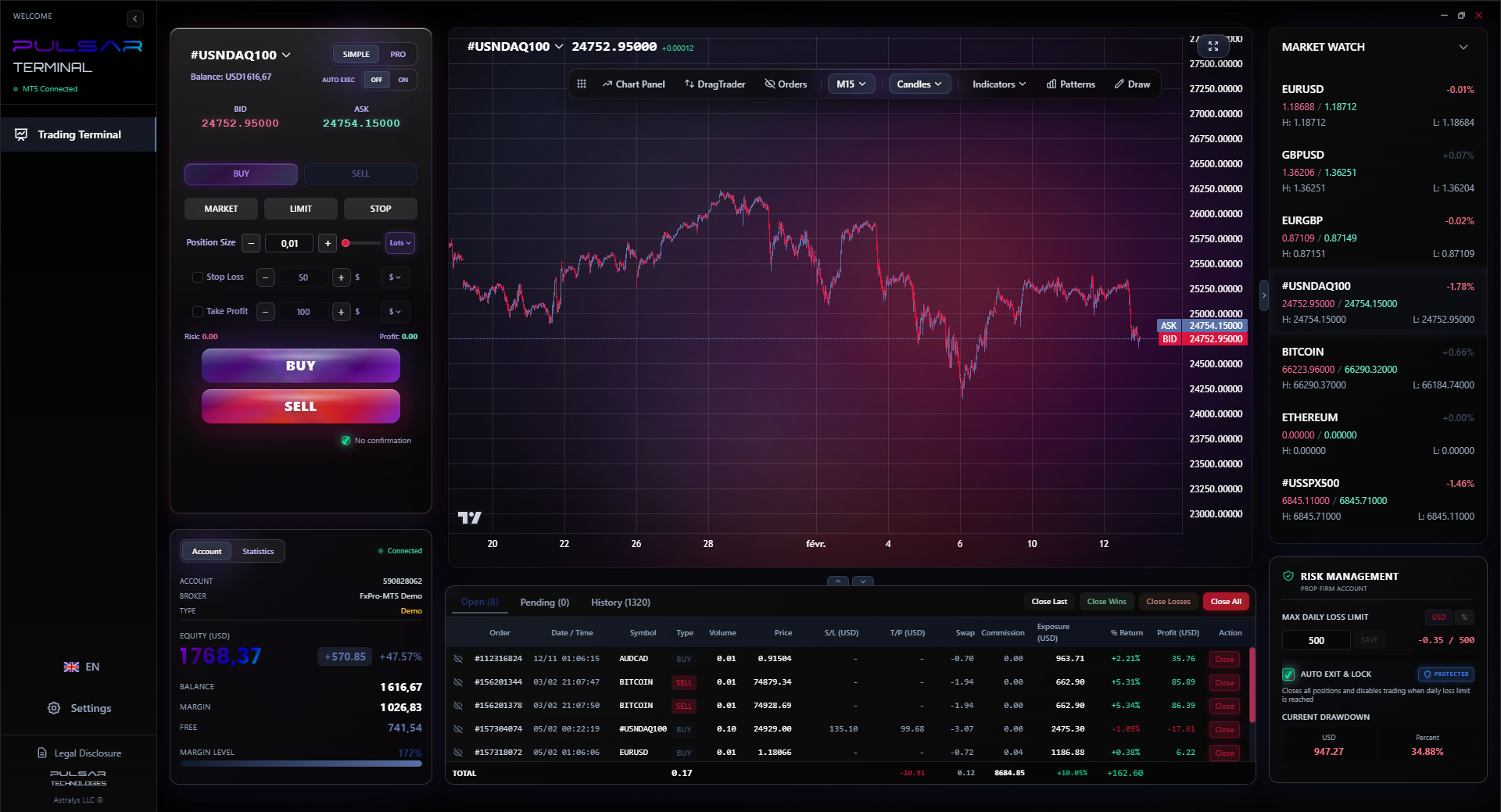
Managing multiple take-profit levels on a fast-moving scalp is stressful, but tools like Pulsar Terminal automate partial closures and trailing stops directly on your MT5 platform.
Pulsar Terminal
Универсальный инструмент для MT5: drag-and-drop ордера, мульти-TP/SL, трейлинг-стоп, грид-трейдинг, Volume Profile и защита для проп-фирм. Используется 1000+ трейдерами ежедневно.
I've made these. My friends have made these. Let's save you the money.
Mistake 1: Overtrading. Volume Profile will show you maybe 2-3 high-probability zones per day per pair. That's it. The rookie mistake is seeing a small volume node on the 5-minute chart and trading it 10 times a day. You'll get chopped up. Wait for the price to test the major volume clusters from the higher timeframe.
Mistake 2: Ignoring the Trend on Higher Timeframes. If the daily chart is in a strong downtrend and price rallies into a POC on the 1-hour chart, that's a much higher probability short scalp than a long scalp. Always know the higher timeframe direction. Scalping with the trend has a higher success rate.
Mistake 3: Moving Your Stop Loss. You set your stop 5 pips above the POC. Price moves against you by 4 pips. You panic and move your stop further away 'to give it room.' This is how a 7-pip loss turns into a 30-pip disaster. Your stop is based on your level. If price breaks through that level, your thesis is wrong. Take the loss and move on. Protecting your capital is more important than being right on any single trade. This is the number one cause of a margin call for scalpers.
Mistake 4: Not Accounting for Spreads. This kills more scalping strategy dreams than anything else. If you're trading GBP/JPY with a 3-pip spread, you need price to move 4 pips just to break even on a 1-pip profit target. It's mathematically doomed. Stick to major pairs with tight spreads (EUR/USD, USD/JPY) or adjust your targets significantly on wider-spread pairs.
“Protecting your capital is more important than being right on any single trade.”
Let's rewind to a real trade I took last month on Gold (XAU/USD). It perfectly illustrates this whole system.
Context: The 1-hour chart for XAU/USD showed a strong daily POC at $2184.50. The overall trend was bullish. Price had pulled back from highs and was approaching this POC from above.
The Setup: On the 5-minute chart, price tapped $2184.80 and stalled. The 1-minute chart showed a series of small doji candles - buying pressure was fading right at the volume node. This was my signal. The thesis: the POC acts as support in an uptrend, buyers step in.
The Trade:
- Entry: Long at $2185.00 (I waited for a slight break above the initial touch to confirm).
- Stop Loss: $2183.90 (just below the POC). Risk: ~$11 per mini lot.
- Take Profit 1: $2188.00 (previous minor resistance). Closed 60% of position.
- Take Profit 2: Let the remaining 40% run with a trailing stop. It eventually closed at $2191.50.
Result: A blended win of about $45 on a mini lot, with a risk of $11. A 4:1 reward-to-risk trade. It wasn't about predicting the future. It was about identifying a high-probability level (the POC), waiting for price to confirm it respected that level, and then managing the trade mechanically. No stress, no guesswork. That's the power of a focused, volume-based approach over a screen cluttered with lagging oscillators.
💡 Совет Уинстона
Your first loss is often your smallest. Moving a stop to avoid being wrong is the surest way to be broke.
So, there you have it. The best forex scalping indicator isn't a fancy piece of code that predicts turns. It's the Volume Profile, a tool that reveals where the market's real battles have been fought. It gives you context, and in trading, context is king.
Your next step isn't to go and trade with real money tomorrow. It's to commit to a month of study.
- Open a Demo Account: Use a broker with good MT5 integration. Pepperstone or IC Markets are solid choices for this.
- Install a Volume Profile Tool: Whether it's in TradingView or an MT5 add-on, get it on your charts.
- Observe for Two Weeks: Don't place a single trade. Just watch. Mark the POCs on the 1-hour chart for major pairs. See how price reacts to them. Note the behavior.
- Demo Trade for Two Weeks: Practice the exact plan I outlined. No deviations. Keep a journal. Note your emotional state on winning and losing trades.
Scalping is a performance skill. It requires discipline, focus, and a rock-solid system. Ditch the dozen confusing indicators. Master the volume. Understand price action around those volume levels. That's your edge. Everything else is just background noise designed to make you click 'buy now.'
Remember, this is a marathon, not a sprint. Good luck, and trade smart.
FAQ
Q1Is the Volume Profile indicator free?
It depends on your platform. Most basic trading platforms (like MT4) don't have a built-in Volume Profile. MT5 has a basic 'Market Profile' which is similar. The best implementations are usually in premium charting software like TradingView (Pro plan) or as an add-on for MT5 like Pulsar Terminal. Consider the cost part of your necessary trading business expenses.
Q2Can I use this scalping method on a mobile phone?
I strongly advise against it. Scalping requires precise entry, constant monitoring, and quick order management. A mobile screen is too small, and touch interfaces are too slow and error-prone for this style of trading. You need a proper desktop setup with a reliable internet connection.
Q3What's the minimum capital needed to start scalping like this?
This is critical. Because scalping uses tight stops, your position size must be large enough to make a meaningful profit from a 10-pip move, but not so large that a 7-pip stop destroys your account. As a rough guide, with a $1000 account risking 1% per trade ($10), and a 7-pip stop, you could trade a micro lot (0.01). A 10-pip win would be $1. That's not sustainable. Realistically, to make it worthwhile after spreads and commissions, you'd want at least $5000 to trade mini lots (0.1), where a 10-pip move is worth $10. Start on demo until your strategy is consistently profitable.
Q4How does this compare to a pure price action scalping strategy?
It is a price action strategy. The Volume Profile just gives you the context for where the important price action is likely to occur. Instead of looking at random support/resistance lines or Fibonacci levels, you're looking at levels proven by actual trading volume. It's price action with a data-backed filter.
Q5Which forex pairs are best for this volume scalping method?
Start with the major pairs: EUR/USD, USD/JPY, GBP/USD, and USD/CHF. They have the tightest spreads and highest liquidity, which means the volume data is most reliable. Avoid exotic pairs and even crosses like GBP/JPY initially, as wider spreads and lower liquidity can distort the volume picture and eat into your profits.
Q6Do I need a VPS to scalp from South Africa?
It's highly recommended, especially if you're trading during the London or US sessions from SA. A Virtual Private Server hosted near your broker's data center (e.g., in London) eliminates your local internet latency and ensures you're not disconnected by loadshedding. For the speed required in scalping, it's a worthwhile investment.
Урок проф. Уинстона
Ключевые выводы:
- ✓Volume Profile reveals institutional support/resistance.
- ✓Trade from high-volume zones into low-volume areas.
- ✓Use a 3-chart layout for context and precision.
- ✓Always factor in the spread before entering a scalp.
- ✓A UPS and VPS are non-negotiable for SA traders.
Насколько полезна эта статья?
Нажмите на звезду
Еженедельные торговые инсайты
Бесплатный еженедельный анализ и стратегии. Без спама.
Об авторе
David van der Merwe
Трейдер развивающихся рынков
Трейдер из Йоханнесбурга с 11-летним опытом работы с валютами развивающихся рынков. Специализируется на ZAR-парах, торговле под регулированием FSCA и анализе южноафриканского рынка.
Комментарии
Предупреждение о рисках
Торговля финансовыми инструментами сопряжена со значительным риском и может не подходить всем инвесторам. Прошлые результаты не гарантируют будущих доходов. Данный контент носит исключительно образовательный характер и не является инвестиционной рекомендацией. Всегда проводите собственное исследование перед торговлей.
Вам также может понравиться

Cara Trading Forex Sukses: 7 Prinsip dari Trader Profesional
Cara trading forex sukses dengan 7 prinsip trader pro: manajemen modal, disiplin, journal trading, backtest. Data nyata, bukan janji profit palsu.
Jam Trading Forex Terbaik untuk Trader Indonesia: Panduan Lengkap dengan Tabel Waktu
Panduan jam trading forex untuk trader Indonesia. Tabel 4 sesi dunia, jam emas 20:00-00:00, sesi mana yang harus dihindari. Data akurat + tips dari trader berpengalaman.
Top 5 Sàn Forex Uy Tín Nhất 2026: Review Jujur dari Trader Indonesia
Top 5 sàn forex uy tín 2026 untuk trader Indonesia. Review jujur: spread, deposit, withdraw, dukungan lokal. Exness, XM, IC Markets & lebih.
Скачать Pulsar Terminal
Все эти калькуляторы встроены в Pulsar Terminal с данными в реальном времени с вашего счёта MT5.
Скачать Pulsar Terminal