


Here's a hard truth most 'gurus' won't tell you: over 95% of people who try to trade forex for a living in South Africa fail within the first year.

David van der Merwe
Трейдер развивающихся рынков ·  South Africa
☕ 10 мин чтения
Что вы узнаете:

Here's a hard truth most 'gurus' won't tell you: over 95% of people who try to trade forex for a living in South Africa fail within the first year. They blow their accounts, get scammed by fake 'prop firms', or simply can't handle the pressure. The dream of a forex trader job - working from home, being your own boss, making money from the Rand's moves - is incredibly seductive. But the reality is a minefield. I've been trading professionally for over 12 years, and I've seen it all. This isn't a hype piece. This is a map of the actual landscape, showing you the real paths to a forex income, the traps to avoid, and what it truly takes to make it.
When you hear 'forex trader jobs South Africa', you're probably picturing two very different things. The first is the Hollywood version: a solo retail trader in a home office, clicking buttons and making millions. The second is a more traditional salaried position at a bank or fund. In South Africa, the first path is far more common, but it's not a 'job' in the traditional sense. It's self-employment with extreme risk.
The Two Real Paths
1. The Independent Retail Trader: This is you, trading your own capital. Your 'job' is to manage risk, execute a strategy, and generate returns. Your income is your profits, minus your losses. There's no salary, no UIF, and no boss except the market. Success here means treating it like a serious business, not a hobby. You'll need a solid scalping strategy or a swing trading plan, and the discipline to stick to it.
2. The Institutional Trader: These are the actual salaried jobs. You'll find them at the big five banks (Standard Bank, FNB, Absa, Nedbank, Investec), asset managers like Coronation or Allan Gray, or hedge funds. These roles are fiercely competitive, usually require a finance degree or CFA, and you're trading the company's money, not your own. The work is often more about analysis and risk management for clients than the high-frequency trading you see in movies.

Warning: Be very wary of any 'job ad' that asks you to pay for training, software, or a 'starter account' with the promise of managing client funds. This is almost always a scam. A real trading firm pays you; you don't pay them.

Let's talk numbers, because the fantasy figures online are dangerous. As an independent trader, your income is 100% variable. In a bad month, it's negative. I remember one brutal quarter in 2018 where I had three consecutive losing months, drawing down over R45,000 from my savings just to cover living expenses. It was humbling.
For a salaried junior trader at a Johannesburg bank, you might start between R300,000 and R500,000 per year, plus a bonus tied to performance. A senior trader with a proven track record could earn R1 million plus. But remember, these jobs are rare.
As a retail trader, a common and realistic target for a skilled, consistent trader is to aim for a 10-20% annual return on your trading capital. Not 100% a month. So, if you have R100,000 in your trading account, a good year might see you pull out R10,000-R20,000 in profit to live on. That's why building your capital base is so critical. You can't live off R20,000 a year, so you either need a huge account or another income stream while you grow.

Example: You start with R50,000. You make a steady 15% return in your first year (which is excellent). That's R7,500 profit. After platform fees, data costs, and taxes, you might net R6,000 for the year. That's R500 a month. This is the reality that separates the dreamers from the future professionals.

💡 Совет Уинстона
Your first R10,000 profit is the most dangerous money you'll ever make. It convinces you you're a genius. That's when the market humbles you.
“Success in forex is less about predicting the market and more about managing your reaction to it.”
Skipping the foundational steps is the fastest route to failure. You wouldn't try to perform surgery after watching a few YouTube videos. Don't try to trade with real money until you've done the work.
1. Education (The Free Part First): Before you spend a cent, learn the absolute basics. Understand what a pip definition is, how spread definition affects your entries, and what a margin call feels like (it feels terrible). Use demo accounts relentlessly. I spent my first 6 months only on demo, and it saved me thousands.
2. Choose a Reliable Broker: This is your most important business relationship. You need a broker regulated by a reputable authority (like the FSCA in SA) with tight spreads, fast execution, and a good local support. Do your homework. Read our detailed reviews of brokers like Exness review, IC Markets review, XM review, and Pepperstone review to see how they stack up for South African traders.
3. Develop and Test a Strategy: Don't just guess. Build a rules-based system. Will you trade the EUR/USD guide during London sessions? Will you use the RSI indicator for overbought signals? Maybe combine it with the MACD indicator for confirmation? Backtest it on historical data. Then forward-test it on a demo account for at least 2-3 months. Keep a detailed trading journal. If your strategy can't make fake money, it definitely won't make real money.
4. Start Small with Real Money: When you finally fund an account, start with an amount you can afford to lose completely. I'm talking R2,000 or R5,000. The goal of this first real account is not to get rich. The goal is to survive. To learn how your emotions react when real Rand is on the line. Use a position size calculator for every single trade to manage your risk.

This is a huge topic for anyone searching for forex trader jobs South Africa. Proprietary trading firms (prop firms) offer a potential path: pass their trading challenge, and they'll give you capital to trade for a share of the profits. It sounds like the perfect shortcut to a forex trader job.
Some are legitimate. They make money when you make money. But the market is flooded with scams and poorly structured challenges designed to make you fail and forfeit your challenge fee.
Here’s what to look for (and run from):
Green Flags:
- Realistic profit targets (8-10% in a challenge phase, not 50%).
- Reasonable drawdown limits (5-10% max).
- A clear, fair profit split (often 80/20 or 70/30 in your favor).
- Transparent rules and good customer support.
Red Flags (Run!):
- Challenges that forbid using stop-losses (this is insane).
- Daily loss limits that are tighter than a tick's behind (like 2%).
- 'One-phase' challenges with huge profit targets.
- Overly complex rules designed to catch you out.
My experience? I passed a two-phase challenge for a UK-based firm in 2021. The first phase required a 10% profit with a 5% max drawdown. I made 11.3% trading mostly Gold (XAU/USD guide) on lower timeframes. The second phase had similar rules. I got a $50,000 funded account. It's real, but the pressure is immense. You're trading someone else's rules. One bad week can end it.

Pro Tip: Before paying for any challenge, practice their exact rules on a demo account for a full month. If you can't consistently pass their simulated challenge, you won't pass the real one. Don't donate your money to them.
💡 Совет Уинстона
A trading plan you don't follow is just a piece of paper. Discipline is the bridge between your plan and your profits.
“The primary job of a trader isn't to make money. It's to not lose money.”
Technical analysis gets all the attention, but it's probably only 30% of the job. The other 70% is psychology and business management.
Risk Management is Your Job #1: Your primary duty isn't to make money. It's to not lose money. Every trade must have a predetermined stop-loss. You must know your maximum risk per trade (I never risk more than 1% of my account on a single idea) and per day. This is non-negotiable.
Emotional Discipline: The market is designed to trigger your fear and greed. The desire to 'get back' after a loss is what destroys accounts. The ability to sit on your hands when there's no good setup is a superpower. I've lost more money by forcing bad trades out of boredom than from any technical mistake.
Treat It Like a Business: You need to track everything for SARS. Keep records of all deposits, withdrawals, profits, and losses. Set aside money for tax (income tax on your net profits). Pay yourself a 'salary' from your profits monthly or quarterly, don't just re-invest everything and blow it all in one go.
Continuous Learning: The market changes. Strategies that worked last year might not work now. You need to be adaptable, always reviewing your performance, and willing to learn new techniques or adjust old ones.

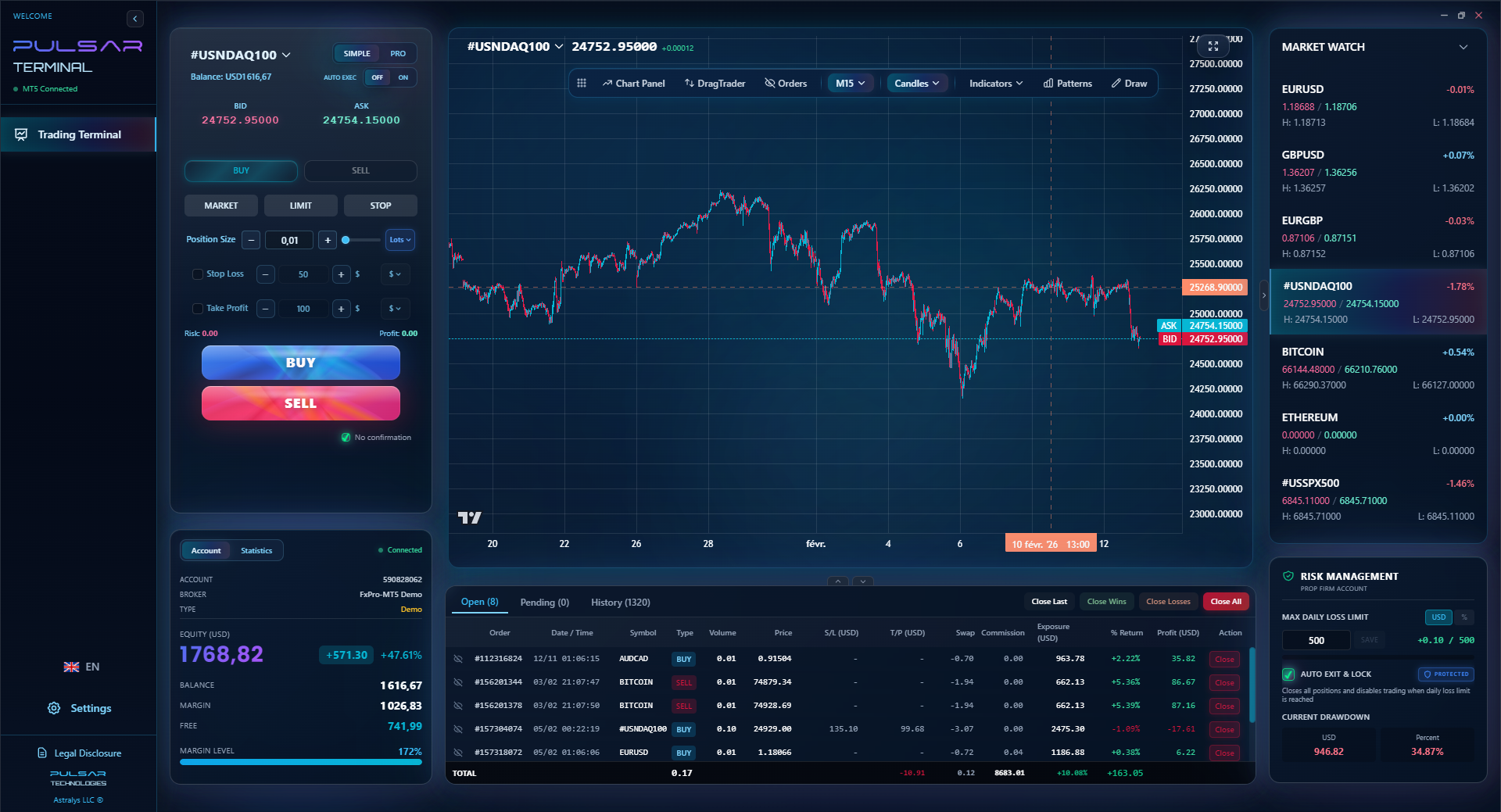
Managing complex prop firm rules and multiple trades is stressful; Pulsar Terminal automates your breakeven, trailing stop, and daily loss limits directly on your MT5 charts.
Pulsar Terminal
Универсальный инструмент для MT5: drag-and-drop ордера, мульти-TP/SL, трейлинг-стоп, грид-трейдинг, Volume Profile и защита для проп-фирм. Используется 1000+ трейдерами ежедневно.
South Africa's forex scene has more sharks than the Durban coastline. Protecting yourself is your first line of defense.
1. The 'Signal Seller' Guru: They flash screenshots of massive wins, often on a demo account or using Photoshop. They promise guaranteed returns if you just pay R500/month for their signals. Reality: If their signals were so good, they'd be trading them with their own millions, not selling them to you for peanuts.
2. The Fake Prop Firm: As mentioned, they set impossible challenge rules. Their entire business model is collecting challenge fees from thousands of hopeful traders who are destined to fail.
3. The Unregulated Broker 'Bucket Shop': They might offer crazy use like 1000:1 and 'zero spread' accounts. They often manipulate prices, delay executions on winning trades, and make it impossible to withdraw your money. Always, always check their regulatory status.
4. The Ponzi Scheme / 'Fund Management': "Invest R10,000 with us and get 5% returns weekly!" This is simple math. Consistent weekly returns are impossible. They use new investors' money to pay old investors, until the whole thing collapses.
The rule is simple: If it sounds too good to be true, it is. No one has a secret, risk-free way to print money. If they did, they wouldn't tell you.
💡 Совет Уинстона
The market doesn't care about your rent, your dreams, or your ego. Trade the price you see, not the price you hope to see.
“A three-year track record of small, consistent returns is worth more than one spectacular, lucky month.”
Thinking in terms of a 'forex trader job' can be limiting. Think bigger: you're building a track record. This is what turns a hobby into a profession.
Document Your Journey: Your trading journal is your CV. A three-year track record of consistent, albeit small, returns is infinitely more valuable to a real prop firm or investor than one amazing month followed by a blow-up.
Consider Specialization: The forex market is vast. Maybe you become an expert in trading USD/ZAR during local market hours. Or perhaps you focus solely on major news events. Depth of knowledge in one area can be more profitable than shallow knowledge of everything.
Network (The Right Way): Join local trading communities, but be skeptical. Look for groups that focus on education and accountability, not bragging about profits. Sharing losses and lessons learned is more valuable than sharing screenshots of wins.
The Ultimate Goal: The real freedom comes when your trading capital is large enough that your 10-15% annual return provides the income you need. That takes years of disciplined saving and compounding. There's no elevator to this floor; you have to take the stairs, one careful step at a time. It's a marathon where most people sprint in the first 100 meters and collapse. Your job is to keep a steady, sustainable pace.
FAQ
Q1Do I need a finance degree to get a forex trader job in South Africa?
For a salaried position at a major bank or fund, almost certainly yes. They typically look for degrees in finance, economics, mathematics, or engineering, and often a CFA charter. For the path of an independent retail trader, no formal degree is required. Your track record and proven profitability are your only credentials.
Q2How much money do I need to start trading forex in South Africa?
You can open an account with as little as R500 with some brokers, but that's not advisable for learning. A more realistic starter amount for serious practice is R2,000 to R5,000. This is capital you must be prepared to lose entirely as part of your education. The goal with this initial sum is to learn live-market mechanics and emotional control, not to generate income.
Q3What is the best forex trading platform for South Africans?
MetaTrader 5 (MT5) is the industry standard for a reason. It's powerful, stable, and supported by almost every reputable international broker that accepts South African clients. Its scripting and automation capabilities are top-notch. While local brokers might have their own platforms, MT5's widespread use means more resources, indicators, and community support.
Q4Are forex trading profits taxable in South Africa?
Yes. SARS views forex trading as a business if you do it regularly for profit. Your net profit (total profits minus total losses, minus allowable business expenses like data fees, platform costs, and education) is considered income and is taxable at your marginal income tax rate. You must declare it. Keep impeccable records from day one.
Q5Can I really make a living from forex trading in SA?
Yes, but it's one of the hardest ways to make an easy living. It requires significant starting capital (think R500,000+ to generate a modest monthly income), years of disciplined practice, and an iron-clad psychological constitution. Most people who try fail. It's a profession, not a get-rich-quick scheme. You should have other income or savings to support yourself for at least the first 2-3 years.
Q6What's the difference between a forex broker and a prop firm?
A broker (like IC Markets or Pepperstone) provides you with the platform and market access to trade your own money. You keep 100% of your profits but bear 100% of the losses. A prop firm provides you with their capital to trade after you pass their evaluation. You get a share of the profits (e.g., 80%), but you trade under their strict rules and risk limits. They are fundamentally different business models.
Урок проф. Уинстона
Ключевые выводы:
- ✓Risk a maximum of 1% of capital per trade.
- ✓Demo trade for 6 months minimum.
- ✓Prop firm challenges have a 95% failure rate.
- ✓Treat net profits as taxable income for SARS.
- ✓Your trading journal is your professional CV.
Насколько полезна эта статья?
Нажмите на звезду
Еженедельные торговые инсайты
Бесплатный еженедельный анализ и стратегии. Без спама.
Об авторе
David van der Merwe
Трейдер развивающихся рынков
Трейдер из Йоханнесбурга с 11-летним опытом работы с валютами развивающихся рынков. Специализируется на ZAR-парах, торговле под регулированием FSCA и анализе южноафриканского рынка.
Комментарии
Предупреждение о рисках
Торговля финансовыми инструментами сопряжена со значительным риском и может не подходить всем инвесторам. Прошлые результаты не гарантируют будущих доходов. Данный контент носит исключительно образовательный характер и не является инвестиционной рекомендацией. Всегда проводите собственное исследование перед торговлей.
Вам также может понравиться

Cara Trading Forex Sukses: 7 Prinsip dari Trader Profesional
Cara trading forex sukses dengan 7 prinsip trader pro: manajemen modal, disiplin, journal trading, backtest. Data nyata, bukan janji profit palsu.
Jam Trading Forex Terbaik untuk Trader Indonesia: Panduan Lengkap dengan Tabel Waktu
Panduan jam trading forex untuk trader Indonesia. Tabel 4 sesi dunia, jam emas 20:00-00:00, sesi mana yang harus dihindari. Data akurat + tips dari trader berpengalaman.
Top 5 Sàn Forex Uy Tín Nhất 2026: Review Jujur dari Trader Indonesia
Top 5 sàn forex uy tín 2026 untuk trader Indonesia. Review jujur: spread, deposit, withdraw, dukungan lokal. Exness, XM, IC Markets & lebih.
Скачать Pulsar Terminal
Все эти калькуляторы встроены в Pulsar Terminal с данными в реальном времени с вашего счёта MT5.
Скачать Pulsar Terminal