


Let's get this out the way: most 'Christian trading' advice is useless.

David van der Merwe
Трейдер развивающихся рынков ·  South Africa
☕ 9 мин чтения
Что вы узнаете:
- 1The Stewardship Test: Is This Gambling or Managing?
- 2Greed: The Silent Killer of Accounts and Convictions
- 3Practical Ethics for the SA Trader: Taxes, Prop Firms, and Honesty
- 4Building a Faith-Aware Trading Plan (Not a 'Holy' One)
- 5The Red Flags: When to Walk Away (Completely)
- 6The South African Context: ZAR Volatility and Local Community
- 7Conclusion: A Framework, Not Rules
Let's get this out the way: most 'Christian trading' advice is useless. It's either too vague to help you place a single trade, or it's a prosperity gospel scam dressed in pips and prayers. If you're a South African Christian trying to figure out if trading the ZAR is compatible with your faith, you're asking the right question, but you're probably getting terrible answers. I've traded through bull markets, bear markets, and my own moral confusion. This isn't about finding Bible verses to justify your next USD/ZAR swing trade. It's about building a framework where your trading doesn't eat your soul. We'll look at the real ethical tension points, what the FSCA and SARS don't tell you, and how to structure a trading life that doesn't leave your faith in the dust.
This is the core question. Christianity talks a lot about stewardship - managing resources wisely. The financial sector conduct authority (FSCA) talks about risk warnings and use limits. Where they meet is where you live.
I used to think any speculative trade was a form of gambling, and therefore wrong. Then I lost a real opportunity. Back in 2020, I saw a clear setup on gold (XAU/USD). Strong support, bullish divergence on the RSI indicator, the works. My 'principles' told me not to 'gamble.' I watched it rally over $300 per ounce without me. That wasn't stewardship; that was fear disguised as piety.
Stewardship in trading means treating your capital with serious respect. It's not the family grocery money. It's a dedicated pool you've allocated, understanding you could lose it. The sin isn't in the speculation; it's in the recklessness. Are you using a proper position size calculator so one bad trade doesn't blow your account? Are you chasing 100:1 use on a wild tip, or building a plan based on analysis? The FSCA now limits retail use to 30:1 for a reason - to protect people from themselves. A good steward would use even less.

Warning: If you're funding your live account with money meant for rent, school fees, or tithes, you've already failed the stewardship test. You're not trading; you're desperate. Stop.
The local angle matters. Trading USD/ZAR with a 500:1 use (if you can even find it) because you 'believe God for a breakthrough' is not faith. It's idiocy with a spiritual veneer. The ZAR is volatile enough on its own. Adding extreme use is poor stewardship of whatever capital you have.
“Using spiritual language to override your trading plan is a surefire path to blowing your account and damaging your faith.”
Greed doesn't look like a cartoon villain rubbing his hands. In trading, it looks like perfectly rational decisions that slowly corrupt your process.
It starts small. You take a nice 50-pip profit on EUR/USD. Good trade. Then the thought: "What if I'd held for 70 pips?" Next trade, you move your take-profit further out. The market reverses, you hit breakeven, and you're annoyed at 'only' breaking even. That's greed shifting your goalposts. I've been there. I once turned a guaranteed R2,000 profit on a swing trading setup into a R500 loss because I got greedy on the exit. I wanted the 'home run' trade to brag about.
Greed also stops you from cutting losses. That's its most dangerous form. You're in a losing USD/ZAR trade. It's 20 pips against you. Your analysis is clearly wrong. But closing it makes the loss 'real.' So you pray over the chart, you look for another confluence to justify holding, you tell yourself it'll come back. That's not faith; that's greed's cousin, pride, refusing to admit a mistake. You'll often hit a margin call this way.
How Greed Masquerades in a Christian Context
This is the ugly bit. Greed gets spiritual makeup. "God told me to hold." "I'm believing for a turnaround." Let's be blunt: God is not your free risk-management tool. He's not a celestial stop-loss hunter. Using spiritual language to override your trading plan is a surefire path to blowing your account and damaging your faith. Your trading plan, based on your strategy and risk parameters, is your primary authority. If 'God tells you' something that contradicts it, the problem is likely your interpretation, not your plan.
A practical antidote? Automated trade management. Use tools that execute your plan without your emotional input. Set your stop-loss and take-profit and walk away. If the idea of not being able to interfere makes you nervous, ask yourself why. That's often where the greed lives.

💡 Совет Уинстона
A stop-loss isn't a lack of faith, it's a confession of humility. You're admitting your analysis could be wrong. That's the starting point for all real learning in this game.
“Your stop-loss might be the most spiritual tool you use all day.”
Your faith gets tested in the boring, administrative details. This is where rubber meets the road in South Africa.
Taxes (SARS): This is non-negotiable. Rendering unto Caesar isn't a suggestion. Your forex profits are taxable income. I declare every cent, even the trades from my offshore IC Markets account. Yes, it hurts sometimes. In the 2023 tax year, I paid just over R42,000 in tax on my trading profits. It was a big chunk. But trying to hide trading income from SARS is stealing, and it's stupid. They have data-sharing agreements. They will find out. Keep careful records - it's both good stewardship and a legal requirement.
Prop Firm Challenges: Here's a modern ethical dilemma. You join a prop firm challenge. The rules say a 5% daily loss limit. You're down 4.8% and have a losing trade still open. Letting it hit 5% fails the challenge. So, you hedge it with another broker to 'freeze' the loss, pass the challenge, and collect the funded account. Is that clever or dishonest? I think it's dishonest. You're gaming the system you agreed to. If your faith includes integrity, this should be a clear line. The purpose of the challenge is to test your discipline. Cheating it might get you capital, but it corrupts the foundation. If you need help with the strict rules of a prop firm, look for tools built for that discipline, don't resort to tricks.
Broker Choice: Is using an unregulated offshore broker with huge use ethical if it's 'legal'? The FSCA regulations exist to protect you. Choosing to bypass that protection for the thrill of 500:1 is poor self-stewardship. Stick with FSCA-regulated brokers like those we've reviewed, such as Exness or Pepperstone (where their local entities are regulated). It's safer and wiser.
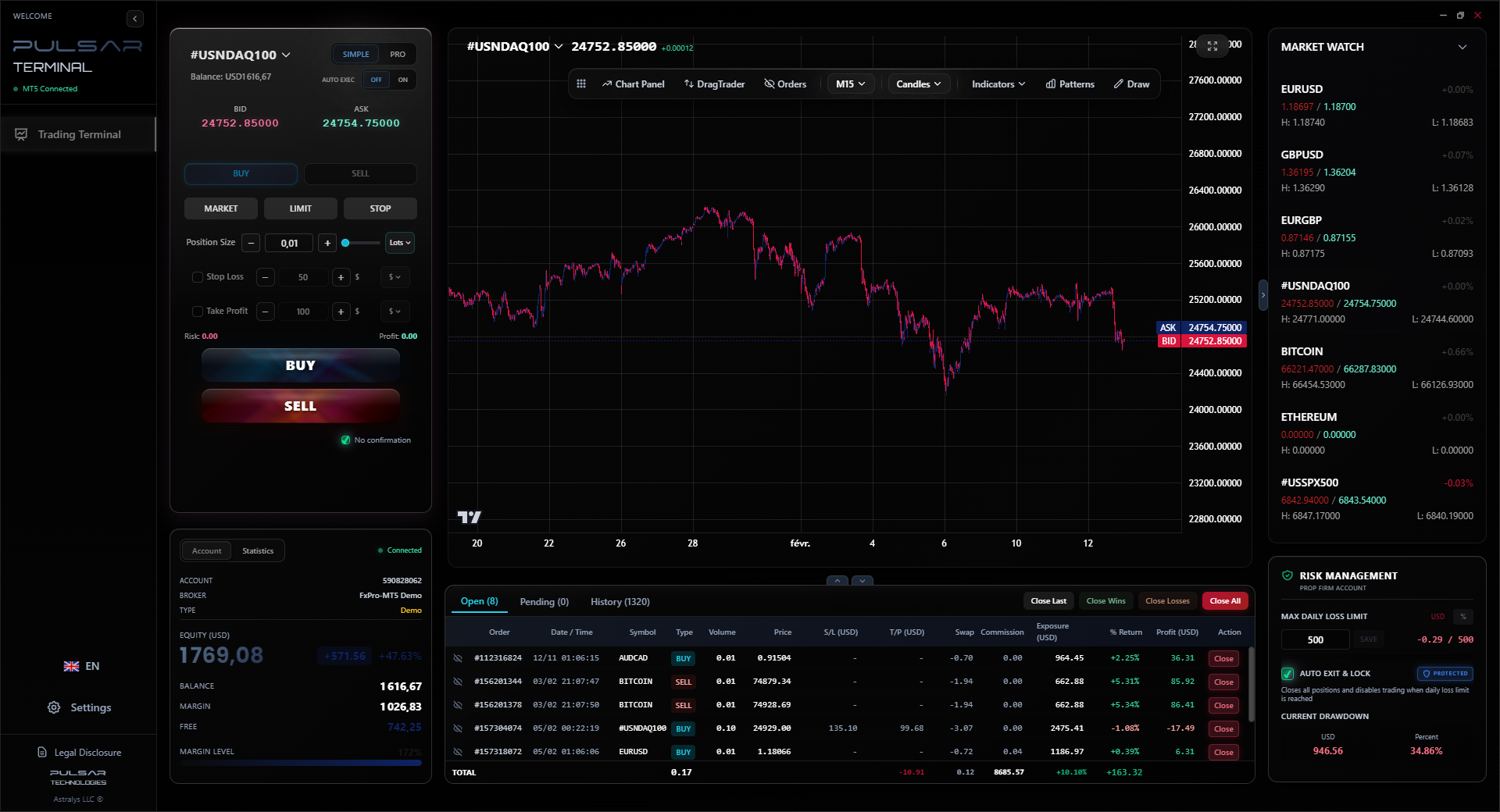
Sticking to your trading plan, especially stop-losses and take-profits, is a core discipline where faith and trading meet, and Pulsar Terminal's automated order management on MT5 removes the emotional temptation to interfere.
Pulsar Terminal
Универсальный инструмент для MT5: drag-and-drop ордера, мульти-TP/SL, трейлинг-стоп, грид-трейдинг, Volume Profile и защита для проп-фирм. Используется 1000+ трейдерами ежедневно.
“Your stop-loss might be the most spiritual tool you use all day.”
Your trading plan shouldn't have a 'What Would Jesus Do?' section next to your entry rules. But your overall approach can be shaped by your values.
- Capital Allocation: Define your trading capital as 'risk capital.' Once it's gone, it's gone. Never dip into other pools. This creates a psychological and ethical boundary.
- Time Management: Does trading consume all your time? Are you skipping family, church, or rest to watch the charts? That's an idol. Schedule your trading sessions. Use alerts. A good platform with reliable execution lets you set trades and walk away. You're a trader, not a chart hostage.
- Profit Goals: Set realistic, monthly profit goals based on a percentage of your capital (e.g., 5-10%). When you hit it, consider stopping for the month. This fights greed. Withdraw profits regularly. Letting it all ride in the account tempts you to overtrade.
- Community & Accountability: Trade in the open. Have a trusted friend or spouse who can see your account statements. Not to give advice, but to ask the hard questions: "You're down this month, are you revenge trading?" Isolation is where bad ethics grow.

Pro Tip: Build your plan's risk management first. Decide your max risk per trade (e.g., 1% of capital) and max daily loss (e.g., 3%) BEFORE you decide on your fancy entry strategy. This is stewardship in action. A tool like a good position size calculator is more spiritually significant than you think.
💡 Совет Уинстона
If you wouldn't show your trade history and broker statement to your spouse or a trusted friend, you're already on the wrong path. Secrecy is the fertilizer for bad decisions.
“Greed doesn't look like a cartoon villain rubbing his hands. In trading, it looks like perfectly rational decisions that slowly corrupt your process.”
Trading isn't for everyone. And being a Christian doesn't give you a supernatural edge. Here are signs this might be harming you:
- You're Constantly Stressed or Angry: If a losing trade ruins your day, your mood, your prayer life, your identity is too tied to P&L.
- You're Hiding It: If you're secretive about losses, or lying about how much time/money you're spending, it's become a source of shame.
- It's Replacing Income You Should Be Earning: Trading as a hopeful get-rich-quick scheme instead of a skilled profession while you neglect your actual job is irresponsible.
- You're Chasing Losses: This is the biggest one. You blow an account, deposit more 'to make it back,' and blow that too. This cycle is addictive and destructive.
I took a full 6-month break in 2021 after a bad loss streak made me short-tempered with everyone I loved. It was the best trading decision I ever made. It reset my relationship with the markets. Walking away to preserve your character, your family, and your faith isn't failure. It might be the most successful trade you ever make.
“Greed doesn't look like a cartoon villain rubbing his hands. In trading, it looks like perfectly rational decisions that slowly corrupt your process.”
Trading in South Africa has unique pressures. The ZAR's wild swings (like the dive to nearly R20/$ in 2025) can trigger fear and greed like no major pair can. Trading your home currency feels different. A big win on USD/ZAR as the Rand weakens can feel like profiting from your country's misery. It's a weird feeling. I don't have a clean answer, but being aware of it matters.
Also, the 'community' here is rife with scams - WhatsApp groups promising 'God-anointed' signals that are just pump-and-dumps. Any group or mentor that blends spiritual authority with trading advice is a massive red flag. Your pastor is (likely) not a trading expert. Your trading mentor shouldn't be your spiritual authority. Keep those roles separate.
Use local, FSCA-regulated brokers that offer ZAR accounts to avoid conversion fees. Understand the costs - trading exotics like EUR/ZAR means wider spreads. Factor that into your plan. Your faith doesn't get you tighter spreads; good broker choice does.
💡 Совет Уинстона
The most 'Christian' thing in your trading toolbox might be the 'Withdraw Funds' button. Regularly taking profits out of the market enforces discipline and reminds you the money is real.
“Walking away to preserve your character isn't failure. It might be the most successful trade you ever make.”
Forex trading and Christianity in South Africa isn't about a list of do's and don'ts. It's about building a framework of character that informs your technical process.
- Stewardship over Speculation: Manage risk fiercely. Protect what's entrusted to you.
- Humility over Greed: Have a plan and stick to it. Admit losses quickly. Take profits gratefully.
- Integrity over Gain: Pay your taxes. Follow broker rules. Be honest with yourself and others.
- Balance over Obsession: Don't let the charts consume your life.
You can be a skilled, disciplined trader and a faithful Christian. But it requires more self-awareness than the average punter. It means your stop-loss might be the most spiritual tool you use all day. It's not about praying for pips; it's about building the discipline to deserve them. Now go check your position size calculator settings. That's a good place to start.
FAQ
Q1Is forex trading a sin according to the Bible?
The Bible doesn't mention forex trading. It does speak extensively about greed, dishonesty, poor stewardship, and love of money. Trading itself isn't inherently sinful, but the way you do it very easily can be. If your trading is driven by greed, involves deceit, or neglects your responsibilities, you're in dangerous territory.
Q2Should I tithe on my forex trading profits?
This is a personal conviction, but here's my take: If you consider trading a business (which SARS does), then your net profit is income. Tithing on business income is a common practice for many. I tithe on my net profits after expenses. It's a tangible way to acknowledge that the skill and opportunity to generate that profit aren't entirely my own doing.
Q3I lost money trading. Did God punish me?
Almost certainly not. The market punishes poor risk management, emotional decisions, and bad analysis. Blaming God for a loss you caused by ignoring your stop-loss is avoiding responsibility. Losses are part of trading. Analyze the trade technically and psychologically, not theologically.
Q4Are 'Christian forex trading groups' safe?
Be extremely wary. Many are scams that use spiritual language to create trust before selling worthless signals or courses. Legitimate trading education doesn't need a faith-based wrapper. Keep your spiritual community and your trading education separate for safety and clarity.
Q5How do I handle the stress of trading as a Christian?
First, reduce the source of stress: lower your risk per trade. If you're sweating over a 0.5% risk trade, you're over-leveraged. Second, schedule your trading. Don't live on the charts. Third, have an accountability partner who knows your plan and can ask tough questions. Finally, remember your identity isn't in your P&L. A bad day trading doesn't make you a failure in life or faith.
Q6Can I use high use if I'm careful?
The FSCA's 30:1 limit for retail traders is a good guide. Even that is high. Using maximum allowed use is rarely 'careful.' High use amplifies both gains and losses, and it directly tests your greed and fear. Good stewardship usually means using far less use than you're allowed. Start low (10:1 or less) to master the psychology before even considering more.
Q7Do I need to tell my pastor I trade forex?
Not necessarily, but you do need someone in your life who knows what you're doing and can hold you accountable. If that's a pastor you trust, great. If it's a mature friend or spouse, that's also fine. The key is avoiding secrecy, which is where ethical compromises thrive.
Урок проф. Уинстона
Ключевые выводы:
- ✓Risk a maximum of 1% of capital per trade.
- ✓Withdraw trading profits quarterly.
- ✓Never trade money needed within 12 months.
- ✓Keep a printed trading journal for accountability.
- ✓Use use under 20:1 for stewardship.
Насколько полезна эта статья?
Нажмите на звезду
Еженедельные торговые инсайты
Бесплатный еженедельный анализ и стратегии. Без спама.
Об авторе
David van der Merwe
Трейдер развивающихся рынков
Трейдер из Йоханнесбурга с 11-летним опытом работы с валютами развивающихся рынков. Специализируется на ZAR-парах, торговле под регулированием FSCA и анализе южноафриканского рынка.
Комментарии
Предупреждение о рисках
Торговля финансовыми инструментами сопряжена со значительным риском и может не подходить всем инвесторам. Прошлые результаты не гарантируют будущих доходов. Данный контент носит исключительно образовательный характер и не является инвестиционной рекомендацией. Всегда проводите собственное исследование перед торговлей.
Вам также может понравиться

Cara Trading Forex Sukses: 7 Prinsip dari Trader Profesional
Cara trading forex sukses dengan 7 prinsip trader pro: manajemen modal, disiplin, journal trading, backtest. Data nyata, bukan janji profit palsu.
Jam Trading Forex Terbaik untuk Trader Indonesia: Panduan Lengkap dengan Tabel Waktu
Panduan jam trading forex untuk trader Indonesia. Tabel 4 sesi dunia, jam emas 20:00-00:00, sesi mana yang harus dihindari. Data akurat + tips dari trader berpengalaman.
Top 5 Sàn Forex Uy Tín Nhất 2026: Review Jujur dari Trader Indonesia
Top 5 sàn forex uy tín 2026 untuk trader Indonesia. Review jujur: spread, deposit, withdraw, dukungan lokal. Exness, XM, IC Markets & lebih.
Скачать Pulsar Terminal
Все эти калькуляторы встроены в Pulsar Terminal с данными в реальном времени с вашего счёта MT5.
Скачать Pulsar Terminal