


I remember watching the USD/INR chart on a Tuesday afternoon in March 2025.
Rajesh Sharma
Старший форекс-аналитик ·  India
India
☕ 10 мин чтения
Что вы узнаете:
I remember watching the USD/INR chart on a Tuesday afternoon in March 2025. It was hovering around 83.15. A student of mine, let's call him Rohan, had just taken a class from a fancy South Mumbai academy. They'd taught him a 'surefire' breakout strategy. He went long. Thirty minutes later, an RBI policy announcement hit the wires. The pair tanked 45 pips in two minutes. His stop-loss? Slipped. He lost nearly 40% of his account, about ₹80,000. He called me, voice shaking, asking what he did wrong. The truth? His first mistake was believing the class he took prepared him for the reality of trading in India. It didn't. It glossed over the single most important thing: you're playing in a heavily restricted, legally grey arena. Let's cut through the marketing and talk about what forex trading classes in Mumbai are really selling you.
Before you learn a single candlestick pattern, you need to understand the walls around you. The Reserve Bank of India (RBI) and SEBI aren't messing around. Their rules aren't suggestions, they're the playing field.
What You CAN Trade (The Short List)
You are legally allowed to trade currency derivatives on Indian exchanges like the NSE and BSE. That means pairs like USD/INR, EUR/INR, GBP/INR, and JPY/INR. That's it. Full stop. This is done through SEBI-regulated brokers like Zerodha, Upstox, or ICICI Direct. It's a regulated, above-board market.
What You CAN'T Trade (The Big Lie)
Any class that spends hours teaching you EUR/USD, GBP/JPY, or gold (XAU/USD) without a massive, blinking warning sign is doing you a disservice. Trading these major forex pairs through offshore platforms like XM, Exness, or IC Markets is prohibited for Indian residents. The RBI calls it a violation of FEMA. The government's latest warnings in April 2026 make this crystal clear. They publish an 'Alert List' of unauthorized platforms for a reason.
There's a tiny, technical loophole via GIFT City and the Liberalised Remittance Scheme (LRS), but I've yet to meet a retail trader in a Mumbai class using it. The vast majority are quietly signing up with offshore brokers, crossing their fingers, and hoping the enforcement Directorate doesn't come knocking. It's a risk, and you need to price that in before you deposit a single rupee.

Warning: I've seen traders get their bank accounts flagged for transferring money to these offshore brokers. The process to unlock them is a bureaucratic nightmare. The risk isn't just theoretical.
So you walk into a class at one of these institutes. You're paying between ₹700 to ₹1,000 per hour for one-on-one sessions, or ₹6,000 to ₹12,000 for a monthly package. What do you get?
Most follow a similar script: basic chart reading, a few indicators like the RSI indicator and MACD indicator, support and resistance, and then a 'proprietary' strategy. The problem isn't the content, it's the context. They're teaching you to drive a Formula 1 car, but you're only legally allowed to drive on a crowded Mumbai street with a scooter license.
I audited a course from a popular academy last year. The instructor spent 20 minutes glorifying a grid trading strategy on EUR/USD. Not one word about the legal stance of the RBI. Not a mention that if you're using a standard account with a 2-pip spread, that grid will eat you alive before the market moves. It was financially and legally irresponsible.
The better classes, often the cheaper certificate courses from institutions like the IIBF (around ₹1,100), focus on the fundamentals: how the forex market works, the role of central banks, and the mechanics of trading INR pairs on the exchange. They're less sexy, but they're grounded in reality.
Here’s a brutal truth: no 12-class package will make you a profitable trader. It can give you the tools, but the real education happens when you lose your own money. The best thing a class can do is teach you strict risk management - how to use a position size calculator, what a margin call really feels like, and why chasing losses is a one-way ticket to zero.

💡 Совет Уинстона
If a class spends more time on fancy indicators than on position sizing and stop-loss placement, you're being sold a toy, not a tool. The foundation of survival is risk management, not prediction.
“You are legally allowed to trade currency derivatives on Indian exchanges. That's it. Full stop.”
This is where the rubber meets the road. Your class might demo on a fancy platform, but your real-world choices are constrained.
For Legal (Exchange) Trading: You'll use a platform like Zerodha Kite or Upstox Pro. The trading is straightforward, but the product is different. You're trading futures contracts on USD/INR, not the spot forex you see on YouTube. The liquidity is deep, but the strategy nuances change.
For The Grey Market (Offshore): This is where most class graduates slink off to. They're lured by the $5 minimum deposit from brokers like XM or the raw spreads from IC Markets. Let's be clear about what you're dealing with:
| Broker Example | Typical Offer | The Catch for an Indian Trader |
|---|---|---|
| XM | $5 min deposit, MT4/MT5 | Standard account spreads avg. 2.0 pips on EUR/USD. That's a huge cost for a scalping strategy. Regulation is offshore (Belize). |
| IC Markets | Raw spreads, cTrader | Min deposit $200. You'll need to fund it via methods that might attract scrutiny. Execution is great, legality is not. |
| Tickmill | Spreads from 0.1 pips | $100 min deposit. Again, you're operating in a prohibited activity, regardless of how good the pricing is. |
I made this mistake early on. I funded an account with a now-defunct offshore broker because their spreads were "unbeatable." I made a 15% return in two months. Then, one Friday, the platform just froze. Withdrawals were "delayed." I never saw that $2,000 again. The class I took never mentioned broker insolvency risk. They just assumed the platform was a utility, like electricity.

Pro Tip: If you go the offshore route despite the warnings, treat your broker like a temporary hotel. Withdraw profits regularly. Never keep your entire capital on the platform. And for god's sake, understand the spread definition and how commissions work on raw accounts - it’s not free.
The class fee is just the entry ticket. The real financial bleed starts after.
1. The Spread Tax: Let's say you take a class on swing trading and you hold a EUR/USD trade for a week. If you're on a standard account with a 1.8 pip spread, you're down ₹450 (approx.) on a standard lot the moment you click buy. That's not a trading cost, it's a toll. Every single trade pays it. A good class will make you calculate this on every hypothetical trade.
2. The Funding Surcharge: You want to put $500 into IC Markets? Your bank or payment gateway will take a cut. Using something like PayPal? That's about 4.4% + fees. So your ₹41,500 deposit instantly becomes worth about ₹39,700 in your trading account. You're in a hole before the market opens.
3. The Psychological Cost: This is the big one. Trading a prohibited market adds a layer of low-grade anxiety that messes with your judgment. You'll close winners early because you're nervous. You'll let losers run, hoping to get back to breakeven. I've coached traders who were technically sound but made terrible decisions purely because they felt they were doing something "wrong."
I once held a winning USD/INR futures trade on the NSE overnight during a volatile period. I slept fine. Contrast that with a time I held a GBP/JPY trade with an offshore broker. Every police siren outside my window felt like a potential raid. I closed it for a measly 8-pip profit out of sheer paranoia. The market then ran another 60 pips in my direction. The opportunity cost of operating in the shadows is immense.
💡 Совет Уинстона
Before funding any broker, do a dry run. Try to withdraw a small amount first. If it's complicated or slow getting money out, imagine what it'll be like when you have real profits stuck in there.
“The class fee is just the entry ticket. The real financial bleed starts after.”
Do you need to spend ₹12,000 a month on forex trading classes in Mumbai? Probably not.
Here's my alternative curriculum for the cost of a few coffees:
- Learn the Rules First: Spend a weekend reading the RBI's Master Direction on Electronic Trading Platforms and SEBI's FAQs. It's dry, but it's your reality.
- Paper Trade INR Pairs: Open a demo account with Zerodha or Upstox. Trade USD/INR futures for three months. No real money risk, full legal compliance. Learn how the Indian market moves. It reacts differently to RBI news than EUR/USD reacts to the ECB.
- Master One Strategy: Don't collect strategies like Pokémon cards. Pick one - price action, a simple indicator setup - and test it relentlessly on your demo. Track every trade in a journal. Why did you enter? Where was your stop? What was the pip outcome?
- Find a Mentor, Not a Guru: Look for someone who shows you their losses, not just their Lamborghini. A real mentor will grill you on your trade journal, question your biases, and tell you when you're being an idiot. Most expensive classes provide a guru, not a mentor.

Example: Let's say you saved that ₹12,000 monthly class fee for 6 months. That's ₹72,000. You could use that as a dedicated risk capital pool for your legal USD/INR trading. With a sane 1% risk per trade, that's a ₹720 risk stake. That's a real education.
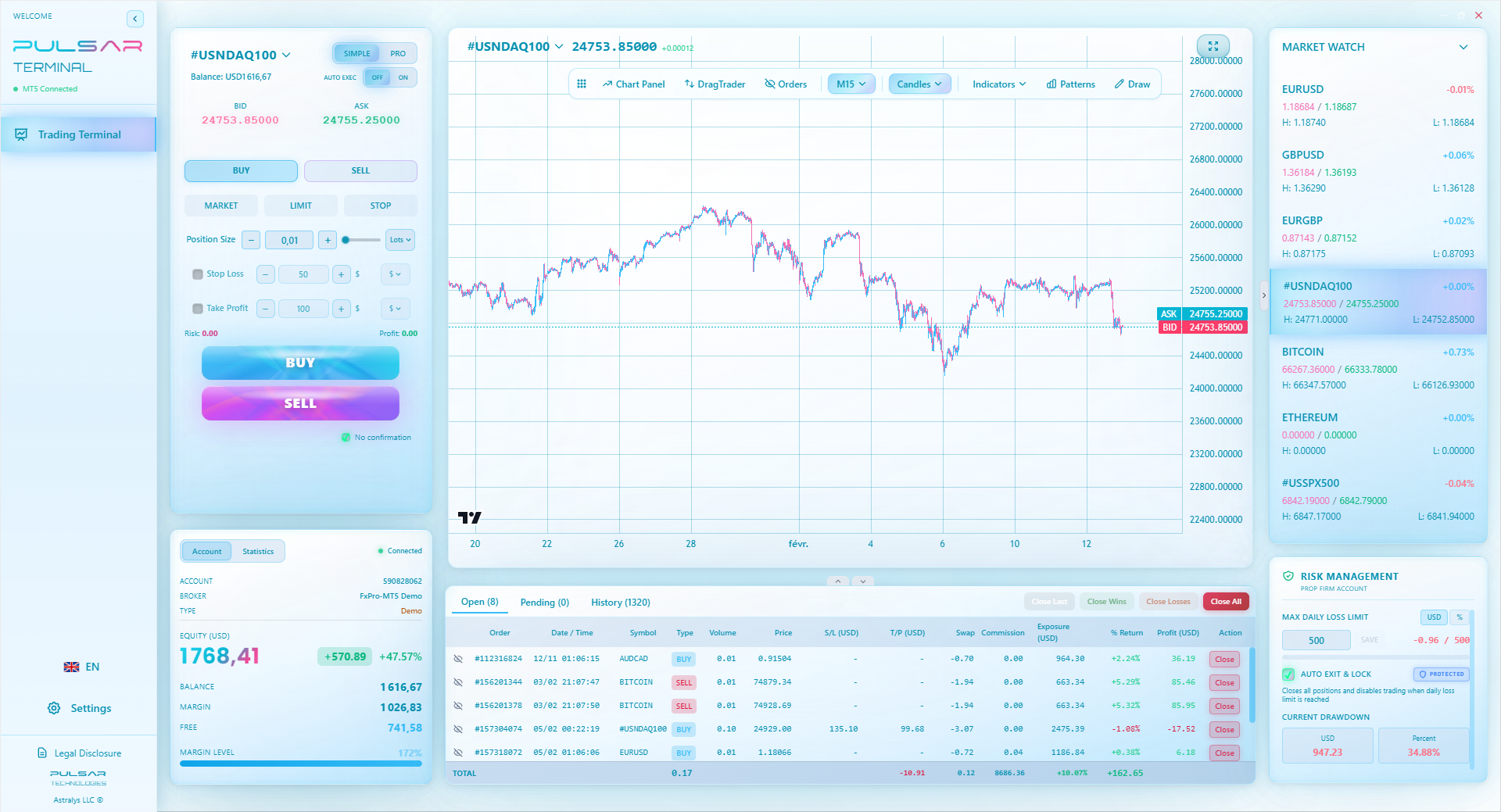
The fancy platforms and tools shown in classes? You can learn MT4 or MT5 from free YouTube tutorials. The advanced order types like trailing stops or multi-level take-profits? You can get tools like Pulsar Terminal that add that functionality directly to MT5. You don't need a class for that, you need a manual and some practice.
When you're ready to move beyond basic platform orders, tools like Pulsar Terminal add professional features like multi-TP/SL, trailing stops, and grid trading directly to your MT5, letting you execute complex strategies taught in classes without manual hassle.
Pulsar Terminal
Универсальный инструмент для MT5: drag-and-drop ордера, мульти-TP/SL, трейлинг-стоп, грид-трейдинг, Volume Profile и защита для проп-фирм. Используется 1000+ трейдерами ежедневно.
It depends on what you're buying.
Maybe consider a class if:
- It is explicitly focused on exchange-traded currency derivatives (USD/INR futures).
- The instructor is transparent about their own trading track record (including drawdowns).
- A huge portion of the curriculum is dedicated to risk management, psychology, and journaling.
- The cost is a fixed certificate fee (like the IIBF course) and not an open-ended monthly drain.
Walk away immediately if:
- The sales pitch focuses on getting rich quick or "passive income."
- They gloss over the legalities of trading major pairs.
- They have a partnership with a specific offshore broker and push you to sign up during the class.
- They teach overly complex strategies like grid trading or arbitrage to beginners.
My final take? The knowledge gap for a beginner is huge, and a structured course can help bridge it. But in Mumbai, the market for these classes is saturated with outfits selling a dream, not a skill. The most valuable lessons - discipline, emotional control, risk management - aren't taught in a classroom with a PowerPoint. They're learned in the quiet panic of a losing trade, staring at a screen, with your own money on the line. No class can simulate that pressure.
If you must take a class, go in with your eyes open. See it as buying a structured syllabus and some basic coaching, not a ticket to profitability. The rest, the hard part, is on you. And it always will be.
FAQ
Q1Is forex trading legal in India after taking these classes?
Yes, but in a very specific way. Trading currency pairs involving the Indian Rupee (like USD/INR) on SEBI-regulated exchanges like NSE is legal. However, the forex trading classes in Mumbai often teach trading major pairs like EUR/USD, which is prohibited for Indian residents through offshore platforms. The class doesn't make the activity legal.
Q2What is the average cost of forex trading classes in Mumbai?
You're looking at ₹700-₹1,000 per hour for one-on-one sessions. Monthly packages for 12 classes range from ₹6,720 for group sessions to ₹12,000 for private coaching. Certificate courses can be cheaper, from around ₹1,100.
Q3Can I use platforms like MetaTrader 5 legally in India?
You can use MT5 as a platform. The legality depends on what you're trading and through whom. If an SEBI-regulated broker offers MT5 for trading INR pairs, it's legal. If you download MT5 from an offshore broker like XM or Pepperstone to trade EUR/USD, you are violating RBI rules.
Q4Do these classes guarantee I will become a profitable trader?
Absolutely not. No reputable educator will guarantee profits. Trading is a skill with a high failure rate. A good class provides knowledge and tools, but your psychology, discipline, and risk management - which you develop yourself - determine success.
Q5What's the difference between trading USD/INR on NSE and EUR/USD offshore?
It's the difference between driving on the expressway with a license and driving off-road without one. USD/INR on NSE is a regulated futures contract with defined expiry dates. EUR/USD offshore is spot forex trading on a prohibited, leveraged product with different liquidity, spreads, and, crucially, legal risk.
Q6Are there any good online alternatives to classes in Mumbai?
Yes. Start with a demo account on a legal Indian platform like Zerodha. Use free resources to learn price action and risk management. Consider a low-cost, theory-focused certificate course from a recognized institution. Paid online courses from global educators can be good, but ensure their content is adaptable to the restricted Indian context.
Урок проф. Уинстона
Ключевые выводы:
- ✓Legal trading is only INR pairs on NSE/BSE.
- ✓Offshore broker spreads add a hidden 1-2 pip "tax".
- ✓Funding costs can instantly wipe 4% of your capital.
- ✓No 12-class package can teach trading discipline.
Насколько полезна эта статья?
Нажмите на звезду
Еженедельные торговые инсайты
Бесплатный еженедельный анализ и стратегии. Без спама.
Об авторе
Rajesh Sharma
Старший форекс-аналитик
Более 10 лет торгует на индийских и южноазиатских рынках. Начинал с валютных деривативов на NSE, затем перешёл на международный форекс. Специализируется на USD/INR и парах развивающихся рынков.
Комментарии
Предупреждение о рисках
Торговля финансовыми инструментами сопряжена со значительным риском и может не подходить всем инвесторам. Прошлые результаты не гарантируют будущих доходов. Данный контент носит исключительно образовательный характер и не является инвестиционной рекомендацией. Всегда проводите собственное исследование перед торговлей.
Вам также может понравиться

Cara Trading Forex Sukses: 7 Prinsip dari Trader Profesional
Cara trading forex sukses dengan 7 prinsip trader pro: manajemen modal, disiplin, journal trading, backtest. Data nyata, bukan janji profit palsu.
Jam Trading Forex Terbaik untuk Trader Indonesia: Panduan Lengkap dengan Tabel Waktu
Panduan jam trading forex untuk trader Indonesia. Tabel 4 sesi dunia, jam emas 20:00-00:00, sesi mana yang harus dihindari. Data akurat + tips dari trader berpengalaman.
Top 5 Sàn Forex Uy Tín Nhất 2026: Review Jujur dari Trader Indonesia
Top 5 sàn forex uy tín 2026 untuk trader Indonesia. Review jujur: spread, deposit, withdraw, dukungan lokal. Exness, XM, IC Markets & lebih.
Скачать Pulsar Terminal
Все эти калькуляторы встроены в Pulsar Terminal с данными в реальном времени с вашего счёта MT5.
Скачать Pulsar Terminal