


You're looking for real forex trading info, not the 'get rich quick' nonsense plastered all over social media, right? Good.

David van der Merwe
Трейдер развивающихся рынков ·  South Africa
☕ 12 мин чтения
Что вы узнаете:
- 1The Legal Landscape: FSCA Rules You Can't Ignore
- 2The Real Costs of Trading in South Africa
- 3Choosing a Broker: What Actually Matters
- 4Trading the ZAR Pairs: The Local Opportunity
- 5A Simple, Realistic Starting Strategy
- 6Taxes and Records: Don't Mess with SARS
- 7Common Pitfalls (And How I Fell Into Them)
- 8Your First Steps: A 30-Day Action Plan
You're looking for real forex trading info, not the 'get rich quick' nonsense plastered all over social media, right? Good. You're in the right place. Trading from South Africa comes with its own unique set of rules, costs, and opportunities that most generic guides completely miss. I've been trading for over a decade, and I've seen too many local traders get burned by not understanding the local landscape. This guide cuts through the noise. We'll cover what's legal, what it really costs, which brokers are worth your time, and how to approach the market with your eyes wide open. Let's get you started on solid ground.
Before you even think about placing a trade, you need to understand the rules of the game here. Forex trading is 100% legal in South Africa, but it's regulated by the Financial Sector Conduct Authority (FSCA). Think of them as the referees. Trading with an unlicensed broker is like playing soccer without a ref - you're asking for trouble.
The FSCA's main job is to protect you. They mandate that brokers keep your money in segregated accounts (separate from the company's own cash), so if the broker goes under, your funds should be safer. They also enforce strict Know-Your-Customer (KYC) and anti-money laundering checks. You'll need your ID and proof of residence to open an account, no way around it.
One of the biggest FSCA rules is the use cap. For retail traders, use is limited to 30:1 on major currency pairs. That means for every R1,000 in your account, you can control a position worth R30,000. Some international brokers might offer you 500:1 or even 'unlimited' use, but if they're not FSCA-licensed, you're stepping outside the regulated safety net. I learned this the hard way early on. Chasing insane use with an offshore broker led to my fastest-ever margin call. The potential reward wasn't worth the colossal risk.

Warning: Always verify your broker's FSCA license number on the official FSCA register. If they can't provide one, walk away. No license means no local recourse if something goes wrong.
Forget the 'zero cost' advertising. Trading has costs, and if you don't account for them, they'll eat your account for breakfast. Here’s the breakdown.
The Spread: Your Entry Fee
The spread is the difference between the buy and sell price. It's how many brokers make their money. For a pair like EUR/USD, a good, tight spread from a regulated broker might be around 0.6 to 0.9 pips. On a R100,000 position, a 0.9 pip spread is a R90 cost the moment you enter the trade. You're already down R90 before the market even moves.
Commissions & Fees
Some accounts, especially 'Raw' or ECN accounts, offer super-tight spreads (like 0.1 pips) but charge a commission per lot. For example, you might pay $3 to open a trade and another $3 to close it. You need to do the math: spread + commission = your total cost. A broker advertising '0.0 pips' almost always charges a commission.
The ZAR Conversion Hit
This is a silent killer for South African traders. If your broker account is in USD and you fund it with Rands, your bank or payment provider will charge a conversion fee and give you a poor exchange rate. I once lost nearly 2% of my deposit just on the currency conversion before I even traded. The solution? Look for brokers that offer ZAR-denominated accounts. It simplifies everything for tax, too.
Minimum Deposits
These vary wildly. You can start with as little as R100 (or $5) with some brokers, while others require R4,000 or more. My advice? Start with the absolute minimum you can. Your first goal isn't to make money, it's to not lose money while you learn. Use a position size calculator religiously to keep your risk tiny.

Example: Let's say you trade 0.1 lots on EUR/USD with a 0.8 pip spread. The cost is 0.1 * 0.8 = 0.08 standard lots in cost. At $10 per pip per standard lot, that's an $0.80 (about R15) cost on entry. Small, but it adds up fast over dozens of trades.

💡 Совет Уинстона
The market's job is to make you feel stupid right before it makes you right. If your analysis is sound, have the patience to let it play out. Impatience is a tax on your profits.
“Your first goal isn't to make money, it's to not lose money while you learn.”
With so many options, how do you pick? Don't just go for the one with the flashiest ads on Facebook. Here’s my checklist, born from painful experience.
1. Regulation is Non-Negotiable: FSCA license. Full stop. Brokers like IG, Tickmill, and AvaTrade have local FSCA regulation. Others, like IC Markets or Exness, are regulated elsewhere but are popular internationally. For your first account, I strongly recommend sticking with an FSCA-licensed entity for that extra layer of protection.
2. Platform & Tools: MetaTrader 4 (MT4) or MetaTrader 5 (MT5) are the industry standards. They're reliable, and every strategy tutorial you'll find is based on them. Some brokers have their own fancy platforms, but you can't go wrong starting with MT4/5. The availability of good tools can make a difference. For instance, managing complex trades with multiple take-profit levels is much easier with the right software.
3. Deposits & Withdrawals in ZAR: Can you deposit Rands directly? What are the fees? How long do withdrawals take back to your South African bank account? A local broker like Khwezi Trade excels here, while international ones might involve slower SWIFT transfers.
4. Customer Support: Test them. Send an email or call their SA support line (if they have one) with a question before you deposit. If they're slow or unhelpful now, imagine how they'll be when you have a real problem with your money.
I made the mistake early on of choosing a broker solely for their high use and bonuses. When I needed to withdraw my profits, it was a month-long nightmare of delays and excuses. The peace of mind of using a properly regulated broker is worth far more than any sign-up bonus.
While everyone is staring at EUR/USD, some of the most interesting moves happen right here with our own currency. ZAR pairs like USD/ZAR, EUR/ZAR, and GBP/ZAR can be incredibly volatile. That means more opportunity, but also much more risk.
Why trade them? You have a natural feel for the local news. You know when load-shedding is hitting, you understand political announcements, and you feel the impact of local economic data. This 'home-ground advantage' can be real if you use it wisely.
The big caveat: The spread on ZAR pairs is usually much wider than on majors. Where EUR/USD might have a 0.8 pip spread, USD/ZAR could have a 50-100 pip spread. That's a huge cost to overcome. You can't be a scalping strategy on these pairs; the spread will destroy you. They are better suited for swing trading where you hold positions for days or weeks, aiming for moves of 500-1000 pips to make the spread negligible in comparison.
I trade USD/ZAR occasionally, but I treat it with immense respect. In 2020, I caught a nice 800-pip move over two weeks. My entry wasn't perfect, but because I was swing trading and my profit target was large, the 60-pip spread I paid was just a small tax on a good trade. Trying to day-trade it would have been a different, and much more expensive, story.

Pro Tip: When trading volatile pairs like USD/ZAR, use a wider stop-loss. The normal 20-pip stop you might use on EUR/USD will get taken out by random noise on the ZAR. Give your trade room to breathe.
“The spread on ZAR pairs is a huge cost to overcome. You can't be a scalper here.”
You need a plan. Here’s a basic, time-tested framework to build on. It combines price action with one reliable indicator.
1. Find the Trend (The Big Picture): Don't fight the trend. Use the daily chart. Is the price mostly making higher highs and higher lows (uptrend)? Or lower highs and lower lows (downtrend)? If you can't tell, it's probably ranging - stay out.
2. Wait for a Pullback: In an uptrend, the price won't go straight up. It will dip back down (pullback). That's your potential entry zone. In a downtrend, wait for a rally back up.
3. Look for Confirmation on a Lower Timeframe: Switch to the 1-hour or 4-hour chart. Wait for the pullback to show signs of stalling. This is where an indicator like the RSI can help. In an uptrend pullback, look for the RSI to dip near 40 (not oversold at 30) and then start curling back up. That's a signal the pullback might be over.
4. Enter with a Tight(ish) Stop: Place your buy order. Your stop-loss should go just below the recent low of the pullback. Your take-profit target should be at least 1.5 to 2 times the distance of your stop-loss. This gives you a positive risk-to-reward ratio.
Let me give you a real example from last year on XAU/USD (Gold). The daily chart was in a clear uptrend. It pulled back from $1980 to $1945. On the 4-hour chart, the RSI hit 42 and turned up. I entered at $1948. Stop at $1939 (9 pip risk). Target at $1966 (18 pip reward). Risk/Reward = 1:2. It hit the target two days later. Simple, mechanical, no emotion.
This isn't a holy grail. You will have losing trades. The goal is to have your winners be bigger than your losers. Discipline in following this process is 80% of the battle.
💡 Совет Уинстона
Your trading platform is your cockpit. Knowing how to quickly set a stop-loss, take-profit, and modify an order is as important as your trading idea. Practice these mechanics on a demo until they're second nature.
This is the part everyone wants to ignore. You can't. The South African Revenue Service (SARS) views frequent forex trading as generating income, not capital gains. That means your profits are added to your other income and taxed at your marginal rate (which can be up to 45%).
What you must do:
- Keep a detailed log of every single trade: date, instrument, entry price, exit price, profit/loss in Rands.
- Keep all your broker statements, deposit/withdrawal records, and bank statements.
- Convert all your profits and losses to ZAR at the exchange rate on the day of the trade. This is a pain, but it's necessary.
- Declare your net profit (total profits minus total losses) on your annual tax return under 'Other Income'.
I use a simple Excel spreadsheet. One tab for trades, one tab for deposits/withdrawals. At the end of the tax year, it takes me an hour to summarize everything for my accountant. The peace of mind is priceless. I know a trader who didn't keep records for three years. When SARS came knocking, the reconstruction process was a nightmare and he faced hefty penalties. It's not worth the stress.
Warning: SARS is getting more sophisticated in tracking online income. Assuming they won't find you is a very, very expensive gamble. Be a pro from day one: keep your records.
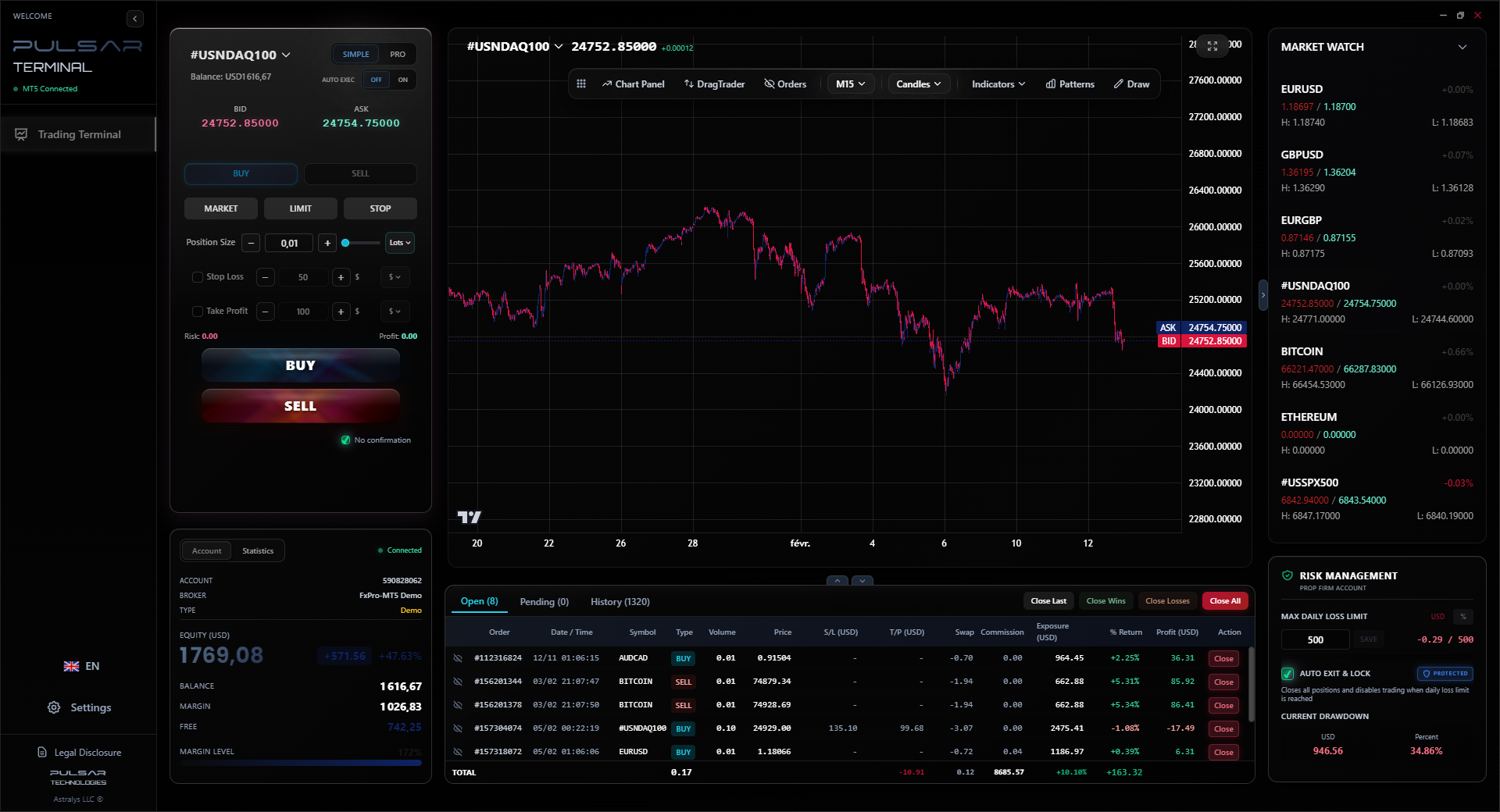
Managing the psychology of multiple open trades is easier when your platform lets you set and adjust take-profit and stop-loss levels visually and efficiently.
Pulsar Terminal
Универсальный инструмент для MT5: drag-and-drop ордера, мульти-TP/SL, трейлинг-стоп, грид-трейдинг, Volume Profile и защита для проп-фирм. Используется 1000+ трейдерами ежедневно.
“Assuming SARS won't find you is a very, very expensive gamble.”
Let me save you some money and heartache by sharing my own stupid mistakes.
Pitfall 1: Overtrading. This is the #1 account killer. You're bored, the market is slow, so you take a low-probability trade just to 'be in the action.' I once took 12 trades in a single day out of boredom. Ten were losers. I wiped out a week's profits in hours. Now, if my strategy doesn't give me a clear signal, I don't trade. It's that simple.
Pitfall 2: Not Using a Stop-Loss. You think you'll just 'watch it closely.' Then the price moves against you, you freeze, and a small loss becomes a catastrophic one. Always, always have a stop-loss order in the market. It's your life jacket.
Pitfall 3: Chasing Losses. You have a bad day, lose R500, and immediately try to win it back by doubling your position size. This is emotional trading, and it's how accounts get blown up. After a loss, I have a rule: I walk away for the rest of the day. The market will still be there tomorrow.
Pitfall 4: Believing the 'Gurus'. The online world is full of people selling signals, secret indicators, and dreams. I wasted hundreds of dollars on this rubbish in my first year. The truth is, no one has a crystal ball. Your success depends on your own discipline and risk management, not someone else's Telegram messages.
Pitfall 5: Ignoring Your Psychology. Trading is 90% mental. Fear and greed will distort your judgment. The only fix is to have a written trading plan and stick to it, no matter how you feel. Your plan is the boss, not your gut.
💡 Совет Уинстона
The first profit you should aim for is the profit of a lesson learned. Journal every trade, especially the losers. A reviewed loss is tuition, not a cost.
Okay, enough theory. Here's what to do next.
Week 1: Education & Paper Trading.
- Don't deposit real money yet.
- Open a demo account with an FSCA-regulated broker.
- Practice the simple strategy from Section 5 on your demo account. Get used to placing orders, setting stops, and taking profits.
- Read up on the MACD indicator to add another tool to your toolbox later.
Week 2-3: Live Observation & Journaling.
- Keep watching the markets, but now with a focus on EUR/USD and USD/ZAR.
- Start a trading journal (even for your demo trades). Write down the setup, why you took it, your emotion, and the result.
- Research 2-3 FSCA brokers in detail. Compare their spreads on the pairs you want to trade, their minimum deposit, and their withdrawal policy.
Week 4: Go Live (Tiny).
- Fund your chosen broker with the minimum possible amount. For you, that's probably R500-R1000.
- Your goal for the first month is not profit. Your goal is to execute 10-20 trades following your plan perfectly, with correct position sizing. If you end the month break-even or down a few Rands but followed your rules, that's a HUGE success.
- Set up your record-keeping spreadsheet from day one.
Remember, this is a marathon. The traders who last are the ones who manage risk, keep learning, and stay disciplined. You've got this. Now go start your demo account and get your feet wet.
FAQ
Q1Is forex trading legal and safe in South Africa?
Yes, it's legal, but safety depends entirely on you. It's safe if you use an FSCA-licensed broker, which ensures client fund segregation and regulatory oversight. It's unsafe if you use unregulated brokers or trade with poor risk management, regardless of the broker.
Q2How much money do I need to start forex trading in South Africa?
You can start with as little as R100-R500 with some brokers. However, I strongly recommend starting with a demo account for at least a month. When you go live, start with the absolute minimum. Your first investment should be in education and experience, not a large trading bankroll.
Q3How are my forex trading profits taxed by SARS?
SARS generally treats frequent, speculative forex trading as income. Your net profit (total profits minus total losses) for the tax year must be declared as 'Other Income' and is taxed at your marginal income tax rate. You must keep detailed records of all trades and conversions to ZAR.
Q4What is the best trading platform for beginners in SA?
MetaTrader 4 (MT4) is the most common and beginner-friendly. It's stable, widely supported by brokers, and there's a mountain of free educational content based on it. It's the best place to start before exploring other platforms like MT5 or cTrader.
Q5Can I trade South African Rand (ZAR) pairs?
Absolutely. Pairs like USD/ZAR and EUR/ZAR are widely available. Be aware they are much more volatile and have significantly wider spreads than major pairs like EUR/USD. They are better suited for swing trading strategies rather than short-term scalping.
Q6What's the most important rule for a new trader?
Risk management. It's not a strategy or an indicator. It's using a stop-loss on every trade and never risking more than 1-2% of your account on a single trade. Protecting your capital is job number one. Everything else comes second.
Q7Are prop trading firms a good way to start in South Africa?
They can be, but be very careful. They offer a chance to trade with larger capital, but their challenges have strict rules (like daily loss limits). They require even more discipline. Only consider them once you have a proven, profitable strategy on your own small live account first.
Урок проф. Уинстона
Ключевые выводы:
- ✓FSCA regulation is your primary safety net. Verify the license.
- ✓Total cost = Spread + Commission + Conversion Fees. Calculate it.
- ✓Trade ZAR pairs for swings, not scalps, due to wide spreads.
- ✓Risk max 2% per trade. Survival is the first objective.
- ✓SARS taxes trading income. Keep immaculate ZAR records from day one.
Насколько полезна эта статья?
Нажмите на звезду
Еженедельные торговые инсайты
Бесплатный еженедельный анализ и стратегии. Без спама.
Об авторе
David van der Merwe
Трейдер развивающихся рынков
Трейдер из Йоханнесбурга с 11-летним опытом работы с валютами развивающихся рынков. Специализируется на ZAR-парах, торговле под регулированием FSCA и анализе южноафриканского рынка.
Комментарии
Предупреждение о рисках
Торговля финансовыми инструментами сопряжена со значительным риском и может не подходить всем инвесторам. Прошлые результаты не гарантируют будущих доходов. Данный контент носит исключительно образовательный характер и не является инвестиционной рекомендацией. Всегда проводите собственное исследование перед торговлей.
Вам также может понравиться

Cara Trading Forex Sukses: 7 Prinsip dari Trader Profesional
Cara trading forex sukses dengan 7 prinsip trader pro: manajemen modal, disiplin, journal trading, backtest. Data nyata, bukan janji profit palsu.
Jam Trading Forex Terbaik untuk Trader Indonesia: Panduan Lengkap dengan Tabel Waktu
Panduan jam trading forex untuk trader Indonesia. Tabel 4 sesi dunia, jam emas 20:00-00:00, sesi mana yang harus dihindari. Data akurat + tips dari trader berpengalaman.
Top 5 Sàn Forex Uy Tín Nhất 2026: Review Jujur dari Trader Indonesia
Top 5 sàn forex uy tín 2026 untuk trader Indonesia. Review jujur: spread, deposit, withdraw, dukungan lokal. Exness, XM, IC Markets & lebih.
Скачать Pulsar Terminal
Все эти калькуляторы встроены в Pulsar Terminal с данными в реальном времени с вашего счёта MT5.
Скачать Pulsar Terminal