


I remember staring at the screen in late 2023, watching USD/ZAR spike from 18.50 to 19.20 in a single session.

David van der Merwe
Трейдер развивающихся рынков ·  South Africa
☕ 11 мин чтения
Что вы узнаете:
- 1What Even Is a Forex Trading Internship? Spoiler: It's Not What You Think
- 2The Price Tag: What Are You Really Paying For?
- 3Playing by the Rules: FSCA, Taxes, and Not Getting Scammed
- 4Your DIY Internship: The Only Plan That Actually Works
- 5The Toolbox: From MT5 to Tax Software
- 6Where Does This Lead? Real Career Paths
- 7Your 90-Day Action Plan: No Bullshit
I remember staring at the screen in late 2023, watching USD/ZAR spike from 18.50 to 19.20 in a single session. My phone was buzzing with messages from a guy I’d paid R15,000 to ‘intern’ under. All he said was ‘hold, it’ll come back.’ It didn’t. I blew half my account because I’d traded someone else’s conviction, not my own analysis. That painful lesson cost me money, but it taught me everything about the fantasy versus the reality of a forex trading internship here. Let’s cut through the Instagram hype and talk about what you’re actually signing up for.
When you hear 'forex trading internship,' you probably picture a glass-walled office in Sandton, a Bloomberg terminal, and a mentor showing you the ropes. For 99% of you, that's not happening. In South Africa, the term is used in three very different ways, and you need to know which one you're buying into.
First, there's the legitimate corporate internship. Think Standard Bank, Investec, or Citi's Global Markets division. These are actual, paid, fixed-term roles (like Citi's 4-week winter program). You're not trading a live personal account; you're learning about sales, structuring, and risk within a massive, regulated bank. It's a career path into finance, not a shortcut to trading riches.
Then there's the educational mentorship program. This is where most 'internship' ads lead. A trader or academy charges you a fee (anywhere from R2,000 to R100,000) for courses, signals, and weekly Zoom calls. The value here ranges from genuinely useful to outright theft. I paid for one early on. The guy could trade, I'll give him that, but his 'mentorship' was just him boasting about his wins. When I asked about his position size calculator logic, he changed the subject.
Finally, there's the prop firm challenge path. This isn't called an internship, but it's the closest thing to 'getting a seat' as a retail trader. You pay a fee to take a trading challenge for a firm like FTMO or The5%ers. Pass it, and you trade their capital for a split of the profits. It's a brutal, high-pressure audition. It forces discipline like nothing else. This is where you actually prove you can trade.

Warning: If an 'internship' promises guaranteed profits, requires you to deposit money into a specific broker they control, or pressures you with 'limited time' discounts, run. The FSCA issued over a hundred warnings about these setups in just the first half of 2025. Check their register before you pay a single cent.

💡 Совет Уинстона
A mentor who won't show you their full, verified trading history is just a storyteller. Demand proof, not promises.
“Passing a prop firm challenge is a better credential than any 'internship' certificate.”
Let's talk numbers, because this is where dreams get expensive. I've seen it all, from the R179 Udemy special to the R80,000 'platinum mentorship.'
Breaking Down the Fees
A basic online course might run you R1,000 to R10,000. You get pre-recorded videos and a PDF. It's information, not transformation. The mid-tier 'group mentorship' programs sit between R15,000 and R30,000. You get live sessions and a Discord channel. The high-end, one-on-one stuff? R50,000 to R100,000+. You're paying for direct access and (theoretically) personalized feedback.
Here’s my brutal take: The correlation between price and value is weak. A R20,000 course from a disciplined swing trading specialist who shows you their full journal is worth more than a R60,000 'masterclass' from a Lamborghini-flashing influencer who only shows you screenshots of wins.
What You MUST Get for Your Money
If you're spending more than R5,000, demand these specifics:
- A documented, repeatable strategy: Not just 'I look at the chart and feel it.' Rules for entry, exit, and position size calculator.
- Live trade analysis: Not just review, but live 'why I am placing this trade NOW' walkthroughs.
- Loss review: How they handle a losing week. If a mentor only shows wins, they're a marketer, not a trader.
- Transparency on their performance: A verified track record (like a Myfxbook link) is ideal. If not, at least consistent, real-time trade calls you can verify.

Example: I once tracked a mentor's 'signal service' for a month. He posted 12 trades. He only ever mentioned the 7 that won, quietly ignoring the 5 losers. His advertised '80% win rate' was actually 58% when you counted all the trades. The net profit was minimal after the spread definition and a few big losers. That's the game.
“The correlation between the price of a mentorship and its actual value is dangerously weak.”
You can't talk about trading in South Africa without talking about the Financial Sector Conduct Authority (FSCA). They're not the enemy; they're the reason your money isn't automatically stolen.
Broker Safety is Non-Negotiable
Only use FSCA-regulated brokers or top-tier international ones with other solid regulations (like ASIC). Why? Client fund segregation. This means your deposit is held separately from the broker's company money. If they go bust, your funds are (theoretically) safe. An unregulated 'broker' offering you a 1000:1 use? That's just a fancy website attached to a bank account in the Seychelles. Your money is gone the second you deposit it.
Check the FSCA public register. It takes two minutes. I use Exness and IC Markets for their tight spreads and solid reputations, but always on their FSCA-regulated entities.
The use Cap & Tax Reality
Since 2021, the FSCA has capped use for retail traders at 30:1 on major forex pairs if you're with a locally regulated broker. That guy on YouTube talking about 500:1? He's probably using an offshore entity, which means zero FSCA protection. The 30:1 cap is a good thing. It stops you from blowing up in minutes.
And here's the kicker SARS knows everything. All net profits from trading - even in an offshore account - are taxable income. You need to declare it. The notion of 'tax-free trading' is a myth that will get you in deep trouble. Factor tax into your profit calculations from day one.
The New ODP Regime
The market is shifting 'from informal to institutional.' More brokers are moving under the stricter Over-the-Counter Derivatives Provider (ODP) regime. This means more capital requirements, better reporting, and more protection for you. It's a sign of a maturing market. Stick with brokers who are compliant.
“The correlation between the price of a mentorship and its actual value is dangerously weak.”
Forget waiting for someone to give you a seat. Create your own. This is the blueprint I wish I had at 22.
Phase 1: The Unpaid Apprenticeship (Months 1-3)
Capital: R0. You are not allowed to deposit real money. Tools: A demo account on MetaTrader 5 or a platform from a broker like Pepperstone. TradingView for charting. Curriculum:
- Learn what a pip definition really means in ZAR terms.
- Understand the economic drivers of USD/ZAR, EUR/USD, and XAU/USD (gold).
- Paper trade one single strategy. I started with a simple MACD indicator and moving average crossover on the 4-hour chart. Nothing fancy.
- Journal every single 'trade.' Entry, exit, why you took it, emotional state.
Phase 2: The Live Evaluation (Months 4-6)
Capital: The smallest amount your broker allows. For Exness, that's about R15. For others, maybe R150. This is psychologically real money, but an amount you can afford to lose completely. Goal: Not to profit. The goal is to execute your plan from Phase 1 with real money on the line and not deviate. Can you hold a stop-loss when it's real Rands ticking away?
I funded my first live account with R500. My hands shook clicking the mouse. I lost R120 on my first three trades because I moved my stops. That R120 taught me more than any course ever did about emotional control.
Phase 3: The Prop Firm Audition (Month 6+)
Once you have 3-6 months of consistent, journaled demo trading and can handle a micro account without panicking, consider a prop firm challenge. The fee (usually $100-$500) is your tuition. The strict drawdown rules (often 5-10% max) teach you absolute risk discipline. Passing one of these is a better credential than any 'internship' certificate.

Pro Tip: Your first strategy will probably fail. Mine did. I tried to scalping strategy the 1-minute chart on EUR/USD and got chopped to pieces by the spread. I lost R2,000 in a week. The lesson? Match your strategy to your personality and the market's rhythm. I'm not a scalper; I'm a swing trader. Find your lane.
💡 Совет Уинстона
Your first R500 live account will teach you more about yourself than R50,000 worth of courses ever will. The goal isn't to grow it, it's to not destroy it through panic.
“Your trading journal is the only mentor that never lies to you.”
Your internship requires tools. Here’s the essential kit, free where possible.
| Tool | Purpose | South African Note |
|---|---|---|
| MetaTrader 5 (MT5) | Primary trading platform. | More brokers are standardizing on MT5 over MT4. Better for backtesting. |
| TradingView | Charting & analysis. | The social ideas can be noise, but the charts are best-in-class. |
| FSCA Register | Broker verification. | Bookmark this. Check before you deposit. |
| SARS eFiling | Tax compliance. | You'll need a Tax Compliance Status (TCS) pin for larger offshore allowances. |
| Myfxbook / FXBlue | Trade journaling & verification. | Auto-links to your MT4/5. Non-negotiable for tracking performance. |
| Simple Spreadsheet | Personal P&L & journal. | Google Sheets is free. Log every trade, every day. |
A Note on ZAR Accounts
Many local brokers offer ZAR-denominated accounts. This is huge. It means your profits and losses are in Rands from the start, no currency conversion confusion. It makes calculating your tax liability simpler. When looking at a broker like XM or others, check if they offer this.
Payment methods are easy: EFT, credit card, or Skrill/Neteller. Deposits are usually quick; withdrawals can take 1-3 business days.
The single most important tool isn't software. It's your trading journal. I review mine every Sunday. It's a record of my stupidity and, occasionally, my brilliance. It's the only real mentor you need.
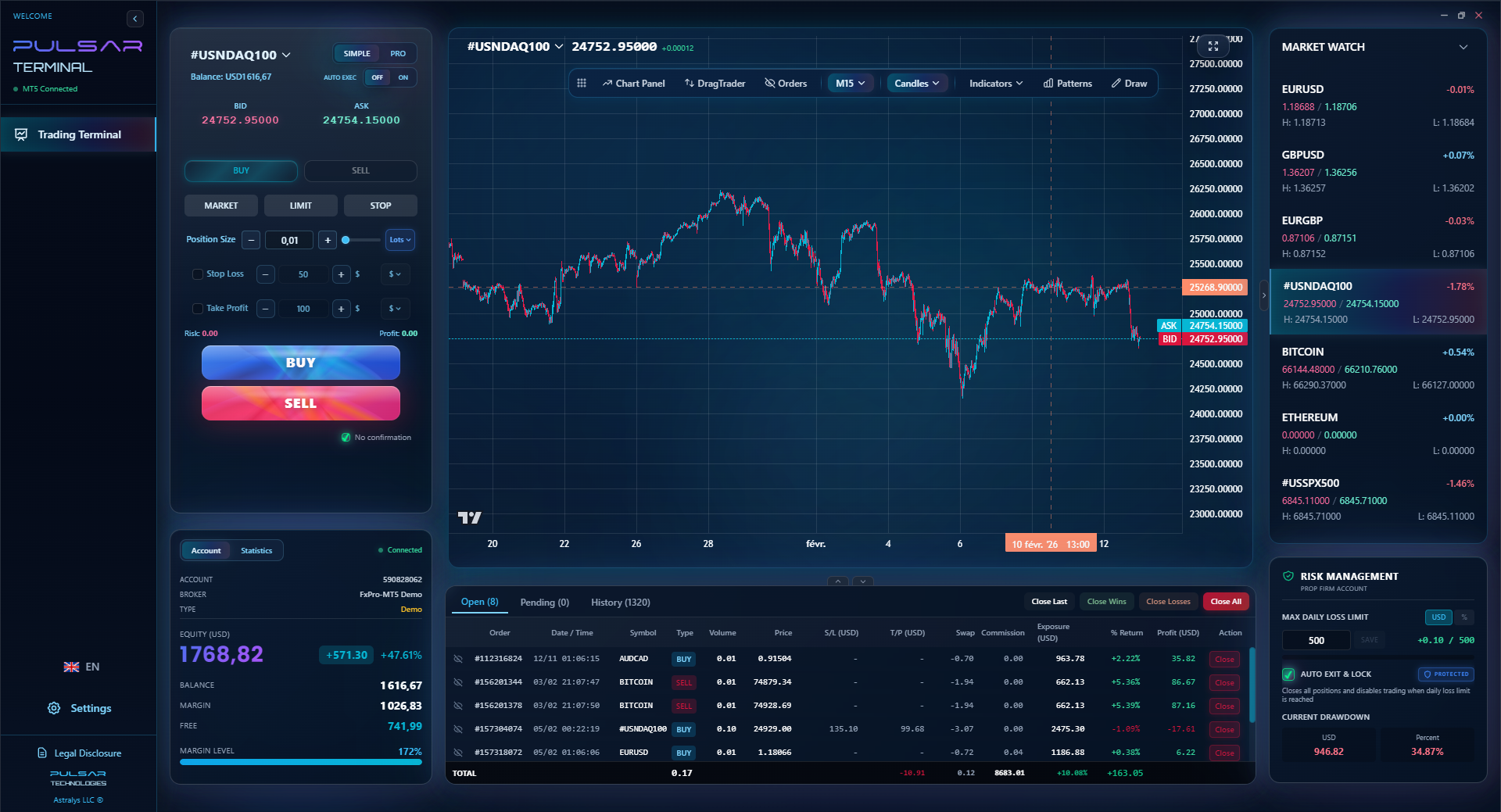
Manually moving stops and managing multiple trades across charts is inefficient; a tool like Pulsar Terminal lets you drag-and-drop orders and set advanced rules like trailing stops directly on your MT5 charts.
Pulsar Terminal
Универсальный инструмент для MT5: drag-and-drop ордера, мульти-TP/SL, трейлинг-стоп, грид-трейдинг, Volume Profile и защита для проп-фирм. Используется 1000+ трейдерами ежедневно.
“Your trading journal is the only mentor that never lies to you.”
Let's be realistic. Becoming a profitable retail trader is one path. It's a lonely, entrepreneurial grind. But the skills you learn open other doors.
1. The Retail Trader: You build your capital over years. You treat it as a business. Success means consistent returns that outpace a unit trust, with all the tax and emotional management that entails. It's a job.
2. The Prop Trader: You pass a firm's challenge and trade their capital. You get a performance-based income. This is the closest to a 'trading job' for most. The firms provide the infrastructure; you provide the edge.
3. The Finance Professional: The analysis, risk management, and economic understanding you develop are valuable in banks, asset managers, or fintech companies. That Citi Global Markets internship? This is the traditional route in. You'll value those EUR/USD guide fundamentals when analyzing carry trades for a sales desk.
4. The Related Fields: Trading knowledge is gold in roles like quantitative analysis, financial journalism, or even developing trading algorithms. Understanding what a margin call really feels like gives you insight no textbook can.
The common thread? None of these paths require a magical, expensive 'internship' with a guru. They require grit, self-education, and a relentless focus on process over profits, especially in the beginning.
💡 Совет Уинстона
The FSCA's 30:1 use cap isn't a limitation, it's a life raft. The guys boasting about 500:1 are just showing you how fast their ship can sink.
“If you can't follow your plan with R5 at risk, you will never follow it with R5,000.”
Stop researching and start doing. Here is your syllabus.
Weeks 1-4: Foundation.
- Open a demo account with an FSCA-regulated broker.
- Learn how to place a market order, a limit order, and set a stop-loss.
- Pick ONE major pair (start with EUR/USD). Ignore everything else.
- Watch 10 hours of basic economics videos (not trading signals) on what moves currencies.
Weeks 5-8: Strategy & Simulation.
- Choose ONE simple indicator system. The RSI indicator overbought/oversold on a daily chart is a decent start.
- Define your rules: Buy when RSI < 30 and price is at a weekly support level. Stop-loss 1.5% away. Take profit at 3%.
- Paper trade this system for 4 weeks. Log every trade in a spreadsheet.
- Review your journal every Friday. Did you follow your rules?
Weeks 9-12: Live Micro-Stakes.
- Deposit the minimum possible amount with your broker (e.g., R150).
- Trade your same system, but size so that your max risk per trade is no more than R5.
- The goal is to feel the emotion of real loss and real gain while following your plan.
- If you can't follow your plan with R5 at risk, you will never follow it with R5,000.
After 90 days, you'll have more legitimate trading experience than 95% of people who just buy signals. You'll have made every beginner mistake in a controlled environment. You'll be ready to learn, truly learn, because you'll have specific questions born from real experience. That's when seeking a mentor might actually make sense.
FAQ
Q1Are forex trading internships in South Africa legit?
Some are, most aren't. Legitimate ones are typically offered by large banks (like Standard Bank or Citi) for their Global Markets divisions and are formal, paid employment programs. The vast majority of ads for 'internships' are expensive educational courses or mentorship programs. Their value depends entirely on the individual mentor's skill and honesty, which is hard to verify.
Q2How much does a forex trading mentorship cost in South Africa?
Costs vary wildly. Basic online courses can be R1,000-R10,000. Group mentorship programs often range from R15,000 to R30,000. High-end, one-on-one coaching can cost R50,000 to over R100,000. There is no guarantee that a higher price means better education. Scrutinize what is promised and demand transparency on past performance.
Q3Is forex trading legal and regulated in South Africa?
Yes, completely legal. The Financial Sector Conduct Authority (FSCA) is the main regulator. Always use an FSCA-regulated broker to ensure client fund segregation and legal protection. The FSCA has capped use for retail traders at 30:1 on major pairs for locally regulated entities.
Q4Do I need to pay tax on my forex trading profits?
Absolutely yes. All net profits from trading, whether in a local or offshore account, are considered taxable income by SARS. You must declare it in your annual return. Failure to do so can result in penalties, interest, and legal trouble.
Q5What is a better alternative to a paid internship?
A disciplined self-directed 'internship' is far more valuable. 1) Trade a demo account for 3 months while journaling religiously. 2) Trade a micro live account (risk R5 per trade) for 3 months to learn emotional control. 3) Consider a prop firm trading challenge (like FTMO) as your final 'exam.' This path costs less and teaches you self-reliance.
Q6What's the single most important thing for a beginner to do?
Keep a detailed trading journal for every single trade, demo or live. Log your entry/exit reasoning, your emotional state, and the outcome. Review it weekly. This feedback loop is the only thing that will show you your repeated mistakes and slowly improve your process. It's your true mentor.
Урок проф. Уинстона
Ключевые выводы:
- ✓Verify brokers on the FSCA register before depositing.
- ✓All trading profits are taxable income for SARS.
- ✓Start with a demo account for at least 3 months.
- ✓use is capped at 30:1 for retail traders locally.
- ✓A detailed trade journal is non-negotiable.
Насколько полезна эта статья?
Нажмите на звезду
Еженедельные торговые инсайты
Бесплатный еженедельный анализ и стратегии. Без спама.
Об авторе
David van der Merwe
Трейдер развивающихся рынков
Трейдер из Йоханнесбурга с 11-летним опытом работы с валютами развивающихся рынков. Специализируется на ZAR-парах, торговле под регулированием FSCA и анализе южноафриканского рынка.
Комментарии
Предупреждение о рисках
Торговля финансовыми инструментами сопряжена со значительным риском и может не подходить всем инвесторам. Прошлые результаты не гарантируют будущих доходов. Данный контент носит исключительно образовательный характер и не является инвестиционной рекомендацией. Всегда проводите собственное исследование перед торговлей.
Вам также может понравиться

Cara Trading Forex Sukses: 7 Prinsip dari Trader Profesional
Cara trading forex sukses dengan 7 prinsip trader pro: manajemen modal, disiplin, journal trading, backtest. Data nyata, bukan janji profit palsu.
Jam Trading Forex Terbaik untuk Trader Indonesia: Panduan Lengkap dengan Tabel Waktu
Panduan jam trading forex untuk trader Indonesia. Tabel 4 sesi dunia, jam emas 20:00-00:00, sesi mana yang harus dihindari. Data akurat + tips dari trader berpengalaman.
Top 5 Sàn Forex Uy Tín Nhất 2026: Review Jujur dari Trader Indonesia
Top 5 sàn forex uy tín 2026 untuk trader Indonesia. Review jujur: spread, deposit, withdraw, dukungan lokal. Exness, XM, IC Markets & lebih.
Скачать Pulsar Terminal
Все эти калькуляторы встроены в Pulsar Terminal с данными в реальном времени с вашего счёта MT5.
Скачать Pulsar Terminal