


Let's cut through the noise.

Olumide Adeyemi
Пионер трейдинга в Западной Африке ·  Nigeria
☕ 10 мин чтения
Что вы узнаете:
- 1What is Forex and Why is Nigeria Hooked?
- 2The Legal & Tax Landscape: Your 10% Partner
- 3The Real Costs of Trading: Spreads, Swaps, and the Naira Squeeze
- 4Brokers & Funding: The Practical Guide
- 5Trading Basics & Realistic Strategies
- 6Risk Management: The Only Thing That Matters
- 7Getting Started: Your First 100 Days
Let's cut through the noise. The biggest myth about forex trading in Nigeria is that it's a quick, unregulated path to millions. Social media gurus sell this fantasy daily. The reality? It's a brutal, highly competitive business with new legal hurdles and a 10% taxman waiting for your profits. This forex trading overview isn't about getting rich. It's about understanding the actual playing field in 2026, from the new SEC rules to the real cost of a pip when your capital is in Naira. I'll show you what works, what's changed, and how not to get wiped out.
Forex is just the global marketplace for exchanging currencies. You're betting on the value of one currency against another. Simple concept, brutally hard execution.
Nigeria's obsession isn't random. Look at the numbers: a young, tech-savvy population, rampant inflation weakening the Naira daily, and limited traditional opportunities. When your local currency feels like it's melting in your hand, looking outwards makes sense. The global market turns over $9.6 trillion a day. That liquidity is seductive. It means you can get in and out of trades fast, unlike our stock market.
But here's the raw truth most won't tell you: that massive size doesn't make it easier for you. It makes it harder. You're competing against central banks, hedge funds with supercomputers, and millions of other retail punters just like you. The attraction is real, but so is the attrition rate. I've seen more accounts blown up in Lagos than I can count, all by people who understood the 'what' but not the 'how' or the 'how much it costs'.
“Forex trading in Nigeria is legal, but your 10% tax partner is always waiting for his share of your gross profits.”
This is where most guides from two years ago are dangerously outdated. The game changed in March 2025.
The New Law: ISA 2025
The Investments and Securities Act, 2025 (ISA 2025) is the big one. It's now illegal to operate an online forex trading platform in Nigeria without registering with the SEC. This targets the local bucket shops and scam "investment" schemes. However, and this is critical: as of right now, the SEC Nigeria still doesn't have a specific license for retail spot forex brokers. Their official advice? Use brokers regulated by top-tier international bodies like the UK's FCA or ASIC in Australia.
So, you're still mostly using international brokers. But the law signals a shift. The free-wheeling days are being reined in.
The 10% Rule You Can't Ignore
Let's talk about your silent partner: the taxman. In Nigeria, forex trading profits are subject to Capital Gains Tax at 10%. This isn't on your net profit after spreads and commissions. It's on your gross profit. You make ₦1,000,000 from trades? You owe ₦100,000. Full stop. It applies whether you use a broker in Cyprus or on the moon, and whether your money is here or offshore. Not declaring this is playing with fire. I learned this the hard way early on, getting a nasty surprise after a good quarter.

Warning: The 10% capital gains tax is on gross trading profits. Keep careful records of every closed trade. The tax authority won't care about your losses unless you can prove them.
CBN vs. SEC: Who Does What?
- Central Bank of Nigeria (CBN): Manages the Naira, the wholesale FX market, and monetary policy. They restrict how banks handle forex for speculation. This affects how you fund your account (more on that later).
- SEC Nigeria: Now, under ISA 2025, they regulate the platforms and intermediaries. They're your (theoretical) protector against platform fraud.

💡 Совет Уинстона
Your first profitable trade is your most dangerous. It convinces you you're a genius, right before the market takes its tuition fee.
“Using high use without a position size calculator isn't trading; it's signing a waiver for your account balance.”
Forget the 'free' signals. Trading is a business with overheads. If you don't know your costs, you're not a trader, you're a donor.
The Spread: This is the difference between the buy and sell price. It's your immediate cost of entry. On EUR/USD, a good standard account might have a 0.8 pip spread. A raw ECN account might have 0.0 pips but charge a commission (e.g., $3.50 per lot). You need to know which suits your style. Scalping with wide spreads is a recipe for failure.
Swap Rates (Overnight Financing): Hold a position past 5 PM NY time? You pay or earn interest. For a currency like the USD/NGN? Forget it, you'll never get a positive swap holding Naira. It's always a cost. I once held a USD/ZAR trade for a week, forgetting about swaps. The position won, but the swaps ate 35% of the profit. A painful lesson in attention to detail.
The Naira Problem: Your capital is in Naira. Your broker account is in USD. Every deposit and withdrawal is a forex transaction itself. If the Naira weakens between when you deposit and withdraw, your buying power shrinks even if your trading breaks even. You're effectively making a long-term bet on the Naira whenever you fund your account. Using a domiciliary account can help, but it's another layer.

Example: You deposit ₦1,000,000 when USD/NGN is 1,500. That's $666.67. You trade brilliantly, grow it to $800. But when you withdraw, USD/NGN is 1,600. Your $800 is now ₦1,280,000. A ₦280,000 gain. Minus 10% tax (₦28,000) = ₦252,000 real profit. Now subtract all your trading costs. See how it shrinks?
“Using high use without a position size calculator isn't trading; it's signing a waiver for your account balance.”
You won't find a Nigerian broker regulated by the SEC for spot forex yet. So you're going international. This is fine, but you must be selective.
Choosing a Broker: Regulation is non-negotiable. Look for FCA (UK), ASIC (Australia), CySEC (Cyprus), or FSCA (South Africa). These entities have client money protection rules. I've had funds stuck with a shady broker years ago. Never again. Check our deep dives on specific brokers like Exness review or IC Markets review for the nitty-gritty.
Funding Your Account (The CBN Hurdle): This is a major headache. CBN restrictions make using your Naira debit card for large international payments unreliable. Here’s what actually works:
- Domiciliary Account: Fund it, then transfer USD to your broker. Most reliable method.
- E-Wallets: Neteller, Skrill, and the like. They act as a middleman. Fees apply.
- Cryptocurrency: Many brokers now accept BTC, USDT, etc. Fast and bypasses traditional banking rails. Volatility risk during transfer is a factor.
- Local Payment Processors: Some brokers integrate with platforms like Flutterwave or Paystack for Naira deposits, which they convert.
Withdrawals: This is the moment of truth. Some brokers like Exness are famous for instant processing to e-wallets. Bank transfers take 1-5 business days. Always factor this in; never withdraw money you need for an emergency tomorrow.
use: It's a double-edged sword. Yes, some offshore brokers offer 1:500 or even 1:1000. Using that without a position size calculator is financial suicide. 1:30 is more than enough to blow an account if you're reckless.
💡 Совет Уинстона
If you can't articulate the exact reason for your trade in one sentence before you click 'buy', you're gambling, not trading.
“Your biggest opponent isn't the hedge funds or the banks. It's the person in the mirror making emotional decisions.”
You know the costs and the rules. Now, how do you actually trade?
The Jargon:
- A Pip: The smallest price move. For most pairs, it's 0.0001. For USD/JPY, it's 0.01. Know what you're counting. Here's a full pip definition.
- A Lot: Standard lot is 100,000 units of currency. A 1-pip move = $10. Most mortals trade mini (0.1) or micro (0.01) lots.
- Margin & Margin Call: Margin is the collateral you put up to open a trade. Use too much, and a small move against you triggers a margin call and automatic liquidation.
Analysis Types:
- Technical Analysis: Reading charts. Using indicators like RSI indicator or MACD indicator to find patterns and potential entries. This is what most retail traders do.
- Fundamental Analysis: Trading based on economic news, interest rates, and geopolitics. Why is the CBN raising rates? What does that do to USD/NGN? This is harder but more powerful.
Strategy Styles:
- Scalping: Taking 5-10 pips, dozens of times a day. Requires intense focus, low spreads, and a iron stomach. Not for beginners. See a scalping strategy breakdown.
- Swing Trading: Holding trades for days or weeks, catching larger moves. More manageable for people with day jobs. Learn more about swing trading principles.
- My Experience: I started as a scalper, glued to the screen. I made money, then gave it all back on one emotional overtrade. I now swing trade major pairs like EUR/USD and XAU/USD (gold), holding for macroeconomic trends. It's less stressful and more profitable for me.

Pro Tip: Don't collect indicators like Pokémon cards. Master one chart setup and one risk management method. A simple 20-period moving average and price action can beat a messy chart with 10 oscillators any day.
“Your biggest opponent isn't the hedge funds or the banks. It's the person in the mirror making emotional decisions.”
This is the section that will save your account. Everything else is secondary.
The 1% Rule: Never, ever risk more than 1% of your account balance on a single trade. Got ₦1,000,000? Your max risk per trade is ₦10,000. This means your stop-loss distance and position size are calculated together. If your stop is 50 pips away on EUR/USD, you size your position so that 50 pips lost = ₦10,000. This is where a position size calculator is essential.
Stop-Loss Orders: You must use them. Every. Single. Time. A stop-loss is not a failure; it's an insurance policy. Setting it is an admission that you can be wrong. If you can't admit that, don't trade.
Take Profit & Risk/Reward: Aim for a risk/reward ratio of at least 1:2. You risk ₦10,000 to make ₦20,000. This means you can be wrong half the time and still break even. Most beginners do the opposite: they risk ₦20,000 to make ₦5,000, which is a guaranteed path to ruin.
Psychology: This is the real battle. Fear of missing out (FMO), greed, revenge trading after a loss. I've broken every rule here out of emotion. The only fix is a trading plan written in cold blood, away from the charts, and the discipline to follow it like a robot. Your biggest opponent is in the mirror.
💡 Совет Уинстона
The market doesn't care about your rent, your ego, or your winning streak. It only responds to collective fear and greed. Trade the chart, not your needs.
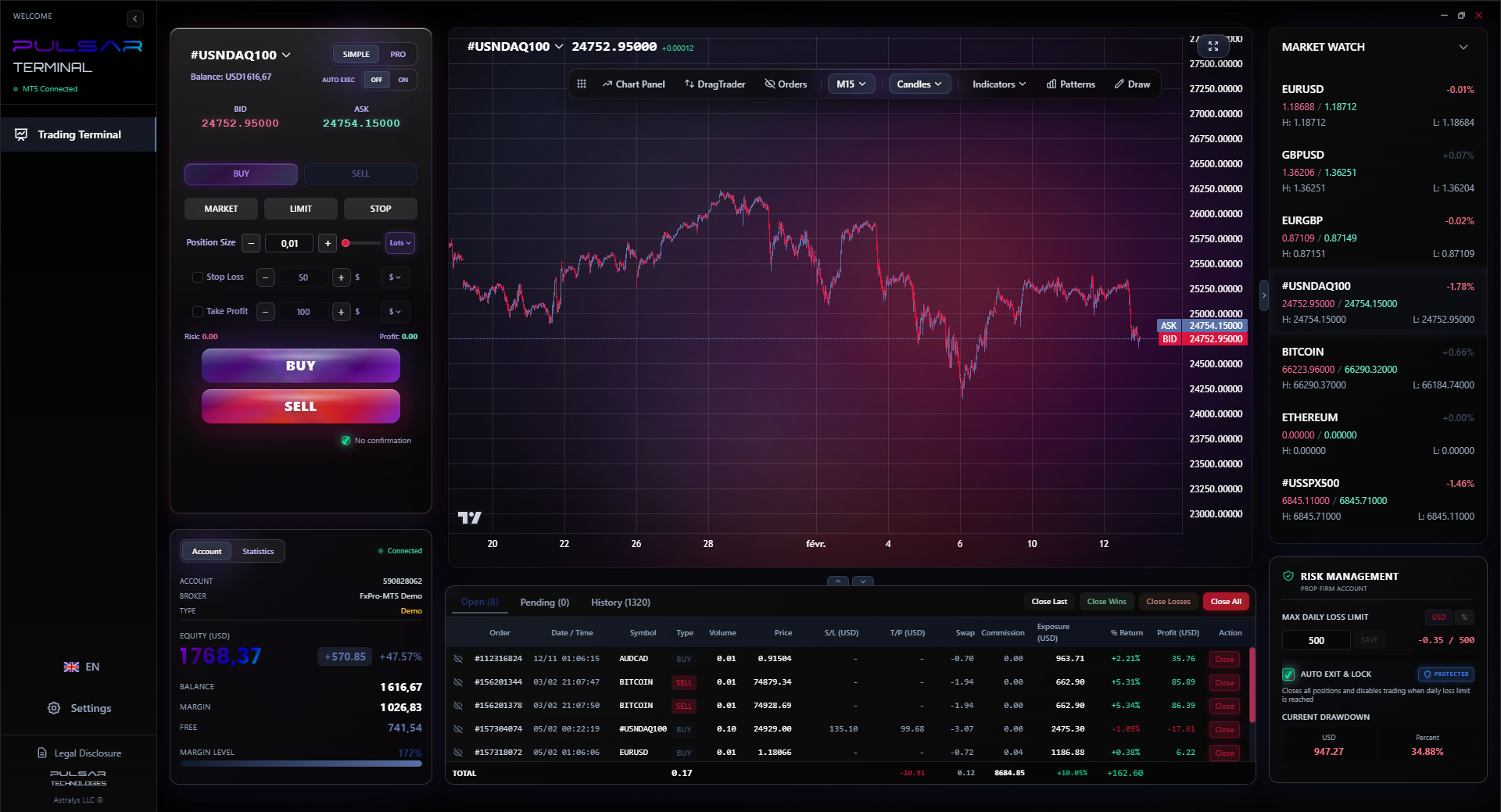
Sticking to a 1% risk rule and managing multiple take-profit levels is tedious manually, but tools like Pulsar Terminal automate this directly on your MT5 chart.
Pulsar Terminal
Универсальный инструмент для MT5: drag-and-drop ордера, мульти-TP/SL, трейлинг-стоп, грид-трейдинг, Volume Profile и защита для проп-фирм. Используется 1000+ трейдерами ежедневно.
“A stop-loss isn't a failure. It's the admission fee for staying in the game long enough to win.”
Here's a step-by-step plan that won't get you rich quick but might keep you in the game.
- Educate, Don't Speculate: Spend your first month learning, not trading. Understand the terms, the platforms (MT4/MT5 are industry standard), and the news cycle.
- Open a Demo Account: Do this with a reputable broker like Pepperstone or XM. Trade it for at least 3 months. Your goal isn't to make fake money. Your goal is to test your strategy and psychology without risk. Can you follow your rules for 100 trades?
- Start Absurdly Small: When you go live, deposit the absolute minimum. Trade micro lots (0.01). Your goal for the first 6 months is not profit. It's to break even. If you can cover your costs (spreads, swaps) over 6 months, you're in the top 20% of beginners.
- Keep a Trading Journal: Log every trade. Entry, exit, reason, emotion. Review it weekly. This is your single most valuable tool for improvement.
- Ignore the Noise: Unfollow the 'gurus' showing off Lamborghinis. Join communities that discuss analysis and risk, not just screenshots of wins.
The forex market will be here tomorrow. Your job is to make sure your account is too. This forex trading overview is your map of a dangerous but navigable territory. Now, go practice on demo.
FAQ
Q1Is forex trading legal in Nigeria?
Yes, trading forex with your personal funds is legal for individuals. However, the operation of online forex trading platforms within Nigeria now requires registration with the SEC under the new ISA 2025 law. Most Nigerian traders use internationally regulated brokers, which is the current practical and advised approach.
Q2How much tax do I pay on forex profits in Nigeria?
You pay a 10% Capital Gains Tax on your gross trading profits. This is not optional. You must declare this income and pay the tax, regardless of which international broker you use.
Q3What is the best broker for Nigerian traders?
There's no single 'best' broker. You need one that is regulated by a top-tier authority (like FCA, ASIC, CySEC), offers reliable deposit/withdrawal methods for Nigeria (e-wallets, crypto, domiciliary account transfers), and has competitive costs on the instruments you trade. Our detailed reviews of brokers like Exness and IC Markets can help you compare.
Q4How much money do I need to start forex trading?
You can start with a very small amount due to micro lots. Some brokers have minimum deposits as low as $10 or even $0. However, you should only trade with capital you can afford to lose completely. A more realistic 'learning' amount is $100-$200, trading 0.01 lots to properly experience real costs and emotions.
Q5Can I use my Nigerian debit card to fund a forex account?
It's often problematic due to CBN restrictions on international transactions for speculative purposes. It may work for small amounts but frequently gets declined. More reliable methods are funding a domiciliary account and doing a USD wire transfer, using e-wallets (Neteller, Skrill), or using cryptocurrency.
Q6What is a good risk/reward ratio?
Aim for a minimum of 1:2. This means your potential profit target is at least twice the distance of your stop-loss. For example, if you risk 50 pips (₦10,000), your target should be at least 100 pips away (₦20,000). This allows you to be profitable even if you're right less than 50% of the time.
Q7What's more important, technical or fundamental analysis?
For beginners, technical analysis (chart reading) is more accessible. But for long-term success, understanding fundamentals (interest rates, economic data, geopolitics) is crucial. They work together: fundamentals give you the direction of the major trend, and technicals help you find a precise entry point within that trend.
Урок проф. Уинстона
Ключевые выводы:
- ✓ISA 2025 changed the game: Platforms need SEC registration.
- ✓10% capital gains tax applies to gross profits, always.
- ✓Risk a maximum of 1% of your account per trade.
- ✓Aim for a minimum 1:2 risk-to-reward ratio.
- ✓Funding via domiciliary accounts or crypto bypasses card issues.
Насколько полезна эта статья?
Нажмите на звезду
Еженедельные торговые инсайты
Бесплатный еженедельный анализ и стратегии. Без спама.
Об авторе
Olumide Adeyemi
Пионер трейдинга в Западной Африке
Один из самых активных преподавателей форекс-трейдинга в Нигерии. 8 лет торгового опыта из Лагоса. Специализируется на стратегиях с малым капиталом и челленджах проп-фирм для африканских трейдеров.
Комментарии
Предупреждение о рисках
Торговля финансовыми инструментами сопряжена со значительным риском и может не подходить всем инвесторам. Прошлые результаты не гарантируют будущих доходов. Данный контент носит исключительно образовательный характер и не является инвестиционной рекомендацией. Всегда проводите собственное исследование перед торговлей.
Вам также может понравиться

Cara Trading Forex Sukses: 7 Prinsip dari Trader Profesional
Cara trading forex sukses dengan 7 prinsip trader pro: manajemen modal, disiplin, journal trading, backtest. Data nyata, bukan janji profit palsu.
Jam Trading Forex Terbaik untuk Trader Indonesia: Panduan Lengkap dengan Tabel Waktu
Panduan jam trading forex untuk trader Indonesia. Tabel 4 sesi dunia, jam emas 20:00-00:00, sesi mana yang harus dihindari. Data akurat + tips dari trader berpengalaman.
Top 5 Sàn Forex Uy Tín Nhất 2026: Review Jujur dari Trader Indonesia
Top 5 sàn forex uy tín 2026 untuk trader Indonesia. Review jujur: spread, deposit, withdraw, dukungan lokal. Exness, XM, IC Markets & lebih.
Скачать Pulsar Terminal
Все эти калькуляторы встроены в Pulsar Terminal с данными в реальном времени с вашего счёта MT5.
Скачать Pulsar Terminal