


Over 300,000 Nigerians are actively trading forex, with a staggering 93.7% of them under 35.

Olumide Adeyemi
Пионер трейдинга в Западной Африке ·  Nigeria
☕ 13 мин чтения
Что вы узнаете:
Over 300,000 Nigerians are actively trading forex, with a staggering 93.7% of them under 35. The market's turnover jumped 56.4% to $8.6 billion in 2025. Those are the shiny pictures you see on social media. But here's the one they don't show: for every trader posting a Lamborghini, there are a hundred quietly nursing margin calls from trading USD/NGN with 80-pip spreads. I've been both. This isn't a hype piece. It's a journal entry from the trenches, showing you the real, unedited forex trading pictures from Lagos to Port Harcourt.
Let's clear this up first. Yes, forex trading is legal for you as an individual in Nigeria. But the 'how' is where it gets tricky, and where I've seen friends get burned.
The Central Bank of Nigeria (CBN) and the Securities and Exchange Commission (SEC) are the main players. The CBN regulates the banks and the official foreign exchange windows. Their biggest rule for you? You cannot use official CBN windows to fund your trading account. Trying to get dollars from your bank at the official rate to send to Exness or IC Markets is a fast track to getting your account flagged.
The SEC's role has evolved dramatically. Back in 2021, they basically said retail forex was the wild west. Not anymore. The new Investments and Securities Act (ISA) 2025 is a game-changer. It now requires any platform offering online forex trading services in Nigeria to register with the SEC. This is huge. It's meant to clean up the space, shutting down the shady 'fund management' schemes that promise 50% monthly returns.

Warning: Any 'broker' or 'investment platform' operating physically in Nigeria without SEC registration is operating illegally under the new 2025 act. Stick with internationally regulated brokers.
Here's the practical reality most Nigerians use: we sign up with international brokers regulated abroad (think FSCA, CySEC, ASIC). Your profit from these is still subject to a 10% Capital Gains Tax with the FIRS. I know, I know... most don't declare it. But that's the law on the books.
The biggest daily headache isn't the SEC, though. It's your bank. Funding your broker account is a constant battle. Naira card limits for international transactions change like the weather. You'll need to get creative with wire transfers, crypto, or payment processors. My first major deposit got held up for two weeks in 'regulatory checks.' I missed a massive move on Gold. Lesson learned: factor in deposit and withdrawal time as part of your trading cost.

💡 Совет Уинстона
A chart is just a picture of past auctions. Your job isn't to predict the next auction, but to assess the probability of who's in control: the buyers who last bought high, or the sellers who last sold low. Trade the imbalance, not the hope.
When you see an ad screaming '0.0 pips on EUR/USD!', that's a snapshot. It's not the whole movie. The real cost picture for a Nigerian trader has more layers.
Let's talk spreads first, with real numbers from my trading logs. On a good ECN account with a broker like IC Markets or Pepperstone, you can get EUR/USD at 0.1 pips, plus a $3.50 commission per $100k lot. That's clean. But try trading something closer to home, like USD/NGN. I made this mistake early on. The spread was routinely 95 to 120 pips. That's right. To even break even on a short-term trade, the market had to move 120 pips in my favor just to cover the cost of entry and exit. It's a sucker's game for scalping.
| Currency Pair | Typical Spread (Pips) | Note for Nigerian Traders |
|---|---|---|
| EUR/USD | 0.1 - 0.6 | The benchmark. Tighter is better. |
| GBP/NGN | 80 - 150+ | Extremely wide. Avoid for short-term. |
| XAU/USD (Gold) | 25 - 50 | Normal for commodities. Mind the pip value. |
| USD/JPY | 0.2 - 0.8 | Generally good liquidity. |
Then there's the hidden tax: slippage. During major news events (like CBN MPC announcements), even your '0.0 pip' spread can blow out. I entered a sell on GBP/USD during high volatility once. My order filled 8 pips below my requested price. That's an instant $80 loss on a standard lot before the market even moved.
Finally, the funding cost. Bank wire fees to send money to your broker can be ₦2,000 to ₦5,000. Some payment processors charge 2-3%. If you're depositing $500, that's another $15 gone. You need to make that back in profits just to get back to zero. This is why proper position size is non-negotiable. A 2% risk on a $500 account isn't just about protecting capital, it's about absorbing these real-world friction costs.
“High use isn't just about margin calls. It's about emotional use. It magnifies fear and greed.”
This is the part of the forex trading pictures that gets the most filters. use of 1:500, 1:1000, even 'unlimited.' It looks like a superpower. And it is. It just happens to be a superpower that blows up accounts with the same efficiency it grows them.
I'll give you a real, embarrassing example from my third year trading. My account was at $2,300. I was feeling clever. I used 1:1000 use on a micro lot (1,000 units) trade on AUD/USD. The math was seductive. A 10-pip move would make me $1. With that use, my margin requirement was tiny, so I thought I was being 'safe.'
I got greedy. I put on 20 micro lots. My margin was still only about $46. But my exposure was $20,000. The trade went against me by 23 pips. A 23-pip move on a $20,000 position? A $46 loss. Wait, that's not right. Let me calculate that again...

Example:
- Position: 20 micro lots = 20,000 units
- Pip value for AUD/USD (approx.): $0.10 per pip per micro lot
- Loss: 23 pips
- Total Loss: 20 lots * $0.10 * 23 pips = $46
See? Even I had to double-check. The loss in dollars was manageable. But here's the real picture: I lost $46 on a $2,300 account. That's a 2% risk. Perfectly acceptable. The problem was the psychological damage. Seeing those 20 open positions swinging wildly, each little pip movement representing $2 of P&L volatility, shredded my nerves. I closed the trade early out of fear, missing out on the eventual reversal that would have hit my profit target. The high use didn't bankrupt me, but it made me act like an amateur.
High use isn't just about margin calls. It's about emotional use. It magnifies fear and greed. Most successful swing trading I've done has been with use under 1:30. It forces you to be patient and pick your spots. The guys offering 1:2000 aren't doing you a favor. They're giving you enough rope to hang yourself, because they know most clients will.
You can stare at MACD crossovers on the EUR/USD all day. But if you're not also watching the charts that move the Nigerian market, you're trading blindfolded.
The DXY (US Dollar Index)
This is the mother of all charts for a forex trader. When the DXY strengthens, it typically pressures EUR/USD and GBP/USD lower. For us trading majors, this is a crucial leading indicator. I have it on a separate monitor at all times. A strong, sustained breakout on the DXY chart often means it's time to look for sell opportunities on Euro and Pound.
Crude Oil Price (Bonny Light)
Nigeria's lifeblood. When oil prices rally, it generally improves Nigeria's foreign exchange reserves outlook. This can sometimes (not always) ease pressure on the Naira and influence CBN policy. I don't trade oil directly from this, but a crashing oil price is a red flag for me to be extra cautious with any Naira-related trades or assumptions about economic stability.
The CBN Monetary Policy Committee (MPC) Calendar
This isn't a price chart, but it's the most important calendar event for any trader with money in Nigeria. The MPC sets the Monetary Policy Rate (MPR). Their decisions and commentary can cause wild swings in the parallel market rate for the Naira. I mark these dates in bright red. I never hold significant, high-use positions across an MPC meeting. The volatility is unpredictable and can gap right through your stop loss.

Pro Tip: Don't just chart currency pairs. Chart your own psychology. Keep a simple journal: 'Felt fearful during London session, closed EUR trade early.' Over time, you'll see your own repetitive patterns on the chart of your mind. That's the most valuable chart you'll ever analyze.
💡 Совет Уинстона
If you can't write down your exact entry, stop loss, and take profit logic before you click 'buy,' you're not trading. You're gambling. A plan doesn't guarantee a win, but a lack of one guarantees a loss over time.
“The most beautiful forex trading picture you can ever create is a steady, upward-sloping equity curve over five years. No drama. Just disciplined growth.”
Enough theory. Let's get into the messy details of my trading journal. These are the unfiltered forex trading pictures.
Trade 1: The Humiliating Gold Trade (2023)
- Instrument: XAU/USD (Gold)
- Thesis: Price bounced off strong support at $1810. RSI showed bullish divergence on the 4-hour chart. Looked like a classic reversal.
- Action: Bought 0.5 lots at $1815. Stop Loss at $1807 (8 pip risk, $400). Take Profit at $1835.
- What Happened: I was right about the direction. Price climbed to $1829. Then, the US Non-Farm Payrolls data hit. A monster beat. Dollar skyrocketed, Gold tanked. It blew straight through my stop loss. My order filled at $1802. A 13-pip loss, not 8.
- Loss: $650 (13 pips * $50 per pip on 0.5 lots).
- Lesson: I ignored the economic calendar. I had a great technical setup, but I was trading into a high-impact news event. My stop loss was a hope, not a guarantee. I now use an economic filter on my charting platform. No major trades 30 minutes before or after red-news events.
Trade 2: The Patient Euro Win (2024)
- Instrument: EUR/USD
- Thesis: After a long downtrend, price formed a clear double bottom on the daily chart. This was a swing trading setup, not a scalp.
- Action: Bought 0.2 lots at 1.0725. Stop Loss at 1.0650 (75 pips). Take Profit at 1.0950.
- What Happened: I entered. Price waffled for two weeks, going nowhere. It tested my stop area twice. I didn't move it. I trusted my analysis. On the third week, it broke upward. It took 19 days total to hit my profit target.
- Profit: $450 (225 pips * $2 per pip on 0.2 lots).
- Lesson: Patience is a strategy. Using lower use (this trade used about 1:15) allowed me to withstand the drawdown without panic. I didn't check the chart every hour. I set alerts and walked away. This single trade made back my Gold loss and then some, but it required a completely different mindset.
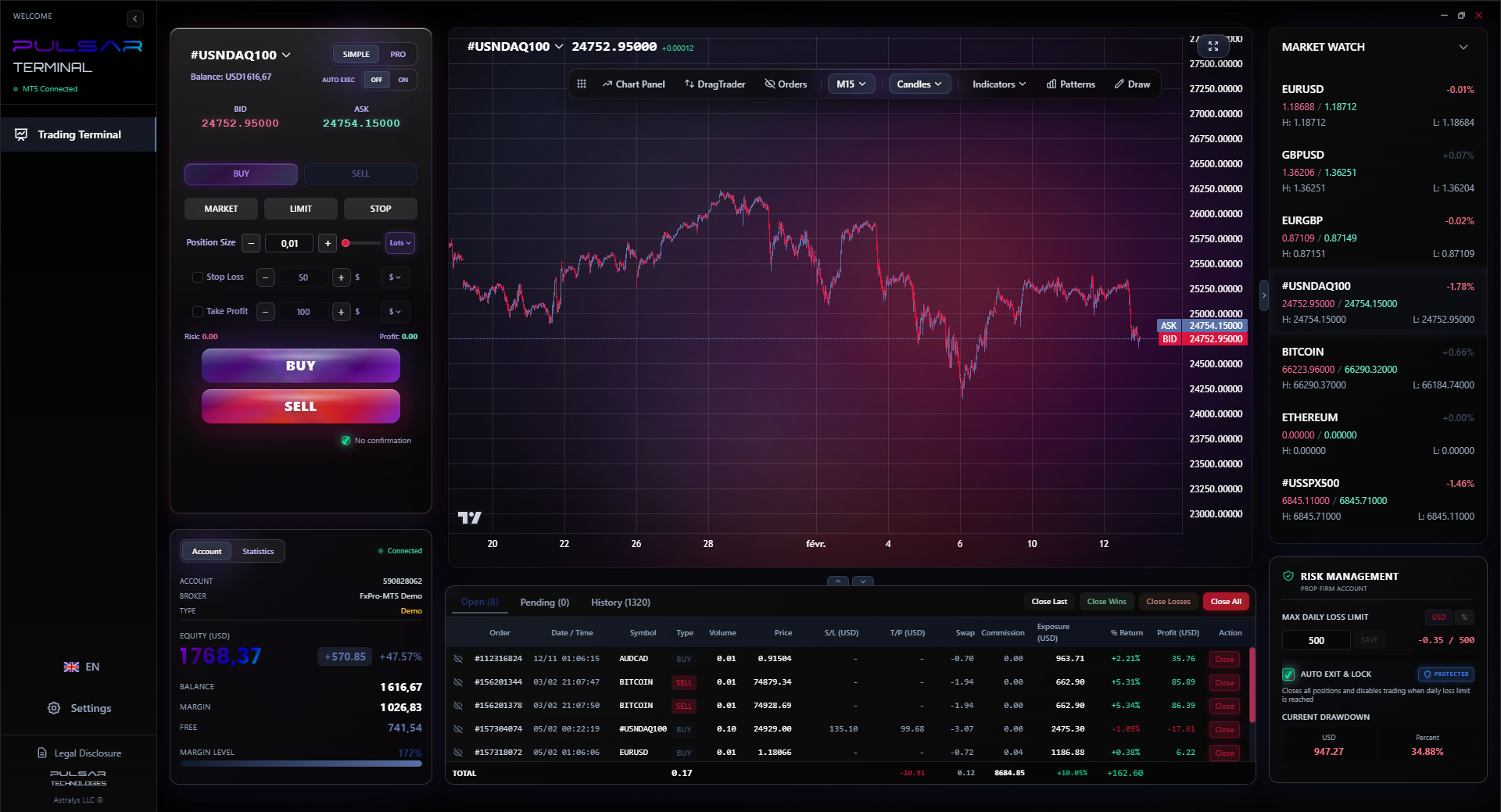
Managing complex trades with multiple targets and trailing stops is stressful, but tools like Pulsar Terminal automate this directly on your MT5 platform, letting you focus on analysis instead of order management.
Pulsar Terminal
Универсальный инструмент для MT5: drag-and-drop ордера, мульти-TP/SL, трейлинг-стоп, грид-трейдинг, Volume Profile и защита для проп-фирм. Используется 1000+ трейдерами ежедневно.
Your broker is your gateway. A bad one will ruin you before the markets get a chance. I've tested many. Here’s my blunt take.
Forget the fancy bonuses. Look for these three things: 1) Solid international regulation (FSCA, ASIC, CySEC), 2) Reliable deposit/withdrawal methods for Nigeria, and 3) Consistently tight spreads on the pairs you trade.
Exness: They're huge here for a reason. Their local deposit options are often seamless, and they offer those crazy high use amounts. But be careful. That ease of access can make overtrading too easy. I use them for testing strategies on a small account, but not for my main capital.
IC Markets & Pepperstone: These are my go-to for serious trading. Their raw spreads are consistently among the best, and execution is fast. Funding them from Nigeria is harder (usually requires a wire transfer or crypto), but the trading environment is professional. It feels like a real market, not a casino. Read our deep dives on IC Markets and Pepperstone for more.
XM and Others: XM is another popular option with good local support. They often have lower minimum deposits, which is great for starting out. Do your own research on their XM review and others.
The biggest red flag? A broker that's only 'registered' in offshore islands with no other oversight, and whose website is covered in promises of guaranteed profits. If their customer service is pushing you to deposit more to 'recover losses,' run. A good broker is a neutral platform, not your cheerleader.
“For every trader posting a Lamborghini, there are a hundred quietly nursing margin calls from trading USD/NGN with 80-pip spreads.”
Copying a strategy from a trader in London or New York won't work. Our context is different. Our internet cuts out during a trade. We have power outages. Our market sentiment is swayed by different things.
First, align your strategy with your reality. If you have a 9-5 job, don't try to become a 5-minute chart scalper. You'll get caught in a meeting while your trade burns. Swing trading on daily or 4-hour charts is often a better fit. It lets you analyze at night, place your trades, set stops and targets, and live your life.
Second, incorporate 'Naira factors' into your analysis. Before you go long on a currency pair that involves the USD, ask: Is the CBN MPC meeting this week? What's the price of oil doing? This is fundamental analysis for the Nigerian trader.
Third, start with a demo, but transition to a live micro account fast. Demo trading doesn't teach you the emotional discipline you need when real money, your money for data or light bill, is on the line. Start with $50. Use a position size calculator to risk no more than $1 per trade (2%). The goal isn't to get rich from $50. The goal is to execute 100 trades with perfect discipline. If you can do that, then you can scale.
Finally, your edge won't be a secret indicator. It will be your patience, your discipline, and your understanding of the unique pressures on the Nigerian market. The guy who wins is the one who sits calmly while everyone else is panicking because of a news headline on Twitter. That calm is a strategy.
💡 Совет Уинстона
The Naira's pressure is a fundamental fact, not a tradeable signal on your EUR/USD chart. Separate local economic anxiety from your cold, technical analysis. Don't let news from Abuja dictate your stop loss on a Yen pair.
Where is this all going? The SEC's 2025 act is a sign. Regulation is coming, and that's good. It will weed out the scams and force more transparency. It might also restrict some of the extreme use offers, which would save a lot of new traders from themselves.
More Nigerian fintechs will likely partner with international brokers to create smoother, localized on-ramps. The trading technology itself is becoming more accessible. Tools that were once only for hedge funds are now in retail platforms.
But the core won't change. The market will still be a brutal teacher. The psychological battle will still be 80% of the game. The pictures on social media will get even more glamorous and misleading.
Your job is to focus on your own chart. Your equity curve. Your journal. Build a process so strong that a string of losses doesn't break you, and a string of wins doesn't make you a genius. The most beautiful forex trading picture you can ever create is a steady, upward-sloping equity curve over five years. No drama. No Lamborghinis. Just consistent, disciplined growth. That's the picture worth aiming for.
FAQ
Q1Is forex trading illegal in Nigeria?
No, it is not illegal for individuals to trade forex. However, the new Investments and Securities Act (ISA) 2025 makes it illegal for platforms to offer forex trading services in Nigeria without registering with the SEC. As a trader, you are legal, but you must use brokers that comply with the law, which typically means using internationally regulated brokers.
Q2What is the best use for a beginner in Nigeria?
Start with no use. Seriously. Use 1:1. Once you are consistently profitable on a demo and then a micro account for 3-6 months, move to 1:10 or 1:20. The 1:500 and 1:1000 you see advertised are professional-grade tools that will destroy a beginner's account. Your goal is to learn, not to blow up.
Q3Why are spreads on USD/NGN so wide?
Extremely wide spreads (80-100+ pips) indicate low liquidity and high volatility in that specific pairing on the retail broker market. It's not a heavily traded pair on major platforms because the underlying Naira market is controlled and has a parallel market. Brokers widen spreads to protect themselves from the risk. Avoid trading these exotics for short-term strategies.
Q4How do I fund my international broker account from Nigeria?
It's a challenge. Common methods include: international bank wire transfers (but be mindful of fees and CBN restrictions), using cryptocurrency (many brokers accept crypto deposits), or through authorized international payment processors. Always check your broker's specific deposit options for Nigeria.
Q5Do I pay tax on my forex trading profits?
Yes, according to Nigerian law, forex trading profits are subject to Capital Gains Tax, which is currently 10%. You are required to declare this income to the Federal Inland Revenue Service (FIRS). In practice, compliance is low, but it is the legal requirement.
Q6Can I make a living from forex trading in Nigeria?
It is possible, but it is exceptionally difficult and statistically unlikely. Treat it as a serious side business that requires years of education and small-scale practice. Do not quit your job to trade. Build a track record of consistent profitability over years, and have at least 2 years of living expenses saved before even considering relying on trading income.
Q7What time is best to trade forex in Nigeria?
The most liquid and volatile sessions overlap from 9 AM to 12 PM Nigerian Time (when the London session is fully open). The New York session opens at 2 PM Nigerian Time, creating another period of high activity. Avoid trading during dead hours like late night Nigerian time (Asian session only), unless that's specifically part of your strategy.
Урок проф. Уинстона
Ключевые выводы:
- ✓Start use at 1:1, not 1:1000.
- ✓Add 30% to your calculated spread cost for real slippage.
- ✓Mark CBN MPC dates in red. No high-use trades.
- ✓A 2% risk rule absorbs real-world funding fees.
Насколько полезна эта статья?
Нажмите на звезду
Еженедельные торговые инсайты
Бесплатный еженедельный анализ и стратегии. Без спама.
Об авторе
Olumide Adeyemi
Пионер трейдинга в Западной Африке
Один из самых активных преподавателей форекс-трейдинга в Нигерии. 8 лет торгового опыта из Лагоса. Специализируется на стратегиях с малым капиталом и челленджах проп-фирм для африканских трейдеров.
Комментарии
Предупреждение о рисках
Торговля финансовыми инструментами сопряжена со значительным риском и может не подходить всем инвесторам. Прошлые результаты не гарантируют будущих доходов. Данный контент носит исключительно образовательный характер и не является инвестиционной рекомендацией. Всегда проводите собственное исследование перед торговлей.
Вам также может понравиться

Cara Trading Forex Sukses: 7 Prinsip dari Trader Profesional
Cara trading forex sukses dengan 7 prinsip trader pro: manajemen modal, disiplin, journal trading, backtest. Data nyata, bukan janji profit palsu.
Jam Trading Forex Terbaik untuk Trader Indonesia: Panduan Lengkap dengan Tabel Waktu
Panduan jam trading forex untuk trader Indonesia. Tabel 4 sesi dunia, jam emas 20:00-00:00, sesi mana yang harus dihindari. Data akurat + tips dari trader berpengalaman.
Top 5 Sàn Forex Uy Tín Nhất 2026: Review Jujur dari Trader Indonesia
Top 5 sàn forex uy tín 2026 untuk trader Indonesia. Review jujur: spread, deposit, withdraw, dukungan lokal. Exness, XM, IC Markets & lebih.
Скачать Pulsar Terminal
Все эти калькуляторы встроены в Pulsar Terminal с данными в реальном времени с вашего счёта MT5.
Скачать Pulsar Terminal