


You've probably seen it.

Olumide Adeyemi
Пионер трейдинга в Западной Африке ·  Nigeria
☕ 11 мин чтения
Что вы узнаете:
- 1Why Quora Forex Answers Are Often Dangerous (And What to Look For)
- 2The Nigerian Forex Rules You Can't Ignore (2026 Update)
- 3The Real Costs of Trading in Nigeria (Beyond the Spread)
- 4The Broker Landscape for Nigerians: Who's Legit in 2026?
- 5Building a Strategy, Not Following a Quora Post
- 6Managing Risk & The Naira Volatility Wildcard
- 7Your Next Steps After Reading This (Not Another Quora Thread)
You've probably seen it. A Quora question like 'Can I make 500k Naira daily from forex?' followed by a dozen answers promising secret strategies and instant wealth. Here's a fact that cuts through the noise: over 70% of retail forex traders lose money. In Nigeria, with over 500,000 active traders, that's a lot of dashed hopes. This guide isn't about Quora fantasies. It's about the real, regulated, and often harsh landscape of forex trading here, updated for the new SEC rules in 2025 and the current Naira reality.
Let's be blunt. Quora is a mixed bag. For every genuine trader sharing a hard-won lesson, there are ten 'gurus' selling a dream. The platform's structure rewards engagement, not accuracy. I've spent hours down rabbit holes there, and it cost me real money early on.
I remember reading a detailed answer in 2021 about a 'guaranteed' gold scalping strategy that used a bizarre RSI setting. I tried it on XAU/USD and blew 15% of my account in a week. The strategy was overly optimized for past data and fell apart in live markets. The person who posted it? They were promoting a paid signal service in their bio.

Warning: Be extremely wary of any answer that:
- Promises specific, high daily returns (e.g., 'Make 100k Naira daily').
- Recommends extremely high use without discussing risk.
- Pushes a 'secret indicator' you must buy.
- Has a profile linking to a Telegram 'VIP group' with a subscription fee.
The valuable answers are usually quieter. They talk about risk management, the psychology of losing streaks, and the importance of a trading journal. They mention specific brokers, not in a promotional way, but to discuss real issues like withdrawal times or spreads on the EUR/USD during London open. Look for the contributors who admit their mistakes and talk about the boring stuff, like position sizing. That's where the real gold is.

💡 Совет Уинстона
The most expensive lesson is the one you ignore. If a trade goes against you and hits your stop-loss, that's your system working. Changing your stop-loss mid-trade is the first step to blowing your account.
This is the most critical part for any Nigerian trader right now. The 'anything goes' era is over. If you're trading based on info from 2023, you're already behind.
The New Sheriff: SEC & ISA 2025
The biggest change is the Investments and Securities Act (ISA) 2025. It's now illegal for any platform offering online forex trading to operate here without registering with the SEC. This is a game-changer for investor protection, but it also means the broker landscape is in flux. Many international brokers we use operate under offshore licenses (like CySEC or FSA). The full impact of how the SEC will regulate or recognize these entities is still unfolding. Always check a broker's regulatory status directly on the SEC website.
Funding Your Account: The Eternal Struggle
The CBN's stance hasn't changed: you cannot use official foreign exchange windows to fund a trading account. Nigerian banks have made international transfers and card payments for brokers notoriously difficult. This is why most of us rely on two main methods:
- Local Bank Transfer/Deposit: Brokers like Exness and XM have local payment partners. You pay Naira into a Nigerian bank account, and it's converted and credited to your trading account. Fees vary.
- Peer-to-Peer (P2P): Using platforms like Binance or Paxful to buy USDT with Naira, then transferring to a broker that accepts crypto. It's faster but comes with its own price volatility and counterparty risk.
The 10% Tax Man Cometh
This one's simple but hurts. You are liable for a 10% Capital Gains Tax on your gross trading profits. Yes, gross. Before you deduct any losses. Keeping careful records isn't just good practice, it's a financial necessity.

Pro Tip: Open a separate spreadsheet or journal from day one. Log every trade, the profit/loss in USD, and the converted Naira value at the time. When tax season comes, you'll save yourself a massive headache.
“The valuable answers on Quora are usually quieter. They talk about risk management, the psychology of losing streaks, and the importance of a trading journal.”
Everyone looks at the spread. Smart traders calculate the total cost of doing business. Here’s what eats into your returns, with real 2026 numbers.
1. Broker Costs (The Obvious Ones):
- Spreads: On major pairs like EUR/USD, expect 0.8 to 1.5 pips on standard accounts. ECN/RAW accounts offer spreads from 0.0 pips but charge a commission, usually $3-$7 per lot round turn.
- Swap Fees: Holding a position overnight? You'll pay or receive swap interest. For a swing trading strategy, this can be a significant factor. A long EUR/USD position might cost you $5 per lot per night.
2. The Nigerian-Specific Costs (The Hidden Ones):
- Deposit/Withdrawal Fees: This is huge. Bank transfer fees can be $20-$50 flat. E-wallet deposits (like Skrill) often take a 2-3% cut. Some brokers absorb this cost as a promotion, but always read the fine print.
- Currency Conversion Loss: Your money lives in Naira, but your trades are in USD. The rate you get from your broker's payment provider is almost never the official CBN rate. You can lose 2-5% in the Naira-USD-Naira conversion cycle alone.
- Internet & Power: This is a real business cost. A reliable 4G/5G data plan is ₦5,000 - ₦10,000 monthly. Add generator or inverter fuel, and you're looking at another ₦10,000+ if you trade during unstable grid hours (which is often).
Let me give you a personal example. In Q4 2025, I made a $1,200 profit on a series of EUR/USD trades. Sounds good, right? After a $30 withdrawal fee, a 3% conversion loss on the $1,170, and my monthly data/power costs allocated to that period, my real take-home was closer to $1,000. That's a 16% haircut before tax. I didn't factor this in early on, and it made my strategy less profitable than I thought.
Choosing a broker is your most important decision after deciding to trade. With the new SEC rules, this is getting more complex. Here’s a breakdown of the current scene.
International Brokers (The Common Choice): Most Nigerian traders use internationally regulated brokers because they offer the platforms (MT4/MT5), use, and asset access we need. They accept Nigerian clients and offer local deposit methods. Their regulation is offshore, but reputable ones are still safe.
| Broker | Typical Min. Deposit | Key Feature for Nigerians | Regulation (Example) |
|---|---|---|---|
| Exness | $10 | Very popular local deposit options, often fee-free. | FCA (UK), CySEC (Cyprus) |
| XM | $5 | Strong educational resources, multiple account types. | ASIC (Australia), CySEC |
| IC Markets | $200 | True ECN spreads, great for scalping. | ASIC, CySEC |
| Pepperstone | $200 | Low spreads, excellent execution speed. | ASIC, FCA |
My Experience: I've used IC Markets for my main ECN account since 2020. The raw spreads are fantastic, especially on news events. However, their minimum deposit is higher, and their local bank transfer option isn't as seamless as Exness's. For a beginner, XM or Exness might be easier to start with.
The Future: SEC-Registered Platforms? As the ISA 2025 is enforced, we may see international brokers apply for SEC registration or partner with local financial institutions. This could improve fund safety but may also come with restrictions (like lower use caps). Keep an eye on financial news for announcements.
Warning: Avoid any 'broker' that:
- Calls you unsolicited to open an account.
- Guarantees profits or offers to manage your money for you.
- Has unclear or no regulatory information on its website.
- Makes withdrawing your money a prolonged, difficult process.
💡 Совет Уинстона
Your trading edge isn't a secret indicator. It's your ability to follow your own rules when you're down 3 trades in a row and want to 'make it back' with one big, reckless bet. Discipline is the edge.
“Your number one job is to not get a margin call. A stop-loss is the cost of doing business, not a failure.”
This is where you separate yourself from the 70% who lose. A strategy isn't a magic indicator setup you copy. It's your personal rulebook for navigating the market.
Start with Your Reality: How much time do you have? If you have a 9-5, don't try to become a scalper. Swing trading over days or weeks is more realistic. How much risk capital do you have? This dictates your position size. If you only have $200, trading gold (XAU/USD) where a $10 move can wipe you out is a bad idea. Start with a micro account on a major pair.
Learn the Core Concepts (Not the Hacks): Forget the '10 pip scalp system' posts. Understand these instead:
- Support & Resistance: Where does price tend to bounce or break? Draw these levels yourself, don't rely on an auto-indicator.
- Price Action: What do candlestick patterns like pin bars or engulfing bars tell you about market sentiment?
- Trend vs. Range: Is the market moving in a clear direction, or is it chopping sideways? Your strategy should adapt. A MACD indicator can help confirm a trend, but don't use it in isolation.
My Failed Experiment & What Worked: I once spent 6 months trying to perfect a complex strategy using 5 indicators, including the RSI indicator and Bollinger Bands. It was over-optimized. I'd get 10 wins in a demo, then a single live market loss would blow past my stop loss due to slippage, wiping out the gains.
What finally worked was simplifying. I now mostly use a 4-hour chart, identify key support/resistance, and wait for a clear price action rejection at those levels. I use a basic position size calculator to risk no more than 1% per trade. It's boring. But it's profitable. The fancy Quora answers didn't get me there, journaling my losses did.
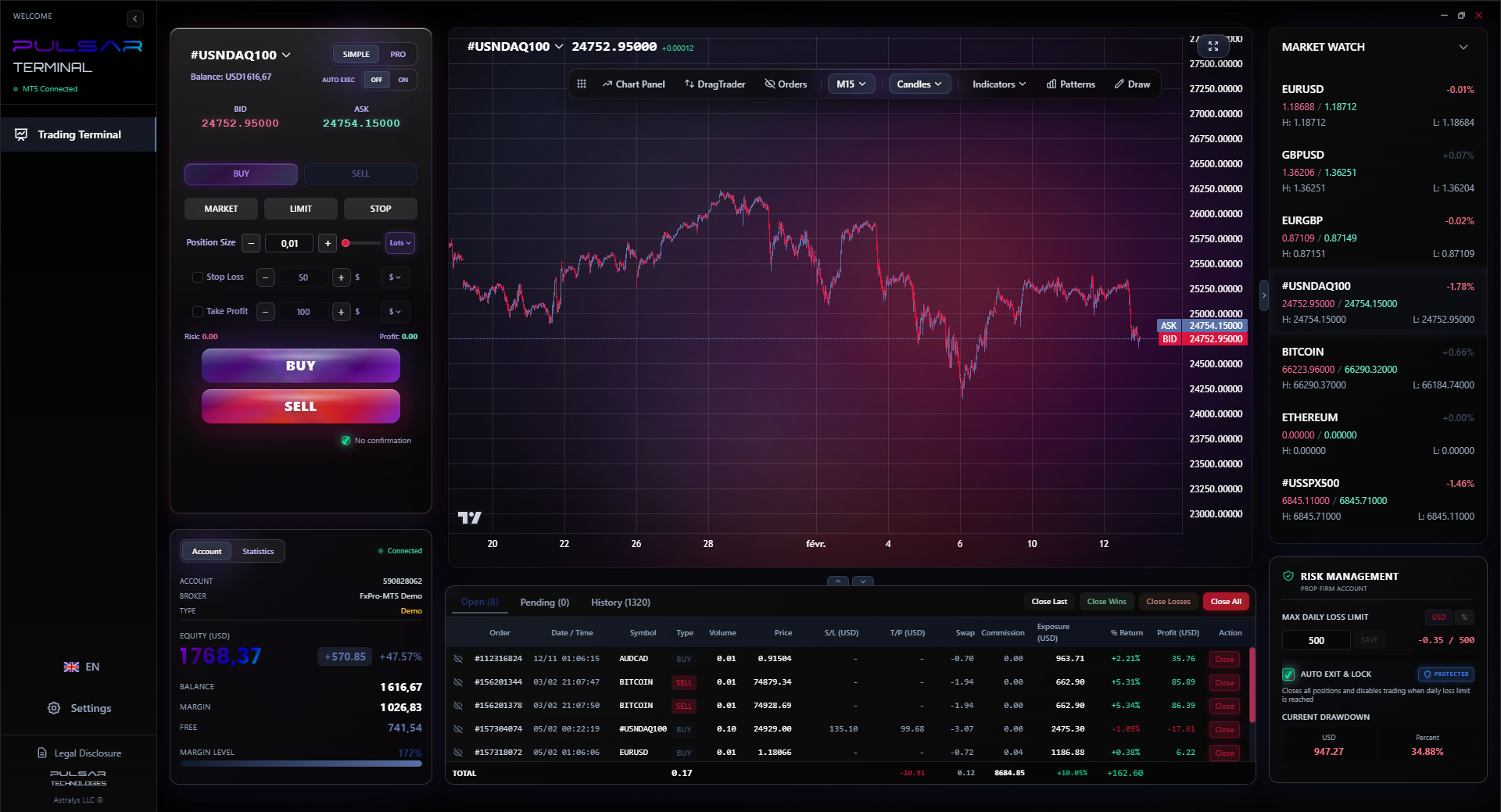
When you're ready to move from theory to disciplined execution, a tool like Pulsar Terminal for MT5 automates your risk management rules, like setting multi-level take-profits and trailing stops, so your emotions don't derail your plan.
Pulsar Terminal
Универсальный инструмент для MT5: drag-and-drop ордера, мульти-TP/SL, трейлинг-стоп, грид-трейдинг, Volume Profile и защита для проп-фирм. Используется 1000+ трейдерами ежедневно.
You're not just trading currencies. You're a Nigerian trading in a globally volatile market, with a hyper-volatile domestic currency. This adds a unique layer of risk.
1. Trading Risk: Protect Your Capital First Your number one job is to not get a margin call. This means:
- Use Stop-Losses. Always. No debate. A stop-loss is the cost of doing business, not a failure.
- Risk a Tiny Percentage. 1-2% of your account per trade is the golden rule. On a $500 account, that's $5-$10 risk. It feels small, but it keeps you in the game after a bad week.
- Beware of Over-use. A broker might offer you 1:1000. That doesn't mean you should use it. use amplifies both gains AND losses. For swing trading, I rarely go above 1:30.
2. The Naira Risk: Your Profits Can Shrink You make $100 profit. Great! But if you withdraw it next week and the Naira has strengthened from 1500/$ to 1400/$, your 100 USD is now worth 140,000 Naira instead of 150,000 Naira. You've lost 10,000 Naira without making a bad trade.
There's no perfect hedge, but you can:
- Keep some profits in USD in your trading account if you plan to re-invest.
- Be strategic about withdrawal timing (though this is near-impossible to predict).
- Just accept it as a cost and factor it into your overall profit targets.
This dual-layer of risk is why Nigerians need to be more disciplined, not less, than traders in more stable economies.
💡 Совет Уинстона
In Nigeria, your final profit is in Naira. A 10% gain in USD can become a 5% loss in Naira after conversion and fees. Always calculate your true net return in your local currency before you call a strategy successful.
“Success requires treating forex as a skilled profession, not a lottery ticket. It's a marathon filled with more losses than wins.”
Okay, you've read the real talk. What now? Here's a concrete, step-by-step plan that doesn't involve buying a course from a Quora 'guru'.
Phase 1: The Paper Phase (1-3 Months)
- Pick a Reputable Broker from the list above and open a demo account. Don't deposit real money yet.
- Learn the MT4/MT5 Platform. Place dummy trades, set stop-losses, track the pip movement.
- Choose ONE Simple Concept to study. I recommend 'Support and Resistance with Price Action'. Ignore everything else for now.
- Paper trade your idea. Execute 20-30 trades based solely on that concept. Record every single one in a journal: entry, exit, why you took it, emotional state.
Phase 2: The Micro-Live Phase (3-6 Months)
- Fund a live account with the minimum amount. For Exness or XM, that's $5-$10. This is real money, so the psychology changes.
- Trade micro-lots (0.01). Your goal is not to get rich. Your goal is to execute your plan under real pressure and to experience the real costs (spreads, potential slippage).
- Focus on consistency, not profits. Can you follow your rules 10 trades in a row? If you blow this micro account, go back to Phase 1. You've just saved your future larger capital.
Phase 3: Scaling Up (6+ Months) Only after you have a proven, journaled track record of consistency on your micro account should you consider adding more capital. This is where tools that help with discipline become valuable. Managing multiple trades and protecting profits becomes key.
The journey from Quora curiosity to consistent trader is a marathon. It's filled with more losses than wins, frustration, and constant learning. But for those who treat it as a serious skill to be mastered, not a lottery ticket, it's a viable path. Just make sure you're walking it with your eyes wide open to the real Nigerian market, not the filtered version you see online.
FAQ
Q1Is forex trading legal in Nigeria in 2026?
Yes, forex trading for individuals is legal. However, the new Investments and Securities Act (ISA) 2025 requires any platform offering online forex trading to register with the SEC. The regulatory environment is tightening, so always verify a broker's status.
Q2What is the best broker for beginners in Nigeria?
For absolute beginners, brokers like XM or Exness are often recommended due to their low minimum deposits (as low as $5), extensive educational materials, and relatively easy local deposit options. Remember to always start with a demo account first.
Q3How do I fund my forex trading account from Nigeria?
The most common methods are through a broker's local bank transfer partner (you pay Naira into a Nigerian account) or via Peer-to-Peer (P2P) crypto transfers. Direct international bank transfers and card payments are typically blocked by Nigerian banks for forex trading.
Q4How much tax do I pay on forex profits in Nigeria?
You are subject to a 10% Capital Gains Tax on your gross forex trading profits. It is crucial to keep detailed records of all your trades for tax purposes.
Q5Can I really make money from forex trading in Nigeria?
Yes, it is possible, but it is statistically difficult. Over 70% of retail traders lose money. Success requires significant education, disciplined risk management (never risking more than 1-2% per trade), treating it as a skilled profession, and the mental fortitude to handle losses. It is not a get-rich-quick scheme.
Q6Why is the information on Quora about forex trading often misleading?
Quora's incentive structure rewards viral, engaging answers. This often promotes sensationalized success stories and 'secret strategies' that sell a dream. Genuine, profitable trading is based on boring discipline and risk management, which doesn't generate as many clicks. Always cross-reference advice and be skeptical of promises of easy, high returns.
Урок проф. Уинстона
Ключевые выводы:
- ✓Assume 70% of retail traders lose; your goal is to be in the 30%.
- ✓Risk only 1-2% of your capital on any single trade.
- ✓The new ISA 2025 law mandates SEC registration for trading platforms.
- ✓Factor in the 10% Capital Gains Tax on gross profits.
- ✓Your real profit is in Naira, after all conversion fees and volatility.
Насколько полезна эта статья?
Нажмите на звезду
Еженедельные торговые инсайты
Бесплатный еженедельный анализ и стратегии. Без спама.
Об авторе
Olumide Adeyemi
Пионер трейдинга в Западной Африке
Один из самых активных преподавателей форекс-трейдинга в Нигерии. 8 лет торгового опыта из Лагоса. Специализируется на стратегиях с малым капиталом и челленджах проп-фирм для африканских трейдеров.
Комментарии
Предупреждение о рисках
Торговля финансовыми инструментами сопряжена со значительным риском и может не подходить всем инвесторам. Прошлые результаты не гарантируют будущих доходов. Данный контент носит исключительно образовательный характер и не является инвестиционной рекомендацией. Всегда проводите собственное исследование перед торговлей.
Вам также может понравиться

Cara Trading Forex Sukses: 7 Prinsip dari Trader Profesional
Cara trading forex sukses dengan 7 prinsip trader pro: manajemen modal, disiplin, journal trading, backtest. Data nyata, bukan janji profit palsu.
Jam Trading Forex Terbaik untuk Trader Indonesia: Panduan Lengkap dengan Tabel Waktu
Panduan jam trading forex untuk trader Indonesia. Tabel 4 sesi dunia, jam emas 20:00-00:00, sesi mana yang harus dihindari. Data akurat + tips dari trader berpengalaman.
Top 5 Sàn Forex Uy Tín Nhất 2026: Review Jujur dari Trader Indonesia
Top 5 sàn forex uy tín 2026 untuk trader Indonesia. Review jujur: spread, deposit, withdraw, dukungan lokal. Exness, XM, IC Markets & lebih.
Скачать Pulsar Terminal
Все эти калькуляторы встроены в Pulsar Terminal с данными в реальном времени с вашего счёта MT5.
Скачать Pulsar Terminal