


You've probably seen the ads: 'Make R50,000 a month from your phone!' The promise of forex trading in South Africa is intoxicating, especially when the Rand is volatile.

Olumide Adeyemi
Пионер трейдинга в Западной Африке ·  Nigeria
☕ 11 мин чтения
Что вы узнаете:
- 1Is It Legal? The FSCA & Your Money
- 2The Real Costs: Spreads, Commissions & The Hidden Tax
- 3Brokers for South Africans: FSCA vs. The World
- 4Trading the ZAR: Your Home Court Advantage (and Danger)
- 5A Realistic Strategy & Why Most Fail
- 6Taxes, Deposits & Getting Your Money Out
- 7Your First Steps & How to Spot a Scam
You've probably seen the ads: 'Make R50,000 a month from your phone!' The promise of forex trading in South Africa is intoxicating, especially when the Rand is volatile. But here's the uncomfortable truth most 'gurus' won't tell you: over 80% of retail traders lose money, and in South Africa, the regulatory landscape makes that failure even more likely if you don't know the rules. I've traded through the 2018 ZAR crash and watched friends blow accounts following bad advice. This isn't another hype piece. It's a risk manager's breakdown of how to actually survive and potentially profit in the South African forex market.
Let's clear this up first: yes, forex trading is completely legal in South Africa. But 'legal' doesn't mean 'unregulated wild west.' The Financial Sector Conduct Authority (FSCA) is the main watchdog, and they've gotten serious. A few years back, you could open an account with almost any offshore broker offering crazy use. Now, the FSCA requires brokers targeting South Africans to be licensed. This is actually good news for you.
Why? Because an FSCA-licensed broker must adhere to client money protection rules. Your funds should be held in segregated accounts, separate from the broker's operating money. If the broker goes under (it happens), your capital isn't automatically gone to pay their debts. The FSCA also enforces use caps for retail clients. You won't find 1:2000 use with a regulated local entity. It's capped at 1:30 for major currency pairs and 1:20 for minors and exotics. This feels restrictive, but it's the regulator trying to stop you from blowing up your account in two trades.

Warning: Many international brokers still accept South African clients under other licenses (like Cyprus's CySEC or the Seychelles FSA). While this is legal for you, you fall under that foreign regulator's protection, not the FSCA's. You're trading in a different legal framework.
The bottom line? For your first account, I strongly recommend using an FSCA-regulated broker. The use limit will force you to learn proper position size calculator use from day one. It removes the temptation of the 'lottery ticket' trade that wipes you out.
Nobody talks about how costs eat returns. In South Africa, with the ZAR as your account currency, this is even more critical. Let's break down where your money goes before you even make a profit.
Spreads & Commissions: This is your direct transaction cost. You'll generally find two account types:
| Account Type | Typical EUR/USD Spread | Commission | Best For... |
|---|---|---|---|
| Standard (No Commission) | 1.0 - 1.5 pips | R0 | Beginners, small accounts, fewer trades. |
| Raw Spread / ECN | 0.0 - 0.3 pips | ~R60 - R100 per R1m traded | Active traders, scalpers, large accounts. |
Here's the math that shocked me early on. On a standard account with a 1.2 pip spread on EUR/USD, opening and immediately closing a 1 lot (R100,000) trade costs you R120. To be profitable, the market must first move 1.2 pips in your favor just to break even. Do that 20 times a month, and you've paid R2,400 in spreads. Your trading must be that much better just to cover costs.
The ZAR Conversion Hit: If you trade global pairs (like EUR/USD) with a ZAR account, your profit/loss is converted from USD to ZAR at your broker's rate. This isn't the interbank rate. There's a small markup. On a R10,000 profit, a 0.5% markup costs you R50. It seems small, but it's another leak in the bucket.
The Broker Choice: This is why South African traders often look at brokers like IC Markets or Pepperstone, which offer true ECN accounts with tight spreads, even though they service SA clients under other licenses. You need to weigh lower costs against the regulatory safety of a local FSCA broker.

💡 Совет Уинстона
Your first R10,000 in profits should be re-invested in your education and trading infrastructure - better internet, a second monitor, quality market data - not a new watch.
“The FSCA's use cap isn't a restriction; it's a life jacket they're forcing you to wear.”
Your broker is your gateway to the market. Picking the wrong one is like trying to win a race with a flat tire. Here’s my take on the landscape, based on experience and what I see in trading communities today.
FSCA-Regulated (Local Presence)
These brokers have a physical office or entity in SA and play by FSCA rules. use is capped at 1:30. Examples include Khwezi Trade, GT247 (part of the GTI Group), and some international brokers with a local license. The pros are clear: local support, ZAR accounts, easy deposits via EFT, and regulatory peace of mind. The con is the use limit and sometimes wider spreads than global giants.
International Brokers Accepting South Africans
This is where most volume goes. They offer the platforms, tools, and conditions serious traders want.
- Exness: Popular for its flexible accounts and acceptance of SA clients. Offers very high use under its offshore entities, which is a massive risk. I've seen traders use it for its unique features, but you must have iron discipline.
- XM: Huge in South Africa. They run frequent seminars and have a strong local marketing presence. Spreads are competitive on their Ultra Low account. They are regulated globally (not FSCA), so use can be higher.
- The 'Raw Spread' Crew: IC Markets, Pepperstone. These are favorites for active traders and scalping strategy enthusiasts. Their technology is top-tier, spreads are razor-thin, but you pay a commission. They are not FSCA-regulated for their international entities, so you get their standard global use (1:500).

Pro Tip: Before you deposit, do two things. First, check the FSCA's website to see if the broker is licensed if that's important to you. Second, open a demo account and test the actual spreads on the pairs you'll trade during the London and New York sessions - when you'll likely be trading. Don't just look at the advertised 'average'.
Trading USD/ZAR, EUR/ZAR, or GBP/ZAR feels familiar. You hear about these currencies on the news. This is where most South African traders start, and it's often where they get slaughtered. Why? Because familiarity breeds overconfidence, and the ZAR is a wild beast.
The Volatility Trap: USD/ZAR isn't like EUR/USD. A 100-pip move on EUR/USD is a big deal. A 100-pip move on USD/ZAR (from R18.50 to R18.60) is a quiet Tuesday afternoon. During a budget speech or a credit rating announcement, it can swing 500 pips in hours. If you use the same position size calculator settings as for a major pair, you will be massively over-leveraged. I learned this the hard way in 2018. I shorted USD/ZAR at R13.80, thinking it was overbought. I used my usual 2% risk. A week later, it was at R14.50. I lost 5% of my account on one trade because I didn't adjust for the pair's true volatility.
The 'News' Illusion: You think you have an edge because you follow South African news? So does every other trader and the big banks' algorithms. The price often moves before the news hits the public. Trading around SARB interest rate decisions is a minefield. I don't do it anymore. The swing trading approach works better for me on ZAR pairs - looking for longer-term trends driven by commodity prices and global risk sentiment, not the daily headlines.
Your real 'home court advantage' should be understanding the macroeconomic flows that drive the Rand: commodity exports (platinum, gold), load-shedding's impact on economic growth, and political stability. Use that for context, not for timing a 5-minute trade.
“Trading USD/ZAR because you follow the news is like trying to out-sprint a cheetah because you read about its diet.”
Forget the 100% per month nonsense. A professional hedge fund manager is thrilled with 15-20% per year. As a retail trader, if you can consistently achieve 5-10% per month on your risk capital, you're in the top 5%. The failure rate isn't about a lack of a 'secret indicator.' It's about psychology and poor mechanics.
The #1 Killer: Poor Risk Management. This isn't just a slogan. It's the reason I blew my first two accounts. I'd risk 5% or 10% per trade trying to 'make back' a loss. A string of three losses would decimate me. Now, I never, ever risk more than 1% of my account equity on a single trade. For a R20,000 account, that's R200. It feels small. But it means I can survive 20 consecutive losses (which has never happened) and still have capital to trade. Use a position size calculator for every single trade.
A Simple, Testable Strategy:
- Timeframe: Use the 4-hour chart for direction. It filters out market noise.
- Trigger: Move to the 1-hour chart. Wait for price to pull back to a key moving average (like the 50-period EMA) in the direction of the 4-hour trend.
- Confirmation: Use a basic momentum indicator like the RSI indicator to see if the pullback is losing steam (RSI moving back above 30 in an uptrend, or below 70 in a downtrend).
- Entry & Risk: Enter on a small bullish/bearish candle pattern at the EMA. Your stop-loss goes below the recent swing low (for a long) or above the swing high (for a short). That distance, in pips, determines your position size based on your 1% risk.
- Exit: Aim for a risk-to-reward ratio of at least 1:2. If your stop is 50 pips away, your take-profit should be 100 pips away.
This isn't glamorous. You'll only take 2-3 trades a week. But it's structured, it's mechanical, and it removes emotion. Backtest it on USD/ZAR or EUR/USD guide for 100 past trades. See if it would have worked. That's the work nobody wants to do.
💡 Совет Уинстона
If you can't explain your trade setup in one simple sentence ('Price pulled back to the 50 EMA in an uptrend'), your strategy is too complicated and will fail under pressure.
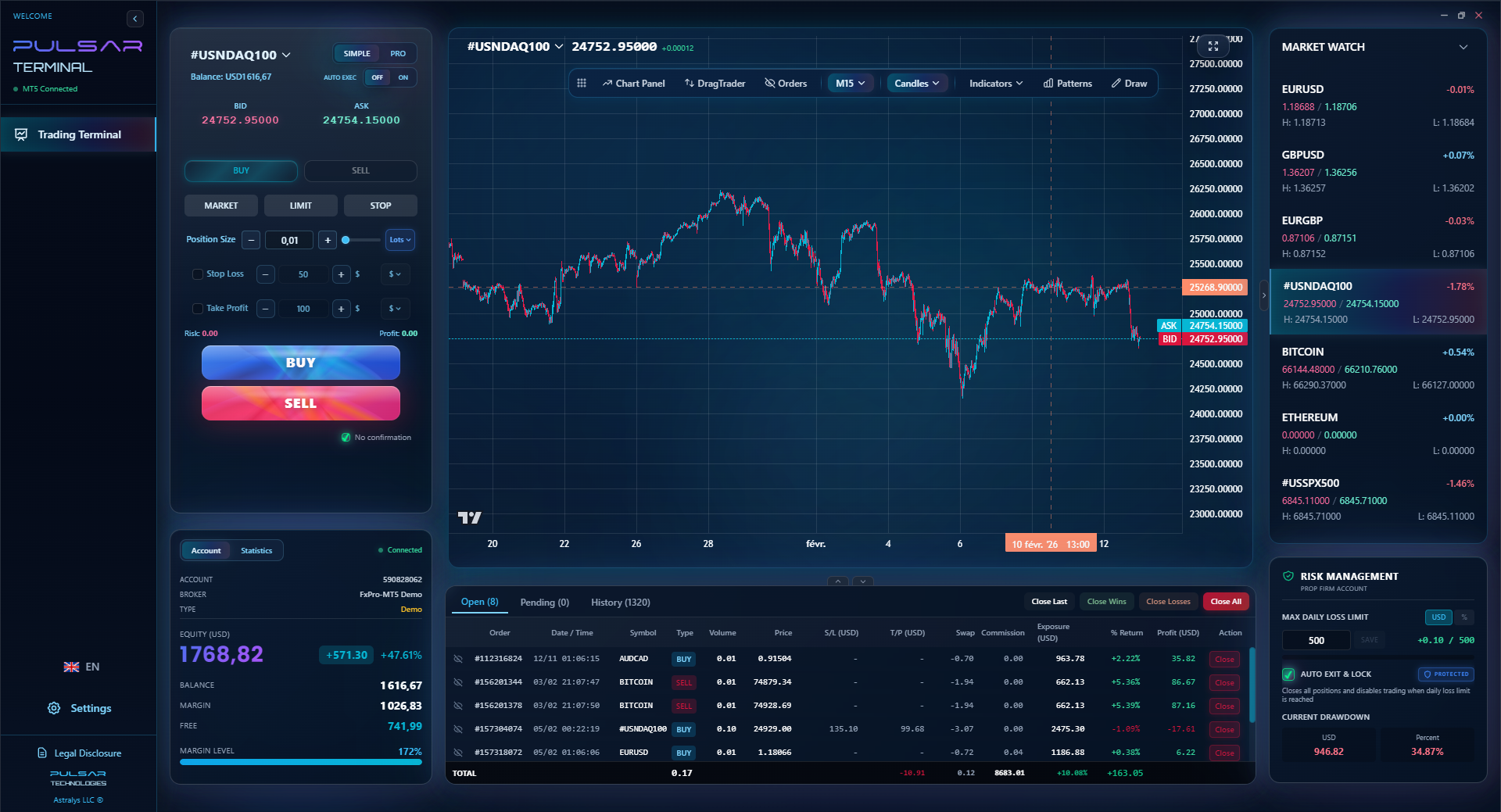
Executing a disciplined strategy with precise stop-loss and take-profit levels is critical, and tools like Pulsar Terminal automate this directly on your MT5 charts, removing emotional exit decisions.
Pulsar Terminal
Универсальный инструмент для MT5: drag-and-drop ордера, мульти-TP/SL, трейлинг-стоп, грид-трейдинг, Volume Profile и защита для проп-фирм. Используется 1000+ трейдерами ежедневно.
This is the boring but crucial part. Get it wrong, and SARS or your bank will cause you more headaches than a losing trade streak.
Tax (The Big One): In South Africa, profits from forex trading are considered capital gains if you're deemed an investor (holding trades longer-term) or income if you're a frequent trader (deemed a 'dealer'). Most retail traders fall under capital gains. Here’s the simplified version:
- You have an annual exclusion of R40,000 in capital gains.
- The inclusion rate for individuals is 40%.
- You pay your marginal income tax rate on that 40%.
Example: You make R100,000 in net profit for the tax year. Subtract the R40,000 exclusion. Your net gain is R60,000. 40% of that (R24,000) is added to your taxable income. If you're in the 36% tax bracket, you'd pay R8,640 in tax on your R100,000 profit.

Example: Keep a detailed trading journal! Your broker's statement is your starting point, but you need to calculate net profit/loss per tax year (March to February). A simple spreadsheet with date, pair, P&L, and running total is enough.
Deposits & Withdrawals: With FSCA brokers, it's easy: EFT from your local bank account. With international brokers, you'll likely use a credit/debit card or a global wire transfer. Be aware of your bank's international transfer fees. Withdrawals are usually the reverse process. Always start with a small withdrawal test to ensure the process works smoothly before you try to pull out large sums.
“A profitable trading system is boring. The excitement of the 'big win' is usually the prelude to the 'big loss.'”
Ready to start? Follow this order. Skipping steps is the fastest path to losing money.
- Education (Free First): Go through the entire free school on BabyPips.com. Understand what a pip definition, spread definition, and margin call are. Don't pay for a course yet.
- Demo Trade: Open a demo account with 2-3 brokers. Practice the simple strategy from Section 5 for at least three months. Your goal isn't profit, it's consistency and discipline in following your rules. Can you take 10 trades in a row following your plan? If not, you're not ready.
- Start Small: Fund a live account with money you can afford to lose completely - R5,000, R10,000. Not your rent money. Trade micro lots (0.01). Your goal for the first six months is to not blow up and to break even. Profit is a bonus.
Spotting Scams: They're rampant on Instagram and YouTube.
- The Signal Seller: 'Pay R2000/month for my guaranteed signals.' If their signals were guaranteed, they'd be trading with bank loans, not selling subscriptions.
- The Prop Firm Bypass: 'I have a bot that will pass your prop firm challenge for you.' This is fraud, and you'll be banned.
- The Managed Account: 'Send me your money, and I'll trade for you with 80% returns.' This is how Madoff-style Ponzi schemes start. No legitimate, profitable manager wants your R20,000. They work for banks or hedge funds.
The rule is simple: if it sounds too good to be true, it is. Real trading is a slow, grinding skill acquisition, like learning a trade. There are no shortcuts.
FAQ
Q1What is the best forex broker in South Africa?
There's no single 'best' broker. For beginners wanting FSCA protection, a local regulated broker like Khwezi Trade is a safe start. For active traders prioritizing low costs and advanced platforms, international brokers like IC Markets or Pepperstone are popular. The 'best' is the one that fits your trading style, risk tolerance, and need for regulatory oversight.
Q2How much money do I need to start forex trading in South Africa?
Technically, you can start with a few hundred Rand on a micro account. Realistically, to practice proper risk management (risking 1% per trade) and not get wiped out by costs, a starting capital of at least R10,000 is more practical. This allows you to trade small positions and absorb losses while you learn. Always start with a demo account first, regardless.
Q3Do I pay tax on forex trading profits in South Africa?
Yes. For most individuals, profits are treated as capital gains. You get an annual exclusion (R40,000 for the 2026 tax year). A portion of the remaining gain is included in your taxable income. You must declare this to SARS. Keep careful records of all your trades.
Q4Is forex trading a good way to make money in South Africa?
It is a possible way to make money, but it is not a 'good' or easy way. It requires significant education, discipline, emotional control, and a tolerance for risk. Most people lose money. View it as a skilled profession that takes years to learn, not a get-rich-quick scheme. The high volatility of the Rand (USD/ZAR) presents both opportunity and significant danger.
Q5Can I use international brokers like Exness or XM in South Africa?
Yes, many international brokers actively accept South African clients. However, they often do so under licenses from other countries (like CySEC or the FSC of Seychelles), not the South African FSCA. This means you are not protected by FSCA rules, and you may have access to higher use, which increases risk.
Q6What is the most traded currency pair in South Africa?
USD/ZAR (US Dollar vs. South African Rand) is by far the most traded pair by local retail traders due to its familiarity and volatility. However, major global pairs like EUR/USD and GBP/USD are also very popular because they often have lower spreads and more predictable liquidity.
Урок проф. Уинстона
Ключевые выводы:
- ✓Never risk more than 1% of your account on a single trade.
- ✓ZAR pairs need 3x the stop-loss distance of majors like EUR/USD.
- ✓FSCA regulation means safety, not necessarily the best pricing.
- ✓Your first year goal is survival, not profitability.
Насколько полезна эта статья?
Нажмите на звезду
Еженедельные торговые инсайты
Бесплатный еженедельный анализ и стратегии. Без спама.
Об авторе
Olumide Adeyemi
Пионер трейдинга в Западной Африке
Один из самых активных преподавателей форекс-трейдинга в Нигерии. 8 лет торгового опыта из Лагоса. Специализируется на стратегиях с малым капиталом и челленджах проп-фирм для африканских трейдеров.
Комментарии
Предупреждение о рисках
Торговля финансовыми инструментами сопряжена со значительным риском и может не подходить всем инвесторам. Прошлые результаты не гарантируют будущих доходов. Данный контент носит исключительно образовательный характер и не является инвестиционной рекомендацией. Всегда проводите собственное исследование перед торговлей.
Вам также может понравиться

Cara Trading Forex Sukses: 7 Prinsip dari Trader Profesional
Cara trading forex sukses dengan 7 prinsip trader pro: manajemen modal, disiplin, journal trading, backtest. Data nyata, bukan janji profit palsu.
Jam Trading Forex Terbaik untuk Trader Indonesia: Panduan Lengkap dengan Tabel Waktu
Panduan jam trading forex untuk trader Indonesia. Tabel 4 sesi dunia, jam emas 20:00-00:00, sesi mana yang harus dihindari. Data akurat + tips dari trader berpengalaman.
Top 5 Sàn Forex Uy Tín Nhất 2026: Review Jujur dari Trader Indonesia
Top 5 sàn forex uy tín 2026 untuk trader Indonesia. Review jujur: spread, deposit, withdraw, dukungan lokal. Exness, XM, IC Markets & lebih.
Скачать Pulsar Terminal
Все эти калькуляторы встроены в Pulsar Terminal с данными в реальном времени с вашего счёта MT5.
Скачать Pulsar Terminal