


I remember staring at my screen on March 15, 2026.

Rajesh Sharma
Старший форекс-аналитик ·  India
India
☕ 11 мин чтения
Что вы узнаете:
- 1What Exactly Are You Trading on MCX?
- 2The Real Costs: Margins, Brokerage, and That Slippery Spread
- 3What Moves Gold in India? It's Not Just Global Prices
- 4Strategies That Worked (And One That Blew Up)
- 5Picking Your Broker and Platform
- 6The Mental Game: Pitfalls I Still Wrestle With
- 7Your First Trade: A Step-by-Step Walkthrough
I remember staring at my screen on March 15, 2026. Gold MCX had just hit an intraday high of ₹166,074 per 10g. My chart showed a perfect double top, my RSI was screaming overbought, and I had a short position ready. I hesitated. 'What if it keeps going?' I thought. It didn't. It reversed hard, and I missed a 4,000-point move because I was scared of my own analysis. That's the thing about gold trading in MCX. It's not just about charts; it's about understanding a market deeply tied to Indian culture, economics, and regulation. Let me walk you through what I've learned, the hard way.
When you trade gold on the Multi Commodity Exchange, you're not buying physical bars. You're trading standardized futures and options contracts. Think of it as a bet on the future price of gold, settled in cash. The exchange acts as the middleman, guaranteeing the trade so you don't have to worry about the other guy not paying up.
The beauty for us retail traders is the variety of contract sizes. You don't need crores to play.
| Contract | Size | Who It's For |
|---|---|---|
| Gold (Standard) | 1 kg | Institutions, high-net-worth individuals, serious traders. |
| Gold Mini | 100 g | The sweet spot for most active retail traders. |
| Gold Guinea | 8 g | Beginners testing strategies with lower capital. |
| Gold Petal | 1 g | Micro-positioning or educational purposes. |
I started with the Mini contract. The 1 kg standard felt too heavy for my account size, and the smaller ones had slightly wider spreads. The Gold Mini gave me the liquidity I needed without over-leveraging. Remember, each contract has an expiry date (usually the 5th of the month). You can't just buy and forget; you're trading a derivative with a time limit.

Warning: This is not a 'buy and hold for 20 years' investment like a physical gold ETF. MCX futures are for shorter-term price speculation. If you hold until expiry, your position will be squared off at the settlement price, and any profit or loss will be credited/debited to your account. You need an active swing trading or shorter-term mindset here.

💡 Совет Уинстона
The '₹150,000 level' is a psychological magnet on MCX. Price will often dance around it for days. Don't trade the chop; wait for a clear close above or below it on the hourly chart with rising volume.
“MCX gold is a function of two volatile assets: international gold price and the USD/INR exchange rate. You're trading both at once.”
This is where most tutorials gloss over the details. Let's get specific with numbers from my trading journal.
The Margin Money
Margin is your security deposit. For a Gold Mini contract (100g), the initial margin is typically around ₹15,000. This isn't a fee; it's collateral you get back when you close the trade (minus your loss, of course). But here's the kicker: that's just the initial margin. If the market moves against you, you'll need to maintain a maintenance margin. If your account equity falls below this, you'll get a margin call.
I learned this painfully in early 2024. I had a ₹152,000 position on a Mini contract with ₹14,800 margin. Gold dropped sharply overnight (a US data release), and by morning, my floating loss had eaten into my maintenance margin. My broker's system automatically squared off 50% of my position at a terrible price. I lost ₹3,200 before I even had my coffee. The lesson? Never use more than 50-60% of your margin limit on a single idea. Always use a position size calculator.
Brokerage and Taxes
My broker charges a flat ₹20 per executed order for futures. That's it. But on top of that, you pay:
- MCX Transaction Charge: ₹2.10 per lakh of turnover.
- Commodity Transaction Tax (CTT): 0.01% on the sell side only.
- GST: 18% on the brokerage fee.
- Stamp Duty: A small state-wise charge on the contract note.
Let's do the math on a real trade. I bought 1 Gold Mini at ₹150,000 and sold at ₹151,500.
- Turnover = Buy (1.5 lakhs) + Sell (~1.515 lakhs) = ~₹3.015 lakhs
- MCX Charge = 3.015 * ₹2.10 = ~₹6.33
- CTT = 0.01% of 1,51,500 = ₹1.51
- Brokerage = ₹20 + GST (₹3.60) = ₹23.60
- Total Cost: ~₹31.44
My gross profit was ₹1,500. After costs, it was ₹1,468.56. That's about a 2% bite. Costs matter, especially for scalping strategy attempts.

Example: On that ₹1,500 profit trade, my net return was 9.79% on my ₹15,000 margin. But if I'd only made ₹300, costs would have eaten over 10% of the profit. Aim for trades where your target is at least 3-4 times your estimated total costs.
“I lost ₹8,000 in two weeks trying to scalp the night session. The market's liquidity has a bedtime, and so should your trading.”
New traders make a huge mistake: they just look at the international gold price in dollars and assume MCX will follow. It doesn't, not exactly. The price of Gold MCX is a function of:
International Gold Price (in $ per ounce) x USD/INR Exchange Rate.
You're trading two volatile assets at once. I've seen gold in dollars go up, but the rupee strengthen even more, causing MCX gold to actually fall. You must watch the USD/INR pair like a hawk. A strong rupee caps MCX gold rallies, a weak rupee amplifies them.
Local Drivers Unique to MCX
- Domestic Demand: Wedding seasons (especially around Diwali), festivals, and rural demand after a good harvest can create seasonal strength.
- Import Duties: Changes in India's gold import duty directly impact the domestic price. A hike in duty makes imported gold costlier, pushing MCX prices up relative to the global price.
- Physical Market Arbitrage: If MCX futures get too expensive compared to the physical market, traders will sell futures and buy physical, pushing the price back down. This creates mean-reversion opportunities.
My biggest win came from understanding this. In October 2025, ahead of Diwali, international gold was flat but the rupee was weakening. I noticed the usual seasonal uptick in physical demand in local news. I went long on Gold Mini at ₹148,200. I held for two weeks as the domestic premium widened, exiting at ₹152,700. A 3% move fueled by local factors global charts missed completely.
For global context, understanding instruments like XAU/USD is crucial, but always filter it through the INR lens.
💡 Совет Уинстона
Your biggest edge in MCX gold is understanding the USD/INR trend. A strong, sustained move in the currency pair will override most technical patterns on the gold chart itself.
“I lost ₹8,000 in two weeks trying to scalp the night session. The market's liquidity has a bedtime, and so should your trading.”
The Breakout Fade (My Go-To)
MCX gold loves to fake out. It will often spike beyond a key technical level (like a previous high or a round number like ₹155,000) on low volume, only to reverse sharply. I wait for these false breakouts. My setup: Price pushes past resistance on the 15-minute chart, but the MACD indicator shows divergence (price makes a higher high, MACD makes a lower high). I enter short with a tight stop just above the false breakout high. The profit target is the middle of the recent range.
Trend Following with the Rupee
When a clear trend is established, I use a simple EMA crossover on the hourly chart (21 & 55 EMA) combined with the USD/INR trend. If both gold $ and USD/INR are trending up, that's a strong signal for MCX. I enter on a pullback to the 21 EMA. The key is trailing your stop. I used to set a fixed stop and watch profits vanish. Now, I move my stop to breakeven once I'm up 1%, then trail below the 21 EMA.
The Strategy That Cost Me Money: Overnight Scalping
I tried to scalp the 9:00 PM - 11:30 PM session based on US market opens. The spreads would widen, liquidity would drop, and I'd get eaten alive by slippage. I lost ₹8,000 over two weeks trying to catch these quick moves. MCX gold is liquid, but not that liquid for 1-minute chart scalping around global events. Stick to higher timeframes (15-min and above) unless you have a phenomenal direct market access setup.

Pro Tip: The first 30 minutes after the MCX open (9:00 AM) and the overlap with the London market (around 1:30 PM IST) often have the cleanest, highest-volume moves. Plan your trades around these windows.
“One Mini contract should be a meaningful position for your account, not a throwaway trade. Respect the use.”
You need a SEBI-registered broker that offers commodity trading. Most major discount brokers do. I've used a few. Here's the real deal:
- Zerodha/Upstox/Angel One: Great for cost (₹20/trade), reliable order execution. Their charting (Kite, Upstox Pro) is decent for basic technical analysis. This is where I started.
- ICICI Direct/Sharekhan: More expensive brokerage, but often better research and customer support if you need hand-holding.
- MetaTrader 5 (MT5) via an International Broker: Some brokers like Exness or IC Markets offer MT5 with MCX data feeds. Why would you consider this? For superior charting, automation, and advanced order types. This is where I migrated to for serious trading.
The platform is everything. Can you place a bracket order (entry, stop loss, take profit) with one click? Can you easily trail your stop? On basic Indian platforms, trailing stops are often manual or clunky. On MT5, it's built-in. This single feature saved me thousands. When I caught the Diwali trend move, I set a trailing stop of 100 points. It locked in profits automatically as the trend ran, and I didn't have to babysit the screen. Managing multiple trades without this is a nightmare.
Also, check the margin requirements. Some brokers require more than the MCX minimum. And always, always test their mobile app. You don't want it crashing when you need to close a position.
💡 Совет Уинстона
Before you place any trade, calculate your 'rupee risk per pip.' For Gold Mini, it's ₹1. If your stop is 200 points away, you're risking ₹200 per contract. If that number makes you uncomfortable, your position is too big.
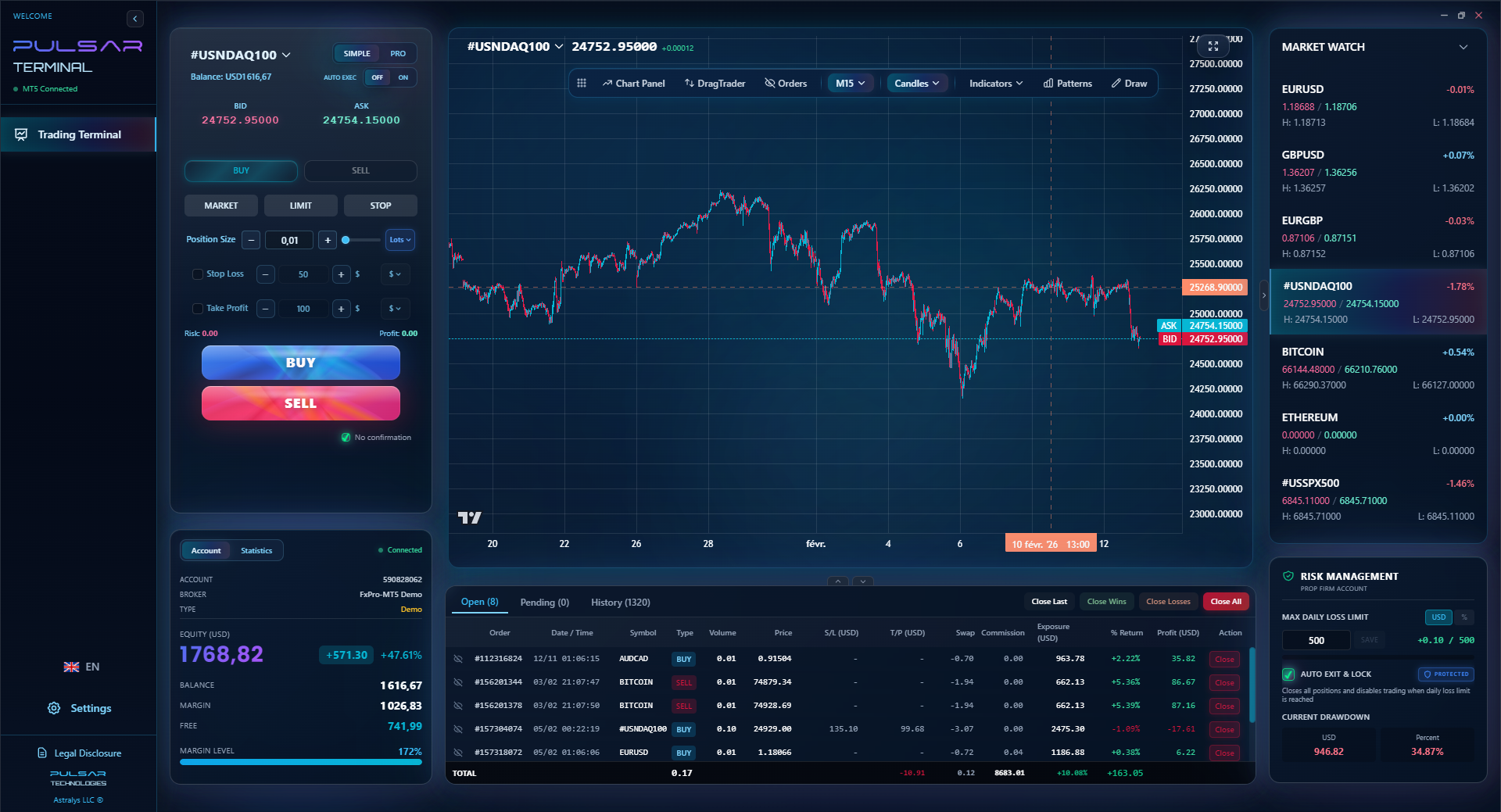
Managing multiple trades and trailing stops manually on MCX is a headache, which is why I use Pulsar Terminal's automated trailing stop and bracket order features directly on my MT5 platform.
Pulsar Terminal
Универсальный инструмент для MT5: drag-and-drop ордера, мульти-TP/SL, трейлинг-стоп, грид-трейдинг, Volume Profile и защита для проп-фирм. Используется 1000+ трейдерами ежедневно.
“One Mini contract should be a meaningful position for your account, not a throwaway trade. Respect the use.”
1. Overtrading the Mini Contract
Because the margin is 'only' ₹15,000, it feels small. It's easy to think, 'It's just one Mini.' But if you have three losing Mini trades, that's a ₹45,000 exposure and potentially a ₹4,500 loss. Size matters. One Mini contract should be a meaningful position for your account, not a throwaway trade.
2. Ignoring Expiry
Gold futures expire. As you get within a week of expiry (the 5th of the month), two things happen: liquidity often moves to the next contract, and volatility can increase. I once held a position into expiry week, and the spread (difference between buy and sell price) widened so much I couldn't exit without a big loss. Always roll over your position to the next contract at least 5-7 days before expiry.
3. Chasing the News
A US inflation print hits, and gold rockets 500 points in a minute. The urge to jump in is immense. 9 times out of 10, by the time your order fills, the move is over, and you're left holding a bag. If you miss the initial spike, wait. There's almost always a pullback or a consolidation to enter more sanely. Let the RSI indicator cool off from overbought.
4. Not Having a Daily Loss Limit
This is non-negotiable. My rule is 2% of my trading capital. If I lose ₹10,000 in a day (on a ₹500,000 account), I shut down the terminal. No revenge trades. No 'one more try.' I learned this after a brutal day where I lost 2%, tried to get it back, and ended the day down 7%. It took me a month to recover emotionally. The market will be there tomorrow.
“If you miss the initial spike on news, wait. The market almost always offers a second chance to enter more sanely.”
- Open a Commodity Trading Account: With your preferred broker (like Angel One or Zerodha). Complete KYC. Fund it with at least ₹50,000 to start comfortably.
- Learn the Platform: Practice on a demo if they offer it. Find where to see the different gold contracts (GOLD, GOLDMINI, etc.), how to place an order, set a stop loss.
- Plan a Trade: Don't just jump in. Let's say you're bullish. Wait for a pullback. Use the daily chart for direction, the 1-hour chart for entry.
- Calculate Your Position: You have ₹50,000. Risking 1% means ₹500. If your stop loss is 150 points away from your entry on Gold Mini (each point = ₹1), your position size should be: ₹500 / 150 = 3.33. So, trade 3 Mini contracts max. Use the position size calculator.
- Place the Order: Enter 'BUY GOLDMINI JUN26' (or the current contract). Quantity: 3. Order Type: LIMIT at your desired price. Immediately add a 'SELL STOP' order for your stop loss and a 'SELL LIMIT' for your take profit. This is a bracket order.
- Manage: If it goes your way, consider moving your stop to breakeven after a 1% move. Don't micromanage. Let your plan work.
- Review: Win or lose, write down what happened. Why did the trade work? Why did it fail? Was it your analysis or just noise?
Gold trading in MCX is a fantastic way to trade a volatile, liquid market with clear fundamentals. It rewards patience, discipline, and a deep understanding of local nuances. Start small, respect the margins, and always know what you're risking before you click 'buy.'
FAQ
Q1What is the minimum amount needed to start gold trading in MCX?
Technically, the margin for a 1g Gold Petal contract can be very small (a few hundred rupees). But for serious trading, you should start with at least ₹50,000. This allows you to trade a Gold Mini contract (margin ~₹15,000) while maintaining enough buffer for other positions and to withstand normal volatility without immediate margin calls.
Q2What are the trading hours for gold on MCX?
From April to October, MCX trades from 9:00 AM to 11:30 PM. From November to March, hours extend to 11:55 PM. The most active periods are the first hour after open (9:00-10:00 AM) and during the overlap with European markets (approx. 1:30 PM onwards).
Q3How is gold trading in MCX different from buying physical gold or a Gold ETF?
MCX gold involves trading futures contracts with expiry dates, using use (margin). It's for short-to-medium term price speculation. Physical gold or Gold ETFs (like SGB) are buy-and-hold investments where you own the asset without time limits or use. MCX trading has higher risk and potential return due to use.
Q4What is the lot size for a standard gold contract on MCX?
The standard Gold futures contract is for 1 kilogram. However, most retail traders use the Gold Mini contract, which has a lot size of 100 grams, making it more accessible.
Q5Do I have to take delivery of physical gold if I hold an MCX contract?
No. Almost all retail traders exit their futures positions before expiry for a cash settlement. The contracts are financially settled; you will not receive physical gold. Your profit or loss is the difference between your entry and exit prices, credited/debited in rupees.
Q6What taxes apply to profits from MCX gold trading?
Profits are treated as business income or speculative income for tax purposes and are added to your total income, taxed according to your income tax slab. You also pay Commodity Transaction Tax (CTT) of 0.01% on the sell side of every trade.
Q7Can I trade gold options on MCX?
Yes, MCX offers gold options contracts. These are more complex derivatives that give you the right, but not the obligation, to buy or sell a gold futures contract at a set price. They require a solid understanding of options Greeks and are generally for more experienced traders.
Урок проф. Уинстона
Ключевые выводы:
- ✓Trade the Gold Mini (100g) contract for optimal retail liquidity.
- ✓Always filter global gold moves through the USD/INR exchange rate.
- ✓Risk a maximum of 1-2% of capital on any single MCX trade.
- ✓Roll futures contracts 5-7 days before expiry to avoid volatility.
- ✓The 9:00 AM and 1:30 PM IST sessions offer the cleanest trends.
Насколько полезна эта статья?
Нажмите на звезду
Еженедельные торговые инсайты
Бесплатный еженедельный анализ и стратегии. Без спама.
Об авторе
Rajesh Sharma
Старший форекс-аналитик
Более 10 лет торгует на индийских и южноазиатских рынках. Начинал с валютных деривативов на NSE, затем перешёл на международный форекс. Специализируется на USD/INR и парах развивающихся рынков.
Комментарии
Предупреждение о рисках
Торговля финансовыми инструментами сопряжена со значительным риском и может не подходить всем инвесторам. Прошлые результаты не гарантируют будущих доходов. Данный контент носит исключительно образовательный характер и не является инвестиционной рекомендацией. Всегда проводите собственное исследование перед торговлей.
Вам также может понравиться

Cara Trading Forex Sukses: 7 Prinsip dari Trader Profesional
Cara trading forex sukses dengan 7 prinsip trader pro: manajemen modal, disiplin, journal trading, backtest. Data nyata, bukan janji profit palsu.
Jam Trading Forex Terbaik untuk Trader Indonesia: Panduan Lengkap dengan Tabel Waktu
Panduan jam trading forex untuk trader Indonesia. Tabel 4 sesi dunia, jam emas 20:00-00:00, sesi mana yang harus dihindari. Data akurat + tips dari trader berpengalaman.
Top 5 Sàn Forex Uy Tín Nhất 2026: Review Jujur dari Trader Indonesia
Top 5 sàn forex uy tín 2026 untuk trader Indonesia. Review jujur: spread, deposit, withdraw, dukungan lokal. Exness, XM, IC Markets & lebih.
Скачать Pulsar Terminal
Все эти калькуляторы встроены в Pulsar Terminal с данными в реальном времени с вашего счёта MT5.
Скачать Pulsar Terminal