


You've probably searched for a 'greek option trading strategies pdf' hoping for a magic formula.

Rajesh Sharma
Старший форекс-аналитик ·  India
India
☕ 11 мин чтения
Что вы узнаете:
- 1Why the Greeks Matter (And Why Most Indian Traders Ignore Them)
- 2Delta: Your Indian Market Direction Gauge
- 3Theta: The Silent Killer (And Money Printer)
- 4Gamma & Vega: The Volatility Twins That Break Accounts
- 5Putting It All Together: A Weekly Trade Plan
- 6SEBI's New Rules: Your 'Fifth Greek' for 2025-2026
- 7Tools, Brokers, and Getting Real Greek Data
- 8Final Word: Beyond the PDF
You've probably searched for a 'greek option trading strategies pdf' hoping for a magic formula. Here's the truth most guides won't tell you: in India, understanding the Greeks without understanding SEBI's latest crackdown is a surefire way to lose money. That free PDF won't mention how the STT hike or the new ₹15-20 lakh contract sizes change everything. Let's cut through the noise. I'll show you how to actually use Delta, Theta, Gamma, and Vega with real numbers from the NSE, and explain why the regulatory landscape is now your most important Greek.
Here's a brutal fact: SEBI says 90% of active retail traders lose money in F&O. The average holding period for an option in India? Less than 30 minutes. In that frenzy, talking about Theta decay or Delta hedging sounds academic. But that's exactly why they matter – they're the antidote to gambling.
The Greeks are simply risk metrics. They quantify what your option price will do next. In a market where a single tweet can swing Nifty 200 points, knowing your Gamma exposure isn't a nice-to-have; it's survival. I learned this the hard way back in 2020. I sold a bunch of Nifty 11500 PUTs thinking support was solid. I was right on direction, but I got obliterated by Vega. Implied volatility spiked 40% overnight due to a global scare, and my "safe" premium-selling trade blew past my stop-loss before I could blink. I lost ₹78,000 on a trade I was "sure" about. That's the power of a Greek you're not watching.

Warning: If you're just buying weekly ATM calls and praying, you're not trading options. You're buying lottery tickets with a terrible payout ratio. The Greeks are your tool to move from betting to calculating.
Delta tells you how much your option's price will change for a 1-point move in the underlying, like Nifty or Reliance. A call option with a Delta of 0.50 will gain roughly ₹0.50 for every 1-point rise in Nifty.
The Practical Indian Delta Play: The Hedge
In India, you can't short stocks easily. But you can use Delta to hedge your portfolio. Let's say you have ₹10 lakhs in equity stocks that move roughly with the Nifty. You're worried about a short-term drop but don't want to sell. You can buy a deep OTM Nifty PUT with a Delta of, say, -0.30. If Nifty falls 200 points, your stocks might lose ₹X, but your PUT gains (200 points * 0.30 Delta * lot size). It's insurance. The premium you pay is your insurance cost.

Example: Nifty is at 22,000. Your stock portfolio has a Beta-adjusted Delta of +750 (meaning it acts like being long 750 Nifty points). To hedge, you buy 1 lot of 21,500 PUT (Delta -0.25) for ₹50. Nifty lot size is 75. Your position Delta becomes: +750 (stocks) + (-0.25 * 75) = +750 - 18.75 = ~+731.25. You've reduced your directional risk by about 2.5%. Not a full hedge, but a cost-effective cushion.
Remember, Delta changes (that's Gamma). An ATM option has a Delta near 0.5, but as Nifty moves, that Delta moves toward 1.0 (for ITM calls) or 0.0 (for OTM calls). Static analysis fails. You need to re-assess.
For directional bets, I use Delta to choose strikes. Want a high-probability, low-cost trade? Sell an OTM option with a Delta of 0.30 or less. You're betting it stays OTM. Want a more aggressive directional play? Buy an option with a Delta of 0.60-0.70. It moves more with the underlying but costs more. There's no free lunch, just different risk profiles. This is a core concept for any serious swing trading approach in options.

💡 Совет Уинстона
Forget 'probability of ITM' from Delta. It's a model fantasy. Delta tells you sensitivity, not fate. Trade the sensitivity, not the fairy tale.
“Theta works for you until it doesn't. I learned that over 11 winning weeks and one catastrophic loss.”
Theta is time decay. It's the amount your option loses in value each day, all else being equal. This is the heart of the classic Indian "premium selling" strategy. You sell options and let time erode their value.
Here's the local twist everyone forgets: Theta isn't linear. An option with 30 days to expiry decays slowly. An option with 7 days decays faster. An option with 1 day to expiry? Theta decay is brutal. This is why weekly expiries are so popular - and dangerous. I used to sell weekly Bank Nifty options every Thursday, collecting small premiums. It worked for 11 weeks straight, netting me about ₹8,000. On the 12th week, a news event caused a 900-point gap-up open. The Theta I'd collected over 11 weeks was wiped out in 5 minutes, plus a ₹15,000 loss. Theta works for you until it doesn't.
Theta Strategy in the New SEBI Regime
With the new 100% upfront premium payment rule (from Feb 1, 2025), buying options just to hold for Theta decay is less attractive. Your capital is locked up. Selling options for Theta is still valid, but margin requirements are higher. You need more capital. A basic position size calculator is non-negotiable now. Don't just sell 10 lots because you can. Calculate the margin, the potential loss, and the Theta you'll earn per day. Is the risk/reward worth it?
A safer Theta play for smaller accounts is the Credit Spread. Sell an OTM option (collect premium) and buy a further OTM option (to limit risk). Your max profit is the net premium (Theta works for you). Your max loss is capped (the difference in strikes minus premium). It's a defined-risk Theta strategy. Much better for sleeping at night.
💡 Совет Уинстона
Theta is your friend only if you manage Gamma. Being short options in the last 3 days is like picking up pennies in front of a steamroller. The steamroller (Gamma) accelerates.
These two are why "greek option trading strategies pdf" documents often fall short. They deal with acceleration and volatility, the most unpredictable parts of the Indian market.
Gamma is the rate of change of Delta. High Gamma means your Delta (and thus your position's sensitivity) can change rapidly. This is huge around expiry. If you're short options (a premium seller) and the market starts moving against you, a high Gamma means your losses accelerate faster than you can adjust. It's like the loss itself starts sprinting.
Vega measures sensitivity to implied volatility (IV). Indian markets, especially around budgets or elections, see massive IV swings. If you buy options, you want high Vega (you profit if IV rises). If you sell options, you want low Vega (you lose if IV spikes).
My Vega mistake? I once sold straddles (selling both a PUT and a CALL at the same strike) before quarterly results, betting on low volatility. Earnings were fine, but a surprise RBI policy comment sent IV through the roof. My Vega loss was double what I lost from the actual price move. The trade was a lesson in hidden risk.

Pro Tip: Check the IV percentile on your platform (Sensibull, Zerodha Greeks show this). Selling options when IV percentile is above 70 is generally better (you're selling expensive volatility). Buying options when IV percentile is below 30 can be better (you're buying cheap volatility). Don't just guess.
💡 Совет Уинстона
The best Greek is often the one you're ignoring. If you're a Vega-blind Delta trader, volatility will find you. Check the IV percentile before every trade.
“Think of Regulation as your fifth Greek - it changes the cost basis and viability of every strategy.”
Let's build a simple, defined-risk strategy using all four Greeks, suited for the current ₹15-20 lakh index contract size. We'll assume a ₹2 lakh dedicated options capital.
Strategy: Iron Condor on Nifty Weekly Expiry Goal: To profit from low volatility and time decay (positive Theta), with capped risk.
- Setup (Monday/Tuesday): Sell 1 OTM Nifty CALL (Delta ~0.30) and 1 OTM Nifty PUT (Delta ~0.30). This gives you negative Delta and positive Theta.
- Define the Risk: Immediately buy 1 further OTM CALL and 1 further OTM PUT to cap your losses. This forms the "condor." Your net position Delta is near zero. You are not betting on direction.
- The Greek Profile:
- Delta: ~Neutral. You don't care if Nifty goes slightly up or down.
- Theta: Positive. Time decay erodes the value of the options you sold, netting you money each day.
- Gamma: Low (because you're far from expiry initially). This avoids acceleration of risk.
- Vega: Negative. You are a net seller of volatility. You want IV to stay low or fall.
- Management: If Nifty makes a big move toward one of your short strikes, your Delta will shift. You may need to adjust by buying or selling shares of Nifty BEES (an ETF) to re-hedge the Delta. Or, just take the small loss and close. The max loss is predefined.
- Exit: Ideally, close the trade on Thursday or Friday for 50-70% of the max profit. Don't greedily hold till expiry where Gamma risk explodes.
This strategy requires patience and respect for the margin call requirements. It won't make you rich overnight, but it can provide consistent, manageable returns by systematically harvesting Theta and selling volatility. It's the antithesis of the 30-minute lottery ticket.
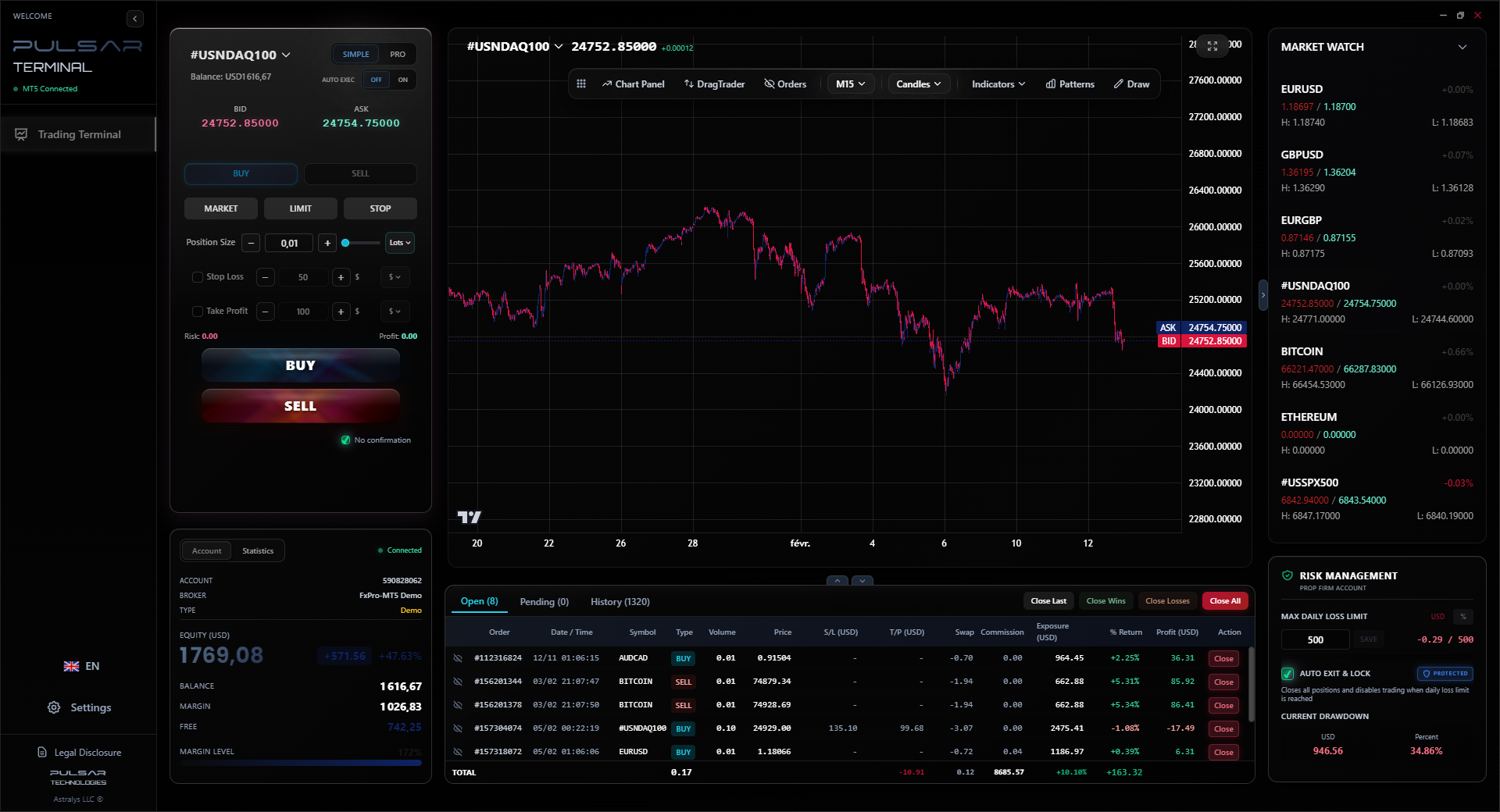
Managing multi-leg option strategies like Iron Condors requires precise order placement and risk management, which tools like Pulsar Terminal streamline directly on your MT5 platform.
Pulsar Terminal
Универсальный инструмент для MT5: drag-and-drop ордера, мульти-TP/SL, трейлинг-стоп, грид-трейдинг, Volume Profile и защита для проп-фирм. Используется 1000+ трейдерами ежедневно.
You can master Delta, Theta, Gamma, and Vega, but if you ignore this section, you'll fail. SEBI's changes are a fundamental shift. Think of Regulation as your fifth Greek - it changes the cost basis and viability of every strategy.
The Game Changers:
- 100% Upfront Premium (Feb 1, 2025): No more free use on long options. Buying that ₹5000 call requires ₹5000 in your account immediately. This kills low-capital, high-use long option speculation. It forces more defined-risk strategies (like spreads) where capital outlay is the max loss anyway.
- Increased Contract Size (₹15-20 Lakh): This is huge. The notional value of one Nifty lot is now massive. A 1% move is ₹15,000-₹20,000. This pushes out small retail from index options. You might shift to stock options (where lot size is still 100 shares), but then you face single-stock risk.
- STT Hike (April 1, 2026): STT on options premium selling increased from 0.10% to 0.15%. On futures, from 0.02% to 0.05%. This directly eats into profitability. For a premium seller collecting ₹10,000, STT is now ₹15 instead of ₹10. It adds up. Your breakeven point just moved.
- Position Limits: New MWPL rules mean heavily traded stocks might hit position limits faster. Your broker's platform might not let you enter a trade if the market-wide limit is breached.
What this means for your Greek strategies: Theta-selling strategies become more capital-intensive but might face less competition. Vega strategies need to account for potentially lower overall volumes affecting liquidity. Your entire risk management framework needs a reset. The old "greek option trading strategies pdf" from 2023 is officially obsolete.
“You should look at an option chain not as a list of prices, but as a grid of interacting risks.”
You need a platform that shows accurate, real-time Greeks. Most Indian brokers provide this, but the quality varies.
Top Platforms for Greek Analysis:
- Zerodha's Console/Sensibull: Sensibull (integrated with Zerodha) is fantastic. It shows live Greeks, lets you build multi-leg strategies, and visualizes your risk profile (the "P&L graph"). Their Greek numbers are reliable for retail purposes.
- Dhan's Options Trader: Built specifically for this. Very clean interface for viewing Delta, Theta, etc., for single options or complex strategies.
- Upstox & Angel One: Their advanced options analytics are decent. Always cross-check a Greek calculation manually once to build intuition.
The International Route for US Options: If you want to trade US options (Apple, Tesla) for diversification, you'll need an international broker like Interactive Brokers. Their platform, TWS, has incredibly powerful Greek analytics and risk modeling. It's overkill for a beginner but is the industry standard for professionals.
A Critical Note on Data: The Greeks your platform shows are based on a model (usually Black-Scholes). The model assumes things like constant volatility, which isn't true. Treat the numbers as guides, not gospel. A 0.50 Delta doesn't mean a 50% chance of finishing ITM in the real, messy market. It's a sensitivity measure. Use them to compare trades (Trade A has a higher Theta than Trade B) rather than as absolute truth.
Funding these accounts is straightforward with UPI, NetBanking, or IMPS. Just remember, with international brokers, you're dealing in USD and facing currency conversion fees. For most Indian traders starting out, mastering the Greeks on a solid local platform like Zerodha or Dhan is more than sufficient. You can read our detailed Exness review for forex, but for Indian equity options, stick with the local specialists.
So, you won't find a single 'greek option trading strategies pdf' that hands you success. What you have now is better: a framework. Start small. Open a practice account (most brokers offer them) and track the Greeks of a simple trade for a week. Watch how Delta changes as the underlying moves. See Theta chip away at a long option's value day by day.
Focus on one Greek per month. Next month, maybe build a small Delta-neutral trade. The month after, try a pure Theta-selling trade in a small size. Journal everything. Note how the new SEBI rules affect your capital and choices.
The goal isn't to memorize formulas. It's to develop a feel for risk. When you look at an option chain, you should instinctively gauge whether the Theta is worth the Gamma risk, or if the Vega is too high to sell. That intuition, built on a foundation of these metrics and a deep respect for Indian regulations, is what separates the 90% who lose from the 10% who have a fighting chance. Now go look at the Nifty option chain not as a list of prices, but as a grid of interacting risks. That's where real trading begins.
FAQ
Q1Where can I find a free greek option trading strategies PDF for Indian markets?
Honestly, most free PDFs are generic and outdated, especially after SEBI's 2024-2026 rule changes. Instead, use the free educational sections on Zerodha Varsity or Sensibull's learning hub. They offer structured, India-specific modules on options Greeks that are constantly updated. They're more valuable than any static PDF.
Q2What is the most important Greek for a beginner options seller in India?
Theta. As a seller, you're primarily selling time. Understanding how time decay accelerates in the final week is critical. However, you must pair it with an understanding of Vega. Selling options when implied volatility (IV) is high (like before a budget) gives you a bigger premium cushion but comes with the risk of an IV crush or spike. Start by selling far OTM options (low Delta) with 30-45 days to expiry to give yourself time and manage Gamma risk.
Q3How do SEBI's new upfront premium rules affect Greek-based strategies?
It massively impacts long option strategies (buying calls/puts). Your capital is now locked up for the full premium, reducing use. This makes simple long calls/puts less attractive compared to defined-risk spreads. For example, a bull call spread (buying a call, selling a higher strike call) often requires similar capital but has a capped max loss. The Greeks of the spread (its Delta, Theta) become more important than a naked long option's Greeks.
Q4Can I use these strategies with a small account (under ₹1 lakh)?
Yes, but you must be extremely careful. With the new ₹15-20 lakh index contract sizes, Nifty/Bank Nifty options are likely out of reach. Focus on stock options with lower margin requirements. Use defined-risk strategies like credit spreads or iron condors where your max loss is known and small. A reckless scalping strategy with naked options will blow up a small account fast. Start with single-lot trades in less volatile stocks.
Q5Do Indian broker platforms show accurate Gamma and Vega?
Major platforms like Zerodha (via Sensibull), Dhan, and Upstox show Gamma and Vega calculated using standard models. They are accurate enough for retail trading decisions. The key is to use them for comparison (e.g., this option has higher Gamma than that one) rather than taking the absolute number as a perfect predictor. Always be aware that models assume constant volatility, which is never true in real markets.
Q6How does the STT hike impact Theta-selling strategies?
It directly reduces your net profit. If you collect ₹10,000 in premium from selling options, your STT cost is now ₹15 (0.15%) instead of ₹10. This means you need to be slightly more right on your trade for it to be profitable. It reinforces the need for high-probability, high-Theta trades and tight risk management. It makes low-premium, high-frequency strategies less viable.
Урок проф. Уинстона
Ключевые выводы:
- ✓Delta hedges direction, but Gamma defines the speed of your P&L change.
- ✓Theta decays fastest in the final 7 days; sell time, don't buy it.
- ✓Vega risk can dwarf directional loss; always check implied volatility.
- ✓SEBI's new rules (2025-26) are now a primary factor in strategy selection.
Насколько полезна эта статья?
Нажмите на звезду
Еженедельные торговые инсайты
Бесплатный еженедельный анализ и стратегии. Без спама.
Об авторе
Rajesh Sharma
Старший форекс-аналитик
Более 10 лет торгует на индийских и южноазиатских рынках. Начинал с валютных деривативов на NSE, затем перешёл на международный форекс. Специализируется на USD/INR и парах развивающихся рынков.
Комментарии
Предупреждение о рисках
Торговля финансовыми инструментами сопряжена со значительным риском и может не подходить всем инвесторам. Прошлые результаты не гарантируют будущих доходов. Данный контент носит исключительно образовательный характер и не является инвестиционной рекомендацией. Всегда проводите собственное исследование перед торговлей.
Вам также может понравиться

Cara Trading Forex Sukses: 7 Prinsip dari Trader Profesional
Cara trading forex sukses dengan 7 prinsip trader pro: manajemen modal, disiplin, journal trading, backtest. Data nyata, bukan janji profit palsu.
Jam Trading Forex Terbaik untuk Trader Indonesia: Panduan Lengkap dengan Tabel Waktu
Panduan jam trading forex untuk trader Indonesia. Tabel 4 sesi dunia, jam emas 20:00-00:00, sesi mana yang harus dihindari. Data akurat + tips dari trader berpengalaman.
Top 5 Sàn Forex Uy Tín Nhất 2026: Review Jujur dari Trader Indonesia
Top 5 sàn forex uy tín 2026 untuk trader Indonesia. Review jujur: spread, deposit, withdraw, dukungan lokal. Exness, XM, IC Markets & lebih.
Скачать Pulsar Terminal
Все эти калькуляторы встроены в Pulsar Terminal с данными в реальном времени с вашего счёта MT5.
Скачать Pulsar Terminal