


It was March 2020, and the screen was pure chaos.

Olumide Adeyemi
Пионер трейдинга в Западной Африке ·  Nigeria
☕ 10 мин чтения
Что вы узнаете:
- 1What 'Hot Forex' Really Means (Spoiler: It's Not What You Think)
- 2The Nigerian Trader's Unfair Advantages
- 3Brokers That Actually Work Here: Deposits, Withdrawals, and Reality
- 4Finding Real 'Hot' Opportunities, Not Just Noise
- 5Risk Management: The Only Thing That Keeps You in the Game
- 6The Psychology of a Successful Trader in Nigeria
- 7Building a Sustainable Trading Plan, Not a Lottery Ticket

It was March 2020, and the screen was pure chaos. The USD/NGN pair on the black market was jumping like a yoyo, and my phone wouldn't stop buzzing with WhatsApp messages from 'Hot Forex Signal' groups. 'BUY GBP/USD NOW!' one screamed. 'Massive pump incoming on Gold!' promised another. I watched a friend blow through 150,000 Naira in an hour chasing one of these 'hot' tips. That moment, right there, is what most people think 'hot forex' is about: frantic, get-rich-quick chaos. But after 12 years in this game, I've learned the real 'hot' isn't about the latest gossip. It's about finding the consistently warm opportunities everyone else is too impatient to wait for. Let's talk about what 'hot forex' really means for us here in Nigeria.
When you hear 'hot forex' in Nigeria, your mind probably goes to those flashy Instagram ads with guys posing next to Lamborghinis, promising secret signals that print money. That's the fantasy. The reality is far less glamorous and much more powerful.
True 'hot' trading isn't about the temperature of a tip. It's about market liquidity and volatility. A 'hot' market is one that's moving with good volume, offering clear opportunities. For us, that often means focusing on sessions when liquidity is high. The London-New York overlap (3 PM to 5 PM Nigerian time) is typically the 'hottest' period for major pairs like the EUR/USD. That's when spreads are tightest and moves can be decisive.
I made a classic mistake early on. I'd try to trade the USD/NGN during our local afternoon, when the market was as quiet as a library. Nothing moved. I was forcing trades where none existed. I learned the hard way that a 'cold', slow market will drain your account faster than a bad trade in a 'hot' one, because you'll overtrade out of boredom.

Warning: The hottest thing in forex for a new trader is usually their own emotions - greed and fear. A 'hot signal' from a stranger is almost always a recipe for a cold, hard loss.
The real skill is learning to read the market's temperature yourself, using tools like the MACD indicator and volume, not relying on someone else's thermometer.

💡 Совет Уинстона
A 'hot' market is defined by volume, not hype. If you can't see the volume profile, you're trading blind. Always know who's in the market with you.
We actually have a few unique edges sitting right here in Nigeria. First, our experience with currency volatility is a brutal but effective teacher. Watching the Naira teaches you about economic pressure, central bank intervention, and pure market sentiment in a way a textbook never could. You understand forex fundamentals because you live them.
Trading the Naira Pairs
While direct USD/NGN trading with a standard forex broker is rare (you'll usually find it as a CFD with specific brokers), monitoring it is crucial. It's a fantastic sentiment gauge. When the parallel market rate spikes, you often see risk-off sentiment globally. That can be a cue for safe-haven flows into the US Dollar or Swiss Franc. I once shorted the AUD/USD (a risk-sensitive currency) in late 2022 after seeing sustained pressure on the Naira, and it netted a clean 85-pipe move. The Naira was my canary in the coal mine.
The Session Advantage
Our time zone (WAT) is perfect. We're awake for the tail end of the Asian session, the entire European session, and the open of the US session. You can catch the setup in London and the follow-through in New York without pulling all-nighters. This is perfect for a swing trading approach where you place trades in the evening and manage them the next afternoon.

Pro Tip: Use your local knowledge. If you see major news about Nigerian oil exports or debt negotiations, think about the currencies that would be impacted. A negative story might strengthen the US Dollar index (DXY), which affects all major pairs. Connect the local dots to the global chart.
“True 'hot' trading isn't about the temperature of a tip. It's about market liquidity and volatility.”
This is where the rubber meets the road. All the strategy in the world is useless if you can't fund your account or get your profits out. The 'hottest' broker is the one that's reliable for you in Nigeria.
You need a broker with reliable local deposit options. Bank transfers, credit/debit cards, and especially popular e-wallets like SticPay or cryptocurrency gateways are essential. Withdrawal speed is the real test. I've had withdrawals take 3 hours with some brokers and 7 business days with others. That stress is unnecessary.
Based on my experience and that of a tight-knit trading circle here, a few names consistently come up for their operational reliability in Nigeria:
| Broker | Key Advantage for Nigerians | Thing to Watch For |
|---|---|---|
| Exness | Excellent local deposit/withdrawal processing, accepts Naira. | Can be very focused on short-term traders. |
| XM | Strong educational resources, good for beginners building skills. | Withdrawals might be a tad slower than some. |
| IC Markets | Raw spreads, great execution for scalping. | Might be better for more experienced traders. |
| Pepperstone | strong platform (cTrader & MT4/5), very reputable. | Minimum deposit might be higher for some accounts. |
My personal rule: always start with a small test withdrawal before you commit large capital. Deposit 20,000 Naira, trade a little, then try to withdraw 15,000. If that process is smooth, you've got a green light. I learned this after a frustrating episode where a broker's 'instant' withdrawal took 11 days. It was a lesson in due diligence.
Remember, regulation is key. Always check for a top-tier license (like CySEC, ASIC, FCA). It's your safety net.

Forget the signal groups. Let's talk about how to spot genuine trading setups. A 'hot' opportunity is one with a clear reason, not just a price spike.
Economic Calendar is Your Best Friend
This is non-negotiable. High-impact news events (like US Non-Farm Payrolls, CPI data, or ECB rate decisions) create volatility. The key is not to trade the news blindly (that's a gamble), but to trade the reaction to the news. I wait for the initial spike and look for a failure or a consolidation pattern. For example, if the USD spikes on strong data but then fails to break a key resistance level on the 15-minute chart, that's a potential reversal signal.
Technical Confluences
A 'hot' setup for me has at least two things agreeing. Maybe price is hitting a major Fibonacci retracement level (like the 61.8%) AND that level aligns with a previous support/resistance zone. On top of that, I want to see momentum slowing, perhaps with a divergence on the RSI indicator. That's a high-probability, warm setup you waited for.
I once took a short trade on Gold (XAU/USD) at $1815. It was a triple confluence: a rejection from the weekly pivot point, a bearish engulfing candle on the 4-hour chart, and an RSI reading over 70. It felt 'hot' because everything lined up. I rode it down to $1792. That's 23 pips in Gold, which is a significant move. The XAU/USD guide breaks down its unique behavior.

Example: Don't just buy because price is 'low'. Wait for the confluence. A pin bar at a support level is okay. A pin bar at a support level that's also the 200-day moving average and the 50% Fib retracement? That's a trade worth taking.
💡 Совет Уинстона
Your first 50 trades should be about following your process perfectly, not making money. The profits will follow the discipline, never the other way around.
“The hardest skill to learn is doing nothing. Most of your time should be spent watching, analyzing, and waiting.”
This is the most important section. You can have a 90% win rate and still blow up your account. How? Bad risk management. In Nigeria, where capital can be hard to come by, protecting what you have is everything.
The 1% Rule: Never, ever risk more than 1% of your trading account on a single trade. If you have a 100,000 Naira account, your maximum risk per trade is 1,000 Naira. This isn't a suggestion. It's a law. Use a position size calculator for every single trade. I got cocky after three wins in a row in 2017 and put 5% on a 'sure thing.' It wasn't. I lost a week's profits in minutes and nearly triggered a margin call. The feeling was sickening.
Stop-Losses are Your Lifeline: Your stop-loss isn't a suggestion; it's an order. Place it at a logical level where your trade idea is proven wrong. If you're buying a pullback to support, your stop goes below that support. If price goes there, your idea is invalid. Take the loss and move on. Letting a loss run is the number one killer of accounts.
Profit is Not a Target, It's a Structure: Have a take-profit level based on the chart (like the next resistance), not a random number. Even better, learn to trail your stop to lock in profits as the trade moves in your favor. This turns big winners into life-changing trades.
Protecting your capital daily is more important than making a profit on any single day. Survival first, growth second.

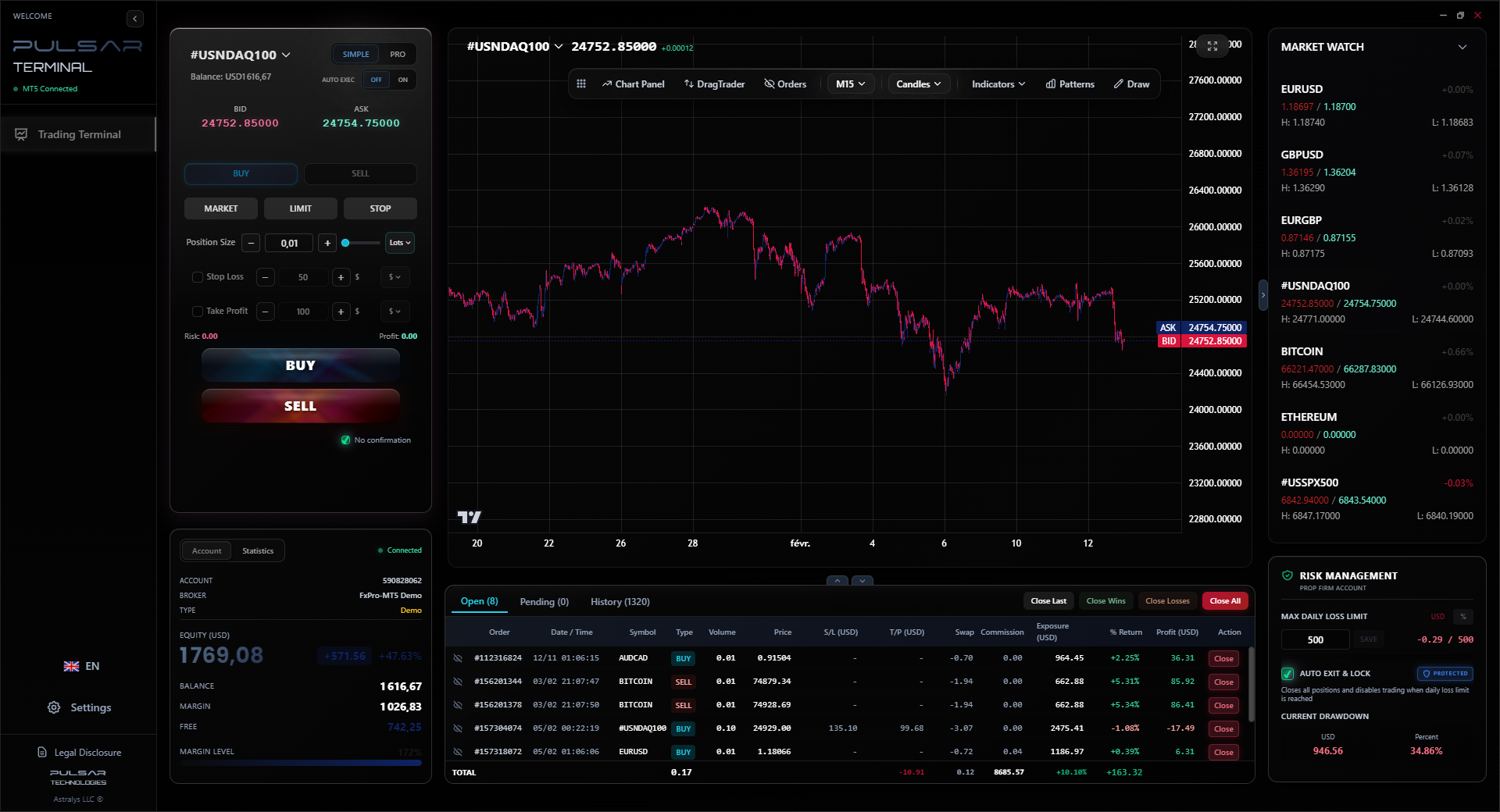
Managing multiple trades and protecting your profits with trailing stops is complex on standard MT5, but tools like Pulsar Terminal automate it all directly on your platform.
Pulsar Terminal
Универсальный инструмент для MT5: drag-and-drop ордера, мульти-TP/SL, трейлинг-стоп, грид-трейдинг, Volume Profile и защита для проп-фирм. Используется 1000+ трейдерами ежедневно.
Trading is 80% psychology, 15% risk management, and 5% strategy. The market is a mirror, and it will expose every flaw in your character.
Dealing with External Pressure: In Nigeria, there's often family pressure to 'make it quick.' You might be trading with money that feels extra precious. This leads to overtrading - forcing setups that aren't there to try and produce a result. You have to build a mental wall between your trading and external expectations. This is a marathon, not a 100-meter dash.
Handling Losses: You will have losing trades. Period. The goal isn't to avoid them; it's to manage them so small they don't matter. If a 10,000 Naira loss ruins your week emotionally, you're trading too big. A loss should feel like a minor paperwork error, not a personal failure.
The Discipline of Waiting: The hardest skill to learn is doing nothing. Most of your time should be spent watching, analyzing, and waiting. The 'hot forex' market of your dreams is one where you're patient enough to let the perfect setup come to you, not where you're chasing every flicker on the screen. I keep a trading journal, and my most profitable months are always the ones with the fewest trades, but the highest-quality setups.
Remember, every great trader has a graveyard of bad trades behind them. The difference is they didn't camp there.
💡 Совет Уинстона
The spread isn't just a cost; it's a signal. A widening spread in a calm market often precedes a storm. Watch it like a hawk.
“A loss should feel like a minor paperwork error, not a personal failure.”
Your trading plan is your business plan. Would you open a shop without one? Here’s what a real plan looks like.
1. Define Your Market: Are you trading major forex pairs? The EUR/USD guide is a great start. Or are you focusing on commodities like Gold? Pick one or two instruments and become an expert in their behavior. Don't jump from Oil to the Japanese Yen.
2. Define Your Strategy: Are you a day trader, a scalping specialist, or a swing trading patient hunter? Your strategy dictates your chart timeframes (e.g., scalpers use 1-min/5-min, swing traders use 4-hour/daily). Backtest it. Don't just assume it works.
3. Define Your Rules: Write down your exact entry criteria (e.g., 'Buy only on a bullish engulfing candle at the 50 EMA with RSI > 30'). Write down your exit criteria for both profit and loss. This removes emotion in the moment.
4. Define Your Money Management: This is where you plug in the 1% rule. Document your position sizing method.
5. Define Your Review Process: At the end of each week, review your trades. Did you follow your plan? Why did you win? Why did you lose? This feedback loop is how you improve.
Stick this plan on your wall. A plan doesn't guarantee profits, but it guarantees you won't fail randomly. You'll fail for specific, correctable reasons, and that's how you grow.
FAQ
Q1Is Hot Forex a legitimate broker?
Hot Forex is a brand name used by HF Markets, which is a regulated international broker. They are legitimate and serve clients globally, including some in Nigeria. However, 'hot forex' as a generic term more commonly refers to the concept of volatile trading or signal services, which is what this article primarily addresses. Always verify a broker's regulation directly on their website.
Q2What is the best time to trade forex in Nigeria?
The most active and liquid times are during the London session (10 AM - 6 PM WAT) and the overlap with the New York session (3 PM - 5 PM WAT). This is when you'll find the tightest spreads and most consistent movements on major pairs like EUR/USD and GBP/USD.
Q3How much money do I need to start trading forex in Nigeria?
You can start with as little as $10 or 10,000 Naira with some micro accounts. However, I strongly advise starting with an amount you are 100% prepared to lose completely - this should be 'tuition fee' money, not rent or school fees. A more realistic starter amount that allows for proper position sizing is around $100 or 100,000 Naira.
Q4Are forex trading profits taxable in Nigeria?
The tax situation for individual retail forex traders in Nigeria is complex and not always clearly enforced. Trading with an international broker offshore may have different implications than local trading. It is crucial to consult with a qualified Nigerian tax professional for advice tailored to your specific situation. Do not rely on general internet advice for tax matters.
Q5Why do most Nigerian forex traders fail?
Most fail due to a combination of poor risk management (risking too much per trade), lack of a tested plan, emotional trading driven by greed or fear, and chasing 'hot' signals from unverified sources instead of learning to read the market themselves. The get-rich-quick mentality is the fastest path to a poor-quick result.
Q6Can I use my Nigerian bank card to fund a forex trading account?
Yes, many international brokers accept deposits via Visa/Mastercard debit and credit cards issued by Nigerian banks. This is often the easiest method. However, always check with your specific broker for supported payment methods and be aware that your bank may charge an international transaction fee.
Урок проф. Уинстона
Ключевые выводы:
- ✓Risk max 1% per trade. No exceptions.
- ✓Trade the London-NY overlap for best liquidity.
- ✓Test broker withdrawals before large deposits.
- ✓A plan prevents random failure.
Насколько полезна эта статья?
Нажмите на звезду
Еженедельные торговые инсайты
Бесплатный еженедельный анализ и стратегии. Без спама.
Об авторе
Olumide Adeyemi
Пионер трейдинга в Западной Африке
Один из самых активных преподавателей форекс-трейдинга в Нигерии. 8 лет торгового опыта из Лагоса. Специализируется на стратегиях с малым капиталом и челленджах проп-фирм для африканских трейдеров.
Комментарии
Предупреждение о рисках
Торговля финансовыми инструментами сопряжена со значительным риском и может не подходить всем инвесторам. Прошлые результаты не гарантируют будущих доходов. Данный контент носит исключительно образовательный характер и не является инвестиционной рекомендацией. Всегда проводите собственное исследование перед торговлей.
Вам также может понравиться

Cara Trading Forex Sukses: 7 Prinsip dari Trader Profesional
Cara trading forex sukses dengan 7 prinsip trader pro: manajemen modal, disiplin, journal trading, backtest. Data nyata, bukan janji profit palsu.
Jam Trading Forex Terbaik untuk Trader Indonesia: Panduan Lengkap dengan Tabel Waktu
Panduan jam trading forex untuk trader Indonesia. Tabel 4 sesi dunia, jam emas 20:00-00:00, sesi mana yang harus dihindari. Data akurat + tips dari trader berpengalaman.
Top 5 Sàn Forex Uy Tín Nhất 2026: Review Jujur dari Trader Indonesia
Top 5 sàn forex uy tín 2026 untuk trader Indonesia. Review jujur: spread, deposit, withdraw, dukungan lokal. Exness, XM, IC Markets & lebih.
Скачать Pulsar Terminal
Все эти калькуляторы встроены в Pulsar Terminal с данными в реальном времени с вашего счёта MT5.
Скачать Pulsar Terminal