


Here's a fact that might surprise you: you can technically start trading forex in Nigeria with less than 1,000 Naira.

Olumide Adeyemi
Пионер трейдинга в Западной Африке ·  Nigeria
☕ 12 мин чтения
Что вы узнаете:
- 1Is Forex Trading Legal in Nigeria? (The 2025 Rule Change)
- 2How Much Money Do You Really Need to Start?
- 3Picking a Forex Broker in Nigeria: What Actually Matters
- 4Your First Trade: A Step-by-Step Walkthrough
- 5Pitfalls Every New Nigerian Trader Faces (And How to Avoid Them)
- 6Building a Sustainable Trading Plan (Your Blueprint)
- 7Next Steps and Continuous Learning
Here's a fact that might surprise you: you can technically start trading forex in Nigeria with less than 1,000 Naira. I've seen ads promising riches with a $1 deposit. But after 12 years in this game, I can tell you that's the fastest way to lose your money. The real question isn't 'can you start,' but 'how do you start properly?' Let's cut through the noise. I'll walk you through exactly how do i start trading forex the right way, from understanding Nigeria's new 2025 laws to picking a broker that won't disappear with your funds.
This is the first thing you need to get straight. Yes, you can trade forex as an individual in Nigeria. It's legal. But the rules just got a major update in 2025, and ignoring them is a bad idea.
The big change is the Investments and Securities Act (ISA) 2025. Before this, the online retail forex space was a bit of a wild west. Now, the Securities and Exchange Commission (SEC) says any company offering online forex trading platforms must register with them. Operating without registration is an offense.
What does this mean for you? It adds a layer of protection. You should be looking for brokers who are taking steps to comply with this new local framework. However, here's the practical reality most Nigerian traders face: many of the most popular and reputable platforms are still international brokers regulated abroad (like CySEC, FCA, ASIC).
The Central Bank of Nigeria (CBN) also has rules. They're cool with you trading, but they absolutely forbid you from using the official FX window (where banks get dollars) to fund your trading account. You can't take cheap CBN dollars and go speculate with them. Your funding has to come through other channels.
And about taxes? Don't kid yourself. If you make a profit, the Federal Inland Revenue Service (FIRS) expects 10% as capital gains tax. Trading with an offshore broker doesn't make your profits tax-free in Nigeria.

Warning: The ISA 2025 is new. While it aims to clean up the market, enforcement is still evolving. Your safest bet is to use an internationally regulated broker with a strong reputation, as their oversight is currently more established. Check our Exness review and XM review for examples of brokers popular here.

💡 Совет Уинстона
Your first investment shouldn't be in the market, it should be in a proper trading journal. A $5 notebook will teach you more than a $500 indicator.
“Starting with too little capital is the fastest way to ensure you'll never learn how to trade properly.”
This is where most new traders get it completely wrong. They see a broker offering a $1 minimum deposit and think, "Great! I'll start with 5,000 Naira." Let me be brutally honest: starting with that little is a practice in futility. You'll be wiped out by your first few losses, or the psychological pressure will make you do stupid things.
The Technical Minimum vs. The Practical Minimum
Technically, you can start with $10 or $20. Some brokers even have cent accounts where $1 is 100 cents, letting you place tiny trades. This is fantastic for learning the platform without real financial risk. But it's not 'trading.' It's practicing.
For actual trading where you aim to make meaningful, sustainable progress, you need a real bankroll. My strong opinion? A realistic starting amount is between $200 and $1,000 (roughly 300,000 to 1.5 million Naira at current rates).
Why? It's all about risk management, the most boring and most important part of trading. If you start with $50 and follow the golden rule of risking only 1-2% of your account per trade, you're risking 50 cents to $1 per trade. After broker spreads and commissions, you need a massive move just to break even. It's mathematically stacked against you.
With a $500 account, risking 1% ($5) per trade, you can actually breathe. A 10-pip move on a micro lot (0.01) is $1. You can be wrong a few times, learn, and not blow up. This is how you build skill, not just gamble.
I learned this the hard way. In my second year, I funded a $100 account, determined to 'prove' I could grow it. I took a trade on EUR/USD, got nervous after a 5-pip move against me, and closed it for a loss. The spread was 2 pips. I lost $7 on a trade that later went my way. My account was down 7% in one emotional move. That's no way to trade.

Example: Let's use a position size calculator. Account: $500. Risk per trade: 1% ($5). Stop-loss distance: 20 pips. Your position size should be 0.025 lots. That's a sane, manageable trade. Try that math with a $50 account.
“Profitable trading is boring. The excitement of gambling leads to poverty.”
Forget the flashy ads with cars and mansions. Choosing a broker is about safety, cost, and convenience. Here’s my checklist, refined from a decade of using different platforms.
1. Regulation & Safety of Funds: This is non-negotiable. Your broker must be regulated by a reputable authority. For Nigerian traders, common ones are the Cyprus Securities and Exchange Commission (CySEC), the Australian Securities and Investments Commission (ASIC), or the Financial Sector Conduct Authority (FSCA) in South Africa. This means client funds are segregated, and there's a governing body to complain to if things go south.
2. Trading Costs (Spreads & Commissions): This is your silent enemy. The spread is the difference between the buy and sell price. On a major pair like EUR/USD, look for average spreads under 1.0 pip on a standard account. Some brokers offer 'raw spread' accounts with spreads from 0.0 pips but charge a commission per trade. You need to do the math on which is cheaper for your style. A scalping strategy needs ultra-low spreads, while a swing trading approach can tolerate slightly higher ones.
3. Deposit & Withdrawal in Naira: This is the local headache. Can you deposit and withdraw in Naira without crazy fees? Do they use local bank transfers or popular e-wallets like Neteller or Skrill? With Nigerian card restrictions for international transactions, this is crucial. Brokers like Exness and HFM have built strong local support for this.
4. Platform & Tools: MetaTrader 4 (MT4) or MetaTrader 5 (MT5) are the industry standards. They're reliable and have every tool you'll ever need. Some brokers have their own platforms, which can be good, but I always prefer MT4/MT5 for their stability and vast library of indicators like the RSI indicator and MACD indicator.
5. use: Nigerian traders often have access to very high use (1:500, 1:1000, even 1:2000). This is a double-edged sword. It lets you control large positions with little capital, but it also amplifies losses. I never use more than 1:50, even if 1:500 is available. High use is the quickest path to a margin call.
Based on my experience and community chatter, brokers like Pepperstone (great execution), IC Markets (low raw spreads), and XM are consistently reliable choices for Nigerian traders.
“Profitable trading is boring. The excitement of gambling leads to poverty.”
Let's make this concrete. I'll walk you through placing your first real trade, assuming you've opened and funded an account with a broker.
Step 1: Analysis (The Boring Part) Don't just jump in. Open your chart. Let's say you're looking at GBP/USD. Check the higher timeframes (4-hour, daily) to see the overall trend. Is it generally going up or down? Then zoom into the 1-hour or 15-minute chart to look for an entry point. Maybe price is pulling back to a key support level in an uptrend. That's a potential buy zone.
Step 2: Planning the Trade (The Critical Part) This is where you make all your decisions before you click buy.
- Entry: At what exact price will you enter? (e.g., 1.2650)
- Stop-Loss (SL): Where will you admit you're wrong and exit to limit losses? This should be based on market structure, not an arbitrary number. (e.g., 1.2620, 30 pips below entry).
- Take-Profit (TP): Where will you take your profit? A common risk-reward ratio is 1:2 or 1:3. If you're risking 30 pips, aim for 60 or 90 pips profit. (e.g., 1.2710 for a 60-pip target).
Step 3: Calculating Position Size Let's say your account is $1,000. You decide to risk 1.5% of it on this trade. That's $15. Your stop-loss is 30 pips away. How much can you trade? The formula is: Risk Amount / (Stop-Loss in Pips * Pip Value). For a standard lot (100,000 units), 1 pip on GBP/USD is roughly $10. So for a micro lot (1,000 units), 1 pip is $0.10. $15 risk / (30 pips * $0.10 per pip per micro lot) = 5 micro lots (or 0.05 standard lots).
Step 4: Placing the Order On your MT4 platform, right-click on the chart, select 'Trading' -> 'New Order'. A window pops up. Set volume to 0.05 (for 0.05 lots). Set your stop-loss (SL) and take-profit (TP) prices. Click 'Buy by Market'.
Step 5: Managing the Trade Once it's live, walk away. Seriously. You've made your plan. Let it play out. The biggest mistake new traders make is moving their stop-loss further away when the trade goes against them, hoping it will turn around. That's how small losses become account-killers.

Pro Tip: Your first 10 trades shouldn't be about making money. They should be about perfecting this process: analysis, planning, execution, and emotional control. Keep a journal. Write down why you took every trade, your emotional state, and the outcome.
💡 Совет Уинстона
If you can't explain your trade setup in one simple sentence, you don't understand it well enough to risk money on it.
“Your stop-loss isn't a suggestion. It's the most important order you'll ever place.”
I've made these mistakes. My friends have. You probably will too. But knowing them in advance gives you a fighting chance.
Pitfall 1: Chasing the 'Holy Grail' Strategy. You'll buy a $500 course promising 90% win rates. You'll download a complicated indicator that paints arrows on the chart. Spoiler: they don't work consistently. The market changes. Price action and understanding support/resistance is the only thing that's constant. I wasted over $2,000 on systems and indicators in my first three years before I finally committed to learning pure price action.
Pitfall 2: Overtrading. This is huge. You have a small account, you want to make it big fast, so you take every little signal. You're in 5 trades at once. The market moves, and you're getting margin calls. Quality over quantity. One or two well-planned trades a week are better than ten rushed ones a day.
Pitfall 3: Ignoring Fundamentals (Especially in Nigeria!). You're trading USD/NGN or even EUR/USD, and the CBN makes a surprise interest rate announcement. If you don't know it's coming, you can get wiped out. Follow economic calendars. Know when major US data (Non-Farm Payrolls, CPI) is released, and know what's happening with the Naira. Liquidity dries up and volatility spikes during these events.
Pitfall 4: No Risk Management. I can't stress this enough. Not using a stop-loss is like driving without a seatbelt. You might be fine for a while, but one accident is catastrophic. Decide your risk per trade (1-2%) and stick to it religiously. Use a position size calculator for every single trade.
Pitfall 5: Trading with 'Emotional Money'. This is money you need for rent, school fees, or to 'rescue' yourself from a financial bind. The pressure will destroy your judgment. Only trade with risk capital you can afford to lose completely.
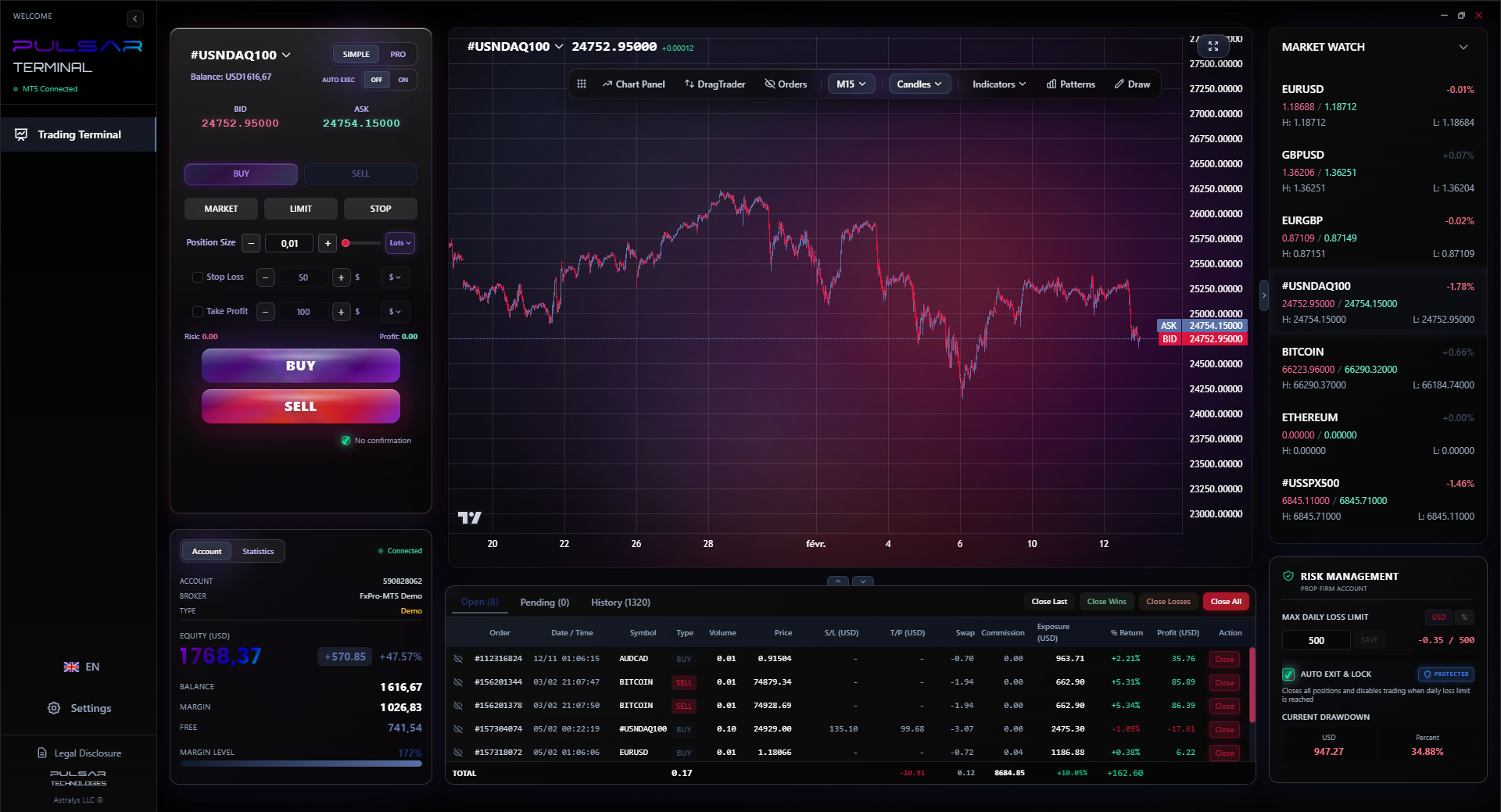
Sticking to your trading plan's exit rules is the hardest part, which is why automating them with a tool like Pulsar Terminal directly on your MT5 can be a game-saver.
Pulsar Terminal
Универсальный инструмент для MT5: drag-and-drop ордера, мульти-TP/SL, трейлинг-стоп, грид-трейдинг, Volume Profile и защита для проп-фирм. Используется 1000+ трейдерами ежедневно.
“Your stop-loss isn't a suggestion. It's the most important order you'll ever place.”
A trading plan is your rulebook. It removes emotion. Here’s what yours must include.
1. Your Trading Style: Are you a scalper (in and out in minutes), a day trader (close all positions by day's end), or a swing trader (hold for days or weeks)? Your style dictates your charts, your pairs, and your broker's required spreads. I'm primarily a swing trader because it fits my personality and schedule.
2. Your Market & Conditions: What do you trade? I stick to major forex pairs like EUR/USD and XAU/USD (Gold). They have the best liquidity and tightest spreads. Also, define your 'trading conditions.' I only trade if there's a clear trend on the daily chart and a pullback to a key level on the 4-hour chart. If that condition isn't met, I don't trade. It keeps me out of trouble.
3. Your Risk Management Rules: This is the core.
- Maximum risk per trade: ___% (I use 1.5%).
- Maximum risk per day: ___% (I stop after losing 3%).
- Maximum risk per week: ___% (I stop after 5%).
- Always use a stop-loss.
- Minimum risk-reward ratio: 1:2.
4. Your Entry & Exit Rules: Be specific. "I will buy when price touches the 50-period EMA and the RSI is above 50" is vague. "I will buy a limit order at the previous 4-hour swing high, with a stop-loss below the corresponding swing low, targeting the next daily resistance level" is a rule.
5. Your Review Process: At the end of each week, review your trades. Did you follow your plan? What worked? What didn't? This is how you improve.
Sticking to a plan is boring. Profitable trading is boring. The excitement of gambling leads to poverty. The discipline of following a plan leads to consistency.
💡 Совет Уинстона
The Naira's volatility isn't just something to trade; it's a real-world lesson in market forces. Watch it to understand how news moves price.
“A trading plan you don't follow is just a piece of paper with lies on it.”
You now know how do i start trading forex. But starting is just the first 1%. The real work is in the years of refinement ahead.
1. Paper Trade First: Most brokers offer demo accounts with virtual money. Use it for at least 2-3 months. Test your plan. Get comfortable with the platform. Make your beginner mistakes there, not with real cash.
2. Start Small for Real: When you go live, start with the smallest possible position size. Your goal for the first 6 months is not to make money, but to not lose money while executing your plan perfectly. If you can break even, you're ahead of 80% of beginners.
3. Find a Community (Carefully): Isolation is a trader's enemy. Find a forum or group of serious traders to discuss ideas. Avoid 'signal seller' groups promising guaranteed wins. Look for groups focused on analysis and education.
4. Keep a Detailed Journal: This is your most valuable tool. Record every trade: screenshot, reason for entry, emotional state, outcome. Review it monthly. You'll see patterns in your mistakes.
5. Never Stop Learning: The market evolves. Read books on trading psychology (like 'Trading in the Zone' by Mark Douglas). Learn about new concepts like market structure and order flow. But always filter new information through the lens of your existing, proven plan.
Remember, this is a marathon, not a sprint. I didn't see consistent profitability until my fourth year. There were months of drawdown, moments of doubt, and the temptation to quit. But by focusing on the process - not the profit - you build a skill that can last a lifetime. Now, go build your plan.
FAQ
Q1What is the minimum amount to start forex trading in Nigeria?
Technically, you can start with as little as $1 with some brokers using a cent account. However, for serious trading where you can apply proper risk management, I strongly recommend starting with at least $200 to $500. This allows you to risk a small percentage (1-2%) per trade without being wiped out by a single loss or the broker's spread.
Q2Which forex broker is best for beginners in Nigeria?
For beginners, I recommend brokers with user-friendly platforms, good educational resources, and reliable customer support. XM and Exness are popular choices as they offer local Naira support, have low minimum deposits, and provide MT4/MT5. Always prioritize brokers with strong international regulation (like CySEC or ASIC) for safety.
Q3Is forex trading taxable in Nigeria?
Yes. Profits from forex trading are considered capital gains and are subject to a 10% tax by the Federal Inland Revenue Service (FIRS). You are required to declare this income, even if you trade with an international broker.
Q4Can I use my Nigerian debit card to fund a forex trading account?
It's become difficult due to CBN restrictions on using Naira cards for international transactions. Most traders now use alternative methods: direct bank transfers to the broker's local payment partner, or e-wallets like Neteller, Skrill, or even cryptocurrency (USDT). Check your broker's deposit options for Nigeria-specific methods.
Q5How much can I realistically make from forex trading as a beginner?
If you're asking this, you're focused on the wrong thing. A realistic goal for your first year is to preserve your capital and break even. Professional traders with years of experience often target 10-20% annual return on their account. Anyone promising you monthly returns of 50% or more is lying. Focus on consistency and risk management, not get-rich-quick schemes.
Q6What is the most important skill for a new forex trader?
Without a doubt, it's risk management and emotional discipline. Knowing how to place a trade is easy. Having the discipline to always use a stop-loss, to only risk 1% of your account, and to walk away after a loss - that's the hard part that separates successful traders from losers.
Q7Are there specific times that are best to trade forex in Nigeria?
Yes. The most volatile and liquid sessions overlap with the London session (1 PM - 10 PM Nigerian time) and the overlap between London and New York sessions (3 PM - 5 PM Nigerian time). This is when you'll see the most movement in major pairs like EUR/USD and GBP/USD. Avoid trading during very quiet periods like the Asian session late at night, as spreads can widen.
Урок проф. Уинстона
Ключевые выводы:
- ✓Start with at least $200 for realistic risk management.
- ✓Always use a stop-loss on every single trade.
- ✓Risk only 1-2% of your account per trade.
- ✓Pick brokers with strong international regulation.
- ✓Your first-year goal is survival, not riches.
Насколько полезна эта статья?
Нажмите на звезду
Еженедельные торговые инсайты
Бесплатный еженедельный анализ и стратегии. Без спама.
Об авторе
Olumide Adeyemi
Пионер трейдинга в Западной Африке
Один из самых активных преподавателей форекс-трейдинга в Нигерии. 8 лет торгового опыта из Лагоса. Специализируется на стратегиях с малым капиталом и челленджах проп-фирм для африканских трейдеров.
Комментарии
Предупреждение о рисках
Торговля финансовыми инструментами сопряжена со значительным риском и может не подходить всем инвесторам. Прошлые результаты не гарантируют будущих доходов. Данный контент носит исключительно образовательный характер и не является инвестиционной рекомендацией. Всегда проводите собственное исследование перед торговлей.
Вам также может понравиться

Cara Trading Forex Sukses: 7 Prinsip dari Trader Profesional
Cara trading forex sukses dengan 7 prinsip trader pro: manajemen modal, disiplin, journal trading, backtest. Data nyata, bukan janji profit palsu.
Jam Trading Forex Terbaik untuk Trader Indonesia: Panduan Lengkap dengan Tabel Waktu
Panduan jam trading forex untuk trader Indonesia. Tabel 4 sesi dunia, jam emas 20:00-00:00, sesi mana yang harus dihindari. Data akurat + tips dari trader berpengalaman.
Top 5 Sàn Forex Uy Tín Nhất 2026: Review Jujur dari Trader Indonesia
Top 5 sàn forex uy tín 2026 untuk trader Indonesia. Review jujur: spread, deposit, withdraw, dukungan lokal. Exness, XM, IC Markets & lebih.
Скачать Pulsar Terminal
Все эти калькуляторы встроены в Pulsar Terminal с данными в реальном времени с вашего счёта MT5.
Скачать Pulsar Terminal