


Most guides on how to open a forex trading account make it sound like a simple five-minute sign-up.

David van der Merwe
Трейдер развивающихся рынков ·  South Africa
☕ 11 мин чтения
Что вы узнаете:
Most guides on how to open a forex trading account make it sound like a simple five-minute sign-up. They skip the part where you can lose your entire deposit in a week if you get the fundamentals wrong. I know because I did exactly that back in 2012, treating my first R2,000 like lottery tickets. Opening an account is easy. Opening the right account, with the right broker, for the right strategy? That's the real work. Let's set the record straight with a no-nonsense, South African-focused walkthrough.
First things first: trading forex is completely legal here. But 'legal' doesn't mean a free-for-all. The Financial Sector Conduct Authority (FSCA) is the sheriff in town, and they've been tightening the reins. Forget the old days of crazy 1:1000 use from offshore brokers. Since 2021, the FSCA has capped use for retail traders at 30:1. There's even talk of a further cap to 1:200 by 2026, so the trend is clear: less use, more protection.
Why does this matter for you? Because any broker offering you an account from South Africa must be FSCA-licensed or be an Authorised Financial Services Provider (FSP). This isn't just bureaucracy. It means they have to follow rules, like keeping your money in a segregated account. That means your capital is separate from the broker's operating funds. If they go bust (it happens), your money should, in theory, be safer.
There's also a shift towards the Over-the-Counter Derivatives Provider (ODP) regime. Fancy name, simple idea: it forces brokers to have more skin in the game with higher capital requirements and stricter reporting. It's moving the market from 'informal to institutional.' When you're looking at brokers, an FSCA license with ODP status is a strong green flag.

Warning: If a broker's website doesn't clearly display its FSCA license number (usually at the bottom of the homepage), walk away. No license, no trade. It's that simple. I learned this after almost depositing with a slick offshore outfit that later vanished.
And yes, your profits are taxable. SARS views forex trading as income. Keep a detailed trade journal from day one. I use a simple spreadsheet logging entry, exit, profit/loss, and the trade idea. It makes tax season a lot less painful.

💡 Совет Уинстона
Your first deposit isn't trading capital. It's tuition fees. Expect to pay some of it to the market for your education. The goal is to make the lessons cheap.
“Opening an account is easy. Opening the right account, with the right broker, for the right strategy? That's the real work.”
This is where most new traders trip up. They see an ad promising 'get rich quick' and sign up without comparing. Your broker is your business partner. You need to vet them.
Regulation is Non-Negotiable
As I said, FSCA regulation is your baseline. But many good international brokers operating here are also regulated by top-tier authorities overseas, like the UK's FCA or Australia's ASIC. This adds an extra layer of security. Brokers like IG and FP Markets have this multi-jurisdictional oversight.
The Real Cost of Trading: Spreads, Commissions & Hidden Fees
This is the meat and potatoes. The advertised 'minimum deposit' is a distraction. The real cost is in the spread (the difference between buy and sell price) and commissions.
Let's get specific. On the EUR/USD, which I trade often:
- IG's standard account averages about 0.98 pips spread.
- Tickmill's 'Raw' account has a tiny 0.11 pip spread but charges a $2 per lot commission. Their effective cost is around 0.71 pips.
- A local broker like Khwezi Trade offers spreads from 0.4 pips with no commission.
- Some, like Exness, offer raw spreads from 0.0 pips but charge a commission.
You need to do the math based on your typical trade size. For my scalping strategy, a 0.5 pip difference in cost is the difference between profitability and break-even over a hundred trades.
Then there are the silent killers:
- Inactivity Fees: AvaTrade charges $50 after 3 months of no trading. If you need to take a break, you better know this.
- Currency Conversion: If your account is in USD but you deposit in ZAR, a broker might charge 1% or more. Look for brokers offering ZAR-denominated accounts to avoid this.
- Swap Fees: Holding a position overnight? You'll pay or earn a swap rate. It can eat into profits on longer swing trading holds.
Platform & Execution
You'll likely use MetaTrader 4 or 5. But does the broker's version have slippage? How fast is execution during news events? I once had a stop-loss on GBP/USD during Brexit news slip 15 pips with a poor broker. That hurt. Read reviews, specifically about order execution quality.

Example: Let's say you trade 1 standard lot (100,000 units) of EUR/USD. A 1 pip move = $10. If Broker A's spread is 1.0 pip and Broker B's is 0.5 pip, you're already $5 in the hole on Broker A before the market even moves. On 10 trades a week, that's $50 just in spread cost.
“High use amplifies losses faster than it amplifies gains.”
Alright, you've picked a regulated broker. Now, let's open that account properly.
- Visit the Broker's South African Site. Often, international brokers have a local
.co.zasite. This ensures you get the right regulatory entity and local support. - Click 'Open an Account' or 'Register'. You'll be asked for basic info: name, ID number, email, phone number. Use your real details. This is for FSCA-mandated KYC (Know Your Customer) and AML (Anti-Money Laundering) checks.
- Complete the Application Form. This gets more detailed.
- Financial Profile: They'll ask about your employment, annual income, and net worth. Be honest. This isn't a competition. It determines your perceived risk level.
- Trading Experience & Knowledge: How many years have you traded? How many trades do you place per year? What's your knowledge of CFDs and use? Don't exaggerate. If you're a beginner, say so. Some brokers will then restrict your use automatically to a safer level, which is a good thing.
- Risk Tolerance: This isn't a personality quiz. They're legally required to gauge if you understand you can lose more than your deposit. Read the warnings.
- Submit Your FICA Documents. This is standard. You'll need:
- A clear colour copy of your South African ID or passport.
- Proof of residence (a utility bill or bank statement less than 3 months old). I scan these as PDFs and keep them ready. The process usually takes 1-3 business days.
- Choose Your Account Type. This is critical. You'll see options like: | Account Type | Typical Feature | Best For... | | :--- | :--- | :--- | | Standard/Classic | Wider spreads, no commission | Beginners, longer-term traders | Raw/ECN/Pro | Tighter spreads, commission per trade | Scalpers, high-volume traders | Islamic/Swap-Free | No overnight swap fees | Traders requiring Sharia compliance Think about your strategy. If you're starting, a standard account is simpler. If you plan to scalp, a raw spread account is cheaper overall.
- Verify and Activate. Once your documents are approved, you'll get a login for the client portal and trading platform. Your account is now live, but empty.
💡 Совет Уинстона
A broker's customer service is best tested before you have a problem. Send them a question about withdrawal times on a Tuesday afternoon. Their speed and clarity tell you everything.
“Your first deposit isn't trading capital. It's tuition fees.”
Here's the moment of truth: putting money in. This is where emotion first meets the market.
How Much to Deposit?
Brokers advertise minimums as low as $1 or R500. That's a trap. Trading with $1 is pointless - you can't practice proper risk management. My brutal lesson? I started with R2,000, used maximum use on two trades, and was wiped out in a day.
Realistically, you need enough to survive your learning curve. I'd say a minimum of R5,000 for a serious beginner. Why? Let's say you risk just 1% of your capital per trade (a golden rule). That's R50. With a 30:1 use cap, you can still get meaningful exposure, but a few losing trades won't destroy you. An ideal starter amount is between R5,000 and R20,000. This allows you to use a position size calculator properly and not be forced to over-use just to see a profit.
How to Deposit?
Most brokers accept:
- Local Bank Transfer (EFT): Direct to their South African bank account. Usually no fee, but can take a day.
- Credit/Debit Card: Instant, but your bank might charge a forex fee.
- E-Wallets: Like Ozow or PayPal. Fast, fees vary.
Crucial: If possible, fund your account in ZAR to avoid conversion fees. If you must convert, check the broker's rate - it's often worse than your bank's.
Your First Trade Isn't About Profit
Before you click 'buy' on anything, do this:
- Open a demo account. Practice placing orders, setting stop-losses, and taking profits.
- On your live account, plan your first trade. Decide your entry, stop-loss (SL), and take-profit (TP) BEFORE you enter.
- Use the 1% rule. If your account is R10,000, your max risk on this trade is R100.
- Calculate your position size. If your stop-loss is 20 pips away on EUR/USD, and 1 pip = $10, then 20 pips risk = $200. To risk only $7 (approx. R100), you'd trade a micro lot (0.07 lots). This is where a position size calculator is essential.
Ignoring this math is how you get a margin call. I've been there, staring at a negative balance. It's not fun.
“Your first deposit isn't trading capital. It's tuition fees.”
Let me save you some money and heartache by sharing my own blunders.
Pitfall 1: Chasing the Highest use. Early on, I was drawn to brokers offering 1:500 or 1:1000. It felt like more power. It's not. It's a quicker path to ruin. With 1:500 use, a 0.2% move against you wipes out your entire margin. The FSCA's 30:1 cap now protects you from this, but some offshore brokers might still offer more. Resist. High use amplifies losses faster than it amplifies gains.
Pitfall 2: Ignoring the Total Cost Structure. I once chose a broker because they had a R500 minimum deposit and 'tight spreads.' What I missed was the $10 monthly inactivity fee and a 1.5% fee on all my ZAR deposits. After three months of cautious demo trading and small live trades, the fees had eaten 15% of my capital. Read the fee schedule. All of it.
Pitfall 3: Not Testing the Platform with Real Market Conditions. Open a demo account during a volatile period - like when the SARB announces interest rates. Place orders. See if there's massive slippage. Does the platform freeze? I learned this the hard way with a broker whose platform would lag during London open, causing me to miss entries and exits.
Pitfall 4: Underestimating the Psychological Jump from Demo to Live. On demo, that R50,000 virtual balance feels like play money. You take wild risks. On live, with your real R5,000, every pip movement feels personal. Your hands sweat. You move your stop-loss further away 'hoping' the trade turns around (guilty!). The only cure is to start small. Treat your first 20 live trades as paid education, with the sole goal of executing your plan perfectly, not making money.

Pro Tip: Before going live, write down your trading rules on a sticky note. 'Max risk 1% per trade.' 'Always use a stop-loss.' 'No trading after 2 losing trades.' Stick it on your monitor. It sounds silly, but it's a physical reminder when your emotions are running high.
💡 Совет Уинстона
The most important line on the account application is 'Trading Experience.' Lying here to get higher use is like telling a driving instructor you're an F1 champion before your first lesson. It only ends in a crash.
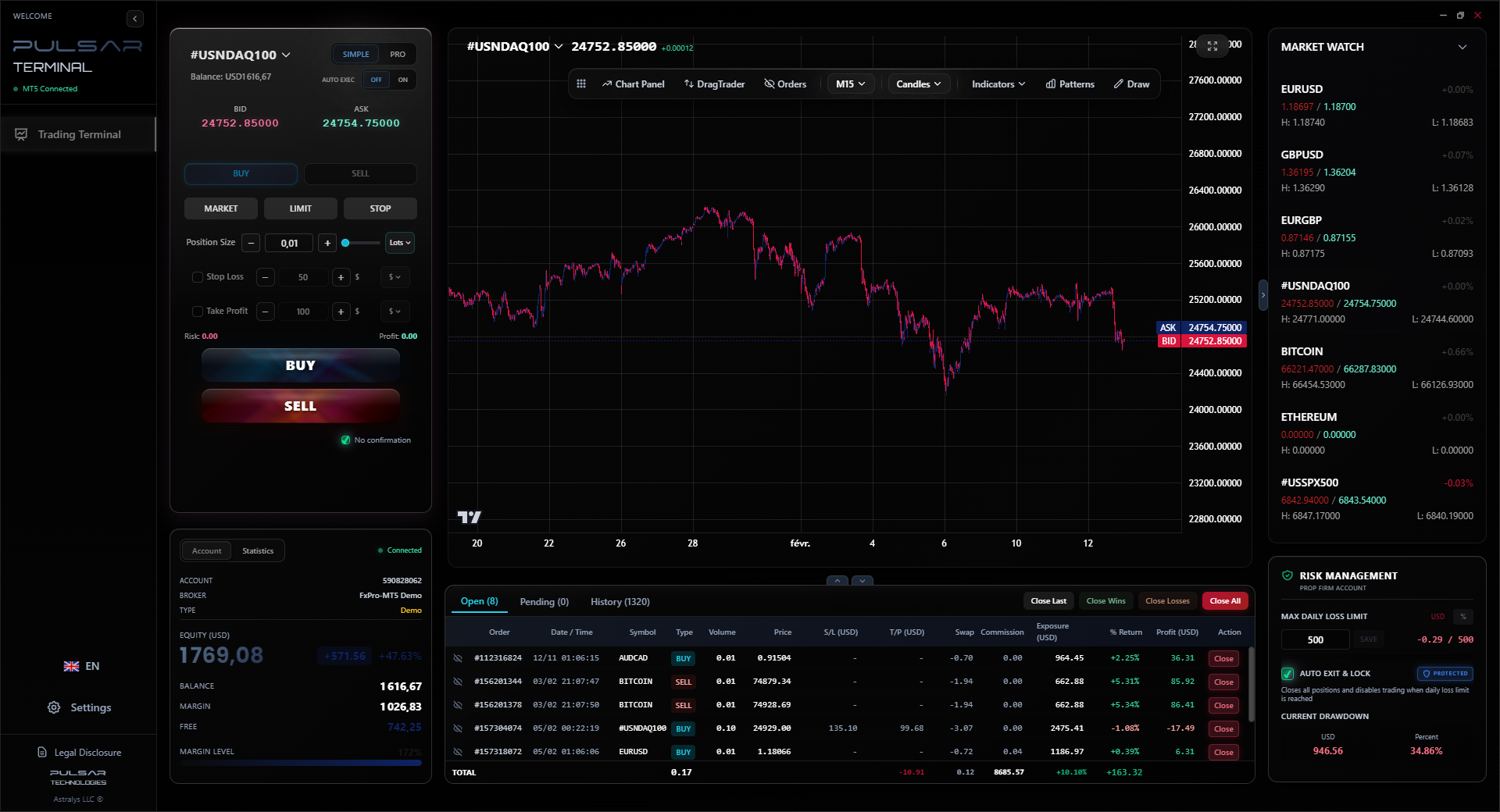
Sticking to your pre-defined stop-loss and take-profit levels is the core of discipline, and tools like Pulsar Terminal let you set and manage these orders visually and efficiently directly on your MT5 charts.
Pulsar Terminal
Универсальный инструмент для MT5: drag-and-drop ордера, мульти-TP/SL, трейлинг-стоп, грид-трейдинг, Volume Profile и защита для проп-фирм. Используется 1000+ трейдерами ежедневно.
“The FSCA's 30:1 use cap isn't a restriction; it's a seatbelt.”
The account is funded. The platform is installed. Now the real work begins.
1. Develop a Simple, Tested Strategy. Don't try to learn 10 indicators at once. Pick a major pair like EUR/USD or XAU/USD (gold). Learn its personality. Start with one or two tools, like the RSI indicator for overbought/oversold levels or the MACD indicator for trend momentum. Backtest it on historical data. Does it have a logical edge?
2. Keep a Trading Journal. This is non-negotiable. For every trade, record:
- Date/Time, Currency Pair
- Entry Price, Stop-Loss, Take-Profit
- Position Size (Lots)
- Reason for entry (e.g., 'RSI oversold on 1H chart')
- Outcome (Profit/Loss in Rands and Pips)
- Emotion/Notes ('Felt rushed,' 'Ignored news calendar') Review this weekly. Your biggest lessons will be in here.
3. Embrace Continuous Learning. The market changes. Use your broker's educational resources. Follow market analysis. Understand what moves the ZAR. Is it commodity prices? Political stability? This context turns you from a gambler to a trader.
4. Plan for Scaling. When you have 3-6 months of consistent, profitable trading (after all costs), then you can think about adding more capital or more complex strategies. Not before.
Opening the account was the administrative task. Building the discipline, knowledge, and emotional control to use it well? That's the lifelong journey of a trader. Start slow, be patient, and protect your capital above all else. That R5,000 is your army. Don't send it into battle without a plan.
FAQ
Q1What is the minimum amount needed to open a forex trading account in South Africa?
Technically, as low as $1 (R18) or R500 with some brokers. But realistically, you should start with at least R5,000. Trading with the bare minimum prevents you from practicing proper risk management and often leads to over-leveraging just to see a meaningful profit. A R5,000-R20,000 starting capital allows you to risk a sensible 1% per trade and survive the inevitable learning curve losses.
Q2Is forex trading taxable in South Africa?
Yes. SARS considers profits from forex trading as income, and it is subject to tax. You must declare your net profit (total profits minus total losses and allowable expenses) in your annual tax return. It's crucial to keep detailed records of all your trades from day one for this purpose.
Q3Can I use international brokers like Pepperstone or XM in South Africa?
Yes, but with a critical caveat. They must be regulated by the South African FSCA to offer their services legally to you as a resident. Many major international brokers like Pepperstone, XM, and IG have obtained FSCA licenses. Always check the broker's website for their specific South African regulatory information before you sign up.
Q4What's the difference between a standard account and an ECN account?
A standard account typically has wider spreads (the broker's profit is built into this spread) but charges no commission per trade. An ECN (Electronic Communication Network) or 'Raw' account offers much tighter spreads (sometimes 0.0 pips) but charges a fixed commission per lot traded. ECN accounts are generally cheaper for high-volume traders and scalpers, while standard accounts can be simpler for beginners with lower trade frequency.
Q5How long does it take to open and verify a forex account?
The online application takes about 10-15 minutes. The verification process, where the broker checks your ID and proof of residence, usually takes 1 to 3 business days. Having clear, colour scans of your documents ready can speed this up. Once verified, you can fund and start trading immediately.
Q6What is a segregated account and why is it important?
A segregated account is a bank account where the broker holds client funds completely separate from its own company funds. This is an FSCA requirement. It's important because it protects your money if the broker faces financial difficulties or goes bankrupt. Your capital should be identifiable and returnable to you, not used to pay the broker's creditors.
Q7What is the maximum use I can get in South Africa?
For retail traders, the FSCA has capped maximum use at 30:1. This means for every R1 in your margin, you can control a position worth R30. Some brokers may offer different use for professional clients who meet specific criteria, but for most new traders, 30:1 is the limit. This is a protective measure to reduce the risk of rapid, large losses.
Урок проф. Уинстона
Ключевые выводы:
- ✓FSCA regulation is your non-negotiable first filter.
- ✓Real trading cost is spread + commission + fees, not the minimum deposit.
- ✓Start with at least R5,000 to practice proper 1% risk management.
- ✓Use a demo account to test platform execution during volatility.
- ✓Keep a detailed trade journal from your very first live trade.
Насколько полезна эта статья?
Нажмите на звезду
Еженедельные торговые инсайты
Бесплатный еженедельный анализ и стратегии. Без спама.
Об авторе
David van der Merwe
Трейдер развивающихся рынков
Трейдер из Йоханнесбурга с 11-летним опытом работы с валютами развивающихся рынков. Специализируется на ZAR-парах, торговле под регулированием FSCA и анализе южноафриканского рынка.
Комментарии
Предупреждение о рисках
Торговля финансовыми инструментами сопряжена со значительным риском и может не подходить всем инвесторам. Прошлые результаты не гарантируют будущих доходов. Данный контент носит исключительно образовательный характер и не является инвестиционной рекомендацией. Всегда проводите собственное исследование перед торговлей.
Вам также может понравиться

Cara Trading Forex Sukses: 7 Prinsip dari Trader Profesional
Cara trading forex sukses dengan 7 prinsip trader pro: manajemen modal, disiplin, journal trading, backtest. Data nyata, bukan janji profit palsu.
Jam Trading Forex Terbaik untuk Trader Indonesia: Panduan Lengkap dengan Tabel Waktu
Panduan jam trading forex untuk trader Indonesia. Tabel 4 sesi dunia, jam emas 20:00-00:00, sesi mana yang harus dihindari. Data akurat + tips dari trader berpengalaman.
Top 5 Sàn Forex Uy Tín Nhất 2026: Review Jujur dari Trader Indonesia
Top 5 sàn forex uy tín 2026 untuk trader Indonesia. Review jujur: spread, deposit, withdraw, dukungan lokal. Exness, XM, IC Markets & lebih.
Скачать Pulsar Terminal
Все эти калькуляторы встроены в Pulsar Terminal с данными в реальном времени с вашего счёта MT5.
Скачать Pulsar Terminal