


You know what's more stressful than a losing trade? Finally making a profit and then realizing you can't get your money out, or worse, that 30% of it vanished in fees and terrible exchange rates.

Olumide Adeyemi
Пионер трейдинга в Западной Африке ·  Nigeria
☕ 10 мин чтения
Что вы узнаете:
You know what's more stressful than a losing trade? Finally making a profit and then realizing you can't get your money out, or worse, that 30% of it vanished in fees and terrible exchange rates. In Nigeria, the withdrawal process isn't just a button click, it's a financial obstacle course. I've seen traders celebrate a $1000 win, only to net less than $700 after the system takes its cut. Let's cut through the nonsense and get your money home.
First, let's be clear: trading forex as an individual in Nigeria is legal. The panic you hear is usually about the framework, not the act itself. The Central Bank of Nigeria (CBN) and the Securities and Exchange Commission (SEC) are the main players. Their job is monetary stability and investor protection, not to hunt down every guy with a MetaTrader account.
The real catch is the CBN's rule that you shouldn't use brokers not licensed by them. Here's the open secret: almost every retail trader uses internationally regulated brokers like Exness, IC Markets, or Pepperstone. Why? Because they offer the platforms, use, and instruments we need. The CBN's focus is on controlling how billions of dollars move, not your $500 withdrawal. However, this creates a grey area for your funds' journey back home.
Recent changes matter. The new Nigerian Foreign Exchange (FX) Code (effective Dec 2024) and the BDC recapitalization rules (deadline Dec 2025) aim to clean up the institutional market. For you, this means the official channels might become more transparent, but also that informal cash-out routes through BDCs could dry up or become more expensive. Your withdrawal strategy must be adaptable.

Warning: Don't confuse corporate forex transactions with retail trading. The CBN's heavy restrictions are on banks and large businesses moving capital. Your personal trading profit is a different beast, but it still has to pass through the same financial system.
“In Nigeria, the withdrawal process isn't just a button click, it's a financial obstacle course.”
Not all payment methods are created equal here. Your choice impacts speed, cost, and reliability.
Bank Wire Transfer (SWIFT)
The classic method. Your broker sends USD (or EUR/GBP) to your Nigerian bank account. Sounds simple, right? It's a nightmare. Your bank will convert the funds to Naira at their own (often poor) rate. You'll pay:
- Broker outgoing fee ($20-$50).
- Correspondent bank fees ($15-$30).
- Your local bank's receiving fee (1-2% of transaction). I once withdrew $2,000 via SWIFT to a major Nigerian bank. After all fees and a terrible conversion rate, I received roughly N1.1 million. The parallel market value of that $2,000 at the time was N1.45 million. I lost over N350,000 in one transaction. Never again.
Cryptocurrency
This is the game-changer for savvy traders. You withdraw Bitcoin (BTC), USDT, or other crypto from your broker to your private wallet (e.g., Trust Wallet, MetaMask). Then, you sell it on a Nigerian P2P platform like Binance P2P or Patricia for Naira directly to your bank account or mobile money. Advantages: Bypasses traditional banking bottlenecks. Faster (often within hours). You control the exchange rate (P2P rate). Disadvantages: Crypto volatility risk during transfer. Requires understanding of wallets and P2P safety. Always use escrow services.
E-Wallets (Skrill, Neteller, PayPal)
Some brokers offer these. The problem? Funding them from Nigeria is hard, and converting the e-wallet balance to Naira in your local bank often involves third-party services with high markups. I find them more trouble than they're worth for Nigerian traders.
Debit/Credit Card
If you funded your account with a card, you can usually withdraw back to it. This can be efficient for smaller amounts. However, your Nigerian card provider will apply a foreign currency conversion fee (2-5%). Check if your broker supports this for Naira cards; many international ones do.

Pro Tip: For any method, always do a small test withdrawal first. Send $50 or $100 to confirm the pipeline works, you understand the fees, and you receive the funds before moving your full profit.

💡 Совет Уинстона
Your profit isn't real until it's converted to spendable local currency, net of all fees and taxes. Trade with the final Naira amount in mind, not just the USD P&L.
“I lost over N350,000 on a $2000 withdrawal because of fees and a terrible bank conversion rate. Never again.”
This is where profits go to die. You think in pips and percentages, but withdrawal costs eat raw Naira. Here’s the breakdown.
1. Broker Fees: Many top brokers like IC Markets and XM offer free withdrawals (a major reason to choose them). Others charge per transaction. Always check their fee schedule.
2. Payment Processor & Bank Fees: This is the killer. SWIFT is the worst offender, as shown in my example. Even card withdrawals get hit with conversion fees.
3. The Spread (Again): You pay the spread when you trade, but you also pay it when your funds are converted. The bank's USD/NGN buy rate is always worse than the market rate. This hidden spread can be 5-10%.
4. Capital Gains Tax: This is the big one everyone ignores. By law, you are liable for a 10% Capital Gains Tax on your gross trading profits. If forex is your main business, add Personal Income Tax on top. The FIRS isn't actively monitoring every trader yet, but as the market grows, this will change. Set aside 10% of your net profits for tax obligations. It's not a fee, it's your civic duty, and failing to plan for it is a financial mistake.
5. Opportunity Cost: Money stuck in processing for 7-10 business days (common with bank wires) is money not in your next trade or paying your bills.

Example: You make a $5,000 profit.
- 10% Capital Gains Tax provision: $500
- Broker & Bank Fees (if not free): $70
- Loss from poor FX conversion (5% spread): $250 Total Deductions: ~$820 What you actually get to spend: $4,180 That's a 16.4% effective tax on your withdrawal. This is why method choice is critical.
“I lost over N350,000 on a $2000 withdrawal because of fees and a terrible bank conversion rate. Never again.”
Let's walk through the two most common pipelines. Forget theory, this is the practical drill.
Pipeline A: The Crypto Route (Recommended)
- Verify Everything: Ensure your broker account and your private crypto wallet are fully verified (KYC).
- Initiate Withdrawal: In your broker's portal, select Crypto (e.g., USDT, TRC-20 network for lower fees) as your withdrawal method.
- Enter Wallet Address: Copy-paste your correct wallet address from your private wallet. Triple-check this. A mistake means lost funds.
- Broker Processes: This can take 1-24 hours. You'll get a transaction ID.
- Sell on P2P: Once crypto arrives in your wallet, go to Binance P2P. Create a sell ad for USDT/NGN or use an existing buyer's ad. Transfer the USDT to Binance (if using external wallet), then complete the P2P trade with escrow.
- Receive Naira: The buyer's Naira payment hits your designated bank account or mobile money. Release the USDT. Funds are now local and spendable.
Pipeline B: The Direct Bank Card Route
- Check Compatibility: Confirm your broker allows withdrawals to the card you deposited with.
- Request Withdrawal: Select 'Credit/Debit Card' as method, enter amount.
- Wait: Processing is usually 2-5 business days.
- Monitor Account: The USD amount will hit your card account. Your bank will automatically convert it to Naira at their rate and notify you of the credit. Check the statement for the final Naira amount and any disclosed fees.
Regardless of method, keep records. Screenshots of withdrawal requests, transaction IDs, bank statements. This is crucial for accounting and resolving any disputes.
💡 Совет Уинстона
Always do a test withdrawal with a small amount when using a new method or broker. The $50 you might 'lose' in testing is cheaper than the disaster of a failed $5,000 withdrawal.
“Profit isn't profit until tax and withdrawal costs are accounted for.”
The desire to get your money out can make you careless. Don't be.
Common Pitfalls:
- Unlicensed "Payment Processors": Individuals or companies offering "instant USD to Naira at best rate." They often overpromise, delay, or disappear with your money.
- Fake P2P Buyers: On P2P platforms, stick to users with high trade volumes and 98%+ positive ratings. Never release crypto before you have confirmed, irrevocable Naira in your account. The escrow system is there for a reason, use it.
- Broker Withdrawal Limits: Some brokers have daily/monthly limits. Know them before you build a position expecting a huge one-time cashout.
- Tax Evasion Delusion: Thinking "it's just forex, no one will know." As your account grows, this becomes a significant liability. Consult a local accountant.
Your biggest risk isn't a margin call during the trade, it's a financial leak during the withdrawal. A solid swing trading profit can be wiped out by one bad cash-out decision. Plan your exit from the market as carefully as you plan your entry.
Warning: If someone offers you a conversion rate significantly better than the parallel market rate, it's a scam. Full stop. They are either using stolen funds, conducting fraud, or will simply ghost you after you send your crypto or forex.
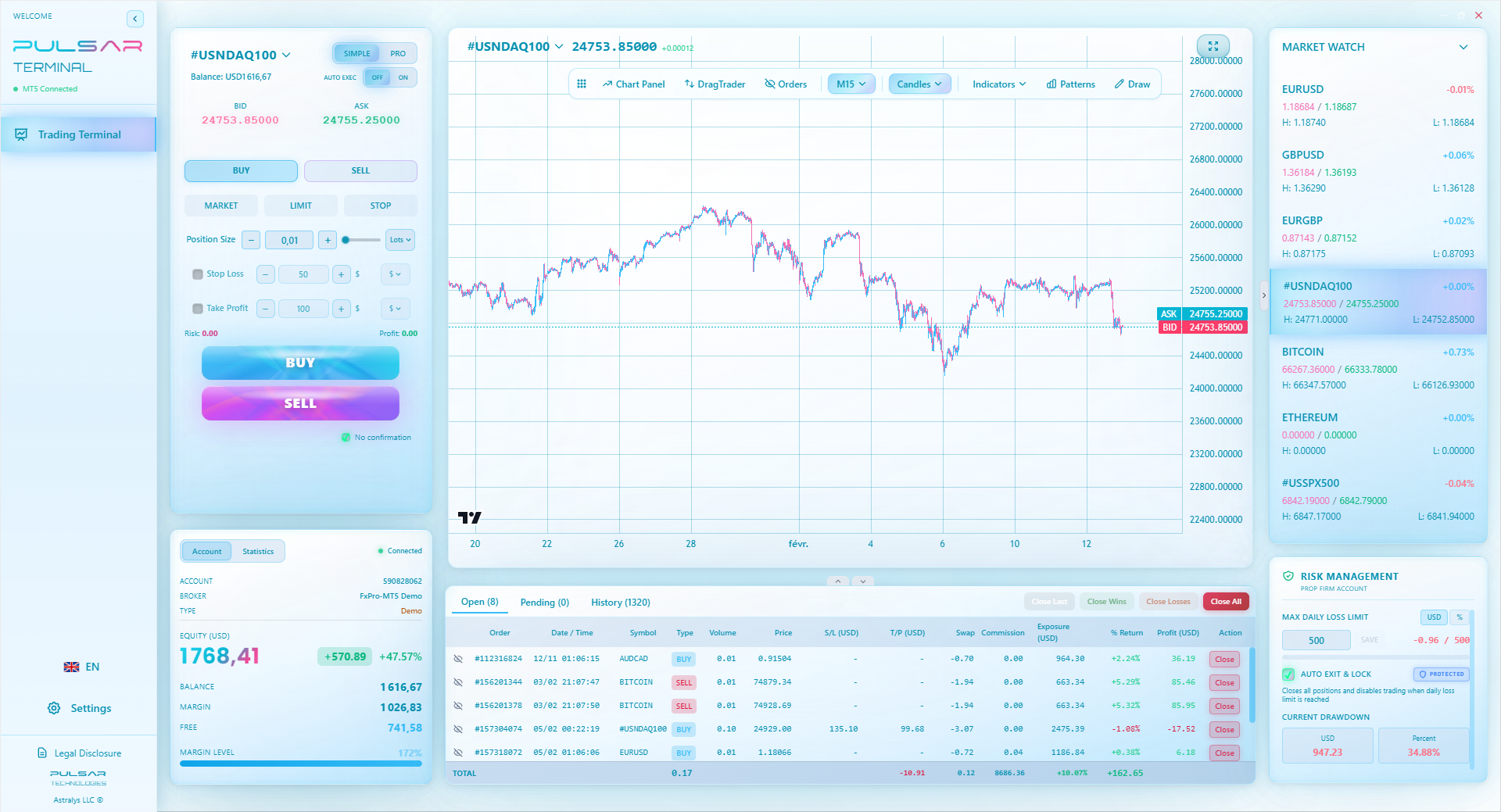
Managing your trading risk to protect profits is key, and Pulsar Terminal's automated daily loss protection feature can help enforce that discipline directly on your MT5 platform before you even think about withdrawals.
Pulsar Terminal
Универсальный инструмент для MT5: drag-and-drop ордера, мульти-TP/SL, трейлинг-стоп, грид-трейдинг, Volume Profile и защита для проп-фирм. Используется 1000+ трейдерами ежедневно.
“Profit isn't profit until tax and withdrawal costs are accounted for.”
Let's talk about the 10% elephant in the room. Yes, you owe Capital Gains Tax on your profits. How you handle this separates the hobbyist from the serious trader.
What You Owe: 10% of your gross profits in a year. If you made N5,000,000 from trading, your CGT liability is N500,000. You report and pay this when filing your annual tax returns.
How to Prepare:
- Segregate Funds: The moment you withdraw profits, move 10% into a separate savings account. Label it "Tax Provision." Out of sight, out of mind, and safe from being re-traded.
- Keep careful Records: This is non-negotiable. You need:
- A trading journal (spreadsheet or software) showing every trade: entry, exit, profit/loss.
- Monthly statements from your broker.
- Records of all deposits and withdrawals, with dates, amounts, and methods.
- Receipts for any trading-related expenses (internet, data, courses? maybe).
- Consider Incorporation: If you're trading large volumes consistently, talk to an accountant about forming a limited liability company. The corporate tax structure might be more efficient than personal income and capital gains taxes.
I learned this the hard way early on. I had a great year, spent all the profits, and then faced a massive tax bill with no cash set aside. It forced me to liquidate a personal asset. Don't be me. Profit isn't profit until tax and withdrawal costs are accounted for.
💡 Совет Уинстона
Set aside your 10% tax liability the moment you withdraw profits. Put it in a separate, no-touch account. Trading discipline includes fiscal discipline.
“If someone offers you a conversion rate significantly better than the parallel market rate, it's a scam. Full stop.”
Your broker choice is foundational to a smooth withdrawal. It's not just about raw spreads for your scalping strategy.
Key Withdrawal Features to Demand:
- Free Withdrawals: This should be a top priority. Brokers like the ones we've reviewed (XM, IC Markets) often offer this. It directly boosts your net profitability.
- Multiple Payment Methods: They must support methods that work for Nigeria. Crypto (USDT, BTC), Card withdrawals, and possibly e-wallets. If they only offer bank wire, be very cautious.
- Fast Processing Times: Look for "within 24 hours" for processing withdrawal requests. The actual transfer time depends on the method, but broker delay should be minimal.
- Clear Regulatory Status: While offshore, they should be regulated by a reputable authority (FCA, ASIC, CySEC, FSCA). This gives you recourse if there's a dispute about your money.
- No Hidden Fees: Read the terms. Some have inactivity fees or minimum withdrawal amounts that could trip you up.
Do your homework. A broker with a 0.1 pip tighter spread but a $30 withdrawal fee is worse than a broker with a slightly wider spread and free withdrawals, especially if you withdraw profits frequently. Your end goal is Naira in your pocket, not just a high floating P&L.
FAQ
Q1Is it illegal to withdraw forex profits in Nigeria?
No, it is not illegal to withdraw your personal trading profits. The legality concerns the channels used. Using CBN-licensed channels (like official bank transfers for converted funds) is compliant. Using international brokers and converting funds via crypto or other means operates in a practical grey area that most retail traders navigate.
Q2What is the fastest way to withdraw forex money to Nigeria?
The fastest reliable method is via Cryptocurrency (e.g., USDT). Withdrawal from broker to your private wallet can be under 24 hours. Selling on a P2P platform for Naira can happen in minutes. The entire process can often be completed within a few hours, compared to 5-10 business days for bank wires.
Q3How much tax do I pay on forex profits in Nigeria?
You are liable for Capital Gains Tax (CGT) at a rate of 10% on your gross annual trading profits. You must declare this and pay it when filing your annual tax return. Failure to do so can result in penalties and interest.
Q4Why did I receive less Naira than I calculated?
This is almost always due to a worse-than-expected exchange rate applied during conversion (a hidden 'spread' by your bank or payment processor), plus any deducted fees. Always calculate using a conservative rate (e.g., 5% below the parallel market rate) to estimate your final take-home.
Q5Can I use PayPal to withdraw forex profits in Nigeria?
It's possible but often problematic. Funding a PayPal account from Nigeria is difficult, and withdrawing Naira from PayPal to a Nigerian bank account involves high fees and restrictive limits. It is generally not the most efficient or cost-effective method for Nigerian forex traders.
Q6What records do I need to keep for tax purposes?
Keep everything: detailed trade logs (date, instrument, entry/exit price, P&L), monthly broker statements, records of all deposits and withdrawals (with transaction IDs), and bank statements showing the final receipt of funds. A simple spreadsheet tracking your running profit/loss is the bare minimum.
Q7My broker is asking for more verification before my first withdrawal, is this normal?
Yes, this is standard and a sign of a legitimate broker. Anti-money laundering (AML) regulations require them to 'Know Your Customer' (KYC). You may need to provide proof of address and the source of your initial deposit funds. Complete this promptly to avoid delays.
Урок проф. Уинстона
Ключевые выводы:
- ✓Prioritize brokers with free & multiple withdrawal options.
- ✓The Crypto/P2P route is often fastest & cheapest for Nigeria.
- ✓Always provision 10% of profits for Capital Gains Tax.
- ✓Bank wire transfers are a last resort due to high hidden costs.
- ✓careful record-keeping is your shield against tax and dispute problems.
Насколько полезна эта статья?
Нажмите на звезду
Еженедельные торговые инсайты
Бесплатный еженедельный анализ и стратегии. Без спама.
Об авторе
Olumide Adeyemi
Пионер трейдинга в Западной Африке
Один из самых активных преподавателей форекс-трейдинга в Нигерии. 8 лет торгового опыта из Лагоса. Специализируется на стратегиях с малым капиталом и челленджах проп-фирм для африканских трейдеров.
Комментарии
Предупреждение о рисках
Торговля финансовыми инструментами сопряжена со значительным риском и может не подходить всем инвесторам. Прошлые результаты не гарантируют будущих доходов. Данный контент носит исключительно образовательный характер и не является инвестиционной рекомендацией. Всегда проводите собственное исследование перед торговлей.
Вам также может понравиться

Cara Trading Forex Sukses: 7 Prinsip dari Trader Profesional
Cara trading forex sukses dengan 7 prinsip trader pro: manajemen modal, disiplin, journal trading, backtest. Data nyata, bukan janji profit palsu.
Jam Trading Forex Terbaik untuk Trader Indonesia: Panduan Lengkap dengan Tabel Waktu
Panduan jam trading forex untuk trader Indonesia. Tabel 4 sesi dunia, jam emas 20:00-00:00, sesi mana yang harus dihindari. Data akurat + tips dari trader berpengalaman.
Top 5 Sàn Forex Uy Tín Nhất 2026: Review Jujur dari Trader Indonesia
Top 5 sàn forex uy tín 2026 untuk trader Indonesia. Review jujur: spread, deposit, withdraw, dukungan lokal. Exness, XM, IC Markets & lebih.
Скачать Pulsar Terminal
Все эти калькуляторы встроены в Pulsar Terminal с данными в реальном времени с вашего счёта MT5.
Скачать Pulsar Terminal