


Most people asking 'is forex a gamble?' are looking for permission to lose money.

David van der Merwe
Трейдер развивающихся рынков ·  South Africa
☕ 10 мин чтения
Что вы узнаете:
Most people asking 'is forex a gamble?' are looking for permission to lose money. They want the thrill of a casino with the respectability of an investment. I'm going to give you a different answer: it's only a gamble if you make it one. For 12 years, I've watched traders from Joburg to Cape Town blow accounts because they treated the ZAR/USD pair like a slot machine. This article isn't about theory. It's about the concrete, regulated reality of trading in South Africa, and how the line between gambling and professional trading is drawn by your own rules.
I need to be blunt. The moment you feel a rush clicking the buy button, you've already lost. That feeling? It's identical to pulling the lever on a one-armed bandit. The market doesn't care about your excitement. It only responds to price.
I learned this the hard way in 2015. The SARB was making noise, the rand was volatile. I saw USD/ZAR ticking up and I jumped in with 3 lots, way beyond my usual position size calculator limits. My heart was pounding. It felt like 'action'. The trade went my way for about 80 pips. I was up nearly R12,000 in minutes. Then it reversed. I didn't have a stop loss because, in my gambler's mind, 'this feeling couldn't be wrong.' I watched it erase my profit and then my initial capital. I lost R8,000 in an afternoon. That wasn't a trade. It was a bet on a feeling.
A trader operates from a checklist. A gambler operates from a gut. A trader's high comes from sticking to a plan that wins over 100 trades. A gambler's high comes from the spin of a single trade. The tools might look the same - a broker's platform, charts, news feeds - but the mindset is worlds apart. The FSCA regulates the broker, but only you can regulate your own head.

Warning: If you find yourself checking your phone every 2 minutes, moving stop losses further away, or adding to a losing position 'to average down,' you're not trading. You're chasing losses. That's casino behavior, and it's the fastest path to a margin call.

💡 Совет Уинстона
A gambler fears missing out. A trader fears being wrong without a plan. Cultivate the second fear; it will save you a fortune.
“The moment you feel a rush clicking the buy button, you've already lost.”
Here’s a critical fact that separates a market from a casino: regulation. In South Africa, forex trading through CFDs is legal, but only with brokers licensed by the Financial Sector Conduct Authority (FSCA). This isn't just a sticker on a website.
What the FSCA Does for You
An FSCA license means the broker has to play by a set of rules designed to protect you, at least a little. They have to keep your money in a separate bank account from their own company funds (client fund segregation). They have to be clear about risks. And crucially for us, they enforce the use cap.
The 30:1 use Cap: Your Best Friend
Since 2021, the FSCA has capped use for retail traders at 30:1. This is the single biggest factor that stops forex from being a pure gamble for new South Africans. On a R10,000 account, 30:1 use means you can control R300,000 worth of currency. That's still powerful, but it's a far cry from the 500:1 or 1000:1 you might see advertised by unregulated offshore entities.
I remember trading at 100:1 early in my career. A 100-pip move could wipe out 50% of my account. It made every trade an all-or-nothing event. The 30:1 cap forces a bit of sanity. It makes you think about position size. It makes a scalping strategy with massive lots less appealing, and that's a good thing. Brokers like IG, Tickmill, and IC Markets offer FSCA-regulated entities that adhere to this.
The Tax Man Cometh
And then there's SARS. You pay income tax on your trading profits. When was the last time you paid tax on your roulette winnings at Sun City? Exactly. This formalizes trading as a business activity. You need records, a strategy, and a degree of consistency to make it work with SARS. A gambler has fleeting luck. A trader has a taxable income stream.
“The 30:1 use cap isn't a restriction; it's a governor on your own worst impulses.”
Let's talk about the elephant in the room. The global statistic that 70-80% of retail traders lose money is often quoted. In South Africa, with our unique volatility, I'd argue the pressure is even higher. This isn't a conspiracy; it's simple arithmetic and psychology.

Example: Let's break down a typical losing scenario. A trader with a R20,000 account uses the max 30:1 use on EUR/USD. That's control over R600,000. A standard lot is 100,000 units, so they take a 0.6 lot position. The spread is 1.5 pips. They're down R150 the moment they enter. A small 25-pip move against them wipes out R375. If they risked 2% of their account (R400), they're already nearly stopped out. They move their stop. The trade goes 50 pips against them. They've now lost R1,500 - 7.5% of their account in one go. This happens in minutes. They need a 16% return just to get back to breakeven. This spiral is how accounts vanish.
Profitable traders reverse this math. They might only risk 1% (R200) on that same trade. Their stop loss is placed 100 pips away, meaning they take a much smaller position size - maybe 0.2 lots. They give the trade room to breathe. They aren't trying to hit a jackpot on one trade; they're executing a plan over hundreds of trades where their edge, however small, plays out. They use tools like the RSI indicator or MACD indicator not as crystal balls, but as components of a system.
The high failure rate exists because people approach the market with a gambler's expectation: double my money fast. The market rewards patience and punishes impatience, relentlessly.
“The 30:1 use cap isn't a restriction; it's a governor on your own worst impulses.”
This is where the rubber meets the road. A gambling mindset asks: 'Do I feel lucky about the rand today?' A trading mindset asks: 'What is my setup, what is my entry trigger, where is my stop loss, where is my take profit, and what is my position size?'
Your plan must be written down. It must include:
- Market Condition: Are you trading trending pairs like USD/ZAR, or ranging pairs like EUR/CHF? Your strategy changes completely.
- Entry Criteria: Is it a breakout of a specific high? A pullback to a moving average? A MACD indicator crossover confirmed by price action? It must be objective.
- Risk Per Trade: This is non-negotiable. I never, ever risk more than 1.5% of my account on a single idea. Most of the time it's 1%. Use a position size calculator every single time.
- Exit Rules: Your stop loss is sacred. Your take profit can be tiered. Maybe you take 50% off at a 1:1 risk-reward ratio and let the rest run. This is where discipline is forged.
- Journaling: Every trade gets logged. Why you took it, the chart time, your emotional state. You review this weekly.
I switched from a gambler to a trader when I started treating my weekly review like a business meeting with my most important employee: me. I stopped looking for the 'next big trade' and started focusing on executing my plan, whether it resulted in 3 small losses or 2 wins in a week. The profits followed the process, not the other way around. This approach is the core of successful swing trading and even longer-term holds.
💡 Совет Уинстона
Your first profit target should always be to move your stop loss to breakeven. Protecting capital is job one. Making money is job two.
“A gambler has fleeting luck. A trader has a taxable income stream.”
Gamblers think about the payout. Traders think about the vig. In forex, your costs are the spread, commissions, and swap rates. Ignore them, and they'll eat you alive.
Let's get local. You want to trade USD/ZAR. It's an exotic pair. On a good day with a broker like Pepperstone, the spread might be 5 pips. On a volatile day when SARB speaks, it can widen to 15-20 pips in a blink.

Pro Tip: Never, ever enter a market order on USD/ZAR during major South African news events (CPI, SARB repo rate announcements, budget speeches). The spread widening can instantly put you in a loss larger than your planned risk. Use limit orders instead.
If you're trading the majors like EUR/USD, spreads are tighter. But if you're a scalper taking 5-pip profits, a 1.5-pip spread means you're giving up 30% of your potential gain to costs before you even start. You need a win rate significantly above 50% just to cover costs. This is why choosing a broker with consistently low costs, like Exness or IC Markets for their Raw accounts, isn't just about saving a few cents. It's about the survival math of your strategy.
Swap rates (overnight financing) matter if you hold trades for more than a day. Sometimes you earn a little, often you pay. It's a factor in your plan, especially for swing trading. A gambler doesn't consider costs. A professional trader builds their entire edge around them.
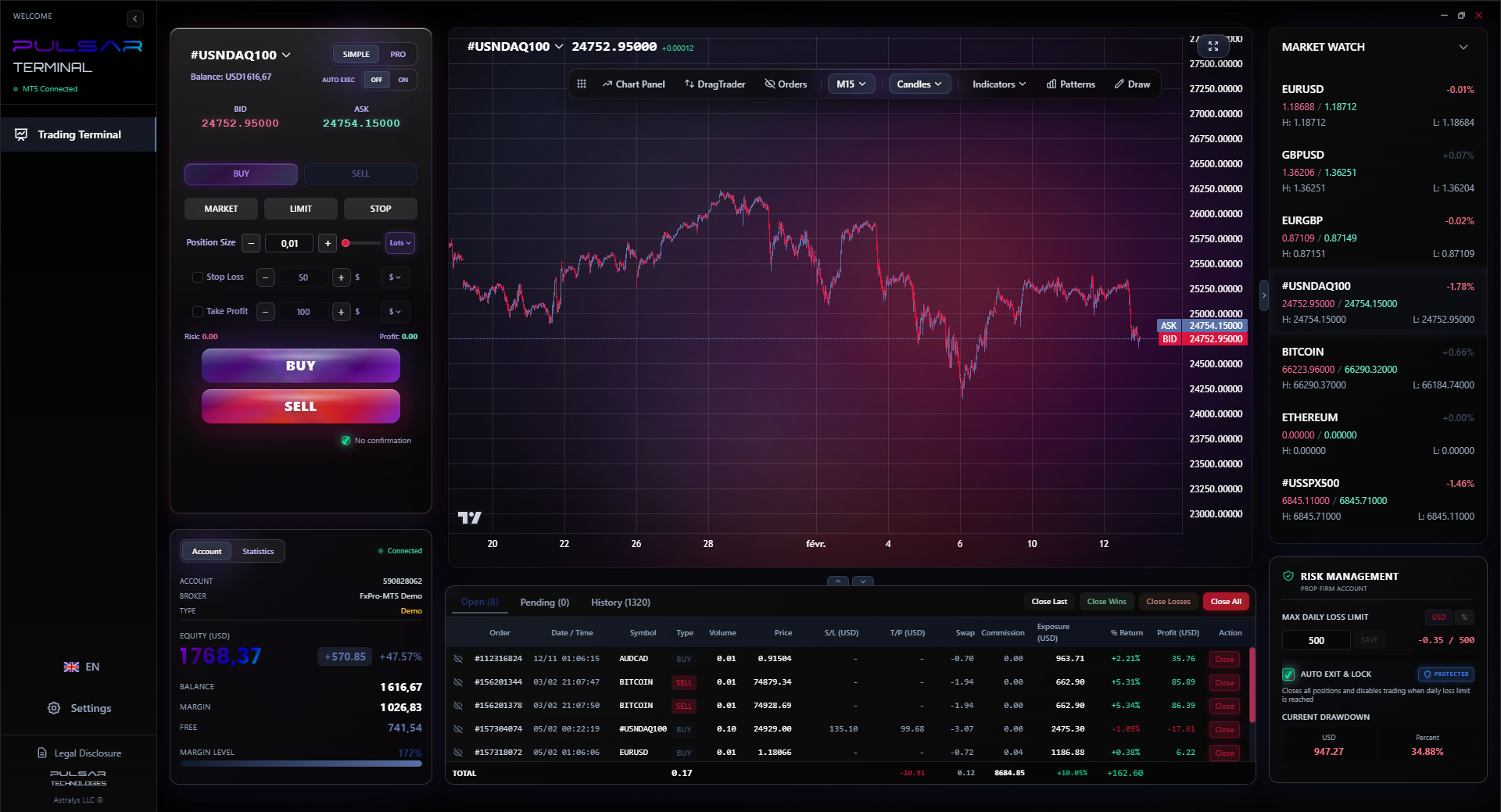
When your trading plan depends on precise order management and risk controls, a tool like Pulsar Terminal turns your MT5 platform into a disciplined execution hub, automating the rules that separate a trade from a bet.
Pulsar Terminal
Универсальный инструмент для MT5: drag-and-drop ордера, мульти-TP/SL, трейлинг-стоп, грид-трейдинг, Volume Profile и защита для проп-фирм. Используется 1000+ трейдерами ежедневно.
“A gambler has fleeting luck. A trader has a taxable income stream.”
I want to share two trades. The first one made me think I was a genius. The second one made me a trader.
The 'Gamble' (2013): Gold (XAU/USD) was crashing. It felt like it couldn't go lower. I threw R15,000 into a buy order with no stop loss, convinced I'd caught the bottom. It rallied $50 the next day. I made over R40,000. I felt invincible. I told my friends I'd cracked the code. That win funded a series of reckless trades that wiped out my entire account plus more within 6 months. That was luck masquerading as skill. It was the most expensive lesson I never learned from.
The 'Trade' (2018): USD/ZAR was in a steady uptrend. It pulled back to a key support level that also aligned with a 61.8% Fibonacci retracement. The 4-hour chart showed a clear bullish pin bar. My plan said this was a buy setup. I calculated my 1% risk (R2,000 on a R200k account). My stop was 120 pips below, so my position size was precisely 1.66 lots. I entered. The price lingered for a day, then slowly climbed. I took half off at a 1:1 risk-reward (120 pips profit) and moved my stop to breakeven. The rest ran for another 300 pips over two weeks. Total profit: R6,800. It wasn't sexy. It was boring. But it was repeatable. That trade, and hundreds like it since, built my career.
The difference was a plan, risk management, and the humility to know that I wasn't betting on a hunch. I was placing a calculated risk where the probabilities, over time, were in my favor. That's the essence of trading. Anything else is just guessing, and the market is the house that always wins at that game.
💡 Совет Уинстона
If you can't explain your trade setup in one simple sentence before you enter, you don't have a setup. You have a wish.
“I stopped looking for the 'next big trade' and started focusing on executing my plan.”
So, is forex a gamble?
If you deposit your money, pick a currency pair because you 'like the country,' use maximum use, and hit buy with no plan for getting out, then yes. You are gambling. You might as well be betting on black at MonteCasino. The outcome is functionally the same: you're relying on luck, and the odds are structurally stacked against you.
But if you treat it as a skilled profession - which it is - then no. It's not a gamble. It's a difficult, demanding business of probability and risk management. You need education (not just YouTube videos), a tested plan, brutal discipline, and the emotional fortitude to handle long strings of losses. You are not predicting the future. You are assessing probabilities and managing risk accordingly, within a regulated South African framework.
The market provides the opportunity. The FSCA provides a basic framework. But you provide the discipline. That's the line. The tools you choose, like a reliable broker or advanced trading software, support that discipline; they don't create it. The moment you blame a loss on 'bad luck' instead of a flaw in your plan, you've crossed back into the casino. Stay on this side of the line. Your bank account will thank you.
FAQ
Q1Is forex trading legal in South Africa?
Yes, it is completely legal, but only when you use a broker that is licensed by the Financial Sector Conduct Authority (FSCA). Always verify the broker's FSP number on the FSCA's website before depositing any money.
Q2What's the biggest difference between a gambler and a forex trader?
A gambler risks money for the thrill of an uncertain outcome. A trader risks capital on a calculated probability with a defined exit plan for both profit and loss. The trader uses a strategy and risk management; the gambler uses a hunch.
Q3Why do most South African forex traders lose money?
Most lose because they trade with a gambling mindset: too much use, no risk management, no written plan, and emotional decision-making. They treat it as a get-rich-quick scheme rather than a skill that takes years to develop.
Q4How much money do I need to start forex trading in South Africa?
While some brokers allow deposits as low as $5, starting with such a small amount often leads to poor risk management due to high relative costs. A more realistic minimum to practice proper risk management is between R3,500 and R7,000. This allows you to risk 1% per trade meaningfully.
Q5Can I make a living from forex trading in South Africa?
It's possible, but it's exceptionally difficult and should not be expected. It requires significant capital (well into six figures), years of experience, a proven profitable system, and the discipline of a surgeon. Most successful traders supplement their income or trade part-time for years before considering it a primary income.
Q6Does the 30:1 use limit help or hurt traders?
It helps, especially beginners. It prevents you from blowing your account in one or two bad trades. High use (like 500:1) amplifies losses so quickly it turns trading into pure gambling. The 30:1 cap enforced by the FSCA forces a degree of sanity onto your position sizing.
Q7How are forex profits taxed by SARS?
Profits from forex trading are considered taxable income. You must declare them to SARS and will be taxed at your applicable marginal income tax rate. You can deduct certain trading-related expenses. Keeping detailed records of all trades is not just good practice, it's a tax necessity.
Урок проф. Уинстона
Ключевые выводы:
- ✓Risk a maximum of 1.5% per trade, always.
- ✓Verify your broker's FSCA license. No exceptions.
- ✓Wider than 5-pip spread on USD/ZAR? Wait.
- ✓Journal every trade. Your mistakes are your syllabus.
- ✓Profit comes from process, not prediction.
Насколько полезна эта статья?
Нажмите на звезду
Еженедельные торговые инсайты
Бесплатный еженедельный анализ и стратегии. Без спама.
Об авторе
David van der Merwe
Трейдер развивающихся рынков
Трейдер из Йоханнесбурга с 11-летним опытом работы с валютами развивающихся рынков. Специализируется на ZAR-парах, торговле под регулированием FSCA и анализе южноафриканского рынка.
Комментарии
Предупреждение о рисках
Торговля финансовыми инструментами сопряжена со значительным риском и может не подходить всем инвесторам. Прошлые результаты не гарантируют будущих доходов. Данный контент носит исключительно образовательный характер и не является инвестиционной рекомендацией. Всегда проводите собственное исследование перед торговлей.
Вам также может понравиться

Cara Trading Forex Sukses: 7 Prinsip dari Trader Profesional
Cara trading forex sukses dengan 7 prinsip trader pro: manajemen modal, disiplin, journal trading, backtest. Data nyata, bukan janji profit palsu.
Jam Trading Forex Terbaik untuk Trader Indonesia: Panduan Lengkap dengan Tabel Waktu
Panduan jam trading forex untuk trader Indonesia. Tabel 4 sesi dunia, jam emas 20:00-00:00, sesi mana yang harus dihindari. Data akurat + tips dari trader berpengalaman.
Top 5 Sàn Forex Uy Tín Nhất 2026: Review Jujur dari Trader Indonesia
Top 5 sàn forex uy tín 2026 untuk trader Indonesia. Review jujur: spread, deposit, withdraw, dukungan lokal. Exness, XM, IC Markets & lebih.
Скачать Pulsar Terminal
Все эти калькуляторы встроены в Pulsar Terminal с данными в реальном времени с вашего счёта MT5.
Скачать Pulsar Terminal