


You're probably asking: 'Is forex trading legal in Nigeria, or will EFCC knock on my door?' The short answer is yes, it's legal to trade.

Olumide Adeyemi
Пионер трейдинга в Западной Африке ·  Nigeria
☕ 8 мин чтения
Что вы узнаете:
You're probably asking: 'Is forex trading legal in Nigeria, or will EFCC knock on my door?' The short answer is yes, it's legal to trade. But the real answer is more complicated, and getting it wrong can cost you more than just a bad trade. I've traded through Naira crashes, regulatory shifts, and watched countless Nigerian traders make the same costly mistakes. Let's cut through the noise from 'gurus' and look at what the law actually says, how you can trade safely, and why most people here lose money despite the legality.
Forex trading in Nigeria operates in a unique, somewhat fragmented space. It's not illegal for you, as an individual, to place a trade on GBP/USD. However, the regulatory oversight has a big hole in the middle.
The Central Bank of Nigeria (CBN) is the big boss of foreign exchange. They control the official windows and have made it crystal clear: using official channels to get dollars to fund a forex trading account is a no-go. They've called it economic sabotage. This is why you can't just walk into your bank and request $10,000 for your Exness review account at the official rate.
Then there's the Securities and Exchange Commission (SEC). Here's where it gets interesting. As of now, the SEC has stated that online retail forex trading falls outside its regulatory framework. They don't oversee the platforms you and I use every day. This creates a regulatory gap. There's no local Nigerian watchdog specifically protecting retail forex traders.
So, what does this mean for you? It means you are on your own. The legality of your actions depends entirely on who you trade with. Trading with an internationally regulated broker (like those under the UK's FCA or Cyprus's CySEC) is your safest legal bet. Trading with an unregulated, fly-by-night "broker" operating from a Lagos basement? That's where you step into the grey zone with zero protection.

Warning: The SEC's position means if a local platform scams you, your recourse is extremely limited. Always verify a broker's international license before depositing a single Naira.

💡 Совет Уинстона
The market's legality is the least of your concerns. Your own lack of a trading constitution is what will get you convicted - of losing all your money.
Given the CBN's rules, how do you get money into a trading account? You use parallel market rates (think Binance P2P, AbokiFX). You buy USDT or USD directly from other individuals, then transfer that to your broker. It's the everyday reality. The minimum deposit varies wildly. Some brokers like XTB offer $0 minimum, while others like AvaTrade ask for $100. My blunt advice? If you're starting with less than $200, you're just paying for an expensive lesson. Proper position size calculator use requires a buffer.
Now, let's talk about the government's share. If you're profitable, you owe tax. The Federal Inland Revenue Service (FIRS) expects a 10% Capital Gains Tax on your trading profits. I know, I know - most people don't declare it. But if you start moving large sums back into your Nigerian bank account, questions might be asked. It's a cost of doing business you must factor in.
Funding costs add up too. Bank transfers for deposits/withdrawals often carry fees. Zenith Bank might charge 1.5%, First Bank a flat ₦2,000 fee. These nibble away at your capital before you even place a trade.
The Broker Landscape
Most successful Nigerian traders I know use international brokers with strong reputations. They might be onboarded through the broker's offshore entity (like in the Seychelles or British Virgin Islands) which offers higher use - sometimes up to 1:2000. This is a double-edged sword. High use is a shortcut to a margin call. Brokers like IC Markets review and Pepperstone review are popular for their raw spreads and reliable execution, which is crucial for a scalping strategy.

Example: You make a ₦1,000,000 profit in a year. After accounting for spreads, commissions, and bank fees, your taxable gain might be ₦950,000. FIRS expects ₦95,000 of that. Failing to plan for this is a plan to fail.
“Your job is to be the regulator of your own account. Be stricter than any government agency ever could be.”
It's not legality. It's use. The high use offered by offshore-regulated brokers is a siren song. I've seen it destroy more accounts than any bad trade idea.
Here's a personal confession. Early on, I funded an account with $500. With 1:1000 use, my broker showed a buying power of $500,000. I felt like a king. I took a 5-lot position on EUR/USD (controlling €500,000). The trade moved 10 pips against me - a mere 0.1% move in the currency pair. My loss? $500. My entire account was gone in seconds. Poof. The market didn't crash; it barely sneezed.
This story repeats daily. The desperation for quick profits in a tough economy meets the dangerous tool of extreme use. People treat forex like a lottery, not a business. They chase "surefire" signals from Telegram channels, risking 20-50% of their account on one trade. They don't understand that a 1:400 use means a 0.25% move against you can wipe out your equity if you're fully loaded.
The spread definition matters too. On a volatile day, widening spreads on exotic pairs can trigger stops you never saw coming. Trading without understanding these mechanics is financial suicide.
💡 Совет Уинстона
use is a rented Lamborghini. It's fun until you crash it. Trade with use you can afford to crash a bicycle with.
Forget fancy bonuses. In Nigeria's context, these are your non-negotiables:
- International Regulation: This is your primary protection. Look for brokers licensed by the FCA (UK), ASIC (Australia), CySEC (Cyprus), or FSCA (South Africa). They have client money protection rules. Their offshore arms (which you'll likely use) still operate under a regulatory umbrella, even if it's lighter.
- Reliable Deposits/Withdrawals: Can you fund with USDT? How fast are withdrawals in Naira? Test with a small amount first. A broker like XM review has a long history of reliable operations in Nigeria.
- Trading Costs: Look at the full picture: spread + commission. For major pairs like EUR/USD guide, you want consistency.
| Consideration | Why It Matters for Nigerian Traders |
|---|---|
| Regulatory License | Your only shield against outright fraud. |
| Naira Account Option | Avoids constant currency conversion fees. Some, like HFM, offer this. |
| P2P/Crypto Funding | Essential for bypassing CBN restrictions on forex purchases. |
| Local Customer Support | Can you call someone in Lagos when you have an issue? |
Platform choice is personal. MT4/MT5 are universal. I spend most of my time on MT5 for its depth of market and superior charting for swing trading analysis.
“If you're starting with less than $200, you're just paying for an expensive lesson.”
To survive and grow here, you need a plan that accounts for local realities.
Capital: Start with money you can afford to lose completely. I recommend at least $500-$1000 to allow for sensible position sizing. This isn't 'get-rich-quick' money; it's tuition for a skill.
Risk Management: This is your holy grail. Never risk more than 1-2% of your account on a single trade. Use stop-losses religiously. If your account is $1000, your max loss per trade is $10-$20. This feels painfully small, but it's what keeps you in the game after a string of losses. A proper position size calculator is your best friend.
Strategy: Keep it simple. Master one or two setups. Are you a scalping strategy person or do you have the patience for swing trading? Don't jump between five different indicator systems. I made my first consistent profits just using price action and the RSI indicator for divergence on the 4-hour charts of XAU/USD guide.
Psychology: The market doesn't care about your rent or your family pressure. Trading from a place of desperation guarantees failure. You must remove emotion. This is the hardest part.

Pro Tip: Before going live, backtest and forward-test your strategy for at least 3 months. Track every trade in a journal. The goal isn't to be right, it's to be profitable over 100 trades.
💡 Совет Уинстона
Your first profitable year should be boring. If it's exciting, you're gambling, not trading.
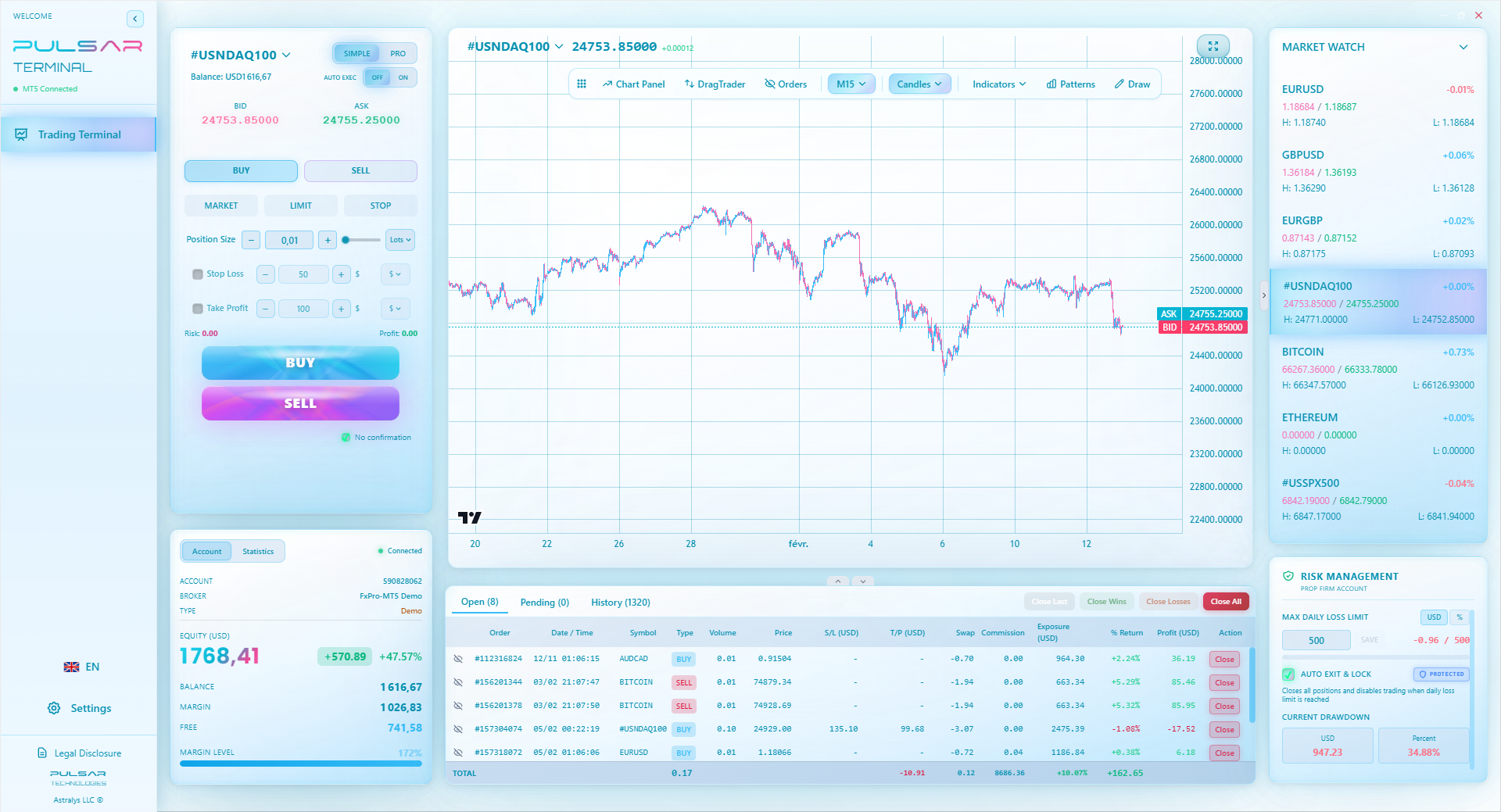
Sticking to a 1-2% risk rule is impossible without precise order management, which is where a tool like Pulsar Terminal automates your risk directly on MT5.
Pulsar Terminal
Универсальный инструмент для MT5: drag-and-drop ордера, мульти-TP/SL, трейлинг-стоп, грид-трейдинг, Volume Profile и защита для проп-фирм. Используется 1000+ трейдерами ежедневно.
Things are moving. The CBN's reforms (like the Electronic Foreign Exchange Matching System - EFEMS) aim to bring transparency to the official FX market. This could, in the long run, trickle down to better structures for retail.
The SEC's expanded powers under the new Investments and Securities Act mean they could step in to regulate retail forex platforms in the future. This would be a good thing - it would weed out the scammers and provide basic investor protection. However, it might also come with restrictions, like lower use caps (similar to Europe's 1:30 for majors), which would actually save many new traders from themselves.
For now, the status quo remains: legal for you, risky due to the regulatory gap. Your job is to be the regulator of your own account. Be stricter than any government agency ever could be.
The growth is undeniable. Daily FX turnover has shot up, and smartphone penetration means more access. The opportunity is real, but so is the pitfall. The traders who will succeed are those who treat it as a professional undertaking, not a speculative gamble.
FAQ
Q1Can I go to jail for forex trading in Nigeria?
No, you cannot go to jail simply for trading forex as an individual with your own capital through a legitimate international broker. The legal risk comes from fraudulent activities (like running a Ponzi scheme), using illegally sourced funds, or violating CBN rules on sourcing foreign exchange from official windows.
Q2Which forex brokers are officially approved by the Nigerian government?
As of now, there is no official Nigerian government approval or licensing regime specifically for international online retail forex brokers. The CBN licenses local bureaux de change and banks for forex activities. You must rely on a broker's international regulatory licenses (FCA, ASIC, CySEC, etc.) for safety.
Q3How much tax do I pay on forex profits in Nigeria?
You are liable to pay a 10% Capital Gains Tax on your net annual trading profits to the Federal Inland Revenue Service (FIRS). It's your responsibility to declare this income.
Q4What is the safest way to fund my forex trading account from Nigeria?
The most common and practical method is through cryptocurrency (buying USDT via P2P platforms) and then transferring to a broker that accepts crypto. Direct bank transfers in USD/NGN to international brokers are also used but may attract higher bank charges and scrutiny.
Q5Is high use (1:1000) from brokers illegal?
No, it's not illegal for the broker to offer it, as they are often regulated in offshore jurisdictions that permit it. However, it is extremely dangerous for you as a trader. It dramatically increases your risk of a total loss and is the primary reason most new traders blow up their accounts.
Q6Does the SEC protect me if my forex broker scams me?
No. The SEC has explicitly stated that online retail forex trading is currently outside its regulatory scope. If you are scammed by an unregulated platform, you have very little formal recourse in Nigeria. This is why using an internationally regulated broker is critical.
Q7What's a realistic starting capital for a beginner in Nigeria?
While you can start with as little as $10-$50, it's not practical for learning proper risk management. A more realistic amount that allows for meaningful trade sizing and emotional stability is between $500 and $1000. Consider the first year an investment in education.
Урок проф. Уинстона
Ключевые выводы:
- ✓Forex is legal, but you operate in a regulatory gap with no local protection.
- ✓You owe 10% Capital Gains Tax on profits to FIRS.
- ✓Never risk more than 1-2% of your account per trade.
- ✓use above 1:100 is a tool for self-destruction for 95% of traders.
- ✓Fund via P2P/Crypto, not CBN official windows.
Насколько полезна эта статья?
Нажмите на звезду
Еженедельные торговые инсайты
Бесплатный еженедельный анализ и стратегии. Без спама.
Об авторе
Olumide Adeyemi
Пионер трейдинга в Западной Африке
Один из самых активных преподавателей форекс-трейдинга в Нигерии. 8 лет торгового опыта из Лагоса. Специализируется на стратегиях с малым капиталом и челленджах проп-фирм для африканских трейдеров.
Комментарии
Предупреждение о рисках
Торговля финансовыми инструментами сопряжена со значительным риском и может не подходить всем инвесторам. Прошлые результаты не гарантируют будущих доходов. Данный контент носит исключительно образовательный характер и не является инвестиционной рекомендацией. Всегда проводите собственное исследование перед торговлей.
Вам также может понравиться

Cara Trading Forex Sukses: 7 Prinsip dari Trader Profesional
Cara trading forex sukses dengan 7 prinsip trader pro: manajemen modal, disiplin, journal trading, backtest. Data nyata, bukan janji profit palsu.
Jam Trading Forex Terbaik untuk Trader Indonesia: Panduan Lengkap dengan Tabel Waktu
Panduan jam trading forex untuk trader Indonesia. Tabel 4 sesi dunia, jam emas 20:00-00:00, sesi mana yang harus dihindari. Data akurat + tips dari trader berpengalaman.
Top 5 Sàn Forex Uy Tín Nhất 2026: Review Jujur dari Trader Indonesia
Top 5 sàn forex uy tín 2026 untuk trader Indonesia. Review jujur: spread, deposit, withdraw, dukungan lokal. Exness, XM, IC Markets & lebih.
Скачать Pulsar Terminal
Все эти калькуляторы встроены в Pulsar Terminal с данными в реальном времени с вашего счёта MT5.
Скачать Pulsar Terminal