


It was August 2025, and I was staring at a EUR/USD chart on my MT5 platform, my finger hovering over the sell button.

James Mitchell
Старший аналитик по трейдингу
☕ 11 мин чтения
Что вы узнаете:

It was August 2025, and I was staring at a EUR/USD chart on my MT5 platform, my finger hovering over the sell button. The setup was perfect, but I hesitated. I’m a US resident, and for a long time, using MT5 felt like navigating a minefield. The question ‘is MetaTrader 5 available in the US?’ isn’t a simple yes or no. It’s a ‘yes, but…’ followed by a list of rules that will fundamentally change how you trade. Let’s cut through the noise and look at what’s actually on the table for American traders right now.
Alright, let's get this out of the way. Yes, MetaTrader 5 is available in the United States. You can download it, install it, and log in. The platform itself isn't banned.
The massive 'but' is that you can only use it through a broker that is fully regulated by US authorities, specifically the Commodity Futures Trading Commission (CFTC) and the National Futures Association (NFA). This isn't a suggestion; it's the law. Trying to skirt this by using an offshore broker as a US citizen is a fantastic way to get your account frozen and lose your money with zero recourse. I've seen it happen.
The regulatory wall is so high that only a handful of brokers bother. As of 2026, your main options are Oanda, FOREX.com, and Trading.com. That's pretty much the list. This scarcity is a direct result of rules like the $20 million minimum net capital requirement for Retail Foreign Exchange Dealers (RFEDs). It keeps the players serious, but it also limits your choices.
So, while the MT5 software is on the table, your access to markets through it is funneled through a very narrow, heavily monitored pipe. Your next question should be: what are the rules inside that pipe?
If you're coming from trading internationally or have watched YouTube gurus talk strategy, forget half of it. The NFA rulebook rewrites the playbook for MT5 in America. These aren't broker preferences; they're federal regulations. Ignoring them isn't a trading mistake, it's a compliance violation.
The FIFO Rule (First-In, First-Out)
This one trips up everyone. You must close positions in the exact order you opened them for the same currency pair. Let's say you buy 1 lot of EUR/USD, then buy another lot later as the price dips. You can't close the second, more profitable lot first to lock in a gain. You must close the first lot you opened. This kills a lot of fancy position management strategies dead in the water. It forces a more linear, less flexible approach.
The Hedging Ban
Simultaneous long and short positions on the same instrument? Not allowed. That grid trading EA you bought? Useless. The classic hedge where you open a counter-trade to manage risk while you figure out the direction? Gone. This rule alone makes the US MT5 environment fundamentally different from the rest of the world. You can't sit on the fence.
use Limits
Say goodbye to 500:1. For major forex pairs, you're capped at 50:1. For minors and exotics, it's even lower. On a $10,000 account, that's a maximum position size of $500,000 on the majors. It sounds like a lot, but if you're used to the wild west of offshore use, it feels handcuffed. The regulators' goal is to prevent you from blowing up your account in 30 seconds. It's paternalistic, but it's the reality.

Warning: These rules are enforced at the broker level in their MT5 implementation. If your platform lets you hedge, you're probably not on a legit US-regulated server. That's a huge red flag.
These restrictions make tools that help manage single-direction trades even more valuable. For instance, using a multi-take-profit tool to scale out of a position becomes a primary strategy since you can't hedge.

💡 Совет Уинстона
Stop fighting the FIFO rule. Build your strategy around it from the start. Use tiered take-profit orders to manage winning trades, since you can't just close the most profitable part of your position first.
“The question ‘is MetaTrader 5 available in the US?’ isn’t a simple yes or no. It’s a ‘yes, but…’ followed by a list of rules that will fundamentally change how you trade.”
Let's talk about the players in the game. This isn't about who has the prettiest website; it's about who can legally provide you with an MT5 terminal and connect you to the markets.
| Broker | Key Offering for US Traders on MT5 | My Take (The Blunt Version) |
|---|---|---|
| Oanda | Full MT5 suite for forex. Tight spreads, excellent research tools. Partnered with FTMO for prop firm challenges as of 2025. | The all-rounder. Reliable, transparent pricing. Their execution is solid, and the FTMO link is a big deal for aspiring prop traders. Their XM review shows how other global brokers operate, but Oanda is the US-regulated equivalent for platform quality. |
| FOREX.com | MT5 for forex and, crucially, futures via parent company StoneX. Strong charting and educational resources. | The institutional choice. If you want to trade futures contracts (E-mini S&P, etc.) on MT5, this is your primary route. Their environment is vast. |
| Trading.com | MT5 access with a focus on CFDs. Known for low fees and a straightforward account setup. | The lean option. Fewer bells and whistles, but gets you into the MT5 environment efficiently. Good for traders who just want the platform without a ton of extra services. |
| AMP Futures | MT5 specifically for futures trading. Low minimum deposit ($100), competitive margins. | The futures specialist. Don't go here for forex. Go here if you want to trade the NASDAQ or Crude Oil futures on MT5 with lower capital requirements. |
Here's a personal experience: I funded a FOREX.com MT5 account with $5,000 in 2024 to test futures trading. I took a long position on the Micro E-Mini S&P 500 (MES) at 4500. The margin was about $40 per contract. I used a simple swing trading approach based on daily support. I closed at 4580 for an $80 profit per contract, minus a $1.92 round-turn commission. The trade worked, but the process of adjusting orders on the native MT5 mobile app was clunky. It hammered home the need for better order management tools, which is why many serious traders look for external solutions.
A quick note on prop firms: The 2024 MetaQuotes crackdown wiped out most 'grey label' MT5 access. FTMO's 2025 return via Oanda is the exception, not the rule. Most US prop firms now use alternatives like DxTrade or cTrader.
Forget the 'commission-free' marketing nonsense. You always pay. With US brokers, it's usually baked into the spread. Here’s the breakdown.
Spreads: Expect EUR/USD spreads to hover between 1.0 and 1.5 pips during major session overlaps on standard accounts. That's wider than what you see advertised by offshore ECN brokers, but it includes the cost of execution. Oanda and FOREX.com are generally competitive here.
Commissions: For futures trading on MT5 (via FOREX.com/StoneX or AMP), you pay explicit commissions. AMP's rate is roughly $0.85 per side per contract for the Micro E-minis. So a round-turn trade costs about $1.70. This is transparent and often cheaper than the equivalent spread markup on a CFD.
The Inactivity Fee Trap: Some brokers still have these. Read the fine print. A $15 monthly fee after 12 months of inactivity can slowly bleed a dormant account.
VPS Hosting: If you run automated trading systems (EAs), you need a Virtual Private Server. FOREX.com offers it free if you hit $500,000 in monthly notional volume. Otherwise, it's about $30/month. Factor this into your costs if you're an algo trader.

Example: Let's calculate the cost of a trade. You buy 1 standard lot (100,000 units) of EUR/USD on FOREX.com with a 1.3 pip spread. 1 pip = $10. So your entry cost is 1.3 * $10 = $13. That's the difference between your breakeven price and your entry. You need the price to move more than 1.3 pips in your favor just to start making money. Use a position size calculator to always know your risk per pip before you enter.
The bottom line: Trading costs in the US are not the cheapest in the world, but you're paying for regulatory oversight and fund security. It's a trade-off.
💡 Совет Уинстона
Your biggest edge in the US market isn't a secret indicator; it's impeccable risk management. With limited use and no hedging, a single bad trade hurts more. Never risk more than 1% of your account on a single idea.
“If your MT5 platform lets you hedge, you're probably not on a legit US-regulated server. That's a huge red flag.”
MT5 isn't your only option, even within its own brokerages. You need to know what you're giving up or gaining.
MT5 vs. MT4: This is the classic debate. MT4 is still widely offered. MT5 is superior technically: more timeframes, a better backtester, and built-in economic calendars. But for a pure forex trader who doesn't use the extra bells and whistles, MT4's simplicity and massive library of custom indicators can be appealing. Honestly, the US rules (FIFO, no hedging) neutralize many of MT5's advanced advantages for forex. Where MT5 shines is if you use your broker's access to futures or stocks through the platform.
MT5 vs. Proprietary Platforms: FOREX.com has its Advanced Trading Platform. Oanda has its own web platform. These are often more user-friendly, with better integrated research and one-click trading. But they lack MQL5 for coding custom EAs and indicators. If you're a coder or rely on specific automated strategies, MT5 is non-negotiable.
MT5 vs. Other Third-Party Platforms (cTrader, DxTrade): As mentioned, many prop firms fled to these after the 2024 crackdown. They offer cleaner interfaces and often better charting out of the box. However, their environment of custom tools and EAs is tiny compared to MetaTrader's. For a trader who builds their own systems in MQL5, there's no real alternative to MT5.
My advice? If you're manually trading forex, try the broker's native platform first. If you're into automation, multi-asset trading, or futures, then MT5 is your destination. Just be prepared to overcome its clunky parts with additional tools.
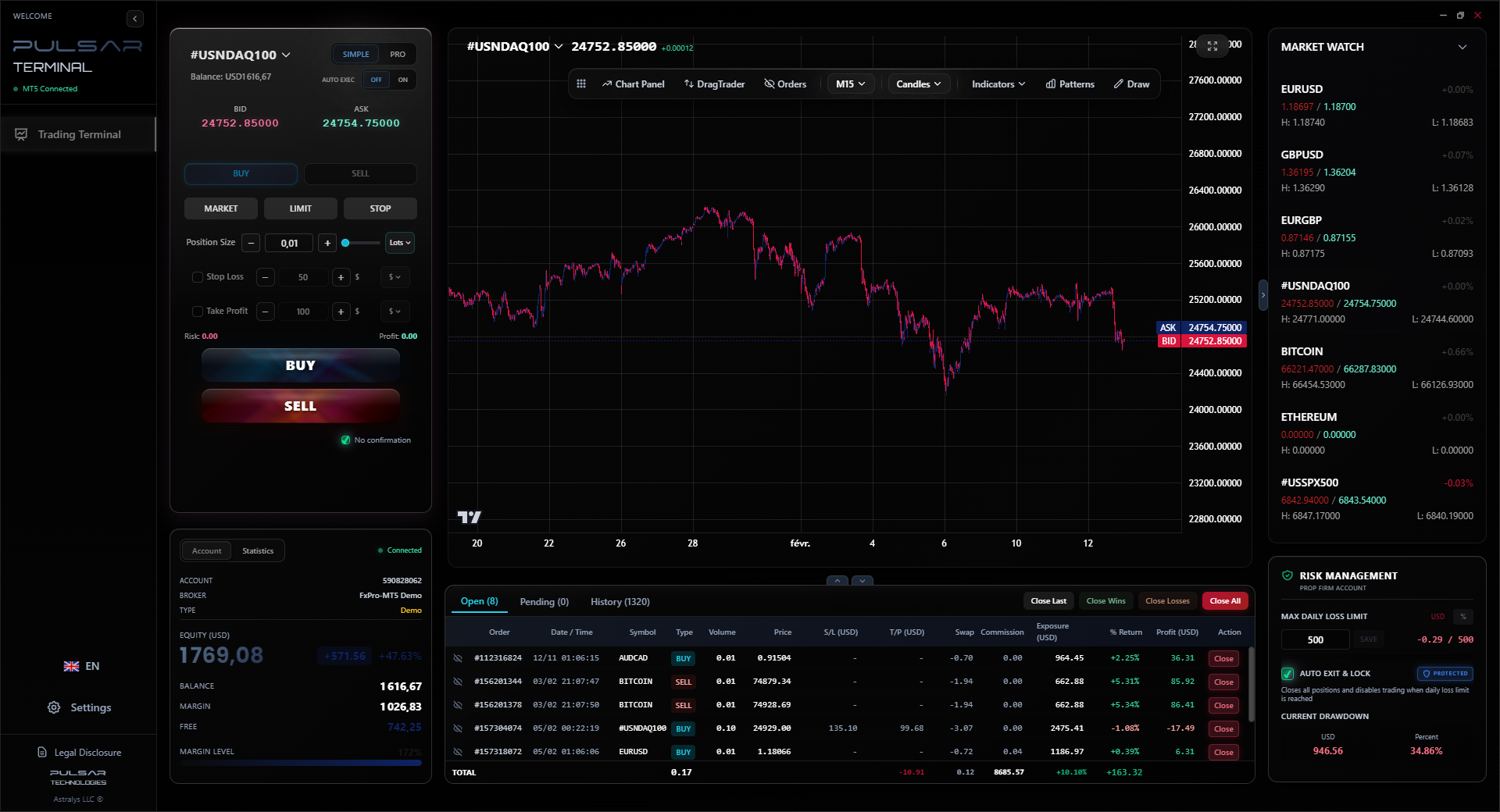
Since US rules kill hedging and complicate trade management, a tool like Pulsar Terminal that lets you drag-and-drop multi-TP/SL orders and set trailing stops directly on MT5 becomes essential for adapting your strategy.
Pulsar Terminal
Универсальный инструмент для MT5: drag-and-drop ордера, мульти-TP/SL, трейлинг-стоп, грид-трейдинг, Volume Profile и защита для проп-фирм. Используется 1000+ трейдерами ежедневно.
Let's walk through the actual process, from zero to a live trade.
- Choose Your Broker: Based on your asset focus (forex vs. futures), pick from the short list above. Open a demo account first. Test their MT5 server's execution speed and spreads during the London and New York opens.
- Download MT5: Always download the platform directly from your broker's website. Do not get it from the MetaQuotes site or a random forum. Your broker's version is configured to connect to their regulated servers. I made the mistake of using a generic download early on and couldn't figure out why login failed for an hour.
- Fund Your Account: Use ACH or wire transfer. The deposit will be in USD. Don't even think about trying to fund in another currency; it adds unnecessary complexity and fees.
- Configure for US Rules: Your platform will already have FIFO enforced and hedging disabled. You don't need to set this. What you DO need to configure is your risk parameters. Set your default stop-loss and take-profit levels. Pre-set your order sizes based on your risk percentage. Before any trade, know your margin call level.
- Develop a US-Compatible Strategy: This is critical. Your strategy must work with no hedging and FIFO. This often means:
- Smaller position sizes to allow for wider stops (since you can't hedge).
- Using multiple take-profit levels to scale out (a partial closure feature is golden here).
- Being more selective with entries, as reversing a position has higher transaction costs.
A trade example from last year: On Oanda's MT5, I went long on XAU/USD (Gold) at $1832. With FIFO, I couldn't average down by adding another lot lower and closing that one first. I had to let the original trade run its course. I used a 3-tier take-profit order (TP1 at $1845, TP2 at $1855, TP3 at $1865) and a trailing stop after the first target was hit. This approach, managing a single direction trade, is the hallmark of adapting to the US environment.
💡 Совет Уинстона
If you're trading futures on MT5, your cost basis is commissions, not spreads. Factor in that $1.70 round-turn fee on micro contracts before you decide if a 2-point scalp is worth it. Often, it's not.
“Trying to trade a $100 account with 50:1 use in the US is a recipe for a quick margin call, not a get-rich-quick scheme.”
Where is this headed? The trend is toward stability, not expansion.
The 2024-2025 period was the shakeout. MetaQuotes cleared the grey-market firms. The brokers left standing - Oanda, FOREX.com - are giants with deep compliance departments. They're not going anywhere.
Technologically, MT5 will keep advancing. The integration of GPU-accelerated models (like in Build 5572) is a big deal for quants and algorithmic traders. The backtester is getting faster. But these core US regulations (FIFO, hedging ban, use caps) are permanent fixtures. They were enacted after the 2008 crisis and have bipartisan support. Don't expect them to be rolled back.
The real evolution will be in the tools built around MT5 to help traders thrive within these constraints. We'll see more smart trade management terminals, advanced analytics packages that plug into MT5, and education focused on single-direction, risk-managed trading.
For you, the trader, it means accepting the framework. The question isn't 'is MetaTrader 5 available in the US?' It's 'how do I become a consistently profitable trader within the unique rules of the US market?' That's the only question worth your energy.
FAQ
Q1Can I use MetaTrader 5 for stock trading in the US?
It depends entirely on your broker's offerings. Most US-regulated MT5 brokers focus on forex and CFDs. FOREX.com, through its parent StoneX, provides access to futures contracts on MT5. For direct stock trading (buying shares of Apple, Tesla, etc.), you'll typically need a separate brokerage account like Fidelity or Interactive Brokers, as most MT5 brokers in the US do not offer a direct equity market feed for the platform.
Q2Are the FIFO and hedging rules applied to demo accounts?
Yes, absolutely. A legitimate US-regulated broker will apply all NFA rules (FIFO, no hedging, use caps) to their demo trading servers. This is crucial because you need to practice and develop strategies under the exact same conditions as your live account. If a demo account lets you hedge, it's not simulating the real US trading environment.
Q3I found a prop firm offering MT5 to US clients. Is it safe?
Extreme caution. As of mid-2026, FTMO's partnership with Oanda is the only major, verified exception. Any other firm claiming to offer MT5 to US traders is likely using a workaround that violates MetaQuotes' licensing terms. Your account and funds could be at risk. Always verify the firm's regulatory status and ask them directly which broker and technology provider they use for their US platform.
Q4How do I know if my MT5 platform is connected to a US-regulated server?
First, you should have downloaded it from your US-regulated broker's website. Second, check the server name in the login dialog or in the platform's Journal. It will usually contain the broker's name (e.g., 'Forex.com-US-Live'). Most importantly, the rules are the tell: if you can open a long and short position on EUR/USD at the same time, you are not on a properly configured US server.
Q5Can I use Expert Advisors (EAs) and custom indicators on US MT5?
Yes, you can. The MQL5 environment works fully. However, you must ensure your EA's logic complies with FIFO and does not attempt to hedge. Many popular EAs from international markets will need to be modified or will simply not function correctly under US rules. Always test extensively in demo first.
Q6Is the use really capped at 50:1 for everyone?
For major forex pairs offered by CFTC-regulated brokers, yes, 50:1 is the maximum legal use for all retail clients. Some brokers may offer lower default use (like 30:1 or 20:1). For non-major pairs and other instruments like indices or commodities, the maximum use is even lower, often 20:1 or less.
Q7What's the minimum deposit to start trading on MT5 with a US broker?
It varies. AMP Futures has a $100 minimum. For major forex brokers like Oanda and FOREX.com, you can often start with $100 or even $0 to open an account, but to trade effectively with proper risk management, I'd recommend at least $1,000-$2,000. Trying to trade a $100 account with 50:1 use is a recipe for a quick margin call.
Урок проф. Уинстона
Ключевые выводы:
- ✓MT5 is US-legal only through NFA brokers like Oanda or FOREX.com.
- ✓FIFO and no hedging are non-negotiable federal rules.
- ✓Maximum use is 50:1 on major forex pairs.
- ✓Your strategy must adapt to single-direction, FIFO-managed trades.
- ✓Costs are higher than offshore, but fund security is stronger.
Насколько полезна эта статья?
Нажмите на звезду
Еженедельные торговые инсайты
Бесплатный еженедельный анализ и стратегии. Без спама.
Об авторе
James Mitchell
Старший аналитик по трейдингу
Базируется в Нью-Йорке, более 9 лет опыта торговли. Работает с основными USD-парами, проп-фирмами и регулированием в США.
Комментарии
Предупреждение о рисках
Торговля финансовыми инструментами сопряжена со значительным риском и может не подходить всем инвесторам. Прошлые результаты не гарантируют будущих доходов. Данный контент носит исключительно образовательный характер и не является инвестиционной рекомендацией. Всегда проводите собственное исследование перед торговлей.
Вам также может понравиться

Cara Trading Forex Sukses: 7 Prinsip dari Trader Profesional
Cara trading forex sukses dengan 7 prinsip trader pro: manajemen modal, disiplin, journal trading, backtest. Data nyata, bukan janji profit palsu.
Jam Trading Forex Terbaik untuk Trader Indonesia: Panduan Lengkap dengan Tabel Waktu
Panduan jam trading forex untuk trader Indonesia. Tabel 4 sesi dunia, jam emas 20:00-00:00, sesi mana yang harus dihindari. Data akurat + tips dari trader berpengalaman.
Top 5 Sàn Forex Uy Tín Nhất 2026: Review Jujur dari Trader Indonesia
Top 5 sàn forex uy tín 2026 untuk trader Indonesia. Review jujur: spread, deposit, withdraw, dukungan lokal. Exness, XM, IC Markets & lebih.
Скачать Pulsar Terminal
Все эти калькуляторы встроены в Pulsar Terminal с данными в реальном времени с вашего счёта MT5.
Скачать Pulsar Terminal