


You want to learn forex trading step by step, but every guide feels like it's written for someone in London or New York.

David van der Merwe
Трейдер развивающихся рынков ·  South Africa
☕ 11 мин чтения
Что вы узнаете:
- 1Step 1: Grasp the Absolute Basics (And Why ZAR Pairs Matter)
- 2Step 2: The South African Rulebook – FSCA & use Limits
- 3Step 3: Choosing a Broker That Works in South Africa
- 4Step 4: Risk Management Before You Even Think About Strategy
- 5Step 5: Developing a Simple, Testable Strategy
- 6Step 6: The Mental Game & Your Trading Journal
- 7Step 7: The Transition From Demo to Live (With Real Rand)
You want to learn forex trading step by step, but every guide feels like it's written for someone in London or New York. Where do you, as a South African, actually start? With the Rand, FSCA rules, and local brokers? I've trained dozens of traders here, and most make the same five expensive mistakes right out the gate. This isn't generic theory. This is the blunt, step-by-step map I wish I had when I started, tailored for our market, our rules, and our unique challenges.
Before you even think about a broker, you need to understand what you're buying and selling. Forex is simply exchanging one currency for another, betting on which one will get stronger or weaker. A 'pair' like EUR/USD is the Euro versus the US Dollar. The price is how many dollars it takes to buy one euro.
For you, the most important pairs will likely involve the Rand. USD/ZAR (US Dollar vs. South African Rand) and EUR/ZAR are where a lot of local action happens. They're more volatile than majors like EUR/USD, which means bigger potential moves (and bigger potential losses).
You make money on the difference between your entry and exit price, measured in pips. One pip is typically a 0.0001 move for pairs like EUR/USD. For USD/ZAR, a pip is 0.0010 because the Rand is worth less. If you buy USD/ZAR at 18.5000 and sell at 18.6000, you've made 100 pips. Sounds simple, right? The complexity isn't in the concept, it's in the execution against millions of other traders.

Warning: Don't start with ZAR pairs because they feel 'familiar'. Their spreads (the broker's fee) are often much wider. A 50-pip spread on USD/ZAR eats your profit before the trade even moves. Start practicing with majors like EUR/USD where spreads are tight, often under 1 pip, then graduate to our local market.
Your first mission isn't to place a trade. It's to watch. Open a free chart on TradingView or your broker's demo platform and just observe USD/ZAR and EUR/USD for a week. Note when they move, how fast, and how much. This passive observation is the first real step to learn forex trading step by step.

💡 Совет Уинстона
Your first R10,000 in the market is tuition, not investment. Pay it slowly, in small lessons, not all at once in one failed 'sure thing.'
“A losing trade where you followed your plan is a good trade. It's paid tuition.”
This is where most global guides fail you. Trading in South Africa comes with a specific set of rules enforced by the Financial Sector Conduct Authority (FSCA). Ignoring these isn't an option.
The FSCA is our watchdog. Any broker you seriously consider must hold an FSCA license (an FSP number). This isn't just a nice-to-have. It means they must segregate client funds, adhere to local conduct rules, and provide a legal recourse if things go sideways. I once had a student deposit with an unregulated offshore 'bucket shop.' When he tried to withdraw his R15,000 profit, they froze his account and demanded endless 'verification.' He never saw that money again.
The biggest FSCA rule for you is the use cap. Since 2021, retail use is capped at 30:1 for major forex pairs. That means for every R1,000 in your account, you can control a position worth R30,000. For a ZAR pair, it's often lower, like 20:1.
Why This use Cap is Your Friend
New traders see use as a way to turn R500 into R50,000. I saw it that way too. My first major blow-up was on a 500:1 account from an unregulated broker. I turned R2,000 into R12,000 in a week, got greedy, and lost it all plus another R3,000 of my own money on one terrible USD/JPY trade. A 30:1 limit forces discipline. It means you need more capital to take a large position, which naturally limits your risk. Don't fight this rule. It's literally there to stop you from destroying your account in minutes.

Example: You have R10,000 capital. At 30:1 use, you can open a position worth R300,000. In forex terms, that's roughly 3 standard lots on EUR/USD. A 10-pip move against you on that size would be a R300 loss. At 500:1, you could control R5,000,000. That same 10-pip move would be a R5,000 loss - wiping out half your account in seconds.
Always check a broker's FSCA status on the FSCA's official website. It's the most important due diligence you'll do. A good local option that plays by these rules is XM, which is FSCA-regulated and popular here.
“Demo trading feels like a video game. Live trading feels like a heart monitor.”
With the FSCA rule in mind, let's talk brokers. You need one that accepts South African residents, offers ZAR accounts, has cheap deposits/withdrawals, and provides a stable platform. The 'best broker in the world' is useless if you can't get your money in and out without losing 5% on bank fees.
Here’s a quick comparison of some FSCA-regulated brokers common in our market:
| Broker | Min. Deposit (ZAR approx.) | Key Feature for SA Traders | Platform |
|---|---|---|---|
| Exness | ~R90 ($5) | Very low minimum, popular for small accounts | MT4, MT5, Proprietary |
| XM | ~R90 ($5) | Strong educational resources, lots of account types | MT4, MT5 |
| Tickmill | ~R1,800 ($100) | Very tight raw spreads (0.11 pips on EUR/USD) | MT4, MT5 |
| IC Markets | ~R3,600 ($200) | Great for raw spread accounts & algorithmic trading | MT4, MT5, cTrader |
| AvaTrade | ~R1,800 ($100) | Offers ZAR as a base account currency | MT4, MT5, Proprietary |
My personal journey started with a broker that had flashy ads but terrible execution. Slippage on news events was brutal. I switched to a broker like IC Markets for their raw spreads and haven't looked back, especially for my scalping strategy.
The Local Deposit Test
Before funding a live account, test the deposit and withdrawal process with a demo. Do they offer Instant EFT? How long does a bank transfer take? What are the fees? A broker that partners with local payment processors is a huge plus. You want your focus on trading, not on why your money is stuck in limbo for two weeks.

Pro Tip: Open demo accounts with 2-3 different FSCA-regulated brokers. Trade the same thing on all of them for a week. You'll feel the difference in execution speed, platform stability, and spreads. That hands-on test beats any online review.
💡 Совет Уинстона
The FSCA's 30:1 use limit isn't a cage. It's the guardrail on a mountain pass. The pros use far less. Try 10:1 while you're learning.
“Demo trading feels like a video game. Live trading feels like a heart monitor.”
Here's the hard truth: your first strategy will probably be wrong. I've never met a trader whose first idea worked long-term. But you can survive being wrong if your risk management is ironclad. This is the core of how to learn forex trading step by step without going bankrupt.
The 1% Rule: Never risk more than 1% of your trading capital on a single trade. If you have a R10,000 account, that's R100 max risk per trade. Not per pip, per trade.
How to apply it: Let's say you want to buy EUR/USD at 1.0850. You place your stop loss at 1.0820, 30 pips away. If your account is R10,000, your max allowed risk is R100. To find your position size: R100 / (30 pips * pip value) = your lot size. Use a position size calculator until this becomes second nature. I didn't do this early on. I risked 5% per trade thinking I was 'confident.' Five losing trades later, I was down 25%. It took me six months to climb out of that hole.
Stop Losses Are Not Optional: A stop loss is a pre-determined exit point for a losing trade. It's an admission that you might be wrong. Not placing one is like driving without a seatbelt because you're a 'good driver.' Market crashes happen. I learned this the expensive way holding a USD/ZAR trade through a SARB announcement. The 80-pip loss turned into a 300-pip nightmare because I was 'sure it would come back.' It didn't.
Understanding your spread cost is also part of risk management. Entering and exiting a trade with a 3-pip spread on USD/ZAR means you start 3 pips in the red. Your strategy needs to account for that.
“Your psychology will break before your strategy does.”
Now, and only now, do we talk about a strategy. Your goal isn't to find a magical indicator that prints money. It's to create a clear set of rules for when to enter, when to exit a winner, and when to exit a loser.
Start with one thing. Price action (support/resistance) or one indicator. I tell my students to start with the RSI indicator or the MACD indicator, but not both. Learn one tool inside out.
Here’s a brutally simple starter framework for a swing trading approach:
- Trend Identification: Is the price generally making higher highs and higher lows (uptrend) or lower highs and lower lows (downtrend)? Use a simple 50-period moving average on the 4-hour chart. Price above it = potential uptrend.
- Entry Signal: In an uptrend, wait for the price to pull back to a previous support level or to the moving average. Look for a bullish price action candle (like a pin bar or engulfing candle) to form as it touches that level.
- Stop Loss: Place your stop loss 20-30 pips below the low of that pullback candle.
- Take Profit: Aim for a risk-to-reward ratio of at least 1:2. If your stop is 30 pips away, your profit target should be 60 pips away.
Backtest this on 100 past trades on your demo account. Write down every result. Does it work more than 50% of the time? Does the average winner outweigh the average loser? If not, tweak one variable (e.g., the moving average period, the RSI level) and test again. This tedious work is what separates gamblers from traders.
My first profitable strategy was a boring 1-hour chart MACD crossover system on EUR/USD. It only gave 2-3 signals a week, but it had a 55% win rate over 6 months of testing. I stuck to it religiously and grew my account 12% in that time. Not exciting, but sustainable.
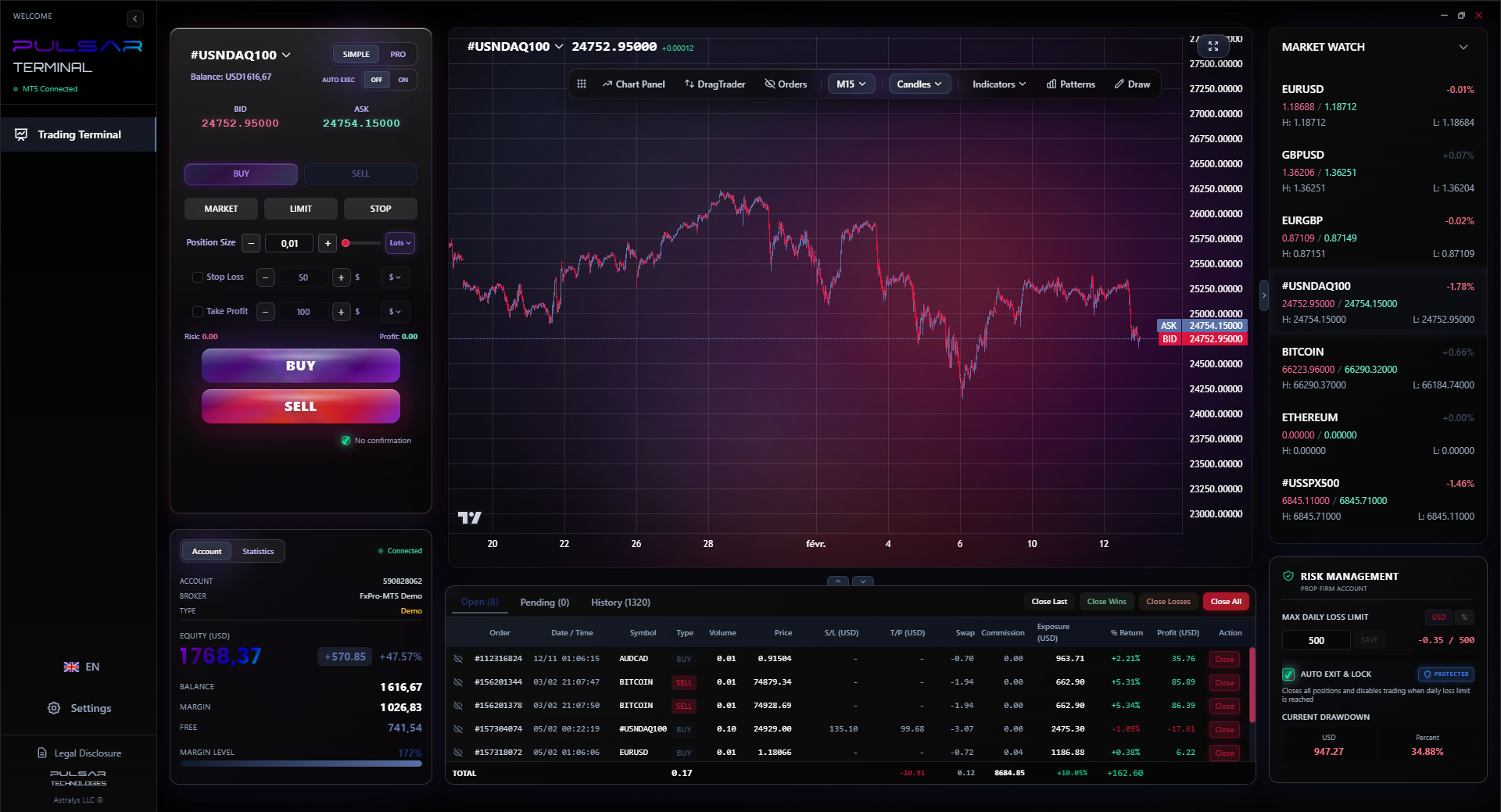
When you're testing and executing a strategy, managing multiple trades and stops manually on MT5 is a hassle; Pulsar Terminal lets you drag-and-drop orders and set multi-level take-profits with partial closures directly on your chart.
Pulsar Terminal
Универсальный инструмент для MT5: drag-and-drop ордера, мульти-TP/SL, трейлинг-стоп, грид-трейдинг, Volume Profile и защита для проп-фирм. Используется 1000+ трейдерами ежедневно.
“Your psychology will break before your strategy does.”
Your psychology will break before your strategy does. Greed, fear, revenge trading, and overconfidence are account killers.
The Trading Journal is Your Mirror: Every single trade goes in the journal. Not just "bought EUR/USD, won." I mean:
- Date, Time, Pair
- Entry Price, Stop Loss, Take Profit
- Position Size (in lots)
- Reason for Entry (e.g., "Bounced off 1.0800 support, 4H bullish pin bar")
- Outcome (P/L in Rands)
- Emotional State: (e.g., "Felt impatient, entered early," or "Scared after previous loss, took profit too early at 1:1 R:R")
Review this journal weekly. Your patterns will scream at you. I found I lost 70% of my trades on Mondays because I was forcing setups after a weekend away. The solution? I banned myself from trading until Tuesday. Problem solved.
Embrace the Loss: A losing trade where you followed your plan is a good trade. It's paid tuition. A winning trade where you ignored your risk management is a disaster waiting to happen. It rewards bad behavior.
When you feel the urge to 'revenge trade' after a loss - to throw on a bigger position to win it back immediately - close the platform. Go for a walk. That impulse has cost me more money than any bad analysis ever did.
💡 Совет Уинстона
If you can't explain your trade's reason in one simple sentence ('price bounced off support'), you don't have a reason. You have a hope.
“Start with majors like EUR/USD where spreads are tight, then graduate to our local market.”
Demo trading feels like a video game. Live trading feels like a heart monitor. The difference is the emotional weight of real money. You can't simulate the gut punch of seeing R500 disappear in 10 seconds.
The Gradual Funding Plan:
- Phase 1 (Demo): Trade your strategy for 3 months minimum. You must have 2 consecutive profitable months. This proves consistency, not luck.
- Phase 2 (Live Micro): Fund your live account with the minimum amount you're willing to lose completely. For most, that's R1,500 - R5,000. Trade your strategy with micro lots (0.01). Your goal for this phase is not to make money. Your goal is to execute your plan under real pressure without deviating. If you can be disciplined while seeing real P/L fluctuations for 2 months, you pass.
- Phase 3 (Live Scaling): Only now do you add more capital. Add in increments, and only after a profitable month. Never add money to try and recover a loss.
I funded my first live account with R5,000. My hands shook clicking the mouse on my first order. I made R200 that week. The feeling wasn't excitement, it was relief that the system worked in the real world. That small, controlled start built the confidence for everything that followed.
Remember, the statistics are brutal: a majority of retail accounts lose money. Your mission is to be in the minority. That happens through the boring, step-by-step discipline outlined here, not through genius or luck.
FAQ
Q1What is the minimum amount I need to start forex trading in South Africa?
Technically, some brokers like Exness or XM let you start with around R90 ($5). But let's be real: that's for pressing buttons, not for meaningful trading. To properly apply risk management and learn without being wiped out by a single trade, a realistic minimum is R1,500-R5,000. For serious, strategy-based trading, aim for R5,000 to R20,000 as starting capital.
Q2Is forex trading taxable in South Africa?
Yes. SARS views profits from forex trading as income, and it's taxable. You are responsible for declaring this income on your annual tax return. Keep careful records of all your trades, deposits, and withdrawals. Losses can sometimes be offset against other income, but you must consult with a tax professional who understands trading.
Q3Can I use my South African bank account to fund a forex broker?
Yes, absolutely. Most FSCA-regulated brokers accept EFTs (Electronic Funds Transfers) from major South African banks like FNB, Standard Bank, Nedbank, and ABSA. Many also support Instant EFT for faster deposits. Always check the broker's 'Deposit' page for specific instructions and any fees. Using a ZAR-denominated account can save you on currency conversion charges.
Q4What's the difference between MT4 and MT5, and which should I use?
MT4 was built for forex and is simpler, with tons of custom indicators. MT5 is newer, can handle more asset types (like stocks), and has more built-in indicators and timeframes. For a pure forex beginner, MT4 is often easier to start with due to its widespread use and simpler interface. Most brokers, like XM or IC Markets, offer both.
Q5How long does it realistically take to become profitable?
Throw out any notion of '30 days to profits.' A realistic timeline is 6 to 18 months of dedicated learning, demo trading, and small-live trading. The first year is about survival and education, not getting rich. If you treat it like a part-time job - studying, practicing, and reviewing - you can build a foundation in that time. Consistent profitability often takes even longer.
Q6What is a margin call?
A margin call is a broker's warning that your losing trades have eaten up most of the required margin (the deposit needed to hold your positions). If your equity falls below a certain level, the broker will automatically close some or all of your trades to prevent your account balance from going negative. It's a safety mechanism that feels like a disaster. Proper position sizing (the 1% rule) is how you avoid ever seeing one.
Урок проф. Уинстона
Ключевые выводы:
- ✓FSCA regulation is non-negotiable for South African traders.
- ✓Never risk more than 1% of your capital on a single trade.
- ✓Backtest any strategy on 100+ trades before using real money.
- ✓A detailed trading journal is more important than any indicator.
Насколько полезна эта статья?
Нажмите на звезду
Еженедельные торговые инсайты
Бесплатный еженедельный анализ и стратегии. Без спама.
Об авторе
David van der Merwe
Трейдер развивающихся рынков
Трейдер из Йоханнесбурга с 11-летним опытом работы с валютами развивающихся рынков. Специализируется на ZAR-парах, торговле под регулированием FSCA и анализе южноафриканского рынка.
Комментарии
Предупреждение о рисках
Торговля финансовыми инструментами сопряжена со значительным риском и может не подходить всем инвесторам. Прошлые результаты не гарантируют будущих доходов. Данный контент носит исключительно образовательный характер и не является инвестиционной рекомендацией. Всегда проводите собственное исследование перед торговлей.
Вам также может понравиться

Cara Trading Forex Sukses: 7 Prinsip dari Trader Profesional
Cara trading forex sukses dengan 7 prinsip trader pro: manajemen modal, disiplin, journal trading, backtest. Data nyata, bukan janji profit palsu.
Jam Trading Forex Terbaik untuk Trader Indonesia: Panduan Lengkap dengan Tabel Waktu
Panduan jam trading forex untuk trader Indonesia. Tabel 4 sesi dunia, jam emas 20:00-00:00, sesi mana yang harus dihindari. Data akurat + tips dari trader berpengalaman.
Top 5 Sàn Forex Uy Tín Nhất 2026: Review Jujur dari Trader Indonesia
Top 5 sàn forex uy tín 2026 untuk trader Indonesia. Review jujur: spread, deposit, withdraw, dukungan lokal. Exness, XM, IC Markets & lebih.
Скачать Pulsar Terminal
Все эти калькуляторы встроены в Pulsar Terminal с данными в реальном времени с вашего счёта MT5.
Скачать Pulsar Terminal