


It was 10:15 AM on a Tuesday, and the Nifty 50 had just hit a fresh high.

Rajesh Sharma
Старший форекс-аналитик ·  India
India
☕ 11 мин чтения
Что вы узнаете:
- 1What Liquidity Trading Actually Means (Forget the Textbook)
- 2The SEBI Rulebook: Your Strategy's Guardrails
- 3The Real Cost of Doing Business: Can Your Strategy Survive It?
- 4Spotting Liquidity Setups: The Price-Volume Dance
- 5Execution & Risk: The Make-or-Break
- 6Brokers & Tools: Setting Up Your Shop
- 7Mistakes I've Made (So You Don't Have To)
It was 10:15 AM on a Tuesday, and the Nifty 50 had just hit a fresh high. My screen was a sea of green, volume was screaming, and I felt that rush. I clicked buy on a banking stock, a decent ₹2 lakh position. The order filled, and for a glorious 30 seconds, I was up ₹1,500. Then, the volume vanished. The bid-ask spread, which was a tight 5 paise, blew out to 50 paise. My profit turned to a ₹800 loss before I could blink. That's when I stopped just chasing volume and started understanding liquidity. A true liquidity trading strategy isn't about trading when there's lots of action, it's about understanding where that action is going to be before it happens, and how the rules of our market shape every single move you make.
Most definitions will put you to sleep: 'the ease of buying or selling an asset.' In the trenches, it's simpler. It's about finding the price levels where the big players - institutions, algo banks, mutual funds - have placed their bulk orders. Your job is to trade with that flow, not against it, and to get in and out before the liquidity dries up and leaves you holding a bad position.
Think of it like this. You're at a crowded Mumbai railway station during peak hour. That's high volume. But if you need to get through the crowd quickly, you don't push against the main flow; you find the channels people are naturally moving through. In trading, those channels are created by buy and sell orders clustered at specific prices. A liquidity trading strategy aims to identify these clusters and use the market's own momentum to execute.
For us in India, this is heavily influenced by two things: FII/DII activity and the opening/closing auctions. A huge chunk of the day's real liquidity is injected during the opening auction (9:00-9:15 AM) and the closing auction (3:30-3:45 PM). If you're not factoring those windows into your plan, you're missing the main event.

Pro Tip: Don't just look at total volume on a chart. Look at the volume profile throughout the day. You'll often see 40-50% of a stock's daily volume print in the first and last 30 minutes. That's where the liquidity is. Planning a scalping strategy for the sleepy 1:30 PM period is a recipe for terrible fills.

💡 Совет Уинстона
Liquidity isn't where the market is, it's where the market is *going to be*. Your edge is in the anticipation, not the reaction.
“The market exists to find your stop and take it. Accept it.”
You can have the best liquidity idea in the world, but if you don't understand SEBI's framework, you'll get a nasty surprise. The regulator isn't trying to stop you; they're trying to stop chaos. But their rules directly shape how you execute.
Algorithmic Trading is Not Just for Big Boys
SEBI allows retail algo trading, but with strings attached. If your 'strategy' involves any automated order placement - even a simple script that sends a limit order when a price hits - it needs approval. You can't just connect some Python code directly to your broker's API. Everything must run through your broker's controlled systems. They have to approve it, register it with the exchange, and tag every order with a unique Algo ID. I learned this the hard way years ago trying to automate a simple breakout strategy. My broker shut it down in hours and gave me a stern warning.
The Speed Limits and Infrastructure
There's a threshold: 10 orders per second per segment (like NSE Equity). Cross that, and you need formal registration. Stay under it, and you still need a 'Generic Algo ID.' This is crucial for a liquidity strategy because your edge often depends on speed. You're competing with institutional algos sitting in co-location servers at the exchange. Your home internet in Bangalore isn't going to cut it for pure speed. Your edge has to be in anticipation, not raw latency.
The New Broker Rules (2026) and RBI Clampdown
The updated SEBI (Stock Brokers) Regulations 2026 put more onus on your broker. They're responsible for your algo's behavior. Also, the RBI's April 2026 rule that bans banks from funding broker prop trading? That matters. It can reduce liquidity from that corner of the market, making some sessions thinner and more volatile. You need to be aware of these macro shifts.

Warning: Thinking of using a 'black box' algo from a provider? They must be SEBI-registered Research Analysts. If they're not, you're risking more than just capital; you're risking regulatory action. Always check their SEBI registration number.
“STT is the silent killer of high-frequency retail strategies in India.”
Here’s where most backtests die. You see a beautiful equity curve, then you add Indian costs and it flatlines. For a liquidity strategy that might involve multiple entries and exits, costs are everything.
Let's break down a single ₹1,00,000 intraday trade in NIFTY futures, assuming you use a discount broker:
| Charge | Calculation | Amount (₹) | When Paid |
|---|---|---|---|
| Brokerage | Flat fee (e.g., ₹20 per order) | ₹40 | On buy & sell |
| Exchange Charge | ~0.002% of turnover | ~₹4 | On sell |
| SEBI Turnover Fee | 0.00015% of turnover | ~₹0.30 | On sell |
| GST | 18% on (Brokerage + Ex. Charge) | ~₹8 | On sell |
| STT | 0.01% of Sell Value | ₹10 | On sell |
| Total Cost | ~₹62.30 |
📊 Example: That's 0.062% of your capital gone before you make a single paisa of profit. On a ₹10,000 trade, that cost is a massive 0.62% hurdle. This is why scalping tiny moves with a large position size is so difficult here. The STT, even at 0.01%, is the silent killer of high-frequency retail strategies.
For equity intraday, STT is 0.025% on the sell side. For options, it's 0.05% on the premium. These aren't trivial. A strategy that generates 10 small trades a day needs to overcome over ₹600 in hard costs on a ₹1 lakh capital, just to break even. This is the single biggest reason I moved away from hyper-active scalping and towards fewer, higher-conviction swing trading setups within liquid stocks. The math simply works better.
💡 Совет Уинстона
In India, STT isn't a fee; it's a strategic constraint. Design your system to survive it, or it will design your failure for you.
“STT is the silent killer of high-frequency retail strategies in India.”
Forget complex indicators. At its core, spotting liquidity is about price action and volume. You're looking for imbalance.
The Absorption Setup: This is my bread and butter. Price approaches a known previous high or low - a obvious level where stops might be clustered. It starts to push into that level on increasing volume, but then... it stalls. The volume remains high, but the price stops moving. That's institutional absorption. They're soaking up all the sell orders (at a high) or buy orders (at a low). Once that volume subsides without price breaking through, the move often reverses sharply. I caught a beautiful one on Tata Motors last month. It ran up to ₹950, a previous swing high. Volume spiked to 3x average, price hovered for 15 minutes, then collapsed back to ₹930. That was liquidity being absorbed and then removed.
The False Break/Breakout Trap: This is a liquidity grab. Price makes a sharp, low-volume move beyond a key level, triggering all the stop-loss orders sitting there. Once those orders (the liquidity) are taken, price reverses violently. The key signal? The break happens on lower volume than the preceding consolidation. The market is taking liquidity, not providing it for a sustained move.
Using Basic Tools: You don't need fancy software. The RSI indicator showing divergence at these key levels (price makes a new high, RSI does not) can confirm the loss of momentum. The MACD indicator histogram losing steam is another clue. But the primary signal is always price and volume.
I keep it on a 5-minute and 15-minute chart for Nifty stocks. The daily chart tells you where the important liquidity levels are (previous highs/lows, gaps). The intraday charts tell you when the market is interacting with them.
“A liquidity trade is often a fade-the-momentum trade. You can be early. You *will* be wrong sometimes.”
This is where you separate the theorists from the performers. A great liquidity setup means nothing if your execution is sloppy.
Order Types Are Your Weapon: For entering a liquidity-based reversal, I almost always use a limit order. Why? I want to define my exact maximum entry price. If I'm betting on a rejection from a ₹1000 level, I might place a limit sell order at ₹999.50. I'm not chasing the breakout; I'm providing liquidity at the edge of the resistance. For stop-losses, it's always a market order. If my thesis is wrong and price breaks through with volume, I need to be out immediately. The extra spread I pay on the stop is the cost of insurance.
Position Sizing is Non-Negotiable: A liquidity trade is often a fade-the-momentum trade. You can be early. You will be wrong sometimes. Your position size must allow you to survive 3-5 consecutive losses without blowing your account. I never risk more than 0.5% of my capital on any single trade in this style. On a ₹5 lakh account, that's ₹2,500. If my stop is 5 points away on a Bank Nifty lot, I can only trade 1 lot. It's that simple. Use a position size calculator religiously.
The Mental Game: The hardest part is watching price scream into your level, your P&L go negative immediately, and not moving your stop. You placed your stop where the liquidity setup would be invalidated. If you move it, you're no longer trading the strategy, you're gambling. I've broken this rule and turned a ₹1,500 loss into a ₹9,000 disaster. More than once. The market exists to find your stop and take it. Accept it.
💡 Совет Уинстона
A limit order at a liquidity zone is a statement of conviction. A market order for your stop-loss is a commitment to survival. Never confuse the two.
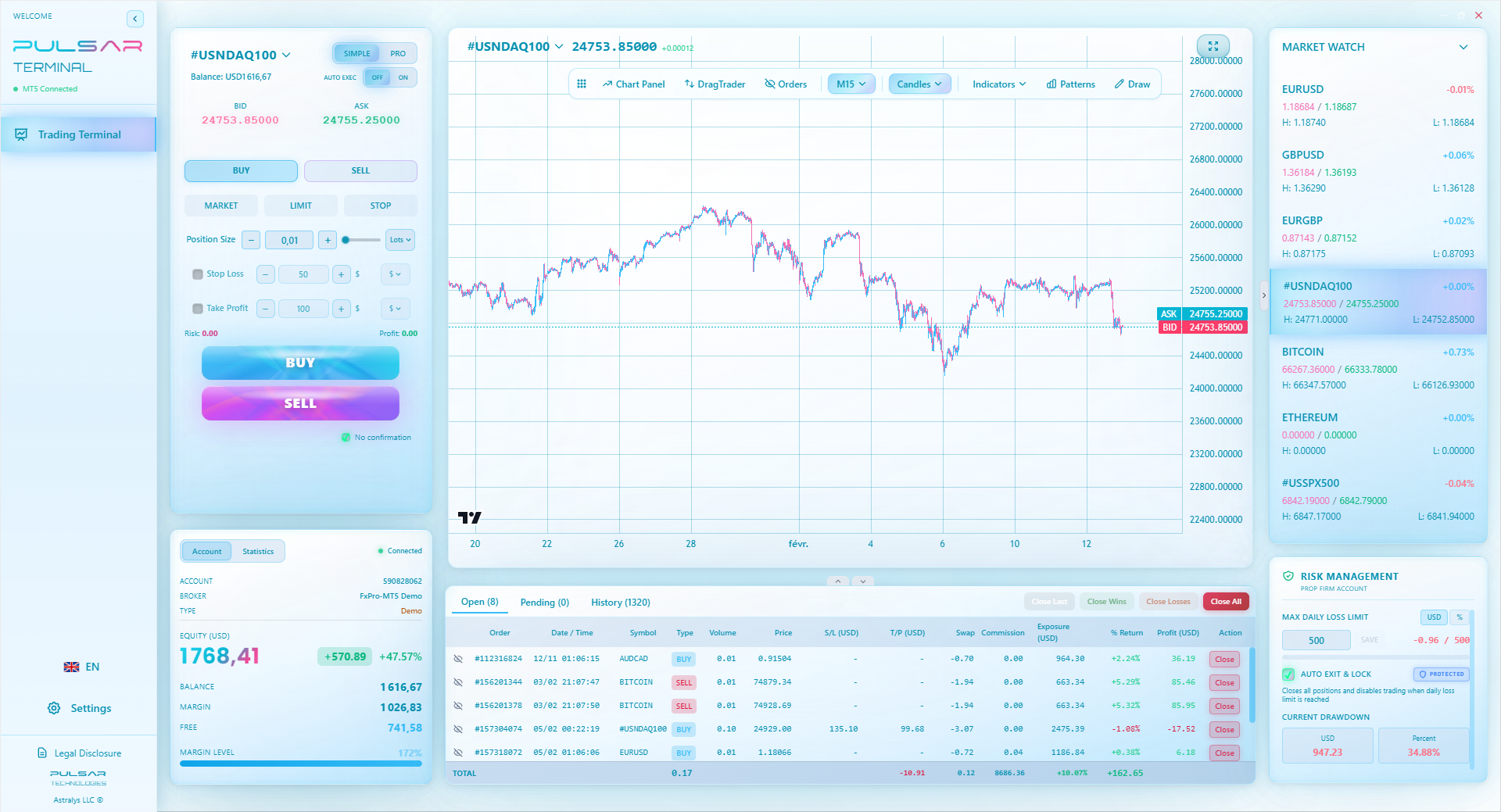
Managing multiple take-profit levels and a trailing stop on a fast-moving liquidity trade is nearly impossible manually, which is where a tool like Pulsar Terminal for MT5 automates it perfectly.
Pulsar Terminal
Универсальный инструмент для MT5: drag-and-drop ордера, мульти-TP/SL, трейлинг-стоп, грид-трейдинг, Volume Profile и защита для проп-фирм. Используется 1000+ трейдерами ежедневно.
“A liquidity trade is often a fade-the-momentum trade. You can be early. You *will* be wrong sometimes.”
Your broker and platform are your connection to the liquidity. You need reliability and decent execution speeds above all else.
Broker Choice: For active trading, discount brokers are the only sensible choice for most. The flat fee structure saves you a fortune. I've used Zerodha for years - their Kite platform is solid and their API (for any approved algo work) is strong. But their customer service during a crisis can be slow. Angel One has a very powerful platform. For those interested in more advanced charting and potential international access, brokers like IC Markets or Pepperstone offer MT4/MT5, but remember, they cater primarily to forex and CFDs, not Indian equities.
Platform Features You Need:
- Good Depth of Market (DOM): This shows you the live buy/sell order queue. It's essential for seeing liquidity in real-time.
- Reliable Historical Volume Data: If your volume data is laggy or incorrect, your analysis is garbage.
- Customizable Alerts: You can't watch 10 stocks all day. Set alerts for when price approaches your pre-identified liquidity levels.
The Tech Edge: While you can't co-locate, you can ensure a wired internet connection (never trade on WiFi) and a broker with servers near the NSE/BSE. Every millisecond of reduced latency improves your fill price, which directly impacts profitability over hundreds of trades.
“Only play in stocks with an average daily volume in the crores. Nifty 50 stocks are your friend.”
Let's get brutally honest. Here's where I've blown up money so you can sidestep the same traps.
1. Chasing Illiquid Stocks for 'Big Moves': Early on, I'd see some small-cap rocket 10% and FOMO in. The spread was 20 paise. I'd buy, and the moment I was in, the buying would stop. The spread would widen to ₹1. To get out, I'd have to hit the bid, locking in an instant loss. Lesson: Only play in stocks with an average daily volume in the crores and a consistent, tight spread. Nifty 50 stocks are your friend.
2. Ignoring the Auction Windows: I used to think the opening 15 minutes were chaos to be avoided. Wrong. That's when the overnight liquidity imbalance is resolved. Placing a trade at 9:16 AM based on pre-open data is often too late. Similarly, the closing auction sets up the next day's sentiment. Not watching it is like leaving a cricket match at the 40th over.
3. Overcomplicating the Strategy: I stacked 10 indicators on my chart, looking for the 'perfect' confluence. All it did was create paralysis. Price, volume, and a key level. That's 90% of it. The MACD or RSI are just for extra confirmation, not the main signal.
4. Not Accounting for All Costs: My first 'profitable' scalping system in a backtest became a loser when I properly coded in brokerage, STT, and exchange charges. It was a humbling moment. If you're not modeling every rupee of cost, you're lying to yourself.
, a liquidity trading strategy in India is about patience and precision. It's waiting for the market to come to your predefined level, executing with discipline, and managing risk so you can live to trade the next setup. It's not glamorous, but it's one of the few edges a disciplined retail trader can consistently have.
FAQ
Q1Is algorithmic trading allowed for retail traders in India?
Yes, SEBI explicitly allows it, but with strict controls. You must operate through your broker's approved systems, get your strategy tagged with an Algo ID by the exchange, and stay within defined order rate limits. You can't just run unchecked code on an open API.
Q2What is the single biggest cost for a high-frequency liquidity strategy in India?
The Securities Transaction Tax (STT). Even at 0.01% for futures or 0.025% for equity intraday sells, it's a fixed, unavoidable drag on every single trade. On small, frequent trades, this cost alone can wipe out your edge. Brokerage is a distant second concern.
Q3Can I use MT4/MT5 for trading Indian stocks with a liquidity strategy?
Generally, no. Most Indian retail brokers use their own proprietary platforms (like Kite, Alice Blue). International brokers like IC Markets or XM offer MT4/MT5, but they provide access to forex, global CFDs, and maybe US stocks - not direct access to NSE/BSE equity markets. For Indian stocks, you're tied to your domestic broker's platform.
Q4What's the best time frame to find liquidity setups in Nifty?
You need a multi-timeframe approach. Use the daily/weekly chart to identify major support/resistance levels (the 'where'). Then use the 15-minute and 5-minute charts to observe the price-volume interaction at those levels (the 'when'). The opening (9:00-9:30 AM) and closing (3:00-3:45 PM) periods often provide the clearest signals.
Q5How much capital do I need to start?
You need enough so that costs don't consume you. With a ₹50,000 account, a single ₹20 brokerage fee on a trade is 0.04% gone immediately. Realistically, to trade even 1 lot of Nifty or Bank Nifty futures comfortably and absorb costs, you should have at least ₹2-3 lakhs in risk capital. For equities, focus on highly liquid stocks and start small to get a feel for the fills and spreads.
Q6What is a 'liquidity grab'?
It's when the market moves quickly to a level where it knows many stop-loss orders are clustered (like above a recent high or below a recent low). It triggers those stops, 'grabbing' that liquidity, and then often reverses direction. It's a false breakout. The tell-tale sign is low volume on the initial break - it's not sustained buying/selling, it's just hunting for orders.
Q7Does SEBI's 2026 rule change affect how I trade?
Indirectly, but yes. The new broker regulations make your broker more accountable for your trading activity, especially algo trading. The RBI's rule restricting bank funding to broker prop desks could reduce a source of market liquidity, potentially making some sessions more volatile. A savvy trader stays aware of these structural changes.
Урок проф. Уинстона
Ключевые выводы:
- ✓Identify liquidity at key highs/lows, not just high volume.
- ✓Factor in all costs: STT can be 0.062% per Nifty futures round turn.
- ✓Use limit orders to enter, market orders to stop out.
- ✓Risk a maximum of 0.5% of capital per liquidity setup.
- ✓The opening/closing auctions contain 40-50% of daily liquidity.
Насколько полезна эта статья?
Нажмите на звезду
Еженедельные торговые инсайты
Бесплатный еженедельный анализ и стратегии. Без спама.
Об авторе
Rajesh Sharma
Старший форекс-аналитик
Более 10 лет торгует на индийских и южноазиатских рынках. Начинал с валютных деривативов на NSE, затем перешёл на международный форекс. Специализируется на USD/INR и парах развивающихся рынков.
Комментарии
Предупреждение о рисках
Торговля финансовыми инструментами сопряжена со значительным риском и может не подходить всем инвесторам. Прошлые результаты не гарантируют будущих доходов. Данный контент носит исключительно образовательный характер и не является инвестиционной рекомендацией. Всегда проводите собственное исследование перед торговлей.
Вам также может понравиться

Cara Trading Forex Sukses: 7 Prinsip dari Trader Profesional
Cara trading forex sukses dengan 7 prinsip trader pro: manajemen modal, disiplin, journal trading, backtest. Data nyata, bukan janji profit palsu.
Jam Trading Forex Terbaik untuk Trader Indonesia: Panduan Lengkap dengan Tabel Waktu
Panduan jam trading forex untuk trader Indonesia. Tabel 4 sesi dunia, jam emas 20:00-00:00, sesi mana yang harus dihindari. Data akurat + tips dari trader berpengalaman.
Top 5 Sàn Forex Uy Tín Nhất 2026: Review Jujur dari Trader Indonesia
Top 5 sàn forex uy tín 2026 untuk trader Indonesia. Review jujur: spread, deposit, withdraw, dukungan lokal. Exness, XM, IC Markets & lebih.
Скачать Pulsar Terminal
Все эти калькуляторы встроены в Pulsar Terminal с данными в реальном времени с вашего счёта MT5.
Скачать Pulsar Terminal