


Looking for a real list of South African forex brokers, not just a generic table copied from some other site? You're in the right place.

David van der Merwe
Трейдер развивающихся рынков ·  South Africa
☕ 10 мин чтения
Что вы узнаете:
Looking for a real list of South African forex brokers, not just a generic table copied from some other site? You're in the right place. I've traded from Johannesburg for over a decade, and I've seen brokers come and go. The key isn't just finding a name; it's understanding which one fits your style, your budget, and, most importantly, keeps your money safe under South African law. Let's cut through the noise and talk about who's actually operating here, what they cost, and how to pick one without getting burned.
Before we look at a single broker name, we need to talk about the FSCA. The Financial Sector Conduct Authority is your first and last line of defence. Trading with an FSCA-licensed broker isn't just a good idea, it's the only smart move for a South African retail trader.
Here's the cold, hard truth: if you deposit with an unregulated offshore broker and something goes wrong, you have virtually no recourse. The FSCA can't help you. I learned this the hard way early on, losing about R8,000 to a slick-looking international outfit that simply stopped processing withdrawals. A locally licensed broker must follow strict rules: they must keep your money in a segregated account (so they can't use it for their own bills), undergo annual audits, and have a physical presence here. That means you can actually knock on their door if you have to.

Warning: The FSCA itself advises against using foreign brokers. They state clearly that they cannot assist you if that broker acts unfairly. Always, always check their website for the broker's FSP number.
The use cap for retail clients is officially 30:1, which is a sensible rule from the FSCA to protect people from blowing up their accounts. However, you'll find that many regulated brokers offer higher use (like 500:1) if you classify as a professional client. That's a whole other conversation with its own risks and requirements.
The bottom line? FSCA regulation is your safety net. It doesn't guarantee profits, but it guarantees you're playing on a field with some basic rules and referees. Every broker on our list below holds this license.

💡 Совет Уинстона
Your first R10,000 in the market is for paying tuition, not buying a car. Choose a broker with a low minimum deposit and trade micro lots. The goal is to learn, not get rich.
Brokers love to advertise 'commission-free' trading or 'tight spreads.' You need to look at the total cost of a round-trip trade. This is where your profits go to die if you're not careful. The main costs are the spread and the commission.
The Spread: The Silent Fee
The spread is the difference between the buy and sell price. It's how many brokers make their money on standard accounts. For example, if a broker quotes EUR/USD at 1.0850/1.0852, the spread is 2 pips. You start your trade 2 pips in the red. On a standard lot (100,000 units), that's a $20 cost before you even move.
Some brokers offer raw spread accounts with commissions. Here, you might see a spread of 0.0 pips on EUR/USD, but you pay a commission per lot traded. This is often cheaper for high-volume traders. I made the switch to a raw account years ago for my scalping strategy, and it saved me thousands in the long run.
Commission Structures
Commissions are usually quoted per lot, per side. A common structure is $7 per round turn (open and close) for a standard lot. So, on that raw account, your cost might be $7 instead of a $20 equivalent spread. You need to do the math based on your typical trade size.

Example: Let's compare. Trade 1 standard lot EUR/USD.
- Standard Account: Spread = 1.8 pips. Cost = 1.8 * $10 = $18.
- Raw Account: Spread = 0.1 pips. Commission = $7. Cost = (0.1 * $10) + $7 = $8. The raw account is significantly cheaper for this size.
Don't forget about overnight financing charges (swap rates) if you hold positions past 5 PM New York time. These can add up if you're a swing trading enthusiast. Always check your broker's swap sheet.
“FSCA regulation is your safety net. It doesn't guarantee profits, but it guarantees you're playing on a field with rules.”
Okay, here's the meat of it. This isn't every broker, but these are the major, credible FSCA-regulated players I or traders I trust have used. Think of it as a shortlist for your own research.
| Broker | FSCA License | Key Feature for SA Traders | Best For |
|---|---|---|---|
| IG Markets South Africa | FSP No. 41393 | Massive global brand, strong local presence, excellent education. | Beginners, those who want a trusted name and research tools. |
| CMC Markets South Africa | FSP No. 42873 | Next Generation platform is superb, good on spreads. | Traders who value charting and platform technology. |
| Saxo Bank South Africa | FSP No. 44475 | Premium service, vast instrument selection (stocks, bonds, etc.). | Serious, high-value investors/traders (high minimum deposit). |
| Global Prime | FSP No. 50926 | True ECN model, transparent, popular with professional communities. | Experienced traders wanting direct market access. |
| Tickmill | FSP No. 49464 | Very competitive raw spreads, low commissions. | Cost-conscious scalpers and active traders. |
| Khwezi Trade | FSP No. 44816 | Local STP broker, offers ZAR-based accounts. | Traders who want everything in Rands, local support. |
Now, you'll also see big international names like IC Markets, Pepperstone, and XM heavily marketed in South Africa. They are excellent brokers. Crucially, they are not regulated by the FSCA. They operate under their home country licenses (ASIC, CySEC, etc.). While they are reputable, remember the FSCA's warning: you are not under South African regulatory protection if you use them. It's a trade-off between potentially better pricing/use and local legal safety.
My personal setup? I use a primary FSCA-regulated broker for most of my capital (for safety) and a smaller account with a low-cost international broker like IC Markets for specific, high-frequency strategies. This diversification also lets me compare execution speeds and fills.
This is the most practical headache for us. You trade in USD, but you live in ZAR. How do you get money in and out without the banks and forex fees eating you alive?
Local FSCA brokers typically offer direct EFT deposits in Rands. This is seamless and fast, often within a few hours. Withdrawals are just as easy back to your SA bank account. The broker handles the USD/ZAR conversion at their commercial rate, which is usually decent.
The problem arises with international brokers. Depositing Rands directly is often not possible. You have two options:
- International Bank Transfer: You do a FOREX conversion at your bank to USD, then send the USD via SWIFT. This is slow (2-5 days) and your bank will charge you a terrible exchange rate plus hefty fees (I've been charged R500+ per transfer).
- Credit/Debit Card or E-Wallets: This is the better way. Use your Visa/Mastercard, or better yet, an e-wallet like Skrill or Neteller. The conversion fees are lower, and it's instant. However, check your broker supports withdrawals back to the same method.

Pro Tip: Open a 'Global Account' with a digital bank like TymeBank or Discovery. They offer multi-currency accounts with much better USD exchange rates than the big four banks. I use mine exclusively for trading deposits and withdrawals, and it's saved me a fortune in fees over the years.
Always factor in these transfer costs and time delays. A 'free' withdrawal doesn't help if you lose 2% on the currency exchange.
💡 Совет Уинстона
Spend an hour on a Saturday simulating a 'disaster' with your broker: lost password, disputed trade, urgent withdrawal. Run through their support channels. Your peace of mind is worth more than 0.1 pip.
“Your broker is a tool. It shouldn't be the reason you lose. A good one becomes invisible.”
You can have the best broker in the world, but if their trading platform is garbage, you'll lose money. For most active traders, MetaTrader 4 or 5 (MT4/MT5) is the standard. Thankfully, almost every broker on our list offers it.
MT5 is the more modern version with more timeframes, an economic calendar, and a better market depth tool. I made the switch to MT5 a few years back and wouldn't go back. The key thing is execution speed and slippage. A good FSCA-regulated ECN/STP broker should have minimal requotes and fast fills, especially on news events.
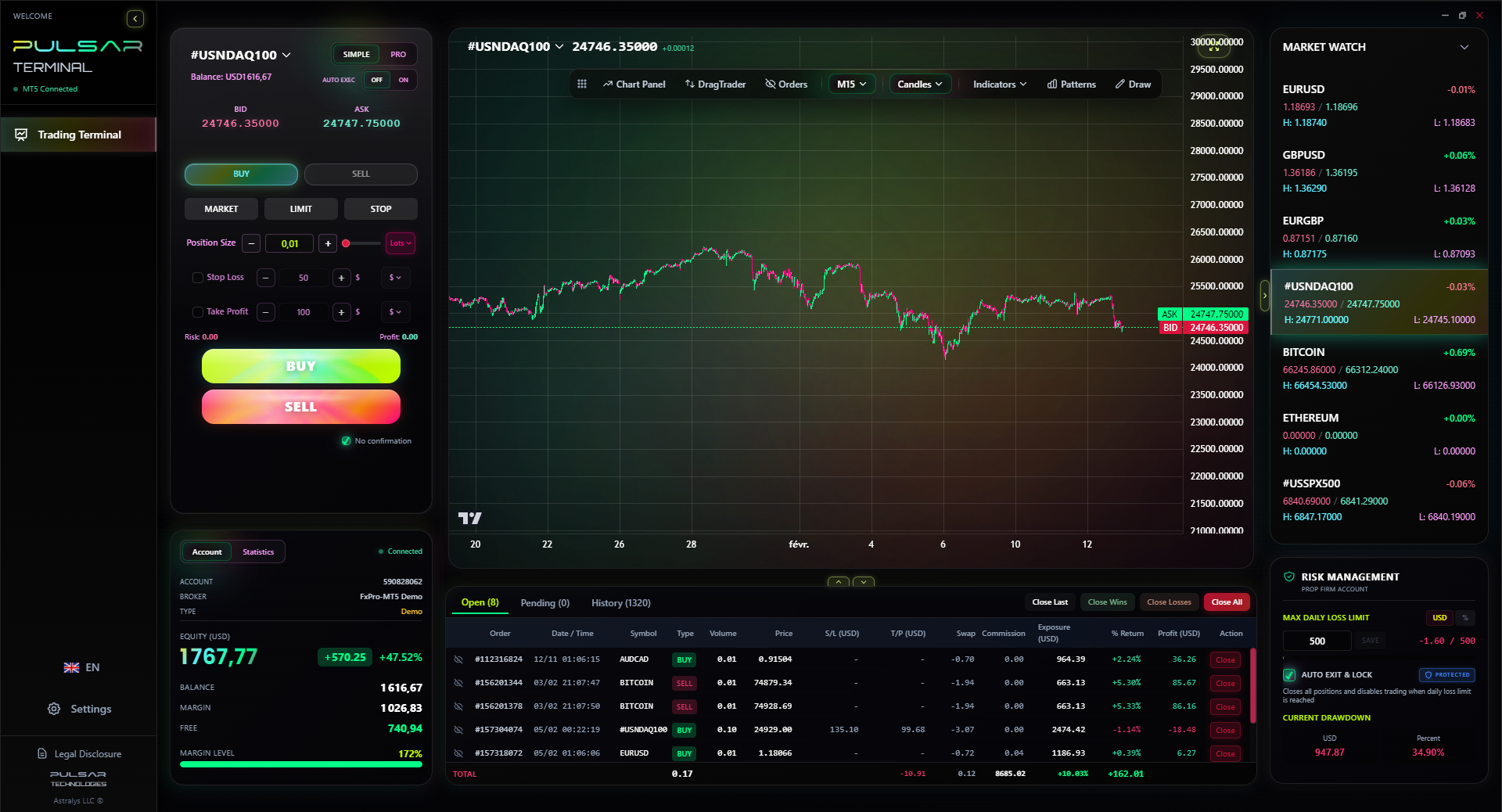
This is where external tools come in. I rely heavily on the RSI indicator and MACD indicator for confluence, but the basic MT5 drawing tools can be clunky. For advanced order management - like setting multiple take-profit levels or a trailing stop that actually works - the native platform is limited.
That's why I use a companion app. Being able to drag and drop orders directly on the chart, set a breakeven stop automatically after a price moves in my favor, or manage a grid of orders for a range-bound strategy has been a complete game... sorry, a massive improvement. It turns MT5 from a simple charting tool into a professional trading terminal. Managing risk, which is 90% of the job, becomes systematic instead of emotional.
Managing complex orders and risk on MT5 is where most traders struggle, which is why a tool that automates trailing stops and breakeven orders is essential for serious trading.
Pulsar Terminal
Универсальный инструмент для MT5: drag-and-drop ордера, мульти-TP/SL, трейлинг-стоп, грид-трейдинг, Volume Profile и защита для проп-фирм. Используется 1000+ трейдерами ежедневно.
SARS is not your broker. They are your silent partner in every profitable trade. Ignoring this will lead to a world of pain. Let's be clear: forex trading profits are generally considered revenue income (not capital gains) by SARS if you're trading frequently. This means it's added to your other income and taxed at your marginal rate.
You need to keep impeccable records. I mean every single trade, every deposit, every withdrawal, and every bank statement showing the ZAR/USD conversion. I use a simple spreadsheet, but dedicated software is better. You need to be able to show:
- Total profit/loss for the tax year (March to February).
- All trading-related expenses (data fees, platform fees, education costs – these may be deductible).
- A clear trail of all funds.
The onus is on you to declare. I made the mistake in my second year of not keeping proper records. Reconciling six months of trades was a nightmare. Now, I do it weekly. It's boring, but it's part of the business.
If your trading is more sporadic and long-term, you might argue for capital gains treatment, but you'd need a tax professional. For most active traders reading a guide like this, you're almost certainly generating revenue. Get an accountant who understands trading. It's worth the fee.
“SARS is not your broker. They are your silent partner in every profitable trade.”
Don't just pick the first name on the list. Work through this.
- Verify the FSP Number: Go to the FSCA website, find their 'Search for an FSP' tool, and type in the number the broker gives you. Confirm the name matches and the license is active.
- Open a Demo Account: This is non-negotiable. Test the platform, the spreads during your preferred trading hours (London open, US open), and see if there are requotes. Try to execute 20-30 demo trades.
- Calculate Your All-In Cost: Based on your typical trade size (use our position size calculator to figure that out), work out whether a standard or raw account is cheaper for you.
- Test the Deposit/Withdrawal Process: Do a small, real deposit (the minimum) and then immediately request a withdrawal. This tests their procedures and speed without risking much. If there's a problem with R500, imagine R50,000.
- Contact Support: Ask a technical question via live chat or email. See how long they take to respond and how helpful they are. You'll need them eventually.
- Read the Fine Print: Understand their policy on margin calls, slippage, and what happens if your internet drops during a trade.
Your broker is a tool. It shouldn't be the reason you lose. A good one becomes invisible, just a reliable pipe between you and the market. A bad one is a constant source of friction and loss.
💡 Совет Уинстона
Print your monthly statement and highlight your three worst trades. Now check the spread and commission on each. If costs made a losing trade worse, you're with the wrong broker.
FAQ
Q1Can I legally use international forex brokers like IC Markets or Pepperstone in South Africa?
Yes, it's legal for you to sign up with them. However, they are not regulated by the South African FSCA. This means you are not protected by South African law if a dispute arises. The FSCA explicitly warns against this. You trade under the broker's home country regulation (e.g., ASIC in Australia), which is often strong, but enforcing it from South Africa is difficult.
Q2What is the maximum use I can get with an FSCA-regulated broker?
For retail clients, the FSCA's official limit is 30:1. However, many brokers offer higher use (e.g., 100:1, 200:1, even 500:1) if you qualify as a 'professional client'. This usually requires meeting certain criteria like trading experience, portfolio size, and financial knowledge. Don't chase high use; it's the fastest way to a margin call.
Q3Which broker has the lowest spreads for major pairs like EUR/USD?
For raw ECN accounts, brokers like Tickmill and Global Prime consistently offer very low spreads, often below 0.2 pips on EUR/USD. Remember to add their commission to calculate the total cost. For commission-free accounts, spreads will be wider, typically starting around 0.8-1.5 pips. Check our EUR/USD guide for more on trading this pair.
Q4How do I pay tax on my forex trading profits in South Africa?
Profits from frequent trading are generally treated as ordinary revenue income by SARS. You must declare it on your annual tax return (ITR12) and will be taxed at your personal income tax rate. You can deduct certain trading-related expenses. It is crucial to keep detailed records of all trades, deposits, withdrawals, and bank statements. Consult a tax professional familiar with trading.
Q5Is MetaTrader 4 or 5 better for South African brokers?
MT5 is the more modern and capable platform. It has more timeframes, a built-in economic calendar, and better hedging capabilities. Most South African brokers now support MT5. While MT4 is still widely used and perfectly functional, if you're starting fresh, I'd recommend going straight to MT5 for future-proofing your trading.
Q6What's the cheapest way to fund an international broker account with ZAR?
Avoid direct SWIFT bank transfers due to high fees and poor exchange rates. The cheapest and fastest method is usually via an e-wallet like Skrill or Neteller, or a direct Visa/Mastercard deposit. Even better, use a digital bank (like TymeBank) that offers a USD wallet with competitive exchange rates, then transfer from there.
Урок проф. Уинстона
Ключевые выводы:
- ✓Always verify the FSP number on the FSCA website.
- ✓Test withdrawals with a small amount first.
- ✓Calculate total cost (spread + commission) for your trade size.
- ✓Taxable as revenue income, not capital gains.
Насколько полезна эта статья?
Нажмите на звезду
Еженедельные торговые инсайты
Бесплатный еженедельный анализ и стратегии. Без спама.
Об авторе
David van der Merwe
Трейдер развивающихся рынков
Трейдер из Йоханнесбурга с 11-летним опытом работы с валютами развивающихся рынков. Специализируется на ZAR-парах, торговле под регулированием FSCA и анализе южноафриканского рынка.
Комментарии
Предупреждение о рисках
Торговля финансовыми инструментами сопряжена со значительным риском и может не подходить всем инвесторам. Прошлые результаты не гарантируют будущих доходов. Данный контент носит исключительно образовательный характер и не является инвестиционной рекомендацией. Всегда проводите собственное исследование перед торговлей.
Вам также может понравиться

Cara Trading Forex Sukses: 7 Prinsip dari Trader Profesional
Cara trading forex sukses dengan 7 prinsip trader pro: manajemen modal, disiplin, journal trading, backtest. Data nyata, bukan janji profit palsu.
Jam Trading Forex Terbaik untuk Trader Indonesia: Panduan Lengkap dengan Tabel Waktu
Panduan jam trading forex untuk trader Indonesia. Tabel 4 sesi dunia, jam emas 20:00-00:00, sesi mana yang harus dihindari. Data akurat + tips dari trader berpengalaman.
Top 5 Sàn Forex Uy Tín Nhất 2026: Review Jujur dari Trader Indonesia
Top 5 sàn forex uy tín 2026 untuk trader Indonesia. Review jujur: spread, deposit, withdraw, dukungan lokal. Exness, XM, IC Markets & lebih.
Скачать Pulsar Terminal
Все эти калькуляторы встроены в Pulsar Terminal с данными в реальном времени с вашего счёта MT5.
Скачать Pulsar Terminal