


I remember staring at the screen in my Port Harcourt apartment in late 2021, watching GBP/JPY.

Olumide Adeyemi
Пионер трейдинга в Западной Африке ·  Nigeria
☕ 12 мин чтения
Что вы узнаете:
- 1The Port Harcourt Forex Scene: Ambition Meets Reality
- 2The Legal Framework & Choosing Your Broker
- 3The Real Costs of Trading: Spreads, Fees, and Minimums
- 4The Psychology of Survival: Why Port Harcourt Traders Blow Up
- 5Building a strong Strategy for the Nigerian Trader
- 6Prop Firms & Challenges: A Double-Edged Sword
- 7Your Next Steps: A Practical Action Plan
I remember staring at the screen in my Port Harcourt apartment in late 2021, watching GBP/JPY. I’d just taken a 2-lot short at 152.80, convinced the Bank of England was done hiking. Thirty minutes later, a surprise hawkish comment from a MPC member sent it screaming to 153.40. My stop-loss at 153.20 got skipped in the volatility. That one trade wiped out 12% of my account - a NGN 240,000 lesson in liquidity gaps. In Port Harcourt, where the promise of quick oil-money alternatives is everywhere, that story is a weekly occurrence. Let's talk about why, and how not to be the next cautionary tale.
Drive through GRA or Rumuola and you'll see the banners: 'Forex Masterclass', 'Financial Freedom Seminar'. The MBA Forex Port Harcourt phenomenon isn't about a specific academy; it's a symbol of the city's hunger for a slice of the global financial pie, separate from the oil and gas grind. The appeal is obvious. With a laptop and an internet connection, you're theoretically in the same market as hedge funds in London. But that's where the fantasy meets a brutal, numbers-driven reality.
I've sat with traders here who've blown accounts funding their first car. The common thread isn't a lack of intelligence - Port Harcourt is full of sharp engineers, accountants, and business minds. It's a fundamental misunderstanding of what trading actually is. It's not a side hustle you check after work. It's a probabilistic business with extreme variance. The local seminars often sell the dream (the Lamborghini parked outside the venue doesn't hurt), but skip the boring, essential chapters on position size calculator, SEC regulations, and emotional discipline.

Warning: If a 'guru' shows you a profit screenshot but can't immediately explain their max risk per trade as a percentage of their capital, walk away. They're selling a story, not a system.
The infrastructure challenge is real too. While Lagos has slightly more stable power, Port Harcourt traders battle with 'NEPA' and internet fluctuations. I lost a profitable trade on XAU/USD once because the light went out right as I was moving my stop to breakeven. By the time my generator kicked in, I was stopped out at a loss. You must have a backup plan for your backup plan.
“In Port Harcourt, the promise of quick oil-money alternatives is everywhere. That story of a blown account is a weekly occurrence.”
This is where most Port Harcourt traders get their first, expensive shock. Forex trading is legal in Nigeria, but it's governed by a dual regulatory system that's often ignored until there's a problem.
Who's in Charge?
The Central Bank of Nigeria (CBN) and the Securities and Exchange Commission (SEC) are the main authorities. The CBN controls the official forex market and licenses financial institutions. The SEC regulates capital market activities, which includes forex and CFDs for the Nigerian public. A broker needs SEC registration to legally solicit clients here. However - and this is critical - Nigerians are also allowed to use international brokers regulated abroad.
The Broker Minefield
You'll see ads for brokers with flashy bonuses and promises of 1:1000 use. Here's the frank truth: if it sounds too good to be true, it's probably a bucket shop operating from a dubious jurisdiction. Your broker is your business partner. If they fail, your money is likely gone.
I only consider brokers with top-tier regulation from bodies like the UK's FCA, Australia's ASIC, or Cyprus's CySEC. Yes, the use is lower (often 1:30 for major pairs), but that's a feature, not a bug. It forces you to size your trades properly. I've had good execution experiences with brokers like IC Markets and Pepperstone for their raw spreads, and XM for their local support and Naira deposit options.

Pro Tip: Before depositing, do two things. First, simulate a withdrawal. Contact support and ask exactly how to withdraw, how long it takes, and what the fees are. Second, test their execution during a volatile news event (like NFP) with a tiny trade. Slippage tells you a lot about their liquidity.
The Tax Man Cometh
Forget what the seminar guy said. Your forex profits are taxable. The Federal Inland Revenue Service (FIRS) considers trading profits as Capital Gains, subject to a 10% Capital Gains Tax (CGT). If you're trading full-time, it could be viewed as business income. Keep a detailed trade journal. I learned this the hard way after a profitable year; getting my records in order was a nightmare.

💡 Совет Уинстона
A trader once told me his goal was to 'get rich.' I asked him what 'rich' meant in Naira. He couldn't answer. Define your success in specific, measurable terms: 'Grow my account by 8% this quarter while never risking more than 1.5% per trade.' Vague goals lead to reckless actions.
“Your broker is your business partner. If they fail, your money is likely gone.”
Let's talk numbers, because this is where your edge gets eaten alive before you even start. The 'zero commission' account is often the most expensive.
Minimum Deposits: You can start with as little as $5 or 2,000 NGN on some platforms. But let's be honest: that's a gimmick. With a $5 account, even a 20-pip move (common in a day) on a micro lot is a 40% swing. You can't practice sane risk management. My strong advice? Don't trade live with real money until you can fund an account with at least $500 to $1,000. This allows you to trade sensible position sizes where a 20-pip loss is a manageable 1-2% of your account, not a catastrophe.
Spreads & Commissions: This is your transaction cost. You pay it on every single trade.
| Broker Type | Typical EUR/USD Spread | Commission (per lot) | Best For... |
|---|---|---|---|
| Standard Account | 0.8 - 1.5 pips | $0 | Beginners learning the ropes. |
| Raw/ECN Account | 0.0 - 0.3 pips | $3 - $7 per side | Active traders, scalping. |
A pip on EUR/USD with a standard lot is $10. So, a 1.5 pip spread means you're down $15 the moment you enter. On a $1,000 account, you need a 1.5% move just to break even. On an ECN account with 0.1 pip spread and $6 round-turn commission, your cost is just $7. For active trading, the ECN model is almost always cheaper.
Other Fees:
- Inactivity Fees: Some brokers charge if you don't trade for 3-6 months.
- Withdrawal Fees: Reputable brokers often don't charge these, but your bank or payment processor might.
- Currency Conversion: If your account is in USD but you deposit in Naira, you pay a conversion fee, usually 1-3%.

Example: You make 50 trades a month on a standard account with a 1-pip average spread on mini lots (0.1 lot). Cost: 50 trades * 1 pip * $1 per pip = $50/month. That's 5% of a $1,000 account gone just in spreads, before you've made a single profitable decision.
“Your broker is your business partner. If they fail, your money is likely gone.”
I've coached traders from Abuja to Yenagoa, and the psychological pitfalls in Port Harcourt have a unique flavor. There's a palpable pressure to 'make it' quickly, to match the perceived wealth from the oil sector. This leads to three fatal errors.
1. Overleveraging: This is the number one account killer. With a $500 account, getting a 100-pip move on a standard lot (1.0) is a 100% return! It's also a 100% loss if it goes 100 pips against you. Brokers offering 1:500 or 1:1000 use are handing you a loaded gun. I used to think, 'I'll just use tight stops.' Then I learned about market noise. A random 15-pip spike can liquidate a highly leveraged position before the market resumes in your intended direction. A margin call isn't a suggestion; it's an automatic execution.
2. Revenge Trading: You take a loss. Maybe NEPA took you out. The instinct is to immediately jump back in with a bigger position to 'win it back.' This is emotional, not analytical. It turns a single bad trade into a catastrophic losing day. I once lost NGN 80,000 on a bad EUR/USD read, then immediately doubled my position size on another pair out of anger. I lost another NGN 120,000 in 10 minutes. I had to walk away from my desk for two full days.
3. Confirmation Bias: You get a 'hot tip' from a friend in a forex WhatsApp group about USD/NGN (which you shouldn't be trading as a retail trader anyway). You only look for charts and news that support going long. You ignore the CBN's potential intervention signals. You're not analyzing; you're looking for excuses to place a bet. Tools like the RSI indicator or MACD indicator become horoscopes - you interpret them to fit your desired bias.
The solution is boring: a written trading plan. It must define your maximum risk per trade (I never risk above 1.5%), your daily loss limit (3%), and the specific conditions that must be present before you enter. Then you follow it like a robot. Your job isn't to be right on every trade; it's to be disciplined on every trade.
💡 Совет Уинстона
Your first loss is often your smallest. The instinct to immediately 'make it back' is what turns a NGN 20,000 mistake into a NGN 200,000 disaster. When you take a hit, close the platform. Your job for the rest of the day is to not trade.
“With a $500 account, a 100-pip move on a standard lot is a 100% return! It's also a 100% loss if it goes 100 pips against you.”
Forget finding a 'secret indicator'. A strong strategy is a simple one you can execute consistently, accounting for local challenges.
Timeframes & Lifestyle: If you have a 9-5 job in Trans-Amadi, you are not a scalper. Checking your phone for 1-minute charts is a recipe for disaster. You're a swing trader. Focus on the 4-hour and daily charts. Place your trades in the evening based on daily closes, set your stop-loss and take-profit, and leave it. This protects you from intraday noise and power/internet issues.
Strategy Core: Your edge should come from one or two clear concepts. For example:
- Price Action with Key Levels: Identify clear support/resistance on the daily chart. Only look for entries when price reacts at these levels. Wait for the candle to close to avoid false breakouts.
- Trend Following: Use a simple moving average (like the 50 EMA) on the H4 chart. Only take trades in the direction of the trend. In a strong uptrend, you only look for buy opportunities.
Adapt for Lagos/Abuja/PH: Your strategy must include a 'Nigerian Factor' rule. Mine states: "No entering new positions within 30 minutes of a major scheduled news event (NFP, CPI, CBN MPC announcements) due to potential volatility and internet instability." Another rule: "If power/internet is unstable for more than 1 hour, close all discretionary positions and only leave running trades with stop-losses in place."
Backtesting & Forward Testing: Don't use your hard-earned Naira to test an idea. Use a demo account for at least 2-3 months of simulated trading. Record every trade in a journal. If it's not profitable on demo, it will destroy your live account.
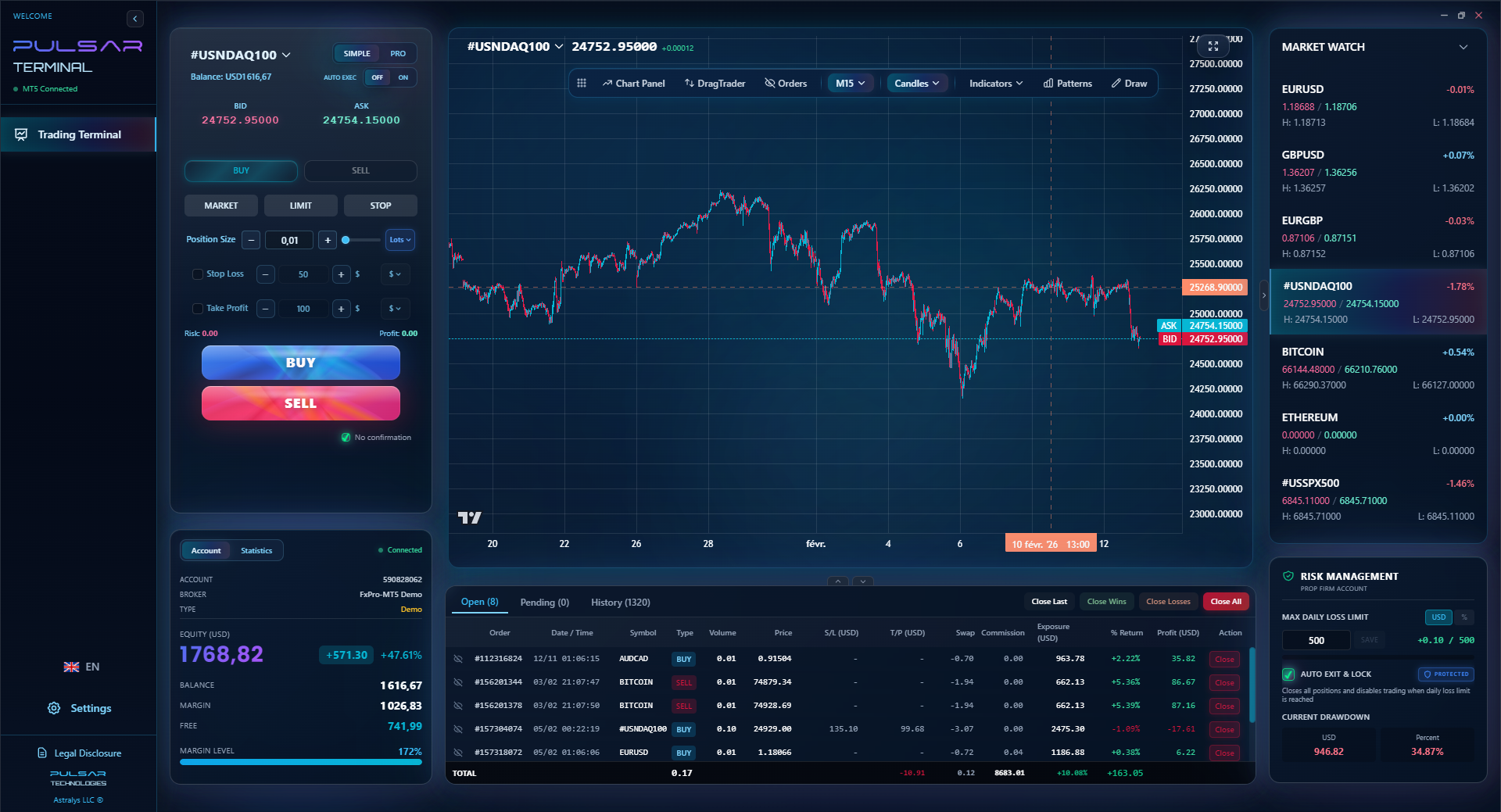
When trading prop firm challenges with strict daily loss limits, a tool that can automatically enforce those rules and manage partial closures directly on your MT5 chart removes emotion and prevents costly rule violations.
Pulsar Terminal
Универсальный инструмент для MT5: drag-and-drop ордера, мульти-TP/SL, трейлинг-стоп, грид-трейдинг, Volume Profile и защита для проп-фирм. Используется 1000+ трейдерами ежедневно.
“With a $500 account, a 100-pip move on a standard lot is a 100% return! It's also a 100% loss if it goes 100 pips against you.”
The rise of proprietary trading firms offering 'challenges' is huge here. The pitch is seductive: pass our test, trade our capital, keep most of the profits. For a skilled but undercapitalized trader, it's a potential path. But it's also a minefield.
These firms make money in two ways: 1) The challenge fee you pay to take the test. 2) From traders who blow the funded account. The rules are designed to be psychologically difficult.
Common Pitfalls in Challenges:
- The Daily Drawdown Trap: You might have a 10% max total loss, but also a 5% daily loss limit. If you're down 4.5% by noon, you're effectively done for the day. One more trade could breach the daily limit and fail you, even if you're still up overall. This forces overtrading early on to hit profit targets.
- Time Pressure: Many challenges have a profit target that must be hit within 30 days. This pushes traders to take sub-optimal, high-risk trades.
- Scaling Rules: Some firms only let you increase your capital after a certain period of consistent profits, which can be a grind.
My view? Treat the challenge fee as an educational expense. If you pass, great. If you don't, the lessons in strict discipline under pressure are useful. But never, ever use money you can't afford to lose for the fee. And remember, trading a $100,000 prop account feels completely different psychologically to trading your own $1,000. The pressure to not lose 'their' money can paralyze you.
💡 Совет Уинстона
If you wouldn't explain your trade setup, including the exact price of your stop-loss, to a skeptical accountant friend in Port Harcourt, you shouldn't place it. Articulating your logic exposes fuzzy thinking.
“Your goal for the first six months is not to make money. Your goal is to not lose money while executing your plan flawlessly.”
If you're in Port Harcourt and serious about this, here's your homework. Skip the next 'MBA Forex' seminar and do this instead.
Week 1-4: Education & Simulation
- Learn the Basics: Understand what a currency pair is, how a spread works, what margin really means. Use free resources like Babypips.com.
- Open a Demo Account: Choose a reputable broker like Exness or IC Markets. Don't chase bonus offers.
- Choose ONE Pair: Start with EUR/USD. It's the most liquid, with the tightest spreads.
- Paper Trade a Simple Strategy: Try the 50 EMA trend-following idea on the H4 chart. Place 20 trades. Journal every single one: entry reason, exit reason, P&L, emotional state.
Week 5-8: Risk Management Foundation
- Define Your Risk: Decide you will never, under any circumstance, risk more than 1% of your demo capital on a single trade. Use the position size calculator for every entry.
- Practice with 'Life' Events: Simulate a power cut. If you were in a trade, what would you do? (Answer: Your stop-loss should already be set, so nothing).
- Review Your Journal: Are you profitable? More importantly, are you following your own rules 100% of the time?
Only Then, Consider Going Live Fund a live account with money you can afford to lose completely. Start with micro lots (0.01). Your goal for the first six months is not to make money. Your goal is to not lose money while executing your plan flawlessly. If you can do that, you're already ahead of 90% of the traders in Port Harcourt.
FAQ
Q1Is forex trading legal in Port Harcourt, Nigeria?
Yes, forex trading is legal in Nigeria. It's regulated by the Securities and Exchange Commission (SEC) and the Central Bank of Nigeria (CBN). However, you must use a broker that is either registered with the SEC or is a reputable international broker regulated by a top-tier foreign authority like the FCA (UK) or ASIC (Australia).
Q2What is the minimum amount I need to start forex trading in Port Harcourt?
Technically, you can start with as little as $5 or 2,000 NGN with some brokers. But practically, this is a trap. You cannot implement proper risk management with such a small amount. A more realistic and responsible minimum to start learning with real money is between $500 to $1,000 (roughly 700,000 - 1.4 million Naira). This allows you to risk small percentages per trade without being wiped out by a single bad move or the cost of spreads.
Q3How are my forex trading profits taxed in Nigeria?
Forex trading profits are subject to a 10% Capital Gains Tax (CGT) by the Federal Inland Revenue Service (FIRS). If you trade full-time, it may be considered business income. It is your responsibility to keep accurate records of all your trades, deposits, and withdrawals for tax purposes. Ignorance is not an excuse with FIRS.
Q4What's the biggest mistake new traders in Port Harcourt make?
Overleveraging, without a doubt. Using use of 1:500 or more because a broker offers it turns small market movements into account-ending events. Combined with the lack of a strict stop-loss, it's the fastest way to turn a NGN 500,000 account into zero. Successful trading is about survival and consistency, not about hitting a 1000% return in a month.
Q5Can I trade forex with my Nigerian bank account?
Yes, but not directly on the interbank market. You fund your brokerage account using your bank card (Mastercard/Visa), bank transfer, or through various online payment processors accepted by your broker (like WebPay, Flutterwave, or direct transfers). The broker converts your Naira deposit into the account currency (usually USD or EUR).
Q6Are prop firm challenges worth it for a Nigerian trader?
They can be, but treat them as an advanced test of discipline, not a shortcut. The challenge rules are designed to be difficult. Pay the fee only with money you can afford to lose. The real value is in the rigorous risk management they force upon you. If you pass, it's a great way to access larger capital. If you fail, the lessons are often more valuable than any seminar.
Q7How do I deal with constant power and internet issues while trading?
Incorporate it into your strategy. 1) Use a UPS for your router and computer. 2) Have mobile data as a ready backup. 3) Most importantly, trade higher timeframes (like 4-hour or daily charts) as a swing trader. Set your orders with stop-losses and take-profits, then you don't need to monitor the screen constantly. The trade runs itself according to your plan.
Урок проф. Уинстона
Ключевые выводы:
- ✓Define risk first: Never risk >1.5% of capital per trade.
- ✓Choose brokers with top-tier regulation, not the highest use.
- ✓Trade higher timeframes (H4/Daily) to survive power instability.
- ✓Profits are taxed at 10% CGT. Keep immaculate records.
- ✓A demo account is for testing strategy, not for fantasizing.
Насколько полезна эта статья?
Нажмите на звезду
Еженедельные торговые инсайты
Бесплатный еженедельный анализ и стратегии. Без спама.
Об авторе
Olumide Adeyemi
Пионер трейдинга в Западной Африке
Один из самых активных преподавателей форекс-трейдинга в Нигерии. 8 лет торгового опыта из Лагоса. Специализируется на стратегиях с малым капиталом и челленджах проп-фирм для африканских трейдеров.
Комментарии
Предупреждение о рисках
Торговля финансовыми инструментами сопряжена со значительным риском и может не подходить всем инвесторам. Прошлые результаты не гарантируют будущих доходов. Данный контент носит исключительно образовательный характер и не является инвестиционной рекомендацией. Всегда проводите собственное исследование перед торговлей.
Вам также может понравиться

Cara Trading Forex Sukses: 7 Prinsip dari Trader Profesional
Cara trading forex sukses dengan 7 prinsip trader pro: manajemen modal, disiplin, journal trading, backtest. Data nyata, bukan janji profit palsu.
Jam Trading Forex Terbaik untuk Trader Indonesia: Panduan Lengkap dengan Tabel Waktu
Panduan jam trading forex untuk trader Indonesia. Tabel 4 sesi dunia, jam emas 20:00-00:00, sesi mana yang harus dihindari. Data akurat + tips dari trader berpengalaman.
Top 5 Sàn Forex Uy Tín Nhất 2026: Review Jujur dari Trader Indonesia
Top 5 sàn forex uy tín 2026 untuk trader Indonesia. Review jujur: spread, deposit, withdraw, dukungan lokal. Exness, XM, IC Markets & lebih.
Скачать Pulsar Terminal
Все эти калькуляторы встроены в Pulsar Terminal с данными в реальном времени с вашего счёта MT5.
Скачать Pulsar Terminal