


Here's a hard truth: 90% of retail traders in India lose money.
Rajesh Sharma
Старший форекс-аналитик ·  India
India
☕ 11 мин чтения
Что вы узнаете:
Here's a hard truth: 90% of retail traders in India lose money. The most common reason? Chasing a mythical 'most profitable trading strategy' that doesn't exist. I've seen it for 12 years - traders blowing accounts on complex F&O strategies they don't understand, all while ignoring the real profit-makers: regulation, cost structure, and their own discipline. In 2026, with SEBI's new algo and options rules, the game has changed completely. The most profitable strategy isn't a single setup; it's a framework that works with the Indian market's unique constraints, not against them.
Everyone wants the holy grail. The one strategy that prints money. Let me save you a decade of pain: it's a fantasy. Profitability isn't about a magical indicator combination you buy from a YouTube guru. It's about expected value over hundreds of trades, minus your costs, within a regulatory box you can't break.
In India, that box is drawn by SEBI. Think of them as the ultimate market maker, setting the rules of the casino. Their 2025-2026 regulatory changes - especially around algo trading and F&O - aren't minor tweaks. They're a fundamental reshaping of what's possible for retail traders. The old HFT scalping tricks? Heavily restricted. Unlimited options selling with minimal margin? Gone.
Your first job is to understand this landscape. The most profitable strategy for a prop firm in London is illegal or impossible here. Your edge must be built within these walls. I learned this the hard way in 2019, trying to run a simple arbitrage bot between NSE and BSE. The latency, the colocation costs, the regulatory scrutiny - it ate any potential profit before the first trade was even placed. I lost about ₹2.5 lakh in setup and testing before admitting defeat. The market doesn't care about your clever idea; it cares about the rules.

Warning: If your 'strategy' involves circumventing SEBI's peak margin rules or trying to hide algo orders, you're not trading. You're gambling with a potential ban. The regulator's tech surveillance is now more sophisticated than most retail traders' setups.
This is where most Indian traders fail. They see a 5-point profit on Bank Nifty and think they're geniuses. They ignore the fees that turned that 5-point win into a net loss. Let's break down a real trade from last week.
I took a delivery trade in 100 shares of a large-cap stock at ₹1,500. Bought at ₹1,500, sold at ₹1,530.
Gross Profit: (1,530 - 1,500) * 100 = ₹3,000
Now, the silent killers:
- Brokerage (Discount Broker): ₹20 per order (buy & sell) = ₹40
- STT (on sale): 0.015% of 1,53,000 = ₹22.95
- SEBI Turnover Fee: ₹10 per crore. Turnover = 1,50,000 + 1,53,000 = 3,03,000. Fee = (3,03,000 / 1,00,00,000) * 10 = ₹0.30 (plus 18% GST)
- DP Charges: ₹15.34 (GST included)
- Stamp Duty: (Varies by state) Assume ~0.015% on buy side: ₹22.5
Total Costs: ~₹102 Net Profit: ₹3,000 - ₹102 = ₹2,898
That's a 3.4% drag on your gross profit. For intraday or F&O, the STT is lower but brokerage can be higher if you're not with a pure discount broker. The lesson? Your strategy must account for a 2-4% friction cost on every round trip. A strategy with a 55% win rate and a 1:1 risk-reward ratio? It's a loser after costs. You need wider targets or a higher win rate just to break even. Always use a position size calculator that includes these local fees.

Example: A scalping strategy aiming for 5-point profits on Nifty Futures. Average trade value: ₹8 lakh. Costs (approx.): Brokerage (₹40), STT (₹16), Exchange Charges (₹10). Total ~₹66. Your 5-point profit is ₹6,250. Costs eat over 1% of your profit. Do this 10 times a day, and you're giving up ₹660 daily, over ₹16,000 monthly. That's your edge, gone.

💡 Совет Уинстона
Your first ₹1 lakh in trading profits should go straight into a separate bank account. Don't touch it. That's your 'I survived' fund. It changes your psychology from desperate to patient.
“Profitability isn't about a magical indicator combination you buy from a YouTube guru. It's about expected value over hundreds of trades, minus your costs, within a regulatory box you can't break.”
So what works? Ditch the search for a single strategy. Build a framework. This is your personalized trading business plan. Mine has three pillars: Instrument, Method, and Execution.
Pillar 1: Choose Your Instrument Wisely
You can't be expert in everything. The days of casually dabbling in equity, currency, and F&O are over.
- Equity Delivery: High capital, lower use, but benefits from long-term tax treatment. Your edge is fundamental research and patience.
- Equity Intraday: You're fighting the 5x use limit (20% peak margin), auto-square-off by 3:20 PM, and intense competition. Your edge needs to be precise entry and strict stop-losses.
- F&O (Futures & Options): The new SEBI rules are a game-ender for many. The higher contract sizes (₹15-20 lakh min for indices) and upfront premium payment for buyers demand serious capital. Selling options requires huge margin. This is now a professional's arena.
- Currency (USD/INR): Less crowded than equities, clear macroeconomic drivers (Fed vs. RBI). But know the pip definition in INR terms and the market timings (9 AM-5 PM).
I made my biggest mistakes in F&O. In 2023, I was selling weekly Bank Nifty puts, collecting small premiums. It worked for months until a 2,000-point gap down wiped out a year's profit in a day. I didn't respect the tail risk. Now, I stick to swing trading liquid large-cap stocks and occasional EUR/USD positions, because I understand their rhythms.
Pillar 2: Define Your Method & Edge
Your edge is what you know that the crowd doesn't. It could be:
- Statistical Edge: A price action pattern that has a 60% historical win rate on the Nifty 50 chart between 10:30 AM and 11:30 AM.
- Technical Edge: Mastery of one or two indicators. Not 10. I use RSI indicator divergences on the hourly chart and a simple moving average confluence. That's it.
- Fundamental Edge: Deep understanding of one sector (e.g., IT), tracking quarterly results and management commentary closer than the analysts.
Pillar 3: Engineer Your Execution
This is the boring stuff that makes you money. Your trade plan must be robotic.
- Entry Signal: Unambiguous. 'If X happens AND Y is true, then enter.'
- Position Size: Fixed percentage of capital (I risk 0.5-1% per trade). No revenge trading after a loss.
- Stop Loss: Defined before entry. Always. This is non-negotiable. A bad stop-loss is what leads to a margin call.
- Take Profit: Multiple levels. Never aim for one 'home run' price.
- Review: Weekly analysis of all trades. Why did winners win? Why did losers lose?
This framework adapts. When SEBI changed algo rules, I had to scrap an automated mean-reversion script I used in equities. My edge vanished overnight. I went back to manual swing trading based on weekly closes until I could re-code the strategy within the new API guidelines.
Your broker is your business partner. Choose wrong, and they'll bleed you with costs or fail you in a volatile market. For most Indian retail traders, a discount broker is the only sane choice.
Key Considerations:
- Fees: Flat fee per trade is king for active traders. Zerodha (₹20/order for intraday/F&O), Upstox, Angel One have similar models. For delivery, many are zero-cost.
- Platform Stability: Does their platform (Kite, Upstox Pro) crash during budget day or high volatility? Check user reviews.
- API Access (For Algo Traders): Post-April 2026, this is critical. Does your broker provide SEBI-compliant, secure API access? What are the limits? Zerodha's Kite Connect and Upstox's Open API are the leaders, but expect stricter controls and approval processes.
- Margin & use: They must strictly adhere to SEBI's peak margin rules. A broker offering 'hidden' extra use is a massive red flag - you'll get penalized, not them.
I've used Zerodha for 8 years. Their execution is reliable, and costs are transparent. I tried a smaller broker in 2021 for lower fees, but their order routing was slow, costing me slippage that was ten times the brokerage I saved. Not worth it.
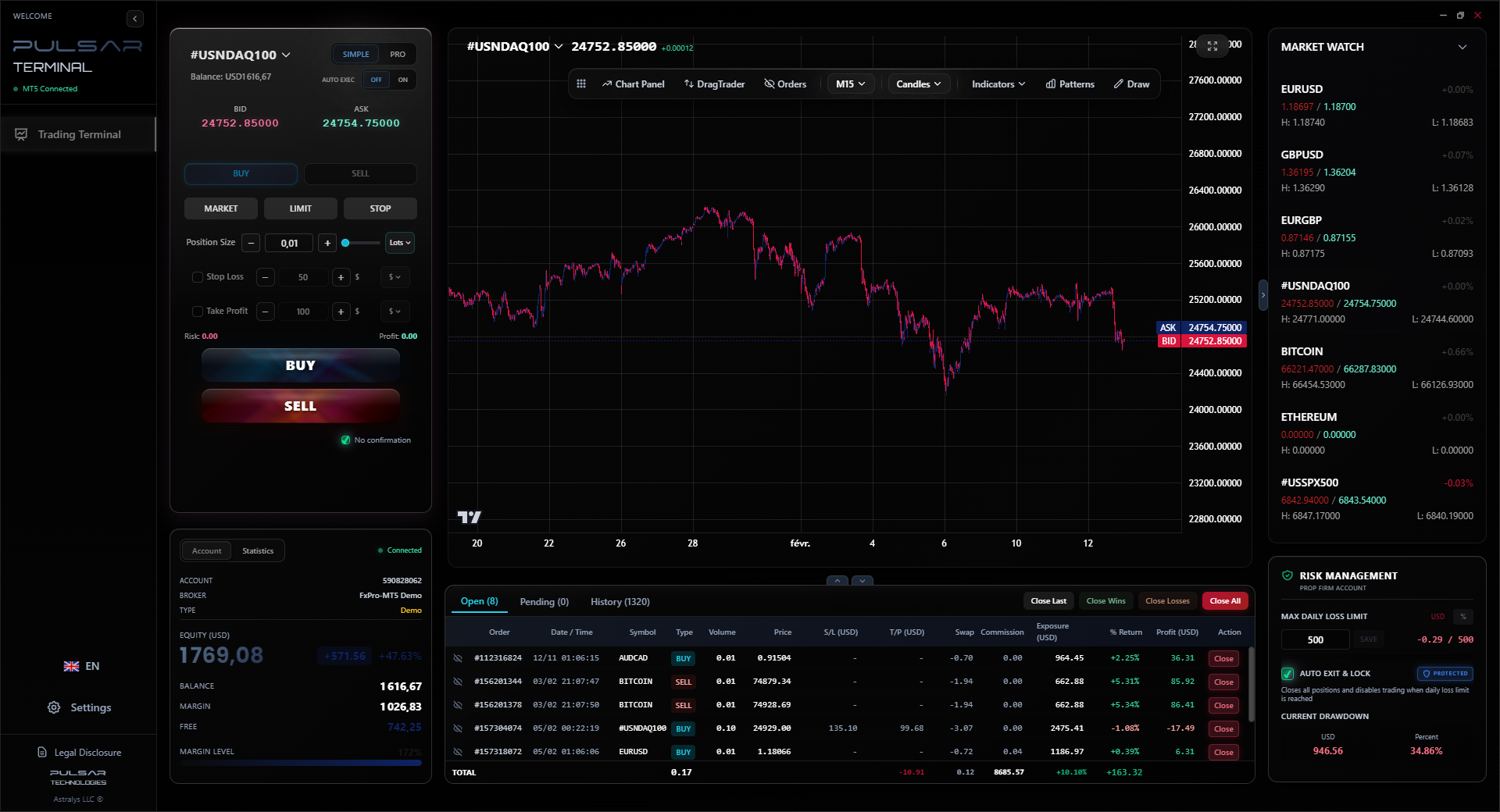
For charting, many Indian platforms now integrate with TradingView (like Dhan). That's a huge upgrade. But remember, fancy charts don't make you money. A clean chart with volume and a couple of lines is often better than 20 confusing indicators. If you're on MT5 for currencies, a tool like Pulsar Terminal can add powerful order management features that most Indian brokers' platforms lack.
Managing multiple take-profit levels and stop-losses manually on volatile Indian indices is stressful; Pulsar Terminal automates this with drag-and-drop multi-TP/SL orders directly on your MT5 platform.
Pulsar Terminal
Универсальный инструмент для MT5: drag-and-drop ордера, мульти-TP/SL, трейлинг-стоп, грид-трейдинг, Volume Profile и защита для проп-фирм. Используется 1000+ трейдерами ежедневно.
“You are the biggest risk to your capital.”
You can have the world's best framework and still blow up your account. I've done it. In 2018, after three consecutive losses (totaling ₹45,000), I doubled my position size on the next trade to 'make it back quickly.' It was another loser. I lost ₹1.2 lakh in an hour. That was the tuition fee for my most important lesson: you are the biggest risk to your capital.
The Indian market has unique psychological traps:
- Auto Square-Off Panic: At 3:20 PM, watching your intraday position get liquidated at a loss because you held hope for a reversal. It feels personal. It's not. It's a rule.
- F&O Lottery Mentality: The lure of turning ₹50,000 into ₹5 lakh on a weekly option. It's marketed that way. It's a trap that destroys more accounts than any bear market.
- Tips & 'Sure Shot' Calls: From WhatsApp groups to Telegram channels. If it were a sure shot, why would they sell it for ₹500 a month?
Your strategy must include psychological rules:
- Daily Loss Limit: Mine is 2% of my trading capital. If I hit it, I shut down the terminal. No debates.
- Maximum Position Limit: No more than 3 open positions at once. Prevents overtrading.
- No Trading After a Big Loss: Take the rest of the day off. Your judgment is impaired.
- Focus on Process, Not P&L: Did you follow your plan? If yes, a losing trade is a good trade. A win where you broke your rules is a dangerous trade.
This mental discipline is what separates the 10% who are consistently profitable from the 90% who aren't. It's boring. It's unsexy. It's everything.
💡 Совет Уинстона
The most important line on your chart isn't a moving average. It's the horizontal line marking your daily loss limit. Draw it in red.
Let's make this concrete. Here's a simplified look at a recent profitable week using a swing trading framework in equities.
Capital: ₹10,00,000 Risk per Trade: 1% = ₹10,000 Instrument: Nifty 50 Stocks (Delivery) Edge: Pullback to 20-week moving average with bullish RSI indicator divergence on daily chart.
Trade 1: ITC Ltd
- Signal: Pulled back to ₹435 (near 20-WMA), daily RSI showed bullish divergence.
- Action: Bought 230 shares @ ₹435. Capital: ₹1,00,050.
- Stop Loss: ₹415 (₹20 risk/share). Total risk: ₹4,600 (<1% capital).
- Target 1: ₹455 (Sell 50% of position)
- Target 2: ₹475 (Sell remaining)
- Result: Hit Target 1 in 3 days. Sold 115 shares @ ₹455. Profit: ₹2,300. Stopped out of remaining at ₹425 a week later. Loss on second half: ₹1,150. Net on trade: +₹1,150.
Trade 2: Reliance Industries
- Signal: Similar setup at ₹2,850.
- Action: Bought 35 shares @ ₹2,850. Capital: ₹99,750.
- Stop Loss: ₹2,780.
- Target: ₹2,950.
- Result: Stop loss hit after 2 days. Loss: ₹2,450.
Weekly Summary:
- Trade 1: +₹1,150
- Trade 2: -₹2,450
- Net P&L: -₹1,300
- Costs (approx.): ₹180
- Total: -₹1,480
A losing week. But my risk was controlled (max loss possible was ₹10,000). I followed my plan. I reviewed the trades: Reliance broke a key support level I missed. I add that to my checklist. The process was intact, so I trade again next week. This is it. No drama. No huge wins. No huge losses. Just consistent application of a framework that, over 100 trades, has a positive edge. That's the 'most profitable strategy' in reality.
“Your goal in the first year is not to make money. Your goal is to not lose money while proving your framework has an edge.”
Forget the movies. Forget the Instagram traders with Lamborghinis. The most profitable trading strategy for you in India is the one you can execute consistently, without emotion, within SEBI's rules, after all costs are paid.
It will be boring. It will involve more screen time studying your mistakes than watching charts. It will mean saying 'no' to 95% of market movements because they don't fit your edge.
Start small. Paper trade your framework for a month. Then trade with a capital amount so small that losing it wouldn't affect your sleep - ₹25,000 or ₹50,000. Track every single trade in a journal, including your emotional state. Your goal in the first year is not to make money. Your goal is to not lose money while proving your framework has an edge.
The markets aren't going anywhere. The spread definition will still matter tomorrow. The opportunity will be there next month, next year. The only thing at risk is your capital if you rush in unprepared. Build your business plan first. The profits will follow, not the other way around.

Pro Tip: The single best investment you can make is in a fast, reliable internet connection and a backup power source (UPS). I've seen more trades go bad from a power cut in Mumbai than from a wrong analysis. Control what you can control.
FAQ
Q1Is algorithmic trading still profitable for retail traders after SEBI's 2026 rules?
It's much harder, but not impossible. The new rules (structured APIs, no open access, order tagging) raise the barrier to entry. Retail traders can't just download a random Python script and run it. You'll need to work through your broker's approved system, and your strategy must withstand higher scrutiny and likely lower order rates. The low-hanging fruit is gone. Profitability now requires a genuinely strong statistical edge and proper backtesting, not just speed.
Q2What is the best trading strategy for a beginner in India with ₹50,000?
The only correct answer: don't trade with it yet. Use that ₹50,000 to paper trade for 3-6 months. If you must deploy capital, use a very small portion (e.g., ₹5,000-₹10,000) for delivery-based investing in a single large-cap stock or an ETF. Your goal is learning, not profit. Avoid intraday and F&O completely - the costs and use will destroy a small account with one mistake. Focus on understanding how the market moves, how to place orders, and how to read a basic P&L statement with all charges included.
Q3Which is more profitable: equity intraday or swing trading?
There's no universal answer, but swing trading (delivery) has structural advantages for most people. Intraday has higher use (5x) but also higher pressure (auto square-off), more noise, and requires constant screen time. Swing trading allows you to capture larger trends, benefits from lower long-term capital gains tax (if held over a year), and lets you make decisions calmly. Profitability is about your personal edge. If you have a full-time job, swing trading is almost certainly more 'profitable' when you factor in the value of your time and reduced stress.
Q4How do SEBI's new options rules (2025) affect strategy profitability?
They dramatically reduce the profitability of selling options (premium selling) for small accounts and make buying options more expensive. The higher minimum contract size (₹15-20 lakh) means you need more capital per trade. The upfront premium payment for buyers kills the 'lottery ticket' mentality - you pay the full potential loss immediately. Profitable options strategies now require significant capital, sophisticated risk management (like delta hedging), and a focus on longer-dated options where time decay works more predictably. The easy money era in F&O is over.
Q5Can I use foreign brokers like Exness or IC Markets to trade global markets from India?
Technically, yes, for trading instruments like forex (EUR/USD, XAU/USD) or global CFDs. However, it operates in a regulatory grey area for Indian residents. The primary legal issue is fund repatriation - sending INR abroad for trading may violate FEMA rules. Also,, SEBI does not regulate these entities, so you have zero investor protection if the broker fails or engages in malpractice. It's a high-risk choice. Most traders are better off using SEBI-regulated brokers for INR-denominated assets or the international services offered by some Indian brokers (like Zerodha's Coin for global stocks).
Q6What's a realistic monthly return from trading in India?
Anybody promising a fixed monthly return is a scam. A realistic, sustainable target for a skilled, disciplined retail trader is 2-5% per month on the capital actively at risk. That's 24-60% annualized, which is phenomenal. But that's not 5% on your total net worth monthly - it's on the portion you're actively trading. Most months might be 0-3%. Some months will be -2%. The key is consistency and protecting capital. Aiming for 20% per month is a surefire path to blowing up your account.
Урок проф. Уинстона
Ключевые выводы:
- ✓There is no single 'most profitable' strategy, only a profitable framework.
- ✓SEBI's 2025-2026 rules have permanently raised the stakes, especially in F&O and algo trading.
- ✓Friction costs (brokerage, STT, DP) eat 2-4% of every trade's profit. Factor them in.
- ✓Risk a maximum of 1% of capital per trade. A 2% daily loss limit is non-negotiable.
- ✓Profitability is 20% method, 80% psychology and execution discipline.
Насколько полезна эта статья?
Нажмите на звезду
Еженедельные торговые инсайты
Бесплатный еженедельный анализ и стратегии. Без спама.
Об авторе
Rajesh Sharma
Старший форекс-аналитик
Более 10 лет торгует на индийских и южноазиатских рынках. Начинал с валютных деривативов на NSE, затем перешёл на международный форекс. Специализируется на USD/INR и парах развивающихся рынков.
Комментарии
Предупреждение о рисках
Торговля финансовыми инструментами сопряжена со значительным риском и может не подходить всем инвесторам. Прошлые результаты не гарантируют будущих доходов. Данный контент носит исключительно образовательный характер и не является инвестиционной рекомендацией. Всегда проводите собственное исследование перед торговлей.
Вам также может понравиться

Cara Trading Forex Sukses: 7 Prinsip dari Trader Profesional
Cara trading forex sukses dengan 7 prinsip trader pro: manajemen modal, disiplin, journal trading, backtest. Data nyata, bukan janji profit palsu.
Jam Trading Forex Terbaik untuk Trader Indonesia: Panduan Lengkap dengan Tabel Waktu
Panduan jam trading forex untuk trader Indonesia. Tabel 4 sesi dunia, jam emas 20:00-00:00, sesi mana yang harus dihindari. Data akurat + tips dari trader berpengalaman.
Top 5 Sàn Forex Uy Tín Nhất 2026: Review Jujur dari Trader Indonesia
Top 5 sàn forex uy tín 2026 untuk trader Indonesia. Review jujur: spread, deposit, withdraw, dukungan lokal. Exness, XM, IC Markets & lebih.
Скачать Pulsar Terminal
Все эти калькуляторы встроены в Pulsar Terminal с данными в реальном времени с вашего счёта MT5.
Скачать Pulsar Terminal