


If you think the Nedbank Forex Department is just for sending money to your cousin in the UK, you're missing the bigger picture.

David van der Merwe
Трейдер развивающихся рынков ·  South Africa
☕ 12 мин чтения
Что вы узнаете:
- 1What the Nedbank Forex Department Actually Does (And Doesn't Do)
- 2SARB's Rules: The Two Allowances Every Trader Must Know
- 3The Real Costs: A Brutally Honest Fee Breakdown
- 4Step-by-Step: Using Nedbank to Fund an Overseas Broker
- 5Foreign Currency Accounts (FCAs): A Trader's Tool
- 6Common Pitfalls and How to Avoid Them
- 7Are There Alternatives to Nedbank Forex?
If you think the Nedbank Forex Department is just for sending money to your cousin in the UK, you're missing the bigger picture. Most traders I talk to either ignore it completely or get a nasty shock from the fees when they finally use it. The truth is, understanding this department is non-negotiable if you're a South African moving money for trading, whether it's funding an international broker or bringing profits home. I've made expensive mistakes here so you don't have to. Let's set the record straight on what it actually does, what it costs, and how to work with SARB's rules without getting tripped up.
Let's clear this up first: the Nedbank Forex Department is not a retail forex trading platform. You can't open a MT5 account with them and start scalping the EUR/USD. I learned that the hard way when I first started and walked into a branch expecting to trade. What you get is a crucial service hub for international finance, operating as an Authorised Dealer under the South African Reserve Bank (SARB).
Their core job is to help and document the legal movement of money across South Africa's borders. For you, the trader, this means they are the gatekeeper for two critical actions: sending your ZAR overseas to fund a trading account with a broker like IC Markets or Pepperstone, and bringing your foreign currency profits back home. Every single transaction you make with them gets tagged with a Balance of Payment (BOP) code, which tells SARB exactly why that money is leaving or entering the country. Think of them as the compliant middleman between your rand and the global financial system.
They also offer Foreign Currency Accounts (FCAs). This is a handy tool. You can hold money in USD, EUR, or GBP (among others) right here in SA. I use my USD FCA as a 'holding pen'. When I withdraw profits from my overseas broker, I sometimes send it to my Nedbank USD account first. It sits there in dollars, shielded from immediate rand volatility, until I decide the ZAR rate is good for conversion. It's a basic but effective form of currency risk management.
This is the most important part. Your ability to move money for trading hinges on two SARB allowances. Forget these, and your transfer gets rejected. I've seen it happen.
First, the Single Discretionary Allowance (SDA). This is R1 million per calendar year. You can use it for almost anything legal overseas - travel, buying stuff online, or funding a trading account. The key here is you don't need a Tax Clearance Certificate from SARS. You just tell Nedbank you're using your SDA, and if you're under the limit, it should go through. It's your 'easy access' money.

Warning: The SDA is a combined limit for all your foreign spending. If you go on a R300k holiday, you only have R700k left for the year to fund your trading account. Keep a personal tally.
Second, the Foreign Investment Allowance (FIA). This is an additional R10 million per year, but it's strictly for investment. This is where you need to pay attention. To use your FIA, you must get a Tax Compliance Status (TCS) PIN from SARS. This proves you're tax compliant. Nedbank's Forex Department will not process an FIA transfer without seeing that PIN. The process involves applying to SARS, and it can take a few days. I always apply for my TCS PIN early in the year, so it's ready when I need to move a larger chunk of capital.
How This Works for Funding a Broker
Let's say you want to send $10,000 (roughly R185,000) to an offshore broker. You'd use part of your SDA. You log into Nedbank Online Banking, initiate an international payment to your broker's account, and select the correct BOP code (something like 'Portfolio Investment'). Because it's under R1 million and within your annual SDA limit, it gets approved, pending the usual checks.
If you wanted to send R2 million, you'd use your R1 million SDA first, and then R1 million of your FIA. For the FIA portion, you'd need to provide your TCS PIN to Nedbank. This is non-negotiable. Understanding this structure is the first step to managing your international trading capital efficiently.

💡 Совет Уинстона
Apply for your SARS TCS PIN in January, not when you need it. Liquidity in trading isn't just about market depth, it's about having your financial permissions ready to deploy capital instantly.
“The Nedbank Forex Department isn't your broker; it's the compliant pipe that connects your ZAR to the global markets.”
Here’s where Nedbank, and all local banks, make their money. The fees are layered, and if you're not careful, they'll eat a meaningful chunk of your transfer. I once sent $5,000 to fund an account and was shocked to see over $150 vanish before it landed. Let's break down what you'll actually pay.
The headline fee is the commission. If you do it yourself online, it's 0.63% of the amount. If you need a banker to do it for you, it jumps to 0.89%. Always, always do it online.
| Fee Type | Online/Digital Rate | Notes |
|---|---|---|
| Commission | 0.63% | Min R205, Max R750. On a R200k transfer, that's R1,260. |
| Correspondent Bank Fee | R150 - R1,500 | A fee from the intermediary bank that handles the transfer overseas. You often don't know this cost until it's deducted. |
| Exchange Rate Margin | ~2.5% (Major Currencies) | This is the silent killer. It's not a separate fee, but a markup on the exchange rate they give you. |
That last one, the exchange rate margin, is critical. Nedbank doesn't give you the pure interbank rate you see on TradingView. They add a margin - around 2.5% for USD, GBP, EUR. So if the real EUR/USD rate is 1.0850, the rate they offer you to convert your ZAR to EUR will be worse by about 2.5%. On a large transfer, this cost dwarfs the commission.

Example: You send R500,000 abroad at a 2.5% margin. The hidden cost is R12,500 (R500,000 * 0.025). Add the R750 max commission, and your total cost is over R13,250 before the correspondent bank fee even hits.
For receiving money, like profits from your broker, fees apply too. Over R2,000, it's 0.63% commission (min R160). Under R2,000, a flat R125 fee. So if you're making small, frequent withdrawals, those R125 charges add up fast. It often makes more sense to let profits accumulate and make fewer, larger withdrawals.
Before you finalize any transfer, use a position size calculator backwards: start with the amount you need to land in your broker account, then work back to see how much ZAR you must send to cover all the fees and the poor exchange rate. It's an eye-opener.
Okay, let's get practical. You've chosen a broker like Exness or XM, and you need to get your rands into their account. Here’s the process, refined from my own (sometimes frustrating) experience.
- Get Your Broker's Details: You'll need the broker's full bank account details: bank name, address, account number, SWIFT/BIC code, and the beneficiary name (which must match your trading account name exactly). A mismatch here causes delays and might trigger a R280 'incorrect instructions' fee.
- Log into Nedbank Online Banking: Navigate to the 'Payments' or 'International' section. Start a new international payment.
- Fill in the Form carefully:
- Beneficiary: Your broker's account name.
- Amount: The foreign currency amount you wish to send (e.g., USD 5,000).
- Reason/BOP Code: This is vital. You'll select a code that indicates this is for 'Portfolio Investment' or 'Foreign Investment'. Do NOT put 'travel' or 'gifts'. Giving the wrong reason is a compliance red flag.
- Allowance Declaration: You'll declare which allowance you're using - SDA or FIA. If it's FIA, you'll input your SARS TCS PIN.
- Review the Rate and Final Cost: The system will show you the exchange rate and the total ZAR debit. Remember, this rate includes their margin. This is your last chance to check if the total cost makes sense.
- Submit and Track: Once submitted, you get a reference. You can track it for a R10 fee, but I usually just wait for the notification from my broker, which can take 2-5 business days.

Pro Tip: Do a small test transfer first. Send $100 or €100. Confirm it lands correctly in your trading account with all details perfect before you send your main capital. The small fee is worth the peace of mind.
A major headache is the 'correspondent bank fee'. Your money rarely goes directly from Nedbank to your broker's bank. It goes through one or more intermediary banks in the US or Europe, each taking a cut (that R150-R1,500 range). You can sometimes choose 'SHA' (Shared) or 'OUR' (Sender Pays All) charges. I always choose 'SHA' - it means Nedbank's fees are covered by me, and any intermediary fees are deducted from the transfer amount. With 'OUR', you pay all fees upfront, but it's more expensive from Nedbank's side. 'SHA' usually works out better.
💡 Совет Уинстона
The exchange rate margin is a silent tax. On a R500k transfer, a 2.5% margin costs you R12,500. That's the equivalent of giving away 25 profitable trades with a 50-pip gain on a standard lot. Negotiate or find cheaper channels.
“That 2.5% exchange rate margin isn't a fee, it's a silent tax on every cross-border transfer you make.”
Nedbank's FCAs are more useful than most traders realize. You can hold eight major currencies, including USD, EUR, GBP, and JPY. The monthly maintenance fee is zero, which is great.
I use my USD FCA as a strategic buffer. Let's say I close a great XAU/USD trade and have $20,000 in profit on my international broker. The ZAR is looking weak at R19.50/USD. I don't want to convert to rands yet because I think the dollar will strengthen further.
So, I withdraw the $20,000 from my broker not to my ZAR account, but to my Nedbank USD FCA. The money lands in dollars. It's now sitting in South Africa, but in a dollar 'bucket'. I can watch the EUR/USD and USD/ZAR pairs, waiting for a better conversion rate. When the ZAR weakens to R20.50/USD, I then instruct Nedbank to convert the dollars to rands and deposit them into my main account. This simple move added an extra R20,000 to my profit on that one withdrawal ($20,000 * (R20.50 - R19.50)).
It's not high-finance, but it's a practical way to add an extra layer of currency trading to your overall strategy. Just remember, when you bring those dollars into the FCA, you'll pay the receiving fee (0.63%). It's a cost, but one that can be easily outweighed by getting the conversion timing right.
I've messed up plenty, so learn from my errors.
Pitfall 1: Ignoring the Total Cost. Focusing only on the 0.63% commission. The real cost is the commission PLUS the exchange rate margin PLUS the correspondent bank fee. Always calculate the total cost as a percentage of your transfer. If it's over 3%, you're paying a lot. On a R100,000 transfer, a 3.5% total cost is R3,500 gone before you've even placed a trade.
Pitfall 2: Getting the BOP Code Wrong. This seems small, but it's a big deal for compliance. If you're funding a trading account, the money is for investment. Using the wrong code (like 'travel') can lead to questions from the Forex Department, delays, and even having your allowances incorrectly recorded. Be accurate.
Pitfall 3: Not Planning for the TCS PIN. You decide to move R2 million on a day the market sets up perfectly. But you need your FIA. No TCS PIN, no transfer. You miss the move. Apply for your TCS PIN from SARS at the start of the year, even if you don't think you'll need the full FIA. It's valid for a period, and having it ready is like having extra ammunition.
Pitfall 4: Frequent Small Withdrawals. Withdrawing $500 profits every week feels good, but that R125 receiving fee (for amounts under R2,000) is a 3.4% haircut on a $500 (≈R9,250) transfer. That's a terrible deal. Compound your profits in your trading account and make quarterly or bi-annual withdrawals. It's more capital-efficient.
Finally, remember that the Nedbank Forex Department is bound by FICA laws. They will monitor transactions. Large, sudden transfers in or out might trigger questions. Just be prepared to explain the source of funds (e.g., 'trading profits from XYZ international broker'). Transparency avoids a margin call on your entire banking relationship.
💡 Совет Уинстона
Use your USD FCA not as a savings account, but as a tactical tool for currency timing. Bringing profits home isn't the end of a trade; converting the currency is the final, often overlooked, profit-taking leg.
“Your Foreign Currency Account is more than a dollar wallet; it's a strategic buffer against rand volatility on your profits.”
Absolutely. The Nedbank Forex Department is a traditional bank solution. It's secure and compliant, but often not the cheapest or fastest. Here are two alternatives South African traders use.
International Money Transfer Specialists: Companies like Wise (formerly TransferWise) and CurrencyFair often offer better exchange rates (closer to the real interbank rate) and lower, more transparent fees. I've used Wise to fund brokers and found the total cost can be 1-2% lower than the bank's all-in cost. The process is online, and they also require you to declare the reason for the transfer for SARB compliance. Speed can be faster too, sometimes same-day.
Cryptocurrency Transfers: This is a more advanced, higher-risk method. Some traders convert ZAR to a stablecoin like USDT on a local crypto exchange, send it to an international crypto exchange that works with their broker, and then fund the account. The fees can be very low, and it bypasses traditional banking channels. However, this comes with major regulatory grey areas, volatility risk (if not using a stablecoin), and potential compliance issues. I don't recommend this unless you fully understand the risks and tax implications.
For most traders starting out, using the Nedbank Forex Department is the path of least resistance. It's integrated with your banking, and everything is documented for SARS and SARB. As you move larger amounts, it's worth shopping around with the specialists to compare the total landed cost. The savings can be significant over a career.
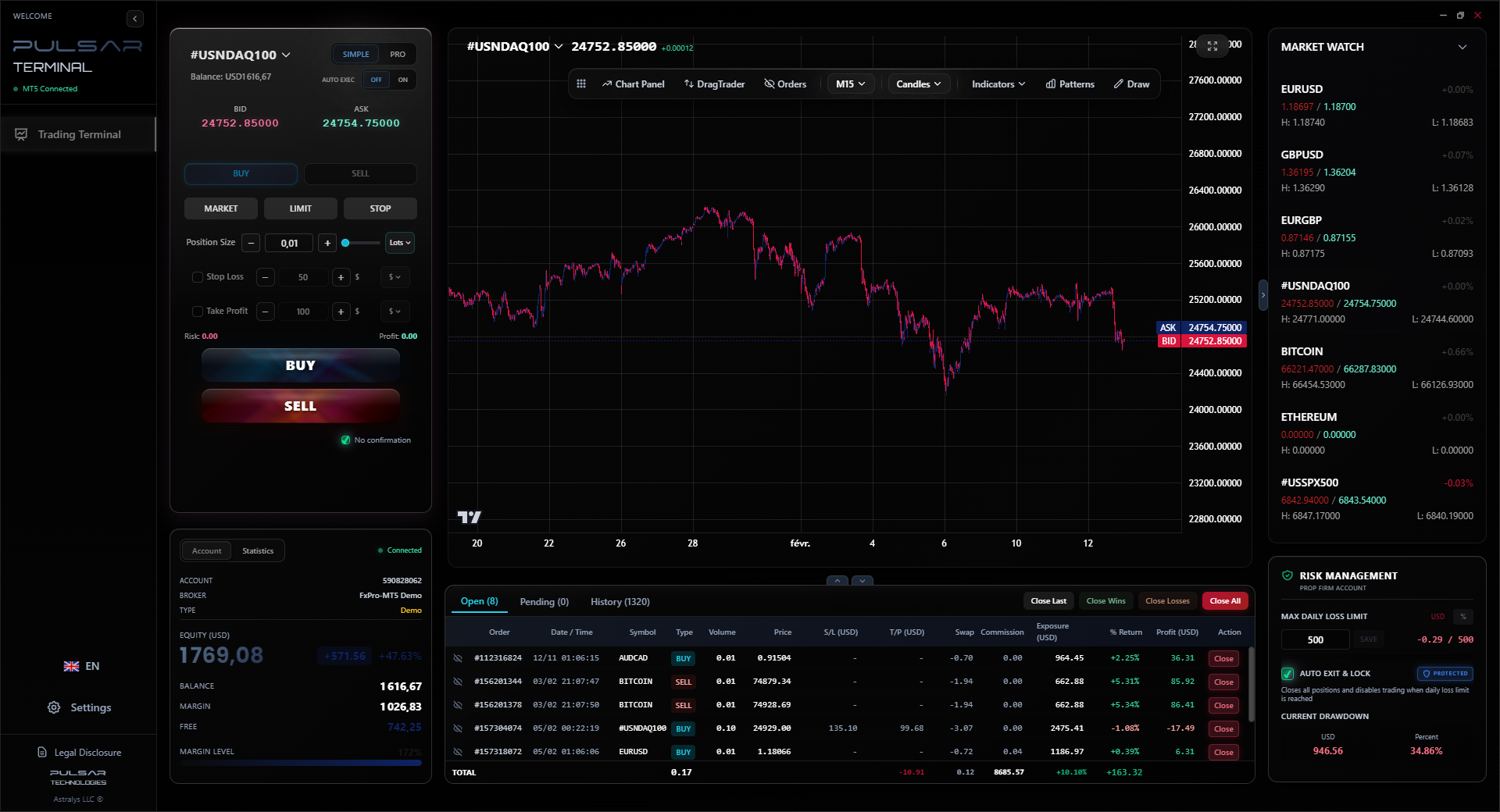
Once your capital is overseas with a broker, managing complex trades and prop firm rules requires precise tools that MT5 alone lacks.
Pulsar Terminal
Универсальный инструмент для MT5: drag-and-drop ордера, мульти-TP/SL, трейлинг-стоп, грид-трейдинг, Volume Profile и защита для проп-фирм. Используется 1000+ трейдерами ежедневно.
FAQ
Q1Can I trade forex directly through Nedbank's Forex Department?
No. They are not a retail forex broker. You cannot download a trading platform, place orders on currency pairs, or use use for speculation through them. Their role is to help the international transfers that allow you to fund an account with a dedicated offshore broker.
Q2What is the difference between the SDA and FIA for a trader?
The Single Discretionary Allowance (SDA) is R1 million per year you can use for any legal purpose abroad without tax clearance. It's your 'quick access' money for funding. The Foreign Investment Allowance (FIA) is an additional R10 million strictly for investment, requiring a SARS Tax Compliance Status (TCS) PIN. Use your SDA first, then your FIA for larger amounts.
Q3How long does an international payment to my broker take?
Typically 2 to 5 business days. Delays can happen due to time zone differences, intermediary bank processing, or compliance checks. Always do a small test transfer first to confirm the timing and details.
Q4Why was my transfer more expensive than just the 0.63% commission?
Because of the exchange rate margin (a ~2.5% hidden cost on the conversion rate) and potential correspondent bank fees (R150-R1,500). The commission is just one part of the total cost. Always ask for the final ZAR amount you'll be debited to see the true cost.
Q5Do I need to pay tax on the money I send overseas to trade?
No, sending the capital isn't a taxable event. However, the profits you make from trading and then bring back to South Africa are subject to income tax. You must declare your worldwide income to SARS, including trading profits from offshore accounts.
Q6Can I use my Nedbank Forex allowance to join a prop trading firm?
Yes, the fees for a prop firm challenge or account are considered an expense for pursuing investment activity. You would use your SDA or FIA to send the fee, using the appropriate BOP code for 'investment'. Managing the daily loss limits of a prop firm is easier with tools that automate risk, a feature offered by platforms like Pulsar Terminal.
Q7What happens if I exceed my R1 million SDA?
Any transfer that would put you over the limit will be rejected by Nedbank's system. You would then need to use your Foreign Investment Allowance (FIA) for the remainder, provided you have a valid TCS PIN from SARS. Keep your own records to avoid surprises.
Урок проф. Уинстона
Ключевые выводы:
- ✓SDA: R1m for quick access. FIA: R10m with a SARS PIN.
- ✓Total cost = Commission (0.63%) + Margin (~2.5%) + Bank Fees.
- ✓Always use the correct BOP code for 'investment'.
- ✓Do a small test transfer before sending your main capital.
- ✓Use an FCA to time your profit conversions, not just store cash.
Насколько полезна эта статья?
Нажмите на звезду
Еженедельные торговые инсайты
Бесплатный еженедельный анализ и стратегии. Без спама.
Об авторе
David van der Merwe
Трейдер развивающихся рынков
Трейдер из Йоханнесбурга с 11-летним опытом работы с валютами развивающихся рынков. Специализируется на ZAR-парах, торговле под регулированием FSCA и анализе южноафриканского рынка.
Комментарии
Предупреждение о рисках
Торговля финансовыми инструментами сопряжена со значительным риском и может не подходить всем инвесторам. Прошлые результаты не гарантируют будущих доходов. Данный контент носит исключительно образовательный характер и не является инвестиционной рекомендацией. Всегда проводите собственное исследование перед торговлей.
Вам также может понравиться

Cara Trading Forex Sukses: 7 Prinsip dari Trader Profesional
Cara trading forex sukses dengan 7 prinsip trader pro: manajemen modal, disiplin, journal trading, backtest. Data nyata, bukan janji profit palsu.
Jam Trading Forex Terbaik untuk Trader Indonesia: Panduan Lengkap dengan Tabel Waktu
Panduan jam trading forex untuk trader Indonesia. Tabel 4 sesi dunia, jam emas 20:00-00:00, sesi mana yang harus dihindari. Data akurat + tips dari trader berpengalaman.
Top 5 Sàn Forex Uy Tín Nhất 2026: Review Jujur dari Trader Indonesia
Top 5 sàn forex uy tín 2026 untuk trader Indonesia. Review jujur: spread, deposit, withdraw, dukungan lokal. Exness, XM, IC Markets & lebih.
Скачать Pulsar Terminal
Все эти калькуляторы встроены в Pulsar Terminal с данными в реальном времени с вашего счёта MT5.
Скачать Pulsar Terminal