


I lost R4,200 in under 90 seconds.

David van der Merwe
Трейдер развивающихся рынков ·  South Africa
☕ 10 мин чтения
Что вы узнаете:
- 1The Big Three: Economic Calendars You Can't Ignore
- 2ZAR's Specific Drivers: It's Not Just The Numbers
- 3How Markets Actually React: Volatility & The Slippage Trap
- 4Trading Strategies: Playing the News, Not Getting Played
- 5Non-Negotiable Risk Management for News
- 6Essential Tools & Resources for the SA Trader
- 7Classic Mistakes (I've Made Them All)
I lost R4,200 in under 90 seconds. It was a Tuesday morning, and I was short on USD/ZAR. The U.S. CPI print came in hot. Not just a little hot, but a full 0.3% above the forecast. The pair spiked 180 pips against me before my stop-loss could even get a look in. The spread widened to 15 pips, and my broker's platform lagged. That's the raw power of news events that move the forex market. It's not academic theory; it's the difference between a good month and a margin call. For the 200,000 or so of us trading here in SA, understanding this isn't optional. It's survival.
If you're not living on an economic calendar, you're trading blind. It's that simple. For us in South Africa, you need to watch three main theatres: the local SA data, the U.S. dollar drivers, and the commodity complex, especially China.
The Local Stage: SARB and Stats SA
Your first port of call is the South African Reserve Bank (SARB) and Stats SA. The SARB's interest rate decisions are the single biggest mover of the Rand. I've seen USD/ZAR swing 300-500 pips on a surprise hike or cut. The Monetary Policy Committee (MPC) statements are pure gold - look for changes in the words 'accommodative' or 'restrictive'. Stats SA releases are next: CPI inflation, unemployment (the QLFS), and GDP growth. A bad GDP print can knock ZAR pairs for a quick 150 pips. You can't just guess these. Mark them in red.
The Global Puppet Master: The U.S. Federal Reserve
The U.S. Dollar is the world's reserve currency, and its strength or weakness pulls every other currency, including the Rand, along with it. The Federal Reserve's FOMC meetings, statements, and press conferences are non-negotiable viewing. Then you have the data: Non-Farm Payrolls (NFP), Consumer Price Index (CPI), and Retail Sales. These move the USD, which in turn moves USD/ZAR, often with violent force. I once caught a 220-pip move on EUR/USD from an NFP surprise, which directly translated to a nice win on my EUR/ZAR hedge.
The Commodity Connection: China's Data
South Africa is a commodity economy. When China sneezes, the Rand gets a cold. Watch China's PMI (Purchasing Managers' Index) data, Industrial Production, and GDP. Weak Chinese factory data signals lower demand for our metals and minerals, which pressures the Rand. Trading USD/ZAR without one eye on iron ore and platinum prices, and the other on Chinese demand, is a recipe for disaster. This is the fundamental bedrock for longer-term swing trading on commodity-linked pairs.

💡 Совет Уинстона
The market's reaction to news is often more important than the news itself. A 'good' number that gets sold is telling you the bullish move was already priced in. Learn to read the price action, not just the headline.
Trading the Rand is a unique beast. It's not just about clean economic data. It's about sentiment, politics, and plain old fear. This is where international traders often get chewed up and spat out.
The biggest local driver, outside of SARB rates, is Eskom and load-shedding stages. I'm not joking. A surprise announcement moving to Stage 6 load-shedding can cause an immediate sell-off in the Rand. The market prices in lost productivity, lower GDP, and capital flight. I've seen USD/ZAR jump 50 pips in minutes on a bad Eskom news flash.
Then there's the political risk. Budget speeches, medium-term budget policy statements (MTBPS), and credit rating announcements from Moody's or S&P are huge. A downgrade to 'junk status' years back caused a multi-year trend. Local elections and policy uncertainty around issues like land reform or mining charters inject volatility. This kind of news doesn't always show up neatly on a standard economic calendar. You have to follow local financial news.

Warning: South African political news can cause 'gap risk' over weekends. If a major political event happens on a Saturday, USD/ZAR can open Sunday evening 2% higher or lower than where it closed on Friday. Never hold a highly leveraged ZAR position over a weekend with a major political event pending unless you have a very, very wide stop-loss (and deep pockets).
“News events that move the forex market are the ultimate test of discipline.”
Here's the part most guides gloss over: the mechanics of the move. When big news hits, it's chaos for a minute or two. Liquidity dries up. The spread (the difference between buy and sell price) widens massively. That 0.6 pip spread on EUR/USD you get from a broker like IC Markets can blow out to 20 pips. Your stop-loss becomes a 'market order' to close your trade, and it gets filled at the worst possible price in that moment. That's slippage. My R4,200 loss? A good chunk of that was slippage.
Volatility spikes. Pairs that normally move 50 pips a day can do 200 pips in an hour. This is why your normal position size calculator settings are useless during news. If you usually risk 1% of your account, a 200-pip spike against you on a standard lot will blow through that in a heartbeat. You need to either size way down or stay out entirely until the dust settles.

Example: Let's say you buy 1 standard lot (100,000 units) of USD/ZAR at R18.5000, with a stop-loss 50 pips away at R18.4500. You're risking R500 (50 pips * R10 per pip on ZAR). News hits, price drops instantly. The spread widens to 15 pips, and your stop is triggered. Due to low liquidity, your order is filled at R18.4300, not R18.4500. That's an extra 20 pips of slippage. Your actual loss is now R700 (70 pips * R10). Your risk was 40% higher than you planned. This happens all the time.
You have three basic choices when it comes to news: trade the breakout, trade the retracement, or hide. I've tried all three, and I'll tell you what's worked for me.
The Breakout (High Risk, High Reward): This is placing orders before the news, anticipating a big move. You set a buy-stop order above the current range and a sell-stop order below it. Whichever way it breaks, you're in. The problem? False breakouts are common. The market can whip both orders, hitting your buy, reversing, hitting your sell, and stopping you out on both for a double loss. I only do this with tiny position sizes, and I cancel the unfilled order the second one is triggered.
The Retracement (My Preferred Method): After the initial explosive move, the market often 'retraces' or pulls back. It's like a rubber band snapping back. I wait for the first 15-30 minutes of chaos to pass. I look for the price to stall and start moving back towards the pre-news level. I then enter in the direction of the original news-driven trend, aiming to catch the 'second wave'. This requires patience and a good read on support/resistance. Using an RSI indicator here can help identify overbought/oversold conditions after the spike.
The Hide (The Smart Choice 80% of the Time): For new traders, this is the best strategy. Close all positions 30 minutes before a major news event. Sit on your hands. Watch. Learn how the price reacts. You lose nothing but opportunity, and you protect your capital. There will always be another trade. A tool like Pulsar Terminal can help here by setting automatic breakeven or trailing stops to lock in profit before an event, so you don't have to babysit the chart.
💡 Совет Уинстона
Your first loss on a news trade is usually your smallest. Re-entering repeatedly as it moves against you, trying to be 'right', is what destroys accounts. Be wrong, take the small loss, and wait for the next clear signal.
“Trading the Rand is about sentiment, politics, and plain old fear.”
This section is the most important one in this guide. Screw this up, and you won't be trading for long.
- Halve Your Position Size, At Least: If you normally trade 1 lot, trade 0.2 lots around news. The increased volatility means the same stop-loss in pips represents double or triple the monetary risk. Use a position size calculator religiously, and input a much higher volatility assumption.
- Use Wide Stop-Losses: A tight 10-pip stop will get vaporized by the initial spike. Your stop needs to be placed beyond the expected 'noise' of the event. This means you must risk fewer units to keep your monetary risk the same. It's a balancing act.
- Avoid Pending Orders Too Close to Price: If you're setting buy/sell stops for a breakout, place them far enough away from the current price that a minor, fake spike won't trigger them. Look at the Average True Range (ATR) indicator and place your orders at least 1.5x the ATR away.
- Expect and Accept Slippage: Assume your stop will get a worse fill. Factor that into your risk calculation. If you can only afford to lose R1000, plan your trade as if you'll lose R700, so the slippage doesn't kill you.
- Know Your Broker's Policy: Some brokers widen spreads massively, some freeze platforms, some don't. A reputable, well-regulated broker with strong liquidity like Pepperstone or Exness is crucial. Check if they offer 'guaranteed stop-losses' (often for a fee) during high volatility - they can be worth it.

Pro Tip: I have a separate, smaller 'news trading' account. It's only 20% of my main capital. All my high-volatility plays happen there. This psychologically contains the madness and prevents me from blowing up my entire trading fund on one bad CPI print.
Managing multiple trades and protecting profits during volatile news events is nearly impossible manually, which is where automation tools like Pulsar Terminal for MT5 become essential.
Pulsar Terminal
Универсальный инструмент для MT5: drag-and-drop ордера, мульти-TP/SL, трейлинг-стоп, грид-трейдинг, Volume Profile и защита для проп-фирм. Используется 1000+ трейдерами ежедневно.
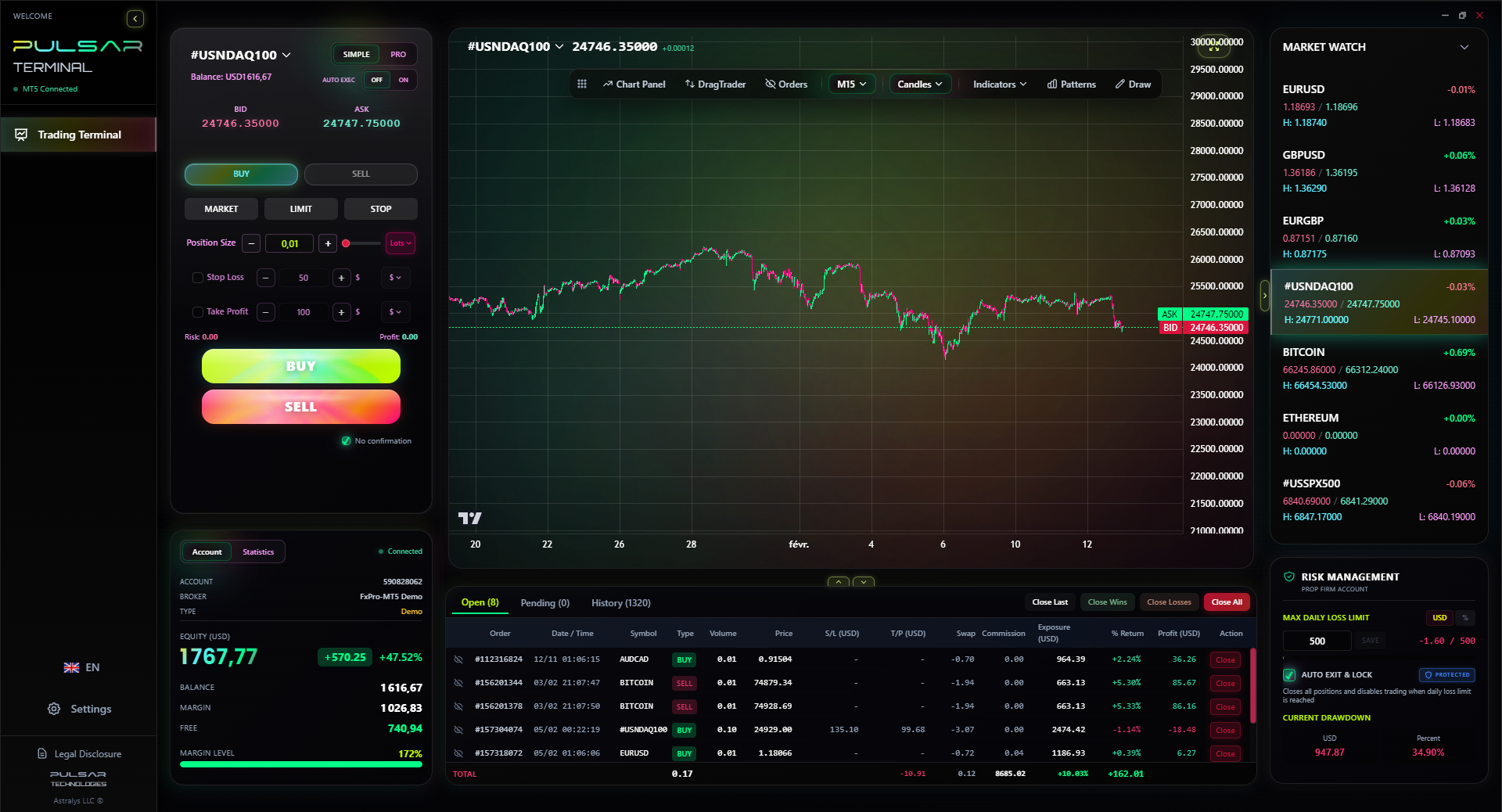
You can't do this manually. Here's my toolkit:
- Economic Calendars: I use Investing.com's calendar (filter for 'High Impact') and Forex Factory. Set the timezone to SAST. Highlight SARB, U.S. Fed, U.S. CPI/NFP, and China PMI.
- News Feeds: Reuters and Bloomberg are the gold standard, but they're pricey. For free, I follow credible SA financial journalists on Twitter (X) and use the BusinessLive and Moneyweb apps for local political and Eskom news.
- Broker Platform: You need a platform that's stable under load. MetaTrader 4/5 is the standard. I use MT5 with a suite of add-ons. The key is one-click trading and reliable execution. I've had good experiences with the execution speed from brokers like XM for major pairs during news.
- Volatility Indicators: Have the ATR (Average True Range) indicator on your chart. It shows you the current average pip movement. If the ATR suddenly expands, you know volatility is picking up, even if the news isn't on your radar.
- A Fast Internet Connection: This is obvious, but with mobile data costs down about 35% since 2022, there's no excuse. Don't trade major news on a shaky public Wi-Fi. That's asking for a disconnected platform and a disaster.
“If you're not living on an economic calendar, you're trading blind.”
Let me save you some money and heartache.
Pitfall 1: Trading Without a Plan. 'The CPI is coming out, I feel lucky!' This is gambling. Decide beforehand: Will you trade the breakout, the retracement, or not at all? What's your entry, stop, and target? Write it down.
Pitfall 2: Chasing the Move. The price has already shot up 120 pips. 'It's going to keep going!' You FOMO buy at the top. It then retraces 80 pips and stops you out. Wait for the pullback. Be patient.
Pitfall 3: Ignoring Confluence. A news event aligns with a major technical level (like a key MACD indicator crossover or a strong support/resistance zone). That's confluence. It makes the trade much higher probability. Trading news in a technical vacuum is dangerous.
Pitfall 4: Revenge Trading After a Loss. You get stopped out on a news trade. You're angry. You jump right back in with a bigger size to 'make it back'. This is the fastest path to a margin call. Walk away. The market will be there tomorrow.
The bottom line? News events that move the forex market are the ultimate test of discipline. They offer huge opportunity but demand even greater respect. Start small, practice in a demo account during real news events, and never, ever risk money you can't afford to lose on a single headline.
FAQ
Q1What is the single most important news event for the South African Rand (ZAR)?
Hands down, it's the South African Reserve Bank (SARB) interest rate decision and the accompanying Monetary Policy Committee (MPC) statement. This directly influences the yield and attractiveness of the Rand. A surprise hike can strengthen the ZAR by 300+ pips against the USD, while a dovish hold or cut can weaken it just as sharply.
Q2How much should I reduce my position size for high-impact news?
At a minimum, cut it by 50-80%. If you normally trade 1 standard lot, trade 0.2 lots. The volatility can be 3-5 times higher than normal, so your standard risk in Rands becomes massively amplified. Always recalculate your position size using a position size calculator with a much higher volatility assumption.
Q3Why did my stop-loss not work during a news event?
This is usually due to slippage. When news hits, liquidity drops and the spread widens. Your stop-loss becomes a market order. If the price gaps or moves extremely fast, your order is filled at the next available price, which can be significantly worse than your stop level. Brokers with poor liquidity partners are worse for this.
Q4Is it better to trade before or after the news release?
For most retail traders, it's far safer to trade after the news. Wait for the initial 15-30 minute spike and chaos to settle. Then, look for a retracement to enter in the direction of the new trend. Trading before requires predicting the outcome and is much riskier due to false breakouts and whipsaws.
Q5What U.S. news has the biggest impact on USD/ZAR?
The U.S. Federal Reserve's interest rate decisions (FOMC) and press conferences are top. For data, Non-Farm Payrolls (NFP) and the Consumer Price Index (CPI) are the biggest market movers. These redefine the outlook for the U.S. dollar, which USD/ZAR directly follows.
Q6Can local South African politics really affect the forex market?
Absolutely. Eskom's load-shedding announcements, national budget speeches, credit rating reviews, and political uncertainty around policies can cause immediate and sharp moves in the Rand. This 'political risk premium' is a constant factor in ZAR's valuation and can cause weekend gap risk.
Q7What's the best way to practice trading news events?
Use a demo account with a broker that simulates real market conditions, like IC Markets or Exness. Follow the economic calendar, plan your trades for high-impact events, and execute them in the demo account. Review your trades afterward. Do this for at least 2-3 months before risking real money.
Урок проф. Уинстона
Ключевые выводы:
- ✓Halve your position size before major news.
- ✓SARB decisions move USD/ZAR 300-500 pips.
- ✓Always expect and budget for slippage.
- ✓Eskom load-shedding is a genuine market mover.
- ✓Wait for the retracement, don't chase the spike.
Насколько полезна эта статья?
Нажмите на звезду
Еженедельные торговые инсайты
Бесплатный еженедельный анализ и стратегии. Без спама.
Об авторе
David van der Merwe
Трейдер развивающихся рынков
Трейдер из Йоханнесбурга с 11-летним опытом работы с валютами развивающихся рынков. Специализируется на ZAR-парах, торговле под регулированием FSCA и анализе южноафриканского рынка.
Комментарии
Предупреждение о рисках
Торговля финансовыми инструментами сопряжена со значительным риском и может не подходить всем инвесторам. Прошлые результаты не гарантируют будущих доходов. Данный контент носит исключительно образовательный характер и не является инвестиционной рекомендацией. Всегда проводите собственное исследование перед торговлей.
Вам также может понравиться

Cara Trading Forex Sukses: 7 Prinsip dari Trader Profesional
Cara trading forex sukses dengan 7 prinsip trader pro: manajemen modal, disiplin, journal trading, backtest. Data nyata, bukan janji profit palsu.
Jam Trading Forex Terbaik untuk Trader Indonesia: Panduan Lengkap dengan Tabel Waktu
Panduan jam trading forex untuk trader Indonesia. Tabel 4 sesi dunia, jam emas 20:00-00:00, sesi mana yang harus dihindari. Data akurat + tips dari trader berpengalaman.
Top 5 Sàn Forex Uy Tín Nhất 2026: Review Jujur dari Trader Indonesia
Top 5 sàn forex uy tín 2026 untuk trader Indonesia. Review jujur: spread, deposit, withdraw, dukungan lokal. Exness, XM, IC Markets & lebih.
Скачать Pulsar Terminal
Все эти калькуляторы встроены в Pulsar Terminal с данными в реальном времени с вашего счёта MT5.
Скачать Pulsar Terminal