


How do you trade the most volatile 60 seconds of the month without getting your account wiped out? If you're a South African trader staring at the NFP report, you know the feeling.

David van der Merwe
Трейдер развивающихся рынков ·  South Africa
☕ 11 мин чтения
Что вы узнаете:
- 1What the NFP Actually Is (And Why It Moves Everything)
- 2Your Pre-NFP Checklist: Getting Ready for the Storm
- 3Three Practical NFP Trading Strategies
- 4Risk Management: Your Only Lifeline
- 5After the Dust Settles: Learning from the Chaos
- 6Mistakes I've Made (So You Don't Have To)
- 7Picking a Broker That Won't Fail You on NFP Friday
How do you trade the most volatile 60 seconds of the month without getting your account wiped out? If you're a South African trader staring at the NFP report, you know the feeling. The data hits, EUR/USD spikes 50 pips in a blink, and your carefully planned trade is already in trouble. I've been there, sweating bullets as my screen flashes red. This isn't about getting rich quick. It's about having a clear, disciplined NFP forex strategy that accounts for our local market, the FSCA's 30:1 use cap, and the unique behavior of ZAR pairs. Let's strip away the hype and build a plan you can actually use.
The Non-Farm Payroll report is the US jobs report, released at 3:30 PM South African time on the first Friday of every month. It counts everyone on a US payroll except farm workers, government employees, and non-profit staff. Simple, right? The market's reaction is anything but.
Traders watch three numbers: the headline jobs added (the NFP figure), the unemployment rate, and average hourly earnings. The market has a consensus forecast. If the actual number beats the forecast significantly, it suggests a strong US economy. That typically strengthens the US Dollar (USD) as it increases the chance of the Federal Reserve raising interest rates. If it misses badly, the USD often sells off.
But here's the kicker for us: it's not just about the number itself. It's about the market's expectation versus the reality, and the subsequent reaction. I've seen a "good" number cause a USD sell-off because it wasn't as good as the whisper number going around. The initial spike is often pure, chaotic emotion. The real trend establishes itself in the minutes and hours after. For a detailed look at how this impacts the world's most traded pair, our EUR/USD guide breaks down its typical NFP behavior.

Warning: Don't trade the headline number the second it prints. The first 30-60 seconds are a liquidity vacuum filled with stop hunts and algorithmic chaos. Your spread on EUR/USD can blow out from 0.8 pips to 2.5 pips or more in a heartbeat. Trading then is like trying to catch a falling knife with oven mitts on.

💡 Совет Уинстона
The market's first reaction to NFP is instinct, not intellect. Your first trade should be based on the second reaction, which is analysis. Patience isn't a virtue here; it's a survival mechanism.
Failing to prepare is preparing to blow up your account. Here’s exactly what I do in the hour before the release.
Close or Hedge Existing Positions If you have open trades on USD pairs (like EUR/USD, GBP/USD) or anything correlated, decide your plan. I either close them for a small profit/loss or set a ridiculously wide stop-loss. Holding a tight stop into NFP is a donation to your broker. I learned this the hard way in 2019. I was long GBP/USD with a 20-pip stop. The number hit, my trade was stopped out instantly, and then price rocketed 80 pips in my original direction. I lost R2000 and missed a R8000 move. Brutal.
Calculate Your Position Size. Seriously. This is non-negotiable. With the FSCA's 30:1 use limit, you might feel the need to size up to make it "worth it." Resist that urge. NFP volatility can easily produce 100-pip moves. On a standard lot (100,000 units), that's $1000 per pip. A 100-pip move against you would be a $100,000 loss without proper sizing. Use a position size calculator. My rule? I risk no more than 1% of my account on any single NFP trade. If my account is R50,000, that's R500. If my stop-loss is 50 pips away, my position size must be small enough that a 50-pip loss equals R500.
Know Your Broker's Conditions Check if your broker has any special NFP terms. Do they guarantee stops? (Most don't during high volatility). Do they widen spreads? (They all do). Will their platform hold up? I once used a broker whose MT4 platform froze for 45 seconds post-NFP. I was stuck in a losing trade with no way out. Now I only use brokers with proven stability, like IC Markets or Pepperstone, for these events.
Set Alerts, Not Orders Have your charts ready on the major pairs and USD/ZAR. Don't place pending orders 5 minutes before. The pre-release drift can trigger them prematurely. Set price alerts at key technical levels instead.
“Trading the first 30 seconds of NFP is like trying to catch a falling knife with oven mitts on.”
You can't just wing it. You need a defined method. Here are three I've used, from safest to most aggressive.
The Wait-and-See (The Sniper)
This is my preferred method now. You do nothing for the first 5-15 minutes after the release. Let the initial insanity play out. The spread will normalize, and a clearer direction will often emerge. Then, you look for a technical setup - a retest of a broken support/resistance level, a pullback to a moving average - and enter with a normal stop-loss. It's less glamorous, but your risk is defined and the market noise has died down.
Example: NFP beats expectations, USD rockets. EUR/USD drops 70 pips in 2 minutes, then stalls. It retraces 30 pips back up to a previous support level (now resistance) and shows rejection on the 5-minute chart. You go short on the rejection with a stop above the high of the retracement.
The Straddle/Strangle (The Trap Setter)
This involves placing two pending orders: a buy stop above the current price and a sell stop below it. The idea is that whichever way the market breaks, you catch the move. Sounds clever, right? It's also dangerous. If the market whipsaws, you can get filled on both sides and lose twice. To manage this, you must cancel the opposite order the second one triggers. Execution speed is critical.

Example: EUR/USD is trading at 1.0850 pre-NFP. You place a buy stop at 1.0880 (30 pips high) and a sell stop at 1.0820 (30 pips low). NFP hits, price spikes to 1.0885, triggering your buy. You MUST immediately cancel the sell stop at 1.0820. Your risk is the distance between your entry and your stop-loss on the triggered trade.
The News Fade (Contrarian Gambit)
This is high-risk, high-reward. You wait for the initial extreme spike (say, 60-80 pips) and then trade in the opposite direction, betting the move was overdone. This requires serious guts and a very wide stop-loss. I only recommend this for experienced traders with a deep understanding of market sentiment. It's wiped me out more times than it's paid off.
A Note on ZAR Pairs: USD/ZAR will move on NFP, but don't expect it to be as clean as EUR/USD. Local liquidity, SARB intervention whispers, and emerging market flows can distort the move. Often, the clearest USD trend will be in the majors (EUR/USD), not in USD/ZAR. Consider trading the USD direction via a major pair for clarity.
Your strategy doesn't matter if your risk management is poor. NFP is where poor risk management goes to die.
Stop-Losses Are Mandatory, But Place Them Wisely A tight stop will get hunted. A stop too wide will ruin you if you're wrong. Your stop should be placed beyond the obvious "spike zone." Look at the Average True Range (ATR) on the 15-minute chart and double it. If the pre-NFP ATR is 20 pips, consider a 40-pip stop as an absolute minimum. Better yet, use the previous hour's high/low as your stop level.
No Revenge Trading You get stopped out. It happens. The worst thing you can do is immediately jump back in, trying to recoup the loss. The market is now different. Close the platform, take a walk. There will be other setups next Friday. I have a rule: one trade per NFP. Win or lose, I'm done.
Beware of the Follow-Through (or Lack Thereof) Sometimes the big move happens Friday, and then Monday opens with a complete reversal as cooler heads digest the data. If you're in a profitable NFP trade, consider taking at least partial profits before the weekend. Holding over the weekend adds event risk you can't control.

Pro Tip: Use a trailing stop to lock in profits once your trade is in the money by a reasonable amount (e.g., 2x your initial risk). This lets you ride a trend while protecting gains. Managing this manually in a fast market is tough, which is where good trading tools come in handy.
💡 Совет Уинстона
If you feel your heart pounding as the clock hits 3:29 PM, your position is too large. Size down until the event feels like a clinical exercise, not a rollercoaster.
“Your strategy doesn't matter if your risk management is poor. NFP is where poor risk management goes to die.”
Your job isn't over when you close the trade. The post-NFP period is for analysis and adjusting your weekly outlook.
Review the Full Report Look beyond the headline. Were there major revisions to previous months' data? That can be more important. What was the labor force participation rate? The details often explain why the market reacted the way it did, especially if the move seemed counter-intuitive.
Analyze Your Trade Execution Did your platform lag? Did your order get slipped? How much did the spread cost you? Keep a journal. Note: "NFP July 2024. Used Wait-and-See on EUR/USD. Entered long on pullback. Spread was 2.1 pips on entry (normal 0.9). Cost me an extra RXX. Next time, wait an extra minute for spread to tighten."
Adjust Your Bias for the Coming Week A strongly bullish NFP sets a USD-positive tone. Look for opportunities to sell EUR/USD or GBP/USD on rallies in the following days. A weak NFP means the USD could be vulnerable. This might create swing trading opportunities for the next week. Don't force it, but let the new information inform your analysis.
This is also the time to assess your tools. Manually moving stop-losses and taking partial profits while monitoring multiple charts is a high-stress task. Having a tool that can automate some of that risk management directly on your MT5 platform can be the difference between a good decision and a panicked mistake.
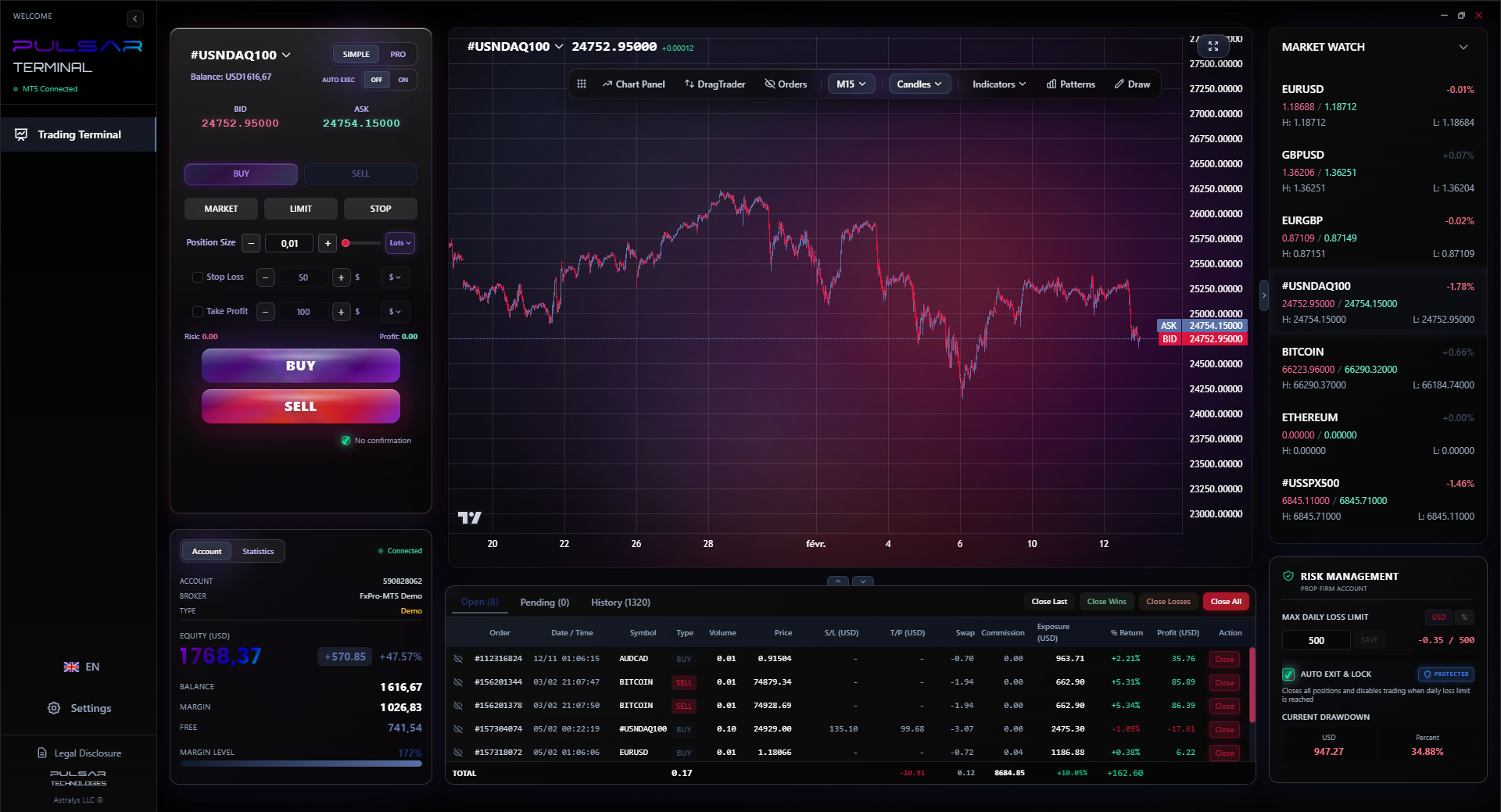
Manually managing multiple take-profit levels and a trailing stop on a fast-moving NFP trade is nearly impossible, which is why a tool like Pulsar Terminal that automates this on MT5 is essential.
Pulsar Terminal
Универсальный инструмент для MT5: drag-and-drop ордера, мульти-TP/SL, трейлинг-стоп, грид-трейдинг, Volume Profile и защита для проп-фирм. Используется 1000+ трейдерами ежедневно.
Let's get brutally honest. Here's where I've lost money so you can avoid these traps.
Trading USD/ZAR Like a Major Pair It's not. Liquidity can dry up, and the spread can become absurd. One NFP, I had a USD/ZAR spread widen to over 50 pips (yes, fifty) with my broker. My planned 30-pip stop-loss was meaningless. I now only trade majors around NFP and leave ZAR pairs alone until things calm down.
Ignoring the FSCA use Limit 30:1 feels restrictive. I've heard traders say, "I'll just use an international broker for higher use on NFP." That's a great way to lose everything faster. The 30:1 limit is there for a reason - to protect you from yourself during exactly this kind of event. Respect it. Use proper position sizing instead.
Chasing the Entry You see the line fly. You panic, thinking you're missing the trade of the year. You click market buy. You're filled 8 pips above the price you saw. The move reverses. You're instantly in a loss. This is the most common emotional error. Have a plan and wait for your level, even if it means missing the very first spike.
Overtrading the Event One NFP doesn't define your month. I used to think I had to have a trade on every major pair. I'd end up with 3 trades, all losing, because I was forcing setups that weren't there. Now, I pick one pair, one setup. Quality over quantity.
💡 Совет Уинстона
Your NFP trade journal should have two columns: 'P&L' and 'Lesson.' The second column is infinitely more valuable than the first. A losing trade with a clear lesson is a win.
“One NFP doesn't define your month. I used to think I had to have a trade on every major pair.”
Not all brokers are created equal for high-volatility trading. Here’s what to look for as a South African.
FSCA Regulation is Key This is your first filter. A local license means they must segregate client funds and adhere to conduct rules. Check the FSCA's website. Don't just take the broker's word for it. I stick with FSCA-licensed entities like Exness or XM for my main trading account.
Execution Speed & Slippage Policy You need a broker with a proven track record of stable servers during news events. Look for brokers offering No Dealing Desk (NDD) or Straight Through Processing (STP) execution. They should have a clear policy on slippage (when you get filled at a worse price than expected). Some negative slippage is inevitable during NFP, but it shouldn't be catastrophic.
Spreads and Commissions Compare the typical spreads on the EUR/USD and the likely NFP spreads. Some brokers are famous for massive widening. Look for brokers known for tight, stable spreads. A commission-based account (e.g., $3.50 per lot per side) with a raw spread of 0.0 pips can be cheaper overall than a "commission-free" account with a 1.5-pip spread.
Platform Reliability MT4/MT5 are standards, but does the broker's version hold up? Check reviews specifically about news trading. Also, consider what tools you can use with the platform. Basic MT5 is good, but having advanced order management and risk tools attached to it can transform your NFP execution from frantic to controlled.
FAQ
Q1What time is NFP released in South Africa?
The NFP report is released at 3:30 PM South African Standard Time (SAST) on the first Friday of every month, unless it's a US holiday. Always double-check the time a day before, as US daylight saving shifts can occasionally affect the timing relative to SAST.
Q2Should I trade USD/ZAR during NFP?
I generally advise against it. While it will move, USD/ZAR is less liquid than major pairs and can have wild, unpredictable spreads during the release (I've seen 50+ pips). The cleaner USD trend is usually visible in EUR/USD or GBP/USD. Trade the USD direction there for more predictable conditions.
Q3How much does the spread widen during NFP?
It varies by broker. On a major pair like EUR/USD, you can expect spreads to widen from a typical 0.8-1.0 pip to anywhere between 2.0 and 5.0 pips at the exact moment of release. This usually settles back down within 2-5 minutes. Always check your broker's specific policy.
Q4Is the initial spike always the right direction?
Absolutely not. The initial spike is often an algorithmic overreaction. It's very common to see a 40-pip spike in one direction, followed by a 100-pip reversal in the other direction over the next 30 minutes. This is why the "Wait-and-See" strategy is often safer than trying to catch the first move.
Q5Can I use a guaranteed stop-loss during NFP?
Almost never. Most brokers remove guaranteed stop-loss orders (or charge a huge premium for them) during scheduled high-volatility news events like NFP. You must assume your normal stop-loss is subject to slippage. Place it wider to account for this.
Q6How do I know the market's forecast for NFP?
Financial news websites (Bloomberg, Reuters, Forex Factory) will publish the consensus forecast from economists in the days leading up to the release. The actual number is judged against this forecast. Also watch for "whisper numbers" circulating on trading desks just before the release.
Q7What's the single biggest mistake new traders make with NFP?
Oversizing their position. The volatility makes them think they need a huge trade to make money. Combined with the emotional pressure, this leads to risking 5%, 10%, or more of their account on one trade. One bad move can then cause a margin call. Always, always use a 1% risk rule.
Урок проф. Уинстона
Ключевые выводы:
- ✓Wait 5-15 minutes post-release for spreads to normalize and real direction to emerge.
- ✓Never risk more than 1% of your account on a single NFP trade.
- ✓Avoid trading USD/ZAR during the release; use EUR/USD for cleaner signals.
- ✓Place stop-losses beyond the initial spike zone, using at least 2x the pre-NFP ATR.
- ✓One trade per NFP event. Win or lose, close the platform and walk away.
Насколько полезна эта статья?
Нажмите на звезду
Еженедельные торговые инсайты
Бесплатный еженедельный анализ и стратегии. Без спама.
Об авторе
David van der Merwe
Трейдер развивающихся рынков
Трейдер из Йоханнесбурга с 11-летним опытом работы с валютами развивающихся рынков. Специализируется на ZAR-парах, торговле под регулированием FSCA и анализе южноафриканского рынка.
Комментарии
Предупреждение о рисках
Торговля финансовыми инструментами сопряжена со значительным риском и может не подходить всем инвесторам. Прошлые результаты не гарантируют будущих доходов. Данный контент носит исключительно образовательный характер и не является инвестиционной рекомендацией. Всегда проводите собственное исследование перед торговлей.
Вам также может понравиться

Cara Trading Forex Sukses: 7 Prinsip dari Trader Profesional
Cara trading forex sukses dengan 7 prinsip trader pro: manajemen modal, disiplin, journal trading, backtest. Data nyata, bukan janji profit palsu.
Jam Trading Forex Terbaik untuk Trader Indonesia: Panduan Lengkap dengan Tabel Waktu
Panduan jam trading forex untuk trader Indonesia. Tabel 4 sesi dunia, jam emas 20:00-00:00, sesi mana yang harus dihindari. Data akurat + tips dari trader berpengalaman.
Top 5 Sàn Forex Uy Tín Nhất 2026: Review Jujur dari Trader Indonesia
Top 5 sàn forex uy tín 2026 untuk trader Indonesia. Review jujur: spread, deposit, withdraw, dukungan lokal. Exness, XM, IC Markets & lebih.
Скачать Pulsar Terminal
Все эти калькуляторы встроены в Pulsar Terminal с данными в реальном времени с вашего счёта MT5.
Скачать Pulsar Terminal